










































































In throwing his support behind Adrian Boafo, Hoyer is using his connections to party leaders and ties with pro-Israel groups to boost his hand-picked choice to the nomination for a safely blue seat
Nathan Posner/Anadolu via Getty Images
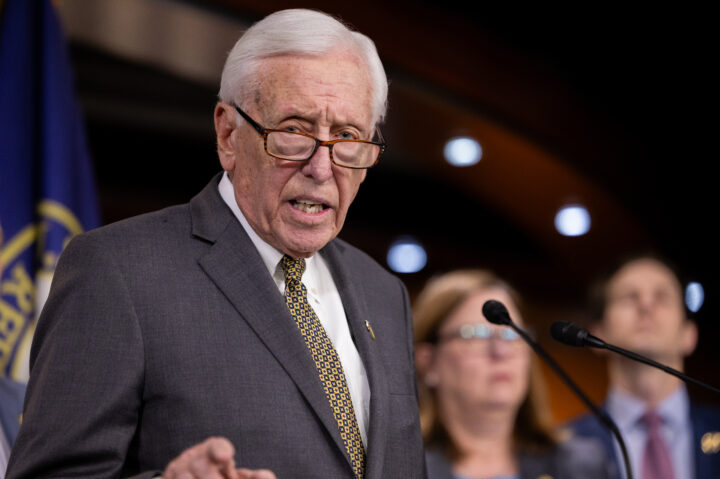
Congressman Steny Hoyer (D-MD) speaks at a press conference in Washington, DC on February 24, 2025.


 Add JewishInsider on Google
As Rep. Steny Hoyer (D-MD) prepares to step down at the end of his current term, the former Democratic House majority leader is staking his pro-Israel legacy on a little-known candidate who he hopes will uphold his long-standing commitment to maintaining a close relationship with the Jewish state.
In throwing his support behind Adrian Boafo, a 32-year-old Maryland state delegate who is among nearly two dozen Democratic candidates running in Maryland’s 5th Congressional District primary on Tuesday, Hoyer, 87, is using his connections to establishment party leaders and ties with pro-Israel groups to boost his hand-picked choice to the nomination for a safely blue seat.
United Democracy Project, AIPAC’s super PAC, has emerged as the biggest spender in the race, investing more than $5.7 million as part of an aggressive effort to promote Boafo launched by Hoyer and his allies.
The well-funded foray is a useful illustration of the degree to which planning and organization helped put Boafo in contention for the seat Hoyer has held for 45 years, in contrast with recent primaries where UDP and other pro-Israel advocacy groups have been relatively cautious with their engagement while being outflanked by the far left.
A UDP source, granted anonymity to speak candidly about the race, said polling showed Boafo was not in the lead when Hoyer endorsed him in January. “It’s a super close race that could go either way,” the source told Jewish Insider on Monday, stressing a high level of undecided primary voters. “Many candidates are in contention.”
One Jewish Democrat in Maryland told JI that Hoyer “put a heavy finger on the scale” in the race, calling in “chits” with influential Democratic officials who gave endorsements to Boafo, such as Gov. Wes Moore and Sen. Angela Alsobrooks (D-MD) — both of whom are featured in UDP’s ad blitz that began late last month.
Boafo also gained support from Democratic Majority for Israel’s super PAC led by Brian Romick, a former longtime senior aide to Hoyer. The group backed him on its first slate of non-incumbent endorsements not long after Hoyer had expressed his preference in the race. Boafo is a former campaign manager for Hoyer.
In New York City’s closely watched primaries on Tuesday, meanwhile, UDP and DMFI PAC have largely been absent from key races where far-left challengers are threatening to unseat pro-Israel incumbents. Polling has indicated that Rep. Dan Goldman (D-NY) is facing long odds against Brad Lander, a former city comptroller, while Rep. Adriano Espaillat (D-NY) hopes to fend off Darializa Avila Chevalier, a democratic socialist insurgent with a long record of anti-Israel activism.
Both Lander and Avila Chevalier have been buoyed by endorsements from New York City Mayor Zohran Mamdani — who is using his own early political capital on a risky gambit to help lift a slate of candidates that has angered the Democratic establishment.
Mamdani has also joined forces with the Democratic Socialists of America’s New York City chapter, which is flexing its local organizational muscle to help Avila Chevalier and Claire Valdez, a state assemblymember who is facing off against Brooklyn Borough President Antonio Reynoso, a progressive backed by retiring Rep. Nydia Velazquez (D-NY).
Even as far-left super PACs like American Priorities, a new group created to counter AIPAC’s spending in Democratic primaries, have been surging money into New York City, UDP has remained on the sidelines — with the exception of money it recently funneled to a pro-Espaillat super PAC disclosed in campaign filings late last week. Still, the pro-Israel group has not been directly engaged in New York City, despite its historic support for Goldman and Espaillat.
UDP has reason for caution, as AIPAC’s brand has become toxic among a growing number of Democrats who have vowed to reject its support and view it as a noxious presence in contested primaries.
Pro-Israel activists speculated UDP chose to stay out of a crowded House contest in New Jersey this month featuring some credible moderate candidates because it had earlier bungled its involvement in another race in the state with an aggressive spending strategy that inadvertently helped elevate a far-left Israel critic to a seat in the House.
In the June primary, some Jewish leaders in New Jersey questioned if UDP’s lack of involvement had helped the nominee, Adam Hamawy, avoid credible opposition — even as he faced scrutiny over his past ties to a radical Muslim cleric convicted of terrorism.
Now, however, UDP is embracing a more proactive approach in Maryland as it seeks to push Boafo past the finish line on Tuesday, in a maneuver suggesting that it is comfortable courting a moderate voter base that Hoyer has represented as a staunch supporter of Israel as well as a close AIPAC ally.
While UDP has faced backlash from the left, the response has been largely reactive. In recent weeks, for instance, the group has drawn criticism from Sen. Chris Van Hollen (D-MD), a vocal detractor of Israel, who has accused AIPAC and crypto-linked interests in the race of “trying to buy” the seat, which extends southward from the eastern Washington suburbs of Prince George’s County. Van Hollen has not made an endorsement in the race.
Meanwhile, three Democratic primary candidates, including Capitol Police officer Harry Dunn, former Prince George’s County Executive Rushern Baker and businesswoman Quincy Bareebe, teamed up to decry the flood of outside spending that is shaping the race.
“Special interests don’t spend money out of civic goodwill,” Baker said last week. “They spend the kind of money that we see because they expect someone to work for them.”
Dunn, who faced opposition from UDP in a separate race last cycle, has claimed Boafo is “benefiting from the MAGA donors who fund AIPAC.”
In an unusual move, UDP released an ad last week seeking to counter the negative attention in which Hoyer himself spoke in a direct-to-camera appeal.
“You’ve probably seen the attacks on Adrian Boafo,” Hoyer said. “Let’s get something straight. Adrian is a man of deep integrity. He has the courage to stand up to any special interest. I trust him. You can, too.”
For his part, Boafo pledges on his campaign site to “strengthen the U.S.-Israel alliance and ensure” it “has the security assistance it needs to defend itself,” but has distanced himself from UDP, saying in response to Van Hollen’s remarks “that big money has no place in politics.”
His comments illustrate how even as AIPAC seeks to build new relationships amid declining support from Democratic members, its preferred candidates are — at least publicly — keeping the group at arm’s length.
If Boafo prevails in Tuesday’s primary, though, his victory could also help AIPAC to reset the narrative, while providing the group with a potential blueprint for engagement in future races as it seeks to fend off the anti-Israel left.
The vote was the latest defeat by anti-Israel activists within the Democratic National Committee
Alex Wong/Getty Images
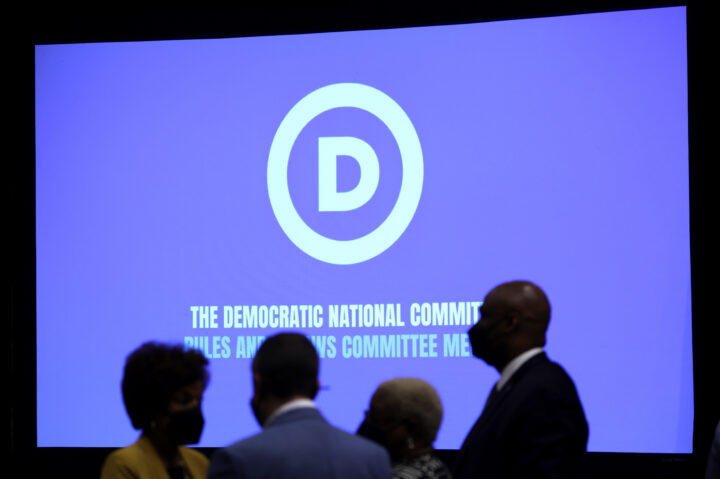
Committee members wait for the beginning of a meeting of the Democratic National Committee’s Rules and Bylaw Committee in Washington, DC
Democratic Party activists on Thursday voted to reject a measure that criticized the involvement of AIPAC in Democratic primaries and the American political system.
The resolution was debated during a meeting of the Democratic National Committee’s Rules Committee at the DNC’s New Orleans meeting. Committee members were considering new policy resolutions, including one introduced by a Florida activist that took aim at AIPAC and the group’s “undue influence over democratic debate and policymaking.” It was voted down in a voice vote.
“The DNC made clear today that all Democrats, including millions who are AIPAC members, have the right to participate fully in the democratic process,” AIPAC spokesperson Deryn Sousa told Jewish Insider.
Jewish Democratic advocates who were in the meeting room praised the decision.
“We’re pleased that the resolution that wrongly singled out AIPAC was defeated, and that the other anti-Israel resolutions failed to move forward. These measures would be a gift to Republicans, would further fracture our party and do nothing to bring Israelis and Palestinians closer to peace,” Democratic Majority for Israel CEO Brian Romick, who attended the meeting, told JI after the vote.
Halie Soifer, the CEO of the Jewish Democratic Council of America, said the group agrees with the goal of getting dark money out of politics but that AIPAC should not be targeted explicitly.
“We agree with the rejection of dark money in politics — a topic covered in another more expansive resolution adopted by the committee — but also believe that singling out any individual organization is both unproductive and unnecessarily divisive,” Soifer, who also attended the meeting, told JI.
Earlier in the meeting, the committee voted to support a measure “condemning the influence of dark money in the 2026 Democratic primary elections” that called out the artificial intelligence and cryptocurrency industries.
The vote by the DNC’s resolutions committee comes as the Democratic Party faces growing internal strife about its long-standing support for the U.S.-Israel relationship, as some party activists seek to push the group to the left. A new Pew Research Center poll released this week revealed that 80% of Democrats and Democratic-leaning independents have an unfavorable view of Israel — an increase from 69% who said the same last year.
Two other resolutions that touched on Israel-related issues were referred to a working group on the Middle East that DNC Chair Ken Martin created last summer to help smooth over some of the party’s fissures on the Israeli-Palestinian conflict.
One of these referred to Israel’s actions in Gaza as a genocide and called for conditioning U.S. military aid to Israel, and the other called for de-escalation in Iran and Gaza. A third resolution on the Middle East, condemning the U.S. missile strike that hit a girls’ school in Iran and killed at least 165 people, passed.
To mark the second anniversary of the Oct. 7 attacks in Israel, the Jewish Insider team asked leading thinkers and practitioners to reflect on how that day has changed the world. Here, we look at how Oct. 7 changed American Politics

Worawat/Adobe Stock
The United States Capitol with reflection at night Washington DC USA
Brian Romick, a longtime senior aide to Rep. Steny Hoyer, will succeed Mark Mellman as the group’s president and CEO

Courtesy DMFI
Brian Romick
Democratic Majority for Israel, a top pro-Israel advocacy group, is announcing a new president and board chair, after a recent leadership shake-up that resulted in the sudden departure of its founder last month.
The organization said in a statement to Jewish Insider on Friday that Brian Romick, a longtime senior aide to Rep. Steny Hoyer (D-MD), will serve as president and CEO, succeeding Mark Mellman, a veteran Democratic pollster who founded the group in 2019 to counter growing anti-Israel sentiment on the left.
Former Rep. Kathy Manning (D-NC), a pro-Israel stalwart and Jewish Democrat who has previously chaired the Jewish Federations of North America, will lead DMFI’s board of directors, the group said.
In a statement shared with JI, Romick, who has helped guide Hoyer’s efforts to advance pro-Israel legislation and fight antisemitism, called DMFI “an essential voice in Washington and in the pro-Israel community across the country,” particularly during what he characterized as a “critical moment in the U.S.-Israel relationship.”
“I want to thank DMFI’s leadership and staff for their efforts over the last six years to build a robust presence in the Democratic Party that reflects our shared values with Israel,” Romick continued. “With the House and Senate in play during the upcoming midterm elections, I am committed to working with Kathy, the board and the staff to expand DMFI’s impact and ensure we are supporting pro-Israel Democrats next year.”
Manning, for her part, said that she was “thrilled to chair DMFI’s board at this very important time for the U.S.-Israel relationship and for the Democratic Party,” while also thanking “the past leadership for establishing DMFI and turning it into a vibrant and formidable organization with an outsized impact.
“I look forward to building on the strong foundation they have created,” Manning said in the statement.
DMFI has not shared a reason for Mellman’s abrupt departure in mid-April, which came as something of a surprise to political observers. He has not publicly addressed the matter.
Mellman had also served as the chairman of DMFI’s super PAC, which has become a prominent player in key Democratic primary battles where conflicts over Israel have featured prominently. The group has yet to select a new chair of its political arm, DMFI PAC, which will be a pivotal role as it begins to strategize in advance of next year’s primaries.
DMFI, for its part, has in recent weeks staked out an increasingly adversarial approach to the new Trump administration, expressing concern that it is leaving Israel exposed amid a U.S. ceasefire agreement with the Houthis in Yemen and criticizing the president’s plans to accept a $400 million luxury jet from Qatar as a threat to national security.
In a statement shared with JI on Friday, Rep. Brad Schneider (D-IL), a pro-Israel champion backed by DMFI PAC, voiced confidence Romick and Manning would guide DMFI “through an ever-more complex and challenging era for the set of issues at the core of its focus.”
“Kathy and Brian are the right leaders for this moment when Democratic Majority for Israel’s mission is more important than ever,” added Todd Richman, a current co-chair of DMFI’s board. “Their deep experience and accomplishments on Capitol Hill, in Democratic politics, and as leading pro-Israel advocates will build on DMFI’s record of achievement.”
DMFI also announced two new additions to its board: Lisa Eisen, the co-president of Charles and Lynn Schusterman Family Philanthropies and the founding board chair of Israel on Campus Coalition; and Stuart Kurlander, a retired partner at Latham & Watkins who has served as a president of the Jewish Federation of Greater Washington
In January, the group named Brian Abrahams, a longtime pro-Israel activist who previously worked for the bipartisan lobbying group AIPAC, as its new vice president and chief advancement officer.
Please log in if you already have a subscription, or subscribe to access the latest updates.
 Continue with Google

 Continue with Apple