













































































Tom Brady, Jon Bon Jovi and Cardinal Dolan joined 800 guests for the largest single-night haul in the history of the Patriots owner's group fighting antisemitism and hate
Haley Cohen
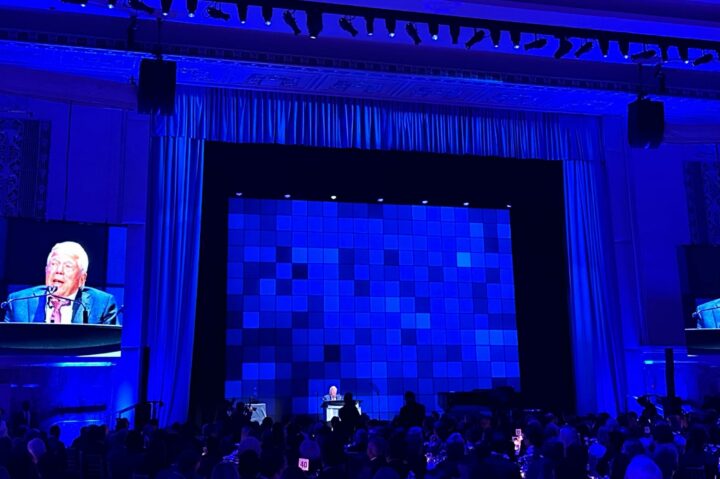
New England Patriots owner Robert Kraft addresses the inaugural benefit gala of his Blue Square Alliance Against Hate, Oct. 21, 2026


 Add JewishInsider on Google
Manhattan’s Waldorf Astoria was basking in blue light on Wednesday night as more than 800 guests gathered for the inaugural benefit gala of Robert Kraft’s Blue Square Alliance Against Hate. The sold-out event raised more than $32 million to combat antisemitism and discrimination, according to the organizers.
The haul marks the largest amount the group has raised in a single night. With opening remarks by CNN commentator Van Jones, the program honored Bank of America Chair and CEO Brian Moynihan for his support of the organization’s work, and featured a video message from former Secretary of State Condoleezza Rice, a member of Blue Square’s advisory board, who shared her personal experiences confronting racism and hate.
Kraft, the New England Patriots owner who founded the organization, took the stage alongside former Patriots quarterback Tom Brady and Cardinal Timothy Dolan, the archbishop emeritus of New York. The trio reflected the group’s effort to enlist figures from sports, religion and business in the fight against antisemitism and hate of all kinds.
Hate “starts with antisemitism, but it doesn’t end there,” Kraft told attendees. “I believe that silence is hate’s greatest ally,” he said. “Silence allows hate to grow unchecked, at devastating speed. That is the premise on which the Blue Square Alliance was founded … I knew if we could find a way to reach people beyond the Jewish community, to educate them, inspire them and give them a simple way to stand with us, we could change the conversation around all hate.”
An eclectic crowd filled the ballroom, where household names sat beside prominent figures from New York’s Jewish community. Spotted in the crowd were singer-songwriter Jon Bon Jovi; Disturbed frontman David Draiman; CNN’s Wolf Blitzer and Bianna Golodryga; New York City Police Commissioner Jessica Tisch; Speaker of the New York City Council Julie Menin; former CEO of UJA-Federation of New York Eric Goldstein; ADL CEO Jonathan Greenblatt; Yeshiva University President Ari Berman; Columbia University Hillel Executive Director Brian Cohen and Rabbi Berel Gurevitch, who leads Chabad West Village.
For all the differences in the room, from celebrities to rabbis to Wall Street executives, nearly everyone shared one accessory: the small blue square that is the organization’s symbol, pinned on lapels and gowns alike. The blue square pin has become a visible symbol of the group’s message, worn by supporters across religious and cultural lines. A video shown during the evening highlighted its reach beyond the Jewish community, including an Oklahoma City pastor who said he ordered 3,000 pins for his congregation.
Kraft founded the organization in 2019 as the Foundation to Combat Antisemitism, launching the blue square campaign in 2023, looking to turn the blue square emoji into the symbol for Jewish solidarity and opposition to hatred against Jewish people. In October 2025, the group rebranded as the Blue Square Alliance Against Hate, reflecting its effort to build a broader coalition of allies while continuing to focus on antisemitism. The expanded push came amid a sharp rise in antisemitism in America following Hamas’ Oct. 7, 2023, attack on Israel and the ensuing war in Gaza. The ADL recorded 9,354 antisemitic incidents nationwide in 2024, its highest annual total in the 46 years it has tracked such incidents.
The gala also revisited the campaign that made the organization a familiar name beyond Jewish communal circles: its Super Bowl commercials.
Clips from the 30-second spots played at the event, as attendees chatted about the ads’ power to bring the fight against antisemitism to one of the country’s biggest cultural stages. The organization is perhaps best known for the high-profile commercials, which have also at times drawn scrutiny. Its first Super Bowl spot, in 2024, featured a former speechwriter for Martin Luther King Jr. urging viewers to stand up to antisemitism.
A 2025 commercial starring Brady and Snoop Dogg broadened the message to standing up to hate of all kinds, while this year’s “Sticky Note” spot depicted a Jewish student bullied at school and a Black classmate who covers an antisemitic slur on his backpack with a blue square.
Robert Kraft’s antisemitism awareness group found 30% of the public now holds antisemitic attitudes — the highest level since it began tracking in 2023
Beth Israel Congregation
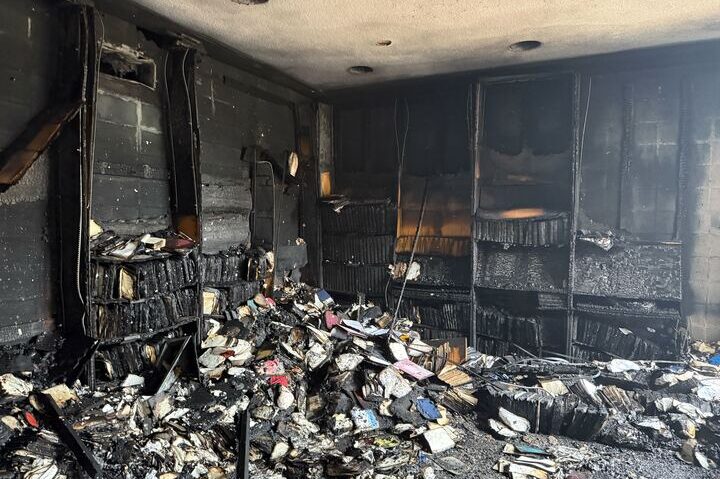
Beth Israel Congregation in Jackson, Miss., targeted in an arson attack on Jan. 10, 2026.
Most Americans say they are concerned about antisemitism in the country, yet more than half are unaware of recent major attacks targeting Jews, such as last December’s Bondi Beach terror attack in Sydney, Australia, a new survey from Robert Kraft’s Blue Square Alliance Against Hate found.
Underscoring this lack of awareness, the number of Americans who identify as allies of the Jewish community continued to shrink, according to the anti-hate group’s semiannual survey on U.S. antisemitism.
The report, drawn from a survey of more than 7,000 online respondents from March 4 to April 3, is titled “Worse Than Before: Antisemitic Attitudes Reach New Levels Across the U.S.,” and indicates that responses to antisemitism among the American public are less forceful than they were in the immediate aftermath of Hamas’ Oct. 7, 2023, terrorist attacks in Israel.
After the Hamas attacks and the onset of the ensuing Gaza war, antisemitic attitudes surged in the U.S., peaking in mid-2024, the Blue Square Alliance found. These numbers have again worsened since August 2025, with negative stereotypes about Jewish people growing most sharply among younger Americans, according to the survey. Additionally, the survey found an uptick in the share of Americans who say they don’t consider Holocaust denial to be antisemitic.
Further, the survey reveals a decline in the public’s desire to combat antisemitism. A plurality of Americans (47%) are now considered “unengaged” in combating anti-Jewish hate, and the share of those characterized as “active allies” has fallen to 23%, down from 30% in August 2025.
According to the group’s typology categorizing Americans according to whether they believe in anti-Jewish tropes, 30% of the population now holds antisemitic attitudes — the highest level recorded by the nonprofit since it began tracking in 2023 and a noticeable increase from 24% in August 2025.
While most Americans say antisemitism is a serious problem, they are often blind to its proximity. The survey found a sharp disconnect — 61% said they would be highly concerned if a Jewish individual or business in their community were harassed, yet only 23% view it as a clear and present threat.
A 53% majority of Americans were unfamiliar with the December 2025 attack at Bondi Beach in Sydney, Australia, in which 15 people were killed during a Hanukkah celebration, and 66% were unaware of the arson of the largest synagogue in Jackson, Miss., in January.
Fifty-five percent of Americans now believe Jewish people can handle antisemitism on their own — up 15 percentage points from June 2023. Gen Z and millennials are more than twice as likely as baby boomers (29% versus 13%) to view Jewish people as a threat to the unity of society.
Meanwhile, nearly one-third (32%) of Americans do not consider Holocaust denial to be antisemitic, up 13 percentage points since June 2023.
The Blue Square Alliance renamed itself from the Foundation to Combat Antisemitism last year, an effort designed to awaken the broader public to anti-Jewish hate. The group’s new name is a reference to its blue square pins that have been distributed to interfaith communities nationwide and posted online as a symbol in the fight against antisemitism.
Adam Katz, the group’s president, told Jewish Insider that the Blue Square Alliance’s ongoing campaigns, including its rebrand, are succeeding in making Americans more aware of antisemitism than they would be otherwise.
“We’ve seen a significant lift in awareness of our brand [and] recognition of our brand [as people] wear or share the blue square and tend to be familiar with the work we’re doing,” said Katz.
Responding to the survey results, Katz said he doesn’t think the solution is “a massive change in our programming, I think it’s continuing to push our programming as fast and as hard as we can.”
He said the group’s Super Bowl ad earlier this year that raised awareness of antisemitic bullying resulted in “nearly half of viewers [taking] action based on seeing the ad, they talked about hate and antisemitism with friends and family, they got more educated on it.”
“That tells us that the messaging works. We need to make sure that we are distributing it as targeted and precisely as we can,” said Katz.
Still, he asserted that getting Americans consistently engaged in antisemitism remains “a real challenge.”
“It’s a function of an extremely fragmented media landscape where everyone is consuming information from different sources and getting personalized feeds, so you have to work that much harder for things like antisemitism to feel proximate,” Katz said. “That’s why we see an almost dichotomous trend — a significant increase in people recognizing antisemitism as a major problem, and simultaneously a significant increase in people saying Jews can handle it on their own. They see it as something that is growing but not something close to them on their street, in their neighborhood. Therefore, they can allow themselves to be on the sidelines.”
Addressing the data that shows antisemitism is significantly higher among Gen Z and millennials compared to older generations, Katz said his organization “needs to focus there.”
“We need even more intense focus on young Americans and making sure we are really meeting them where they are as media consumption evolves.”
The inaugural group includes former Secretary of State Condoleezza Rice and Bank of America CEO Brian Moynihan

Chris Unger/Getty Images
New England Patriots owner Robert Kraft
The Blue Square Alliance Against Hate announced on Tuesday the formation of its inaugural advisory board to help guide the organization.
The five board members of the organization, founded by New England Patriots owner Robert Kraft, includes former Secretary of State Condoleezza Rice; Bank of America CEO Brian Moynihan; Dentons CEO Kate Barton; Salesforce CEO Marc Benioff; and Warner Bros. CEO David Zaslav.
The organization said the board will advise on strategy to combat antisemitism and help deepen institutional relationships.
“Their engagement sends a powerful message: combating antisemitism and hate is a shared responsibility, and one that needs leadership,” Kraft said in a statement. “This group embodies the values of the Blue Square Alliance, and we are deeply grateful that they are bringing their experience, perspective, and influence to our mission as we continue to build bridges.”
“Bank of America supports the Blue Square Alliance Against Hate because antisemitism and other forms of hate must be called out and addressed,” said Moynihan. “I look forward to working with the other members of the advisory group.”
The head of the Blue Square Alliance Against Hate emphasized the ad was intended to persuade all Americans — not just Jews — and survey research proved its effectiveness
Chris Unger/Getty Images
New England Patriots owner Robert Kraft
The Blue Square Alliance Against Hate’s widely watched Super Bowl ad designed to combat antisemitism instead sparked a heated divide within the Jewish community over the effectiveness of its message.
Titled “Sticky Note,” the ad from New England Patriots owner Robert Kraft’s group featured a Jewish student being harassed by his high school classmates because of his religion, with bullies placing a “dirty Jew” sticker on his backpack. In a show of allyship, a Black classmate puts a blue square over the note. “Do not listen to that,” he tells his Jewish classmate. “I know how it feels.”
A chorus of commentators criticized the advertisement, which is part of a $15 million media campaign that will also include ad spots during the Winter Olympics, for depicting Jews as victims in need of protection from non-Jews and for avoiding the reality that the source of many antisemitic incidents in schools stem from hostility toward or hatred of Israel.
But the leader of Kraft’s group told Jewish Insider that the ad wasn’t trying to appeal to a Jewish audience. Instead, Blue Square Alliance president Adam Katz told JI that with more than 100 million viewers, the Super Bowl provides an opportunity to reach an audience that is “unengaged — and in many cases uninformed —- about antisemitism … We’re very focused on this audience that’s lacking awareness, empathy and motivation to act,” he said.
The Anti-Defamation League’s Center for Antisemitism Research also responded to the flurry of negative feedback to the commercial by running its own test last week, and shared the results exclusively with JI. (ADL CEO Jonathan Greenblatt was one of the first Jewish leaders to praise the message of the advertisement, amid the criticism on social media.)
The ADL was involved in testing audience reactions to the Blue Square Alliance commercial amid the political debate over its impact, Katz said. The group conducted a randomized controlled experiment between Feb. 5-6, where about 1,000 viewers saw the group’s ad and a control group that saw an unrelated ad. The survey research, according to the ADL, found that the group that saw the antisemitism ad said they were notably more likely to “think antisemitism is a serious problem,” interrupt friends or family who make antisemitic comments and feel more motivated to fight antisemitism.
While the ADL and Blue Square Alliance often partner with each other, the test was done independently.
Katz told JI that the commercial was also tested for audience reaction by the Blue Square Alliance before it aired. He told JI that, based on the initial feedback, the foundation made tweaks to the ad so it would resonate more closely with viewers disengaged with the issue of antisemitism.
“Our research goes very deep into who [the Super Bowl audience is], what do they know, what don’t they know and we see very concerning data points around the awareness, visibility and concern about antisemitism. It’s just not on their radar. We’re talking about over 100 million Americans classified as unengaged on this topic who just don’t see antisemitism as a significant problem, as their problem to solve or as something they can have an impact on. That’s our audience.”
Leading up to the Super Bowl, Katz said Blue Square ran focus groups mostly consisting of non-Jewish and racially diverse Gen Zers and millennials. “We start by coming up with lots of different content and put those concepts in front of a testing audience, which is representative of our target audience of unengaged,” said Katz.
By the time the ad was finished, Katz said, it was “tested many times in raising awareness, empathy and ultimately raising attention to become an ally.”
“We have seen a particular rise in antisemitic sentiment among younger generations,” continued Katz. “Gen Z is three times more likely to witness antisemitism but twice as likely to say it’s not a problem. How do we reach that audience and give them a visible example of allyship?”
The answer, he said, is “allyship that feels approachable,” such as in a school setting.
“We wanted to focus on [an example] of what it looks like when everyday allies can get involved.”
Katz also said that the slur of “dirty Jew” is one that is increasingly commonplace in school settings, and one that viewers were most familiar with as an indicator of antisemitism.
“There are several real-life examples where students have been harassed using phrases like dirty Jew. We looked at the prominence of that particular phrase, we explored different things that could be written on that sticky note and we looked at what is really cutting across all different segments of the audience.”
Blue Square “found that there were nearly 500 million impressions of the phrase ‘dirty Jew’ on social media in the last three years,” Katz said. “The usage of that phrase is up 174% over the last three years. The usage of all slurs is up but not to that magnitude.”
Please log in if you already have a subscription, or subscribe to access the latest updates.
 Continue with Google

 Continue with Apple