














































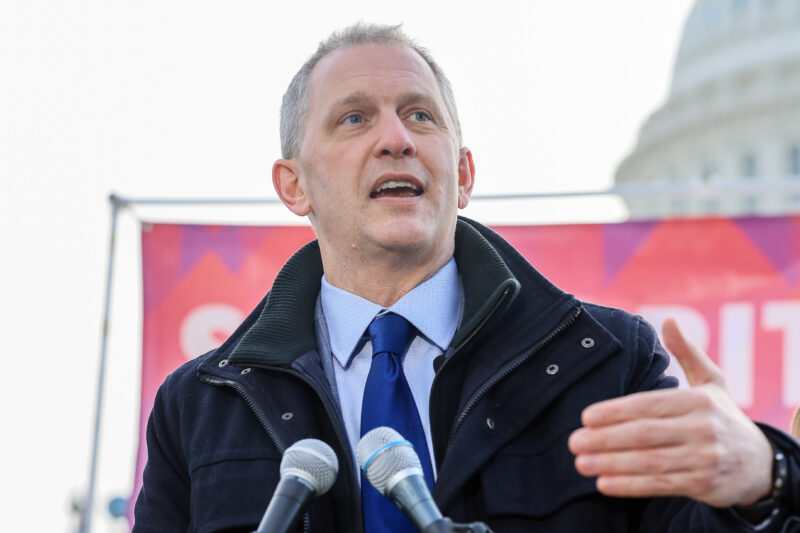

















The couple, once held captive by Hamas, channel their trauma into humanitarian work, volunteering in Kenya’s Kakuma refugee settlement with IsraAid and amplifying the stories of those suffering in silence

IsrAid
Keith and Aviva Siegel volunteer at Kenya’s Kakuma refugee settlement with IsraAid


 Add JewishInsider on Google
Keith and Aviva Siegel have seen the horrors of war up close and personal — torn from their home in Kibbutz Kfar Aza and taken hostage deep into Gaza, where Aviva would spend nearly two months and Keith would be held for more than a year.
And yet, little could have prepared them for what they would encounter at the Kakuma refugee camp in Kenya, where they spent five days last month volunteering at one of the world’s largest refugee settlements with the Israeli humanitarian group IsraAid as part of the couple’s pivot to humanitarian efforts around the world.
Aviva, who was a school teacher before the Oct. 7, 2023, Hamas attacks, choked up as she recalled the pregnant teenagers she met in the camp, where hundreds of thousands of people have fled from places such as South Sudan, Somalia and the Democratic Republic of the Congo.
One of the teens she met, a 15-year-old girl, had just given birth to her second child. She had her oldest child at age 13. “It was too much for me to carry,” Aviva told Jewish Insider from New York. “It was too much for me to carry because of so many things. You know, these girls, some of them have been raped, and there’s nobody in the world that’s protecting them, nobody.”
It was a familiar feeling for the couple, who have each recounted having seen fellow hostages after they had been sexually assaulted by their Hamas captors.
The people she met at the refugee camp, Aviva said, were “screaming out with no voice to tell how bad the situation is there. It took me to Gaza, to those moments, and so many moments and so many days of not knowing if I’ll ever live, if I’ll make it, if I’m visible, if anybody is doing anything they could to take me out of there.”
“I didn’t understand in Gaza how the world let us stay there for so long,” she said.
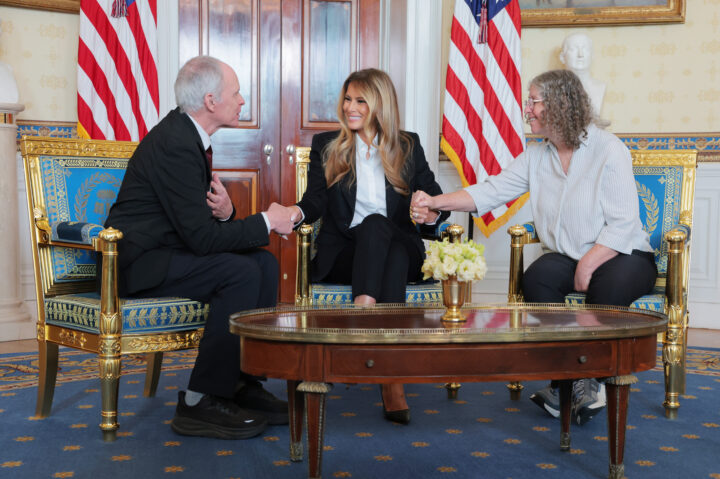
The couple’s time in captivity — and after, as they became prominent activists lobbying for the release of the remaining hostages in Gaza — deepened their resolve to use their newfound prominence for good. From Kenya, the Siegels flew to Washington, where they met last week with First Lady Melania Trump.
“We were at the White House, and I told the first lady about our experience in Kakuma at the refugee camp, and the hardships and the horrific life they have there,” Keith said. “I kind of feel like I carry them with me, in my heart and my soul and my thoughts, and just to be able to be their voice here in the U.S.”
The couple exchanged experiences both with refugees in the camp and IsraAid staffers — many of whom are refugees themselves.
“I really felt like it was like a mutual understanding,” Keith said. “And also feeling like all of us, them and Aviva and I, have experienced suffering. All of us have experienced being hungry because we didn’t have food to eat, being thirsty because we didn’t have water to drink. Just the uncertainty, the lack of security and feeling like death could be imminent.”
Both Keith and Aviva said they were shaped by their early childhood experiences. Coming from apartheid South Africa, Aviva, whose family moved to Israel when she was 9, said that as a child, “I saw things that shouldn’t be in this world.”
Being at the refugee camp, she explained, “brought me back to those days of being a kid in a place that is just a disaster. It’s a disaster.”
Growing up in the U.S., Keith said, “my parents raised me, and they showed me, by their example, tikkun olam. It’s one of the important concepts about values of the Jewish faith.”

“I’m sure my late parents would be very, very proud of me,” he added. “I feel like I’m continuing their legacy of things that were so important to them their whole lives. They were helping people in many, many different ways. Within their community, but also outside of their community and around the world.”
The Siegels were connected to IsraAid through Matan Sivek, a co-founder of the D.C. Hostages and Missing Families Forum and, with his wife, a leader of the group’s U.S. efforts. Sivek, who lives in Washington, joined IsraAid as the group’s head of strategic partnerships last year.
The pairing between the Siegels and IsraAid was, as CEO Yotam Polizer told JI, “a spiritual match.”
“It’s an unbelievable privilege to have Aviva and Keith, because they are really bringing voice to the voiceless,” Polizer said. “They are, for me and for us, the best example of post-traumatic growth, which I believe is the essence of Israel — how these terrible, terrible tragedies could also turn into opportunities to support others and to build bridges.”

IsraAid has operated in the camp for more than a decade, and employs approximately 50 people there. Among the services it provides are health clinics, clean water access and schooling for some of the tens of thousands of children in the camp.
“Keith and I aren’t special in any way,” Aviva said. “We are just two people that were kidnapped from Kfar Aza and spent time in the world’s darkness, Keith for 484 days, and me for 51 days. And we know what it’s like to need help. So we need to help them. We just need to help them.”
Keith became emotional as he talked about the organization’s work across the globe. “I know there are many, many other people all around the world that are in big trouble, and I feel like it’s my responsibility as much as I can to search to be aware of people that are in trouble, and do whatever I can do to help them.”
For him, the pivot to the humanitarian field also served a deeper purpose. “Helping others,” he said, “is part of my healing.”
'Aviva is a warrior. She's a warrior. She was fighting very hard for Keith, and I know he suffered a lot,’ the first lady said
Anna Moneymaker/Getty Images
First Lady Melania Trump, Keith Siegel (L) and Aviva Siegel (R) hold hands during a meeting in the Blue Room of the White House on February 04, 2026 in Washington, DC.
First Lady Melania Trump welcomed freed Israeli hostages Aviva and Keith Siegel to the White House on Wednesday, one year after Aviva met the first lady for the first time and pleaded for help securing her husband’s release.
In the meeting in early 2025, Aviva gave the first lady books that she had written about Keith, who grew up in North Carolina. Trump then passed those books to the president, the first lady shared on Wednesday.
“I gave him the books, the books that Aviva gave me, and I explained the situation — where she thought that Keith was, how he was doing. She didn’t have much information, but she knew how much he was suffering, because she was with him for 50 days,” said Trump. “I explained to him everything, and I know how hard he was working.”
The Siegel couple was kidnapped by Hamas terrorists from Kibbutz Kfar Aza on Oct. 7, 2023. Aviva was held hostage for 51 days before being released in the first ceasefire deal in November 2023, but Keith was not released until 2025, after 484 days of captivity. Over the course of the war, Aviva became one of the most visible activists advocating for the release of all the hostages.
“Aviva is a warrior. She’s a warrior. She was fighting very hard for Keith, and I know he suffered a lot,” Trump said on Wednesday. “I’m happy to see you healthy at home with your children, with your grandchildren, with your family, and I know you’re giving back your time, your energy, to other people.”
Keith responded to the first lady’s remarks with emotional comments of his own, getting choked up at times.
“I want to thank you for being a very compassionate person, for supporting and helping Aviva during those difficult days, and you helped her enormously in many ways,” Keith said to Trump. “I’m eternally grateful to you and President Trump for bringing me home and for bringing all of the hostages back to their families.”
The first lady said the meeting was planned to coincide with the Siegels’ travel schedule in Washington. But she also used the event to tout her new documentary, “Melania,” which the first lady said includes footage of her meeting with Aviva.
According to the White House, text displayed at the end of the documentary lists Trump’s accomplishments as first lady, including: “Melania Trump played a key role in securing the release of Keith Siegel after 484 days as a hostage in Gaza, just 12 days after the inauguration.”
Plus, DMFI names new president & board chair

JACK GUEZ/AFP via Getty Images
This picture taken from a position in southern Israel on the border with the Gaza Strip shows Israeli tanks and bulldozers deployed as smoke billows over destroyed buildings in Gaza during Israeli bombardment on May 17, 2025.
Good Monday morning.
In today’s Daily Kickoff, we spotlight Andrew Cuomo’s efforts to make amends with the Orthodox Jewish community for his COVID policies as governor in the final weeks of the New York City mayoral primary race and report on Democratic Majority for Israel’s new president and board chair. We interview New Jersey congressional candidate Michael Roth, cover a debate at the Center for Jewish History about the future of Jewish students at elite schools and report on criticism of Chicago Mayor Brandon Johnson over the appointment to a prominent city commission of a local activist who tore down hostage posters. Also in today’s Daily Kickoff: Keith and Aviva Siegel, Pope Leo XIV and Yuval Raphael.
What We’re Watching
- South African President Cyril Ramaphosa is traveling to D.C. today and will meet with President Donald Trump at the White House tomorrow amid tensions between the two countries…
- U.S. Special Envoy to the Middle East Steve Witkoff, hostage envoy Adam Boehler and Yehuda Kaploun, President Donald Trump’s nominee for antisemitism envoy, are among the speakers today at The Jerusalem Post’sconference in New York.
- The National Council of Jewish Women will honor Sen. Cory Booker (D-NJ) and Jennifer Klein, former director of the White House Gender Policy Council and now professor of professional practice at Columbia University, at a Washington Institute event this evening.
- The annual ICSC real estate confab is underway at the Las Vegas Convention Center.
- The second and final day of ELNET’s International Policy Conference in Paris will be held today.
- The three-day Middle East Forum 2025 Policy Conference begins today in Washington. Keynote speakers include Daniel Pipes, Masih Alinejad and Rep. Randy Fine (R-FL).
- The World Jewish Congress is holding its 17th Plenary Assembly in Jerusalem today. Israeli President Isaac Herzog presented WJC President Ronald Lauder, who is up for reelection at the plenary, with a Presidential Medal of Honor. Read eJewishPhilanthropy’s report from the WJC gala here.
What You Should Know
A QUICK WORD WITH JI’S LAHAV HARKOV
What does “total victory” in Gaza mean for Israel? It’s a question that’s been asked since the launch of the war against Hamas in response to the Oct. 7, 2023, mass terror attacks.
The answer has generally been two-pronged: Bringing home the hostages and defeating Hamas, in that order for most of the public, but in the reverse for Israeli Prime Minister Benjamin Netanyahu and much of his government. The first goal is unambiguous, even quantitative, but the second has often seemed amorphous: Destroying its military capabilities? Wiping out its leadership? Killing everyone affiliated with Hamas, including those involved in its civil administration of Gaza?
The Israeli government may be getting closer to what it can call “defeating Hamas.” As Israeli analysts have repeatedly noted in the days since a recent IDF operation targeted Hamas’ leader in Gaza, Muhammad Sinwar, and spokesman Hudayfa Samir Abdallah al-Kahlout, known as Abu Obeida, there aren’t any Hamas leaders left in Gaza that most Israelis can name.
Netanyahu’s office indicated an openness to ending the war in a statement about the ongoing talks in Doha, Qatar, to which the prime minister sent his negotiating team minus its leader, Strategic Affairs Minister Ron Dermer, who is sitting shiva in Jerusalem for his mother, but has been involved remotely.
The negotiators are “acting to exhaust every chance for a deal,” the Prime Minister’s Office said yesterday, “whether it is according to the Witkoff outline” — referring to the release of 10 living hostages in exchange for a temporary ceasefire and hundreds of Palestinian prisoners, including terrorists, as offered by Mideast envoy Steve Witkoff — “or in the framework of ending the war, which would include releasing all the hostages, exiling Hamas terrorists and demilitarizing the Gaza Strip.”
Those have been Israel’s conditions for much of the war, which is why, when asked by Jewish Insider, Netanyahu’s spokesman, Omer Dostri, said that sentence was “nothing new.” Yet the Prime Minister’s Office was more reticent in the past to highlight the option of negotiating an end to the war. Mentioning the conditions at this time may indicate that the Israeli team in Doha sees that as a viable option, now that all that is left of Hamas’ leadership in Gaza is effectively anonymous middle management.
Until there’s a deal, Israel is continuing its policy of “negotiations under fire” to pressure Hamas, with the IDF announcing “extensive ground operations” in Gaza on Sunday, as planned for after President Donald Trump’s Middle East trip, which ended on Friday. The Israeli military’s latest maneuvers involve five divisions, amounting to tens of thousands of soldiers. The IDF killed what it said was a senior terrorist on Monday, apprehending his family; the military denied reports that the special ops mission was meant to rescue hostages.
At the same time, Israel announced it would let “a basic amount of food [into Gaza], to ensure that there will not be a starvation crisis,” 11 weeks after cutting off all humanitarian aid because Hamas was hoarding some of it and using it as a means to pocket money and survive. The policy change came “at the recommendation of the IDF,” the Prime Minister’s Office said, “and out of an operational need to allow for the expansion of intensive fighting to defeat Hamas … Such a crisis would endanger the continuation of [Operation] Gideon’s Chariots to defeat Hamas.”
The shift also comes days after Trump talked about “a lot of people … starving” in Gaza, and, as Netanyahu said in a video posted to social media today, “senators I know as supporters of Israel … say ‘we’ll give you all the help you need to win the war … but there is one thing we cannot stand: We can’t get pictures of famine’” in Gaza.
The U.S. and Israel have been working on a mechanism to allow in aid without Hamas getting access to it. That system has yet to be put into place, though American security contractors who will reportedly be involved in distributing the aid arrived at Ben Gurion Airport yesterday. The Israeli Cabinet did not vote on allowing in food without a new distribution mechanism, and the response from ministers has been somewhat mixed, with Public Security Minister Itamar Ben-Gvir railing against it, while Finance Minister Bezalel Smotrich tried to reassure the public that aid would not end up in Hamas hands.
APOLOGY TOUR
Cuomo faces hurdles to winning over Orthodox Jewish voters in mayoral race

In recent weeks, as Andrew Cuomo has stepped up his outreach to Orthodox Jewish leaders across New York City who represent sizable voting blocs crucial to his mayoral bid, he has found himself involved in an effort that is no doubt unfamiliar to the famously hard-nosed former New York governor: an apology tour, Jewish Insider’s Matthew Kassel reports.
Mending ties: Even as Cuomo has been outspoken in his support for Israel and opposition to rising antisemitism that he has called “the most important issue” in the race, he has continued to face lingering resentment from Orthodox voters who remain bitter over restrictions he implemented during the COVID pandemic. In ongoing listening sessions with Orthodox leaders, Cuomo has sought to mend relationships that deteriorated over his crackdown on religious gatherings.
NEW BOSS
DMFI announces new president and board chair following leadership shake-up

Democratic Majority for Israel, a top pro-Israel advocacy group, is announcing a new president and board chair, after a recent leadership shake-up that resulted in the sudden departure of its founder last month. The organization said in a statement to Jewish Insider’s Matthew Kassel on Friday that Brian Romick, a longtime senior aide to Rep. Steny Hoyer (D-MD), will serve as president and CEO, succeeding Mark Mellman, a veteran Democratic pollster who founded the group in 2019 to counter growing anti-Israel sentiment on the left. Former Rep. Kathy Manning (D-NC), a pro-Israel stalwart and Jewish Democrat who has previously chaired the Jewish Federations of North America, will lead DMFI’s board of directors, the group said.
Romick’s statement: Romick, who has helped guide Hoyer’s efforts to advance pro-Israel legislation and fight antisemitism, said in a statement shared with JI that DMFI is “an essential voice in Washington and in the pro-Israel community across the country,” particularly during what he characterized as a “critical moment in the U.S.-Israel relationship.”
ROTH’S RACE
NJ congressional candidate Michael Roth says he wants to be a strong pro-Israel voice for a new generation

Michael Roth, the former Small Business Administration head running as a Democrat against Rep. Tom Kean Jr. (R-NJ) in a northern New Jersey swing district, says he wants to be a leader of a new generation of voices in support of Israel, pushing back on what he sees as concerning trends and rhetoric infiltrating his generation and American politics, Jewish Insider’s Marc Rod reports.
About the candidate: Roth is the grandson of Holocaust survivors who moved to Israel before settling in New Jersey. “When I go to Israel, it feels like I’m going home again,” Roth said. “My guiding light around Israel is I want my grandkids to feel the same way about Israel as I do, and we’ve got a lot of work to do in order to make that happen. We have to think in long terms.” He added, “I don’t care if you’re a Democrat or Republican, if you’re representing the best interest of America, you must support the elimination of Hamas, and you must have extreme resistance to the growing threats in Iran.” With Israel policy becoming increasingly partisan, “I think it’s really important that we elect Democrats in the primary who are staunchly pro-Israel.”
CAMPUS CLIMATE
At Center for Jewish History event, scholars debate the future of Jewish students at elite schools

Will the recent surge of antisemitism on college campuses mark the end of an era for Jews at elite universities? Jewish scholars and funders analyzed the current crisis — and debated whether Jewish students still belong at elite bastions of higher education — at a symposium on Sunday hosted by the Center for Jewish History in Manhattan, Jewish Insider’s Haley Cohen reports.
Wolpe’s words: Rabbi David Wolpe, a former visiting scholar at Harvard University’s Divinity School, delivered the event’s opening address. “I certainly don’t think that we should abandon great citadels of learning or be chased out of them, although to be there takes fortitude that I don’t think should be asked of every student,” Wolpe said. “So I’m going to give a selective answer: it depends who … It was a dream of our ancestors that Jews be able to go to places like Harvard, Stanford, Yale and Princeton, and on and on, certainly Columbia,” Wolpe continued. “It was their dream and they invested their souls in enabling their children and grandchildren to realize that dream. With all my caveats, I’m not ready to give up on the entire investment of all of those souls because others have been so cruel, so thoughtless, so blunt and even evil in the treatment of their descendants. How many souls have we invested? The answer is a lot.”
FISCAL IRRESPONSIBILITY
Chicago mayor appoints local activist who tore down hostage posters to fiscal board

Chicago Mayor Brandon Johnson is facing sharp criticism from the city’s only Jewish alderman over his decision to appoint a local activist who was caught on video tearing down posters of Israeli hostages to a prominent city commission, Jewish Insider’s Gabby Deutch reports. Ishan Daya, the co-director of a think tank called the Institute for Public Good, was named to Johnson’s new Chicago Fiscal Sustainability Working Group, which will make recommendations to the mayor for a long-term financial plan for the city. The group’s other members include prominent Chicagoans working at institutions including Google, United Way, Microsoft and Chicago Urban League.
Rewind: Daya lost his job as CEO of the food and beverage company Crafty in November 2023, just weeks after the Oct. 7 Hamas attacks, when a video filmed in New York showed him ripping down posters of Israelis who had been kidnapped by the Palestinian terror group. “F*** you and burn in hell,” a woman accompanying him said to the people filming the act. “I am appalled by Mayor Brandon Johnson’s decision to appoint Ishan Daya to the city’s newly formed budget working group,” Alderman Debra Silverstein said in a statement on Friday. “Appointing him to a leadership position in Chicago is a deliberate slap in the face to the Jewish community and to all those praying for the release of the [58] hostages still held in Gaza.”
BITTERSWEET BREAKFAST
Siegel family’s pancake tradition raises awareness for Israeli hostages

The sweet scent of maple syrup wafting through the air and the sound of pancakes sizzling on a griddle: For decades, that was the quintessential Shabbat morning in Keith and Aviva Siegel’s home on Kibbutz Kfar Aza in southern Israel. In that home, the couple’s four children — and eventually five grandchildren — would gather for family meals centered around pancakes — a recipe that originally belonged to Keith’s mother, a recipe that “brings back memories of special and happy family times,” he told Jewish Insider’s Haley Cohen. Those meals were put on hold for 484 days. Keith and Aviva were both kidnapped from their home by Hamas during the Oct. 7, 2023, terrorist attacks.
Pop-up pancakes: On Friday, New Yorkers got a chance to taste the pancakes — cooked by Keith and Aviva — at a one-day pop-up pancake house hosted by 12 Chairs Cafe, an Israeli restaurant in downtown Manhattan. The event, which drew lines around the block and raised nearly $15,000, was a fundraiser hosted by the Hostages Forum to advocate for the 58 hostages that remain in Gaza (about a third of them are believed to be alive).
Worthy Reads
The Donald in the Desert: The New York Times’ Luke Broadwater and Jonathan Swan review President Donald Trump’s five-day trip to the Middle East last week: “If a Democratic president did what Mr. Trump has done — praising a former jihadist, welcoming Qatar’s friendship with Iran and accepting a “gift” of a $400 million airplane — Republicans would have been howling in protest and ordering up congressional investigations. What transpired, instead, was mostly an uncomfortable silence. A few Trump allies, like Senator Josh Hawley of Missouri and the far-right activist Laura Loomer, made clear they did not like the plane gift, but contorted themselves to express their discomfort in ways that would be least likely to offend Mr. Trump.” [NYTimes]
Trump’s Gilded Age: The New Yorker’s Susan Glasser reviews Trump’s Middle East trip as a sign of his transactional approach to foreign policy. “Trump, as far as I’m concerned, is never more fully himself than when he’s in the gilded safe spaces of the Middle East — admiring the ‘perfecto’ marble in a royal palace, basking in the judgment-free approval of fellow-billionaires, commingling his family’s and the nation’s business to a remarkable degree. His foreign-policy doctrine is not Kissingerian or Charles Lindberghian; it is not a doctrine at all, in fact, but a way of life, defined by extreme transactionalism and self-interest above all else. The cursed airplane from Qatar is not just a symbol of Trumpism but also its substance.” [NewYorker]
The New Europe: In The National, Paul Salem, vice president for International Engagement at the Middle East Institute, considers how Trump’s Gulf tour could reshape geopolitics. “For Mr Trump to make the Gulf his first official foreign visit again in his second term also indicates that he sees the Gulf countries and economies as main geopolitical and geoeconomic players in many ways surpassing the states and economies of Western Europe. The leaders of Saudi Arabia, Qatar and the UAE now appear to hold more influence with the US President than do some of the leaders of America’s traditional Nato allies.” [The National]
Biden, in Decline: The Atlantic’s Tyler Austin Harper previews Original Sin, the new book by Jake Tapper and Alex Thompson about former President Joe Biden’s mental decline in office. “Some incidents cataloged in Original Sin suggest that Biden may have been struggling to do the job even early in his term. Cabinet meetings were ‘terrible and at times uncomfortable,’ one Cabinet secretary told the authors. ‘And they were from the beginning.’ Biden relied on note cards and canned responses … As some high-ranking Democrats quoted anonymously in the book put it to Tapper and Thompson after Biden’s disastrous debate with Trump last June: ‘Just who the hell is running the country?’ At least one unnamed source close to the Biden administration was willing to provide the authors with an answer. ‘Five people were running the country,’ this insider said, seemingly referring to the president’s closest advisers. ‘And Joe Biden was at best a senior member of the board.’” [TheAtlantic]
Word on the Street
Former President Joe Biden was diagnosed with an aggressive form of prostate cancer that has spread to his bones, his office said in a statement yesterday…
Vice President JD Vance decided against a visit to Israel Tuesday after the IDF expanded its military operations in Gaza, according to Axios. A Trump administration official said that the White House didn’t want to suggest it was endorsing the ground operation at a time when the U.S. is advocating for a ceasefire deal…
The Trump administration is discussing a plan that would permanently relocate Palestinians living in the Gaza Strip to Libya, according to NBC News. The administration has discussed the proposal with Libya’s leadership…
Hamas’ main goal with its Oct. 7 attacks was to derail peace negotiations between Israel and Saudi Arabia, according to documents Israel’s military found in a Gaza Strip tunnel. Hamas’ Gaza chief, Yahya Sinwar, reportedly believed that an “extraordinary act” was required to derail the talks, the Wall Street Journal reports…
The body of Muhammad Sinwar, his brother’s successor in leading Hamas’ military operations, was reportedly found in a Khan Younis tunnel along with 10 aides…
While President Donald Trump touted pledges from the three Gulf state countries he visited as totaling as high as $4 trillion, The New York Times reports “much of that total comes in the form of long-term pledges that may or may not materialize and counts some deals that were already underway.”…
In an interview with NBC News, former Vice President Mike Pence said, “To have the president in Saudi Arabia questioning America’s global war on terror and describing it as nation building and interventionist, I thought was a disservice to generations of Americans who wore the uniform … particularly giving that speech in Saudi Arabia where 15 of the 19 9/11 hijackers hailed from” …
U.S. Special Envoy to the Middle East Steve Witkoff told ABC News that Iranian nuclear enrichment is the Trump administration’s “one very, very clear red line.” He said, “We cannot have that. Because enrichment enables weaponization.” …
At the WJC gala on Sunday night, American Ambassador to Israel Mike Huckabee sought to assuage concerns of a growing disconnect between the United States and Israel, affirming the bond between the two countries and referring to Jerusalem as Washington’s only “true partner.” Meanwhile, newly appointed WJC Israel Region Chair Sylvan Adams spoke out against Qatar, which WJC President Ronald Lauder recently visited during Trump’s Middle East trip….
Catholic-Jewish dialogue is “very precious” and must continue, Pope Leo XIV said at an audience with leaders of other religions on Monday, according to Italian news wire ANSA, Jewish Insider’s Lahav Harkov reports…
The CIA has appointed a popular and experienced Middle East station chief as its new deputy director for operations, overseeing global covert missions, the Financial Times reports…
The Mossad, in cooperation with a foreign intelligence service, recovered some 2,500 documents, photographs and personal items that had been kept in the Syrian archive of materials connected to legendary Israeli spy Eli Cohen, the Israeli Prime Minster’s Office said yesterday…
The New York Times spotlights Project Esther, the Heritage Foundation’s aggressive playbook to deter antisemitism on college campuses, many elements of which have been embraced by the Trump White House…
The Wall Street Journal interviews businessman and private equity investor Brad Jacobs, the chairman and CEO of QXO…
Bloomberg profiles attorney Marty Edelman, known as Abu Dhabi’s ‘Man in Manhattan,’ and his role in helping advance recent deals between the UAE and the U.S…
New York City mayoral candidate Zohran Mamdani declined to support a resolution in the state Legislature recognizing Israel on the 77th anniversary of its founding. Several months earlier, he also declined to sign onto a separate resolution condemning the Holocaust. Both resolutions were overwhelmingly supported by Democrats in the state Assembly…
Israel’s Yuval Raphael, a survivor of the Oct. 7 Hamas attack at the Nova festival, finished in second place at the Eurovision Song Contest in Basel, Switzerland, winning the public vote for the competition for her song “New Day Will Rise”…
The 2025 AI Status Report, released last week by the Israel Innovation Authority, found that while Israel is a global leader in AI innovation, its public institutions are lagging behind but there is a plan in the works to bridge the gap…
The Wall Street Journal reports that Kanye West’s antisemitic song with the hook “Heil Hitler” is “going viral on social media” after being removed from streaming services like Spotify and Apple Music. Popular podcast host Joe Rogan defended the song’s message…
The man convicted of stabbing Salman Rushdie at the Chautauqua Institution in 2022, leaving the acclaimed author blind in one eye, was sentenced Friday to 25 years in prison…
Iran has summoned the British charge d’affaires in Tehran after the arrest of seven Iranian nationals in the U.K. earlier this month as part of a counterterrorism operation; three of the suspects were charged last week with spying offences in connection with a plot to target journalists critical of the Islamic Republic…
Rebecca Rose is starting a new position as director of grants and regional events at the Foundation for Defense of Democracies…
Pic of the Day

Senate Minority Leader Chuck Schumer (D-NY), New York Gov. Kathy Hochul, Israeli Ambassador to the U.N. Danny Danon and Eric Goldstein, CEO of UJA-Federation, attended the Celebrate Israel parade yesterday on Fifth Avenue in New York.
Birthdays

Retired chief judge of the New York Court of Appeals, now of counsel in the NYC office of Latham & Watkins, Jonathan Lippman turns 80…
Retired senior counsel in the DC office of Blank Rome, Harvey Sherzer turns 81… Clinical psychologist, author, teacher, public speaker and ordained rabbi, Dennis G. Shulman turns 75… Former member of the California state Senate, she was also a member of the California Legislative Jewish Caucus, Hannah-Beth Jackson turns 75… Israeli novelist and journalist, Edna Shemesh turns 72… Nurse and former member of the Wisconsin state Assembly, Sandra (Sandy) Pasch turns 71… Retired chief of the general staff of the IDF, now a member of the Knesset for the National Unity party, Gadi Eizenkot turns 65… Chabad-Lubavitch rabbi, born in Milan, now chief rabbi of Russia, Rabbi Berel Lazar turns 61… Journalist, teacher and playwright, now an editor of Streetsblog NYC, Gersh Kuntzman turns 60… Born in Kyiv, he is a professor of mathematics at the University of Chicago, Alex Eskin turns 60… Author of 28 novels that have sold over 40 million copies in 34 languages, four of which have been adapted into Lifetime Original Movies, Jodi Picoult turns 59… Business manager and spokesperson for NBA Hall of Famer Michael Jordan, Estee Portnoy… Former CEO of Bend the Arc, Stosh Cotler turns 57… Israeli-born chef, owner of multiple NYC restaurants, she is a cookbook author and comedian, Einat Admony turns 54… Israeli actress and fashion designer, Dorit Bar Or turns 50… Canadian food writer and cookbook author, she is a judge on Bravo’s “Top Chef,” Gail Simmons turns 49… Member of the Knesset for the Likud party since 2019, Ofir Katz turns 45… Nonprofit manager and consultant, he is the program director of MyZuzah which aspires to place a kosher mezuzah on every Jewish home worldwide, Alex Shapero… Pitcher for Team Israel at the 2017 World Baseball Classic and is now pitching coach for the UC Davis Aggies, Zachary “Zack” James Thornton turns 37… Activist, advocacy educator, engagement strategist and TED speaker, Natalie Warne… Ice hockey forward currently playing for Sibir Novosibirsk (Russia) of the Kontinental Hockey League, Brendan Leipsic turns 31…
Please log in if you already have a subscription, or subscribe to access the latest updates.
 Continue with Google
 Continue with Apple