


























































The vessel carrying activists has briefly taken global attention away from the legitimate efforts to distribute aid in Gaza, amid mounting distribution challenges

Israeli Foreign Ministry
IDF soldiers take Greta Thunberg into custody after boat to Gaza is intercepted, June 9th, 2025


 Add JewishInsider on Google
The image of Greta Thunberg eyeing a turkey sandwich as she is taken into Israeli custody has been picked up across pro-Israel social media. And on the other side of the ideological spectrum, supporters of Thunberg, who is vegan, decried the “hostage-taking” of the Swedish climate activist and other participants on the boat that had been headed to Gaza before its interception overnight by Israel’s navy.
But the stunt — after all, the small vessel carrying Thunberg and the other activists could carry only a minimal amount of aid — has briefly taken global attention away from the legitimate efforts to distribute aid in Gaza, amid mounting distribution challenges following the launch of the Gaza Humanitarian Foundation last month.
Distribution through the GHF was briefly paused last week following a series of incidents in and around distribution sites, including the shooting of some Gazans as they neared sites as instructed, and the rush on other facilities by crowds of Gazans. Additionally, the GHF said it was forced to close its distribution sites on Saturday due to threats from Hamas.
Further complicating issues is Israel’s support for an armed militia in Gaza that opposes Hamas, which Jewish Insider reported on last week. The Israeli decision to arm members of Yasser Abu Shabab’s gang in southern Gaza — which was made without the input of the Israeli security cabinet — is causing backlash in Israel, where former Defense Minister Avigdor Liberman pushed back against the plan, alleging that in attempting to pit Palestinian factions against each other, Israeli Prime Minister Benjamin Netanyahu is “still continuing with the same idea that led us to the greatest massacre in the history of the state.”
Frustration over the situation from some of Israel’s staunchest defenders has at times boiled into public view. Speaking in Turkey last month, Secretary of State Marco Rubio said he was “troubled” by the humanitarian situation in Gaza, while Vice President JD Vance briefly addressed the humanitarian issue over the weekend in an interview with podcaster Theo Von.
The State Department is reportedly considering allocating $500 million to the GHF’s operations — money that would come from USAID’s budget as the agency is folded into the State Department. But Israel has yet to demonstrate that it is able, through the GHF, to distribute aid at a large scale. And major challenges remain: that some of the most vulnerable are not in areas where easy and safe distribution is possible, and also that the distribution is taking place in a war zone with a rapidly changing security situation, and a route or site that is deemed safe one day may be unusable the next.
Kinks are to be expected as the GHF expands its operations. The open question, as distribution enters its third week, is if the GHF, with the backing of Israel and international partners, can address the existing challenges and scale up to meet the soaring humanitarian needs in the enclave, and whether in the longer term it can serve as a viable alternative to the many aid agencies and organizations with whom Israel refuses to work, or vice versa.
It is against that backdrop that the GHF, Israel, the U.S. and other involved parties are working to formulate an implementable plan that avoids the logistical challenges of recent weeks. Thunberg’s boat stunt made headlines. But a functioning aid distribution apparatus, when operating at scale, can make a difference.
Former Defense Minister Liberman warns clan is affiliated with ISIS and can turn on Israel; Netanyahu did not bring decision to security cabinet

BASHAR TALEB/AFP via Getty Images
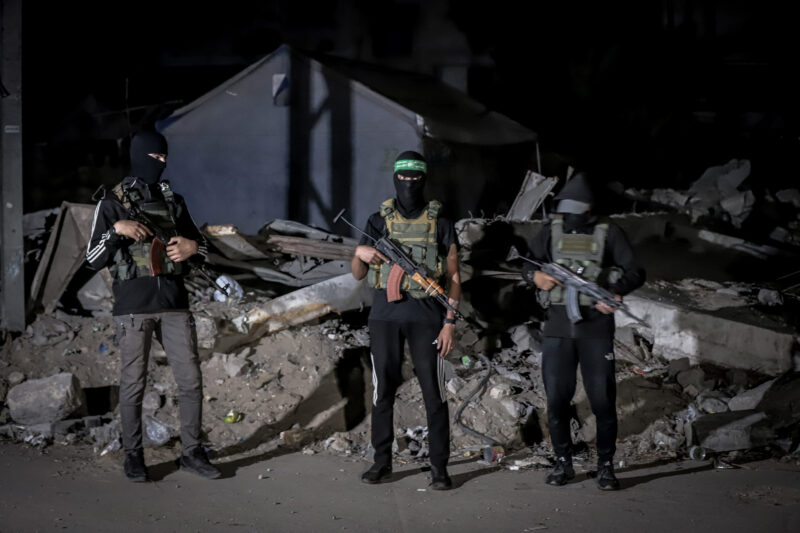
A Palestinian Hamas fighter carries a rifle as terrorists and people gather at the site of the handing over of Israeli hostages at the Nuseirat refugee camp in the central Gaza Strip on February 22, 2025.
Israel is providing weapons to an armed militia opposing Hamas, a defense source confirmed on Thursday.
Following reports in recent weeks that Israel was working with a gang led by Yasser Abu Shabab based in Rafah in southern Gaza, Avigdor Liberman, the former defense minister and current opposition lawmaker, said on Kan radio that “Israel provided assault rifles and light arms to crime families in Gaza, on [Israeli Prime Minister Benjamin] Netanyahu’s orders … These are the equivalent of ISIS in Gaza.”
Liberman said Israel’s security cabinet was not involved in or informed of the decision to give the Al Shabab clan guns, but the Shin Bet was aware of it.
“No one can ensure that these weapons will not be turned against Israel,” he added. “We have no way of supervising or following [where they go].”
Netanyahu’s office did not deny the allegation and responded that “Israel is acting to defeat Hamas in various ways upon the recommendation of the heads of the security establishment.”
Israel is providing the Al Shabab gang with Kalashnikov rifles, some of which were confiscated from Hamas during fighting in the past 20 months.
Liberman compared giving the Al Shabab militia guns to Netanyahu allowing Qatar to send aid to Gaza, based on an idea that keeping Palestinians divided is better for Israel.
“The prime minister of Oct. 7 hasn’t learned anything and is still continuing with the same idea that led us to the greatest massacre in the history of the state,” Liberman posted on X. “For years, Netanyahu nurtured Hamas and refused to listen to me when I said that he is severely damaging Israel’s national security.”
“Now he is making the exact same mistake and sending weapons to clans identified with ISIS in Gaza,” Liberman stated.
Israeli Defense Minister Israel Katz’s office did not respond to Jewish Insider’s request for comment, and National Security Minister Itamar Ben-Gvir declined to comment. Ben-Gvir began his career in political activism opposing the Oslo Accords; one of the Israeli right’s leading slogans against the accords was “don’t give [the Palestinians] guns.”
Hamas posted videos online of its members targeting the militia in Rafah, a city which the IDF controls. Hamas called Abu Shabab “the Israeli Robin Hood” in a social media post on Thursday, and other members of his clan distanced themselves from him.
Michael Milshtein, head of the Palestinian Studies Forum at Tel Aviv University, noted on X that Palestinian media have reported on Israeli cooperation with clan-based militias in recent weeks to secure humanitarian aid distribution in Gaza by the U.S.-backed Gaza Humanitarian Foundation. The Abu Shabab militia has a few hundred members who came together since the IDF entered Rafah in mid-2024.
Milshtein told JI that he does not know of any ties between ISIS and Yasser Abu Shabab, whose gang he called “psychopaths.”
Yasser Abu Shabab spent years in Hamas prisons, mostly for smuggling, theft and selling drugs, and was freed after Oct. 7, 2023, Milshtein said.
Please log in if you already have a subscription, or subscribe to access the latest updates.