










































































The FDD fellow, who said he was taught to hate Israel growing up in Iraq and Lebanon, spoke at a New York launch event for his book on why Arabs should reconsider their views on Israel
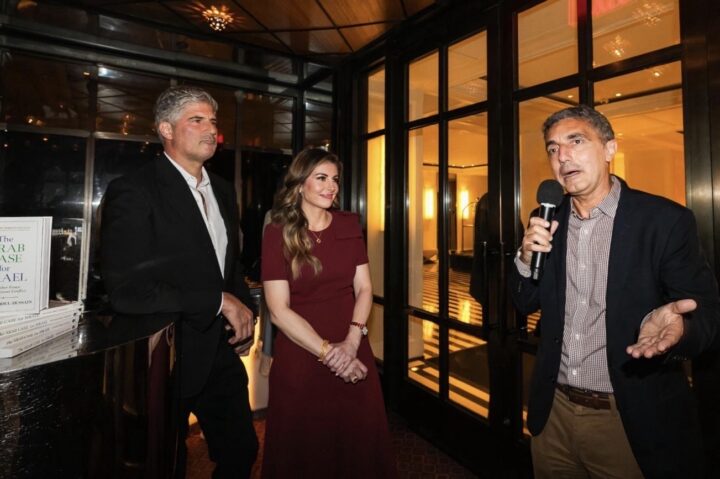
Lilya Espinosa, Soapbox Photography
Philanthropist Antoun Sehnaoui, Morgan Ortagus, former deputy U.S. special envoy to the Middle East and Hussain Abdul-Hussain at the launch of The Arab Case for Israel in Manhattan.


 Add JewishInsider on Google
At a launch event for his book, The Arab Case for Israel, on Tuesday, writer and researcher Hussain Abdul-Hussain argued that the path to peace in the Middle East begins with Arabs reexamining long-held assumptions about Israel, drawing on his own transformation from believing anti-Israel propaganda to an advocate for the Jewish state.
Speaking days after Israel and Lebanon signed a U.S.-brokered framework agreement, Abdul-Hussain said the Lebanese people can follow in his footsteps, as the country remains divided between a faction that promotes the Iranian narrative that Israel “only understands the language of war and force,” and those seeking to reclaim the country’s sovereignty.
“The Lebanese have had their share of sacrifices for big powers. This started back in the 1960s. The Lebanese will stand up for sovereignty and independence. They’ve been thrown under the bus time and time again and this makes them always wary and they try not to stick their neck out… this is what’s keeping them back,” Abdul-Hussain said.
The invitation-only event for the book, published in February, was hosted by Antoun Sehnaoui, businessman and philanthropist, and Morgan Ortagus, former deputy U.S. special envoy to the Middle East, at the Mark Hotel on Manhattan’s Upper East Side.
Abdul-Hussain, a Shia Muslim raised in Iraq and Lebanon where he said he was taught to hate Israel and the West, is now a Washington-based research fellow at the Foundation for Defense of Democracies. The Arab Case for Israel chronicles his unusual journey away from holding anti-Israel views, detailing his argument for why all Arabs should do the same.
“My story is the story of an average person who was told something and when he dug up the story it turned out to be something else,” Abdul-Hussain told some 50 attendees — a mix of Jews, Christians and Muslims — at the event. “I was taught, like every other kid was taught, that Israel must disappear. And I believed it.”
“Over the course of my life, events pushed me to try to learn about Israel.” The biggest turning point, he recalled, was in 2000 while he was working as a reporter in Lebanon. “We covered the Israeli military pulling out of the south and that day I drove my car to the border, which at the time was just a flimsy wire so I could see Israelis,” said Abdul-Hussain. “I became really curious. At the time, I could get on the FM radio of the Israeli channels. If you were in Lebanon at the time, your sources on Israel were [staunch Israel critics] Edward Said, [Noam] Chomsky and [Norman] Finkelstein.”
After learning Hebrew, Abdul-Hussain said he “discovered everything they taught us about Jews — that they were scheming to kill every Arab Lebanese kid — was not true.
“It was a long journey and I decided this journey must be told for other Lebanese, Syrians and Moroccans to understand what they are being fed is not true. I make the case that even if you think Israel has caused you injustice, moving on is much better for your future and the future of your children and grandchildren,” he said.
As Hezbollah continues to oppose the framework agreement aimed at restoring sovereignty and establishing lasting peace, Abdul-Hussain called on Americans to support the efforts of Lebanese President Joseph Aoun to resist the terror group.
“One of the main criticisms against President Aoun and his government is that he’s talking the talk and not walking the walk,” said Abdul-Hussain. “I understand that. But the guy is going all the way against Hezbollah. He’s being vilified and taking a lot of heat. The last thing he needs is for someone like me to try to push him down. Even if he’s not walking the walk, talking the talk is good enough.”
He also called on the U.S. to implement a long-term policy of protecting religious minorities in the Middle East “to make sure that non-Muslim minorities do not vanish.”
“The pattern of minority shrinking is happening all over the place, except for one place, and that’s Israel,” he said. He pointed to Lebanon where lists of registered voters show that Christians are 35% of the population, whereas 20 years ago they made up about half of the population.
“The trends are not lying. This is bad for everyone. It’s bad for diversity,” Abdul-Hussain continued.
“We in the U.S. should send the message to minorities that we are with you, that we will not let [adversaries] come after you and that Israel is something to be proud of.”
During an appearance on the ‘On The Record’ podcast, Sen. Lindsey Graham urges Gulf nations to prioritize regional stability and make tough choices on Iran
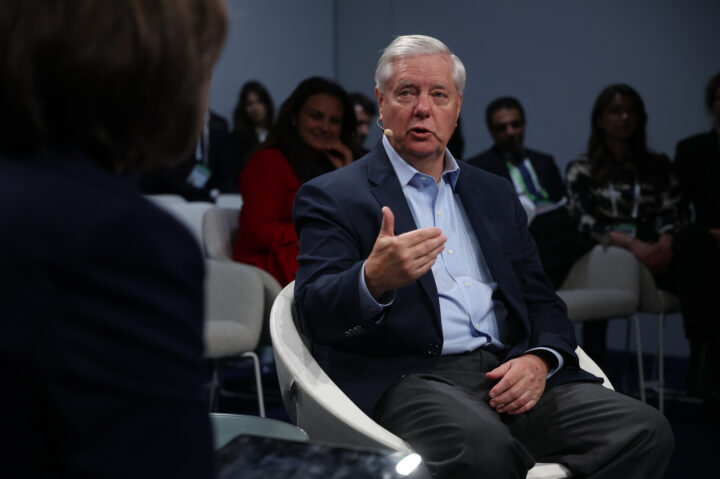
Sean Gallup/Getty Images
Sen. Lindsey Graham (R-SC) speaks at the 62nd Munich Security Conference on February 13, 2026 in Munich, Germany.
Sen. Lindsey Graham (R-SC) on Thursday rejected the suggestion from some in the Arab world that the deaths of civilians in Gaza does not align with Christian values. Graham made the comments during an appearance on an episode of the “On The Record” podcast with Hadley Gamble, while discussing how Israel’s war in Gaza had impacted regional stability in the Mideast and delayed normalization efforts with the Saudis.
“I just don’t buy that at all, because what did we do in World War II? Did we think for one minute about starving the Germans? Did we bomb every city into smitherreens?” Asked if that meant he was comparing Israel’s response to Hamas’ Oct. 7, 2023, attacks on the Jewish state to how the U.S. responded in World War II, Graham responded affirmatively.
“This is an absolute, existential threat to the Jewish people. What happened on October the 7th was 1,200 people were slaughtered, raped and murdered, and filmed by radical Islamists who would kill every Jew if they could.”
Gamble then pressed Graham on Israel “flattening Gaza,” which the South Carolina senator said he took no issue with.
“Just flatten it. We flattened Berlin. We flattened Tokyo,” Graham said. “Were we wrong to drop an atomic bomb to end the Japanese reign of terror? Were we? In my view, if I were Israel, I would have probably done it the same way. Without military victory, there is no hope of breaking radicalism. We flattened Germany. We flattened Japan.”
“It’s a TV war. We didn’t have TV in World War II. The behavior of the United States was to pursue total destruction of the enemy. That was our behavior. Take Tokyo and Berlin,” he added. “Those people who are trying to say this is just another conflict, it’s not another conflict. It’s existential to the Jewish state.”
Graham, who is in the Middle East for meetings with Israeli, Emirati and Saudi officials, also criticized Saudi Arabia for “attacking the United Arab Emirates pretty viciously for being in the Abraham Accords” and questioned assertions that the kingdom’s ongoing dispute with the Emiratis was solely based on differences in Sudan and Yemen.
“Saudi Arabia is now moving backward. They’re attacking the United Arab Emirates pretty viciously for being in the Abraham Accords,” Graham said. “There is no good reason for this. You can have disputes about Sudan and Yemen, but they’re basically declaring war.”
Asked if he believed the dispute “is all about Israel,” Graham replied: “I don’t know what this is about. I know the consequences. [Mohammed bin Zayed], the president of the United Arab Emirates, I’m going to meet him, you could not ask for a better partner. You could not ask for a better partner than the United Arab Emirates. They’ve stuck with the Abraham Accords through Gaza.”
In a post on X after his meeting on Thursday with Saudi Crown Prince Mohammed bin Salman, Graham praised the kingdom while acknowledging his concerns about achieving normalization with Israel.
“The Crown Prince is dealing with the aftereffects of October 7 like all leaders in the region, particularly with the tremendous loss of life in Gaza,” Graham wrote. “Having said that, his vision for the region is for conservative Islam to coexist — with tremendous economic opportunity — for the people of Saudi Arabia, the Middle East, and the entire world. He is the first Arab leader in modern history that’s expressed a vision not only for the faith, but for economic empowerment that is simply stunning when absorbed, and will set the tone for the region for generations to come.”
Graham criticized Gulf state opposition to regime change in Iran over fears about potential fallout as politically weak.
“That is a short-sighted view of the problems you face over here,” he said. “You’ve got domestic problems, so do I. I’ve got domestic problems. It’s probably better for me to be at home than it is here, so I don’t have a lot of tolerance anymore for people having to make uncomfortable decisions, because I have to make them all the time.”
Pressed on Saudi concerns about oil prices and regional instability, Graham said all of the Gulf states needed to “suck it up.”
“I’m telling everybody over here to suck it up. You’ve got to suck it up to bring about real change. Real change doesn’t come without sacrifice. Now, this region is going to change one way or the other,” Graham said. “There are two scenarios. … The inflection point is weeks away, not months away. That’s why I’m here. That’s why I haven’t slept, because it’s either going to go really good or really bad.”
Later Thursday, Graham warned in a post on X that the U.K. should not deny the U.S. the ability to use British military bases to attack Iran.
“If it turns out to be true that Britain is denying the United States the ability to use British bases against Iran if there is a necessity for an attack – it would be beyond surprising,” Graham tweeted. “I’ve been a military lawyer most of my adult life. What they’re saying about the status of Diego Garcia, the joint US-UK military base, is a huge question.”
“To my friends in Britain, sitting this one out puts you on the wrong side of history and is yet another example of how much our alliances throughout Europe have degraded,” the tweet concluded.
Na’eh, who died on Monday, was ‘the Abraham Accords ambassador, ushering in a new era of regional diplomacy,’ Fleur Hassan-Nahoum said

Emre Senoglu/Anadolu Agency/Getty Images
Then-Israeli Ambassador to Ankara Eitan Naeh gives a speech during his first reception in Ankara, Turkey on December 5, 2016.
Veteran Israeli diplomat Eitan Na’eh, who had a long career in key posts representing Israel in the Arab world, died of a heart attack on Monday. He was 62.
Na’eh’s most recent role was as the Israeli Foreign Ministry’s representative to the U.S.-led Civil-Military Coordination Center (CMCC) in southern Israel, established in October to coordinate humanitarian relief efforts and the stabilization of Gaza.
Na’eh played a key role in growing and preserving Israel’s relations with Abraham Accords signatories. He was Israel’s first envoy to the United Arab Emirates in 2021, setting up Jerusalem’s diplomatic representation in Abu Dhabi. His last posting abroad was in Bahrain, where he served as Israel’s first ambassador to the country from December 2021 until August 2025.
In 2022, Na’eh told Jewish Insider: “I sit here in Manama and look outside to a beautiful view of the Gulf, and I am still pinching myself. I feel lucky to work in these countries.” The ambassador said at the time that he was optimistic about expanding the Abraham Accords and the potential in Israel-Bahrain ties.
A Foreign Ministry official characterized Na’eh to JI as “contributing the first steps in establishing relations in the framework of the Abraham Accords. … He built the content of the Abraham Accords at a critical time in which you don’t want to drop the ball.”
The official said Na’eh was skilled at bringing concrete results from diplomatic relations and had a talent for making connections. At the CMCC, “everyone knew him after five minutes,” the official recalled.
A Bahraini diplomat remembered Na’eh as someone who “represented his nation with grace and wisdom, but also fostered genuine goodwill and friendship wherever he went.”
Fleur Hassan-Nahoum, co-founder of the UAE-Israel Business Council and former deputy mayor of Jerusalem, called Na’eh “the Abraham Accords ambassador, ushering in a new era of regional diplomacy in the most professional way.”
Israeli Foreign Minister Gideon Sa’ar said that Na’eh was “a gifted diplomat who stood out in his ability to make connections wherever he served. Above all, in all of his missions and many positions he filled, Eitan was known for his big heart and endless caring.”
Na’eh was also Israel’s ambassador to Turkey from 2016 to 2018, the first after the diplomatic crisis between Jerusalem and Ankara following the 2010 Gaza flotilla incident. However, his term ended abruptly when Turkey expelled him in response to Palestinians killed by the IDF during protests and riots on the Gaza border.
He was previously Israeli ambassador to Azerbaijan and the head of the foreign policy department of Israel’s National Security Council, giving him a broad view of Israel’s international relations that the Foreign Ministry official said was very valuable.
Na’eh was also interim ambassador in London in 2013-2015, and Israel’s political consul at the Israeli consulate in Chicago in 1997-1999.
Hassan-Nahoum recalled Na’eh’s warmth and sense of humor, and said that he and his wife, Cheryl, had a marriage “to emulate in every way.”
Ahdeya Ahmed, former president of the Bahrain Journalists Association, called Na’eh “a friend who was like a brother.”
“I could talk about his professionalism as a diplomat, but what I really want to share is Eitan the friend — Eitan the warm soul who lit up every room, who always had a laugh, and who dreamed of a kinder world,” Ahmed said. “I’ll always remember his smile, his jokes, the way he made life’s burdens lighter for all of us, and all the celebrations we shared.”
Na’eh is survived by his wife, two children, Maya and Itai, and a granddaughter.
Please log in if you already have a subscription, or subscribe to access the latest updates.
 Continue with Google

 Continue with Apple