














































































Citing the threats posed by the Houthis, Abdirahman Mohamed Abdullahi said Somaliland is 'the safest way to world trade, to maritime security, against piracy'
Amos Ben-Gershom/GPO
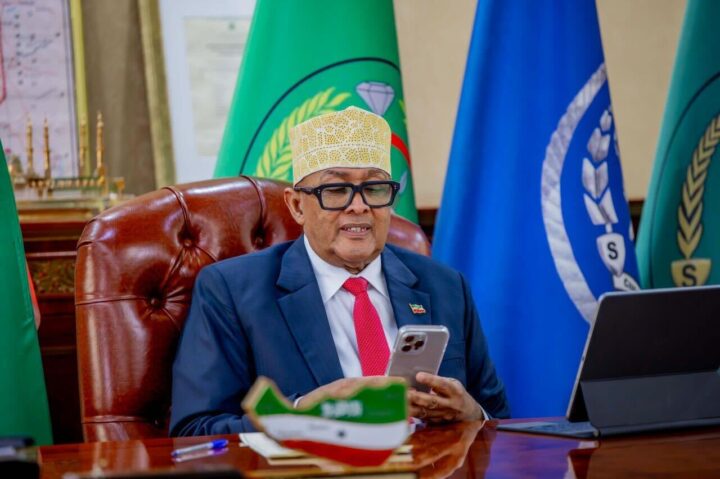
Somaliland President Abdirahman Mohamed Abdullah speaks to Israel Prime Minister Benjamin Netanyahu, Dec. 26, 2025


 Add JewishInsider on Google
Abdirahman Mohamed Abdullahi, the president of Somaliland, the pro-Western region that broke away from Somalia, discussed deepening partnerships with the U.S., including expanded U.S.-Somaliland military cooperation, during a visit last week to Washington, D.C.
Israel was the first state to recognize Somaliland’s independence last year, more than three decades after the region declared independence, though the U.S. has maintained direct and indirect relationships with the government, based in Hargeisa.
The territory in the Horn of Africa is located along the Gulf of Aden and is seen as a potential site for an American or Israeli military base in the Horn of Africa, particularly in light of the growing Houthi control over the Bab al Mandeb Strait, a key passageway through the Red Sea, in recent weeks.
Abdullahi told reporters at a media briefing on Friday that he met with representatives of the State Department, Pentagon, Treasury and Department of Energy as well as at least one representative from the National Security Council.
“We had [with] all of them fruitful conversations. Short of recognizing Somaliland, we feel that there is progress in our conversation, and we shall continue that conversation,” Abdullahi said. “In the meantime, we understand that our cooperation [in] different sectors, will increase and will expand, and we hope that some American presence will be in Somaliland in the near future.”
Somaliland is pushing for the U.S. to open a consulate in Hargeisa and expand its military presence on the ground. The two countries have an existing counterterrorism and national security cooperation program, which includes U.S. officers training Somaliland’s counterterrorism forces.
Bashir Goth, the head of Somaliland’s mission to the United States — its de-facto ambassador — told reporters that Pentagon officials said they plan to increase the size of the U.S. training force in Hargeisa. More broadly, he described the trip as the best series of meetings that a Somaliland president has had in Washington.
Abdullahi said that State Department officials said they would consider opening a consulate in Hargeisa but did not make any commitments.
Asked about his conversations with U.S. officials about potential cooperation in counter-Houthi operations, Abdullahi broadly pitched Somaliland and its port at Berbere as a haven of stability in the region and the Horn of Africa that the U.S. could utilize.
“In general, we gave an offer to the United States [of] partnership in security — whether it’s counterterrorism, maritime security, protection of of ships in the area. We have 850 kilometers of seashore [on the] Gulf of Aden,” he said. “We know that there is a problem in Hormuz, and now … in Bab al Mandeb. So Somaliland is the safest way to world trade, to maritime security, against piracy. Our waters have been free of piracy and terrorism for the last 30 years.”
Abdullahi described Berbere as an attractive site for foreign powers, including the U.S. and Israel, with what was once the longest runway in Africa and a large and efficient port. He said that military officials from both countries have visited Berbere, but said they do not currently maintain a presence there.
He expects Somaliland-Israel security cooperation to begin by the end of the year, with a focus on training Somaliland’s military and police. He said an Israeli military presence in Somaliland is a possibility in the future but not in the near term.
Abdullahi said that some U.S. companies would prefer to operate out of Berbere than Djibouti, which currently hosts the largest U.S. base in Africa. He described Berbere as “the most efficient port in the region” but acknowledged that infrastructure investment is necessary to build out railways to make the port more interconnected with the region — also likely a necessity for a U.S. military base.
China has offered assistance to build such infrastructure — as it did in Djibouti — but Abdullahi said that Beijing attached untenable conditions, including Hargeisa’s rejection of Taiwan.
Somaliland is also working to shift its electric generation away from its current diesel-powered grid toward solar and other energy sources. Somaliland had managed to bring down electricity costs significantly under Abdullahi’s leadership, but they are poised to skyrocket as a result of the Iran war. The government is currently subsidizing energy costs at $20 per barrel of oil, which Abdullahi said may be unsustainable.
At the same time that energy costs have spiked, Somaliland’s tax revenue has plummeted by nearly 50% as a result of a precipitous decline in shipping through Berbere because of the Iran war and the closure of the Strait of Hormuz. Import taxes were the government’s primary source of revenue.
Abdullahi said that Somaliland is not in direct conflict with either the Yemeni government or the Houthis, but predicted that the Houthis’ recent gains along the Red Sea will have further impacts on the trade moving through the region and through Berbere.
Abdullahi accused Somalia, Djibouti and others of working to undermine Somaliland’s stability.
During his time in Washington, Abdullahi met with several lawmakers, including Sen. Ted Cruz (R-TX), Capitol Hill’s most vocal advocate for the U.S. to recognize Somaliland, Sen. Mike Rounds (R-SD) and several House members.
Abdullahi is pushing for the U.S. to consider legislation to allow Somaliland direct access to the international financial system and to differentiate between Somaliland and Somalia in travel advisories.
He also visited multiple think tanks, including the Hudson Institute and Foundation for Defense of Democracies, met officials from the American Jewish Committee and was hosted by Israeli Ambassador to the U.S. Yechiel Leiter.
According to the AJC, the group discussed “developments in the Horn of Africa, regional security, the democratic country’s strategic importance, and Somaliland’s growing relationship with Israel” and the “significance of Israel being the first UN member state to officially recognize Somaliland as an independent and sovereign state, as well as opportunities for deeper cooperation between Somaliland and Israel.”
Leiter said in a statement, “The relationship between Israel and Somaliland has moved beyond formal recognition and official meetings, toward a relationship characterized by the warmth and friendship associated with our nations.”
“Somaliland is a rising strategic partner, and an important voice in the crucial conversations regarding maritime security in the Middle East and the Horn of Africa,” Leiter continued. “Israel is proud to be committed to this new and growing partnership, to ensure a better future for both our countries and the region.”
Abdullahi made his first state visit to Israel, where the two countries agreed to cooperate in economic, agricultural, water, health and security matters. So far, Israel is training 50 engineers in Somaliland on water projects and will begin work on water projects including a desalination plant in Berbere. Ten children suffering from heart problems have also been transported to Israel for treatment.
Abdullahi said he’s hoping to see expanded investment by Israelis and American Jews in Somaliland.
Analysts say Tehran is exploiting the country’s civil war to deepen ties with Islamist factions, threatening regional security and maritime trade routes
AFP via Getty Images
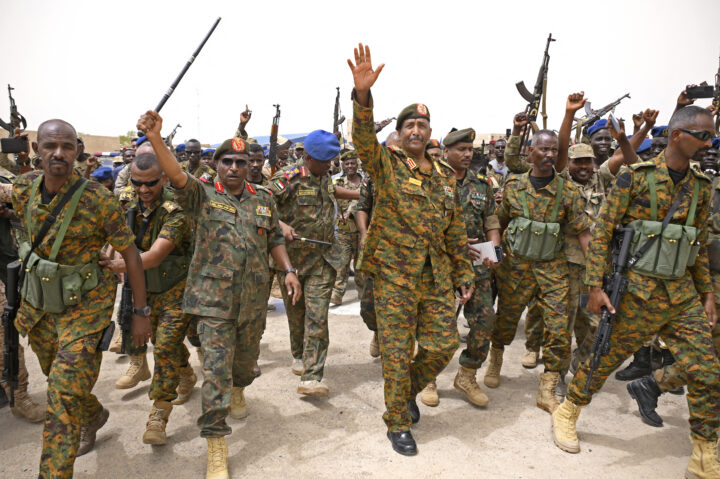
Sudanese army chief Abdel Fattah al-Burhan visits the Flamingo Marine Base in Port Sudan on August 28, 2023.
As Sudan’s devastating civil war drags through its third year, experts warn the conflict could become an arena for Iranian strategic expansion and Islamist extremism in Africa, as Tehran and the Sudanese branch of the Muslim Brotherhood revive a long-standing alliance and threaten to turn the embattled nation into a staging ground for transnational jihadist operations.
Under the cover of Sudan’s official military, the Sudanese Armed Forces (SAF), armed Islamist brigades — most notably the U.S.-sanctioned Al-Bara ibn Malik Battalion (the armed wing of the Sudanese Muslim Brotherhood) — have mobilized to fight alongside state forces led by Gen. Abdel Fattah al-Burhan. Supported by funding, weaponry and training pipelines linked to Iran’s Islamic Revolutionary Guard Corps (IRGC), these factions have effectively embedded themselves within the state apparatus, raising alarm among counterterrorism officials and regional foreign policy experts.
“Iran’s involvement in Sudan serves multiple goals, even amid all the larger wartime changes regionwide and inside Iran,” said Jonathan Ruhe, a fellow at the Jewish Institute for National Security of America (JINSA). “Because Sudan is so far from its own borders, Iran ultimately benefits from fomenting instability for countries that are much closer to the [Sudanese] conflict. Sudan is one more arena for tensions among Iran’s Arab rivals, challenging their ability to form a united front against Tehran.”
“Even if Iran-backed forces don’t ‘win’ [in the Sudanese civil war], Iran wins by threatening to encircle U.S.-aligned Arab countries with its proxy forces, worsening Sudan’s power vacuum, and triggering refugee outflows that stoke tensions with, and inside, neighboring countries,” Ruhe said.
The war in Sudan has created one of the world’s worst humanitarian crises, with an estimated 150,000 deaths and nearly 12 million people displaced. Both the SAF and the RSF stand accused of widespread war crimes, including mass atrocities against civilians, systematic sexual violence and forced blockades.
The convergence of Iranian strategic ambitions with local Islamist networks threatens not only to prolong Sudan’s humanitarian crisis, but also to turn the African country into a hub for extremist recruitment and operational planning. Experts warn it may also disrupt global maritime routes in the Bab el-Mandeb Strait, where Iran-backed Houthi forces in Yemen are already threatening international shipping.
“Even before [the Iran war], but especially now with the reopening of the Houthi front in Yemen and recent attacks near the Suez Canal, the Sudan conflict is one more way Iran can threaten regional shipping and pressure the United States by ratcheting up Red Sea instability,” Ruhe said.
The alliance between Tehran and the Sudanese Muslim Brotherhood is not a sudden emergence, but rather the reactivation of infrastructure established decades ago during the regime of ousted Sudanese dictator Omar al-Bashir. When Bashir was overthrown in 2019, the country’s Islamist movement lost political power, but the outbreak of civil war in April 2023 provided an opportunity for reconstitution.
Arieg Elhag, Arabic content editor at The Washington Institute for Near East Policy, emphasized that unlike groups built from the ground up, the Sudanese Muslim Brotherhood offered ready-made operational architecture for Iran to utilize.
“Unlike Hezbollah, which Iran built from scratch, Sudan already had a governing Muslim Brotherhood with existing networks — the Popular Defense Forces and tribal ‘Emirs of Jihad’ — that Iran could simply reactivate, saving time and cost,” Elhag explained, adding that operating through official army channels provides Tehran with a unique layer of state-level legitimacy. “MB officers operating within the regular army give Iran ‘state’ cover rather than ‘faction’ cover, making targeted sanctions difficult without hitting the military itself.”
According to Elhag, Iranian entrenchment at the junction of the Red Sea and the Horn of Africa creates a danger for future escalation. “Any future Iran-Israel or Iran-Gulf escalation would no longer stay confined to the Levant — Sudan could become a logistics hub, a maritime threat point on a major trade route, or a base exporting ideological mobilization across Africa.”
While the growth of Islamist influence inside the SAF is clear, some analysts view the military leadership’s embrace of Tehran as a marriage of convenience driven by battlefield desperation rather than shared ideological conviction. Facing an existential struggle against the rival Rapid Support Forces (RSF) — a paramilitary group backed by the United Arab Emirates — Burhan has sought military assistance from various external actors, including Egypt, Saudi Arabia, Russia and Iran.
“I don’t think it’s accurate to say that Iran is turning Sudan, or specifically the SAF, into one of its full-on proxies, like Hezbollah or the Houthis or Hamas,” said Joshua Meservey, a senior fellow at the Hudson Institute. “This is opportunism. Burhan is trying to win this war, which is an existential struggle with the RSF, and so he is willing to ally with just about anybody.”
Meservey noted that while Burhan himself is not an Islamist, the exigencies of the war have made him reliant on Islamist fighters to maintain parity on the battlefield.
“If you presented Burhan with a choice and said, ‘Look, you can win the war, but you have to get rid of the Islamists,’ he would take that deal 100 times out of 100,” Meservey said. “But the problem is right now he likely can’t win the war without the Islamists. To Burhan, the bottom line issue is winning this war and surviving it.”
However, he warned that the longer the war drags on without a decisive victory, the more these radical factions could become enmeshed in Sudan’s defense architecture.
“The fear is: the longer this goes, the more embedded they will become,” Meservey warned. “They will burrow in deeper and deeper and deeper, and then maybe eventually the Islamists do succeed in totally seizing the SAF, or at least gaining a preponderance of power where they can run things.” He pointed to Sudan’s historic role hosting transnational terrorist organizations in the 1990s, including al-Qaida, as a cautionary precedent for what a prolonged security vacuum could invite.
“It’s not just Iranian influence. It’s also other terrorist groups that are drawn to this type of instability, especially in a country that has a strong Islamist population, or a strong percentage of the population is Islamist itself,” he added. “Then you can see the potential for terrorist networks embedding themselves or finding safe harbor.”
Still, Meservey cautioned that such a scenario is not “inevitable.”
“The Islamists very much want to be back in power. They want to be running that government. That’s their long-term goal, and I’m sure the Iranians would be very happy for that to happen,” Meservey said. “However, I don’t believe that they hold the current balance of power within the SAF. They are powerful, but they can’t just take over the SAF. That’s not what the situation is.”
Please log in if you already have a subscription, or subscribe to access the latest updates.
 Continue with Google

 Continue with Apple