
























































Competing Middle East frameworks put U.S. allies on rival tracks, experts say
Hudson Institute panelists said the Saudi-Turkish-Pakistani defense pact and the India-to-Europe trade corridor through Israel reflect competing visions, with friction that is manageable if Washington steps in
Screenshot
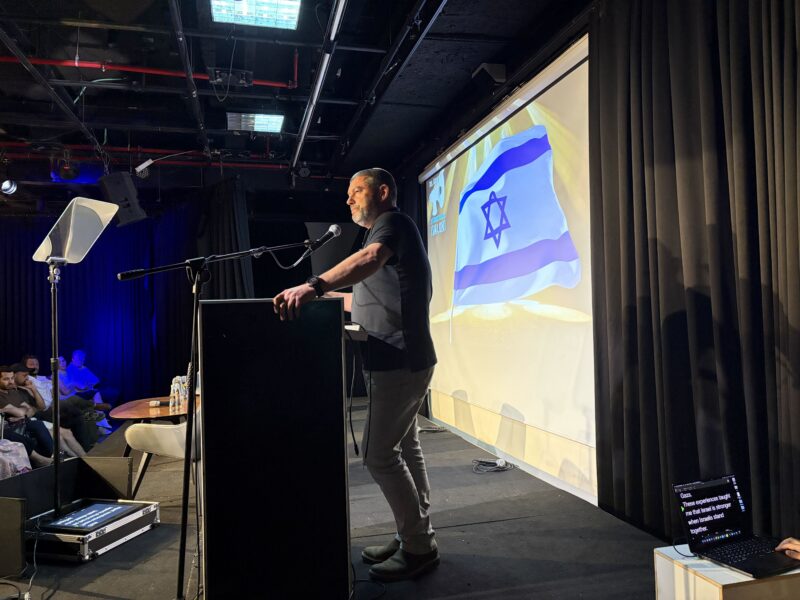
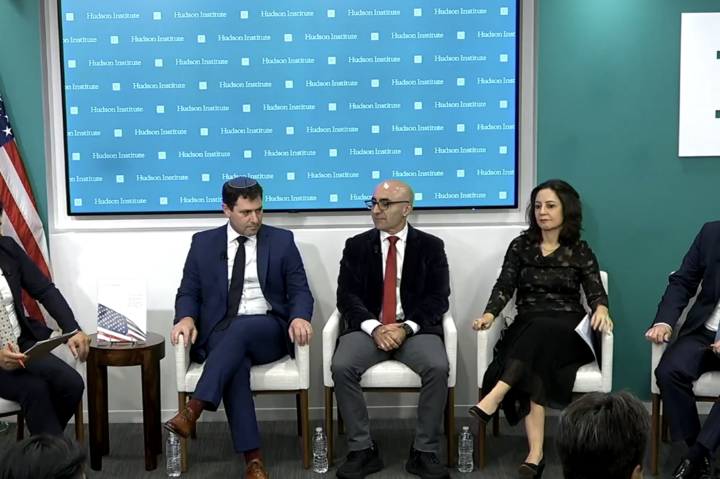
Hudson senior fellow Ken Moriyasu moderates a Hudson Institute panel featuring Chaim Martin, minister of economic affairs at the Israeli Embassy in Washington; Michael Doran, a Hudson senior fellow; Soner Cagaptay of the Washington Institute for Near East Policy; and Asli Aydintaşbaş, director of the Turkey Project at the Brookings Institution, Oct. 26, 2026


 Add JewishInsider on Google
Differing economic and security initiatives are reshaping regional alignments in the Middle East, raising questions about how the U.S. will manage growing competition between Israel, Turkey and other U.S. allies, experts said Monday.
At a Hudson Institute panel titled “Mecca Pact vs. IMEC: Competing Visions for the New Middle East,” foreign policy analysts and diplomats weighed two rival frameworks reshaping the region — and whether the competition between American partners will deepen divisions or open new avenues for cooperation.
The first, the India-Middle East-Europe Economic Corridor (IMEC), is a multimodal transit route linking India to Europe through the Gulf, Jordan and Israel — part of a broader alignment among India, the United Arab Emirates, Israel and Greece. The second, the Mecca Defense Agreement, is a mutual-defense pact among a separate bloc of U.S. allies: Saudi Arabia, Turkey and Pakistan.
The discussion — moderated by Hudson senior fellow Ken Moriyasu — featured Chaim Martin, minister of economic affairs at the Israeli Embassy in Washington; Michael Doran, a Hudson senior fellow; Soner Cagaptay of the Washington Institute for Near East Policy; and Asli Aydintaşbaş, director of the Turkey Project at the Brookings Institution.
While the initiatives serve different purposes, they reflect increasingly competing regional alignments between two sets of American allies, Doran said.
“Ankara has its answer to IMEC, which is the Development Road, developing the route from Basra [in Iraq] to Turkey and then on to Europe. They’re also talking about revitalizing the Hejaz railway from Mecca to Turkey through Saudi Arabia, Jordan and Syria, all of which would cut Israel out,” he said.
Aydintaşbaş argued that the trade networks could coexist peacefully as long as they’re not “exclusionary” and if regional powers refrain from design choices meant explicitly to isolate rivals.
She also cautioned against interpreting the Mecca Pact as an ideological or military bloc comparable to NATO, describing it instead as an early effort by regional governments to assume greater responsibility for their security amid expectations of a reduced American footprint in the region.
“It’s not a Sunni NATO. It’s in very early stages, nor is it a pact that can claim Article 5 [of the NATO charter],” Aydintaşbaş said. “It’s an early exercise in finding regional ownership in a region with an overwhelming number of security problems.”
Cagaptay warned that adversary states like Iran would look to exploit gaps between competing U.S. allies if Washington fails to step in as a mediator. Still, he described the dynamic as manageable friction between two blocs of Washington’s regional partners.
“Just as [Mecca] Pact countries are U.S. allies, so are these [IMEC] countries,” Cagaptay said. “This is a constellation of two groups of U.S. allies and partners. They’re competing, and that can be managed.”
Doran cautioned that lackluster U.S. diplomacy risks allowing tensions between Israel and Turkey to escalate unchecked.
“The U.S. should be working to mediate between the Turks and the Israelis,” he said. “If it doesn’t, you could end up having [a] serious conflict between Turkey and Israel, working to the severe detriment of the United States.”
Despite the potential for conflict, Doran noted that transportation networks can facilitate cooperation even when they are initially developed for competing geopolitical purposes.
“The beautiful thing about transportation corridors is that they can have geopolitical intent, but … they cut in lots of different directions,” Doran said. “Once you have a rail line, anything can move along it. It can move into lots of different destinations.”
However, significant obstacles remain to advancing IMEC. Martin said that while Israel’s existing transportation infrastructure makes it a natural hub for the proposed corridor — pointing to rail lines extending from the Haifa Port toward the Jordanian border — he acknowledged that Jerusalem is not yet a formal signatory.
“One of the things that needs to happen first is that Israel and Jordan become signatory members of IMEC. Currently, we’re not yet a signatory member; we’re one level below,” Martin said.
Meanwhile, Doran raised concerns over whether IMEC will retain momentum following its launch at the 2023 G20 summit, pointing to a lack of clear institutional backing from Washington or New Delhi.
“IMEC doesn’t have an institutional leader,” Doran said. “It doesn’t have a governance structure, a finance structure, and it doesn’t have a major proponent. If you ask American officials about IMEC, they’re very supportive … but that doesn’t mean they’re going to step in and play a leadership role.”
While Martin argued that Israel should become more involved in IMEC, he expressed skepticism over whether participating countries would allow Jerusalem to lead the organization.
“I do think that Israel should have a pivotal position within IMEC,” he said. “Do I think that the other partners of IMEC would be comfortable if Israel was the explicit leader? I don’t know.”
More Stories
analysis
Playing to the cameras in the West Bank

HAWKEYE HANGUP
Top Democratic recruit in Iowa balances support of Israel with criticism of war in Gaza
THREAT THWARTED
Man arrested in Boca Raton for making death threat against Rep. Jared Moskowitz

CAMPUS CLASH
Georgetown Law student association brands Cruz aide Islamophobic after lecture on Muslim Brotherhood
UNKNOWN HORIZON
Final Israeli polls point to stalemate ahead of Tuesday’s election
MINNESOTA MIC DROP
Jacob Frey, Betty McCollum join Minnesota Dem chorus condemning Piker event
Please log in if you already have a subscription, or subscribe to access the latest updates.
 Continue with Google

 Continue with Apple