













































JINSA calls for change in U.S.-Israel military alliance
The new report from the hawkish think tank calls for the countries to sign one final 10-year MOU while focusing more on military cooperation and engagement
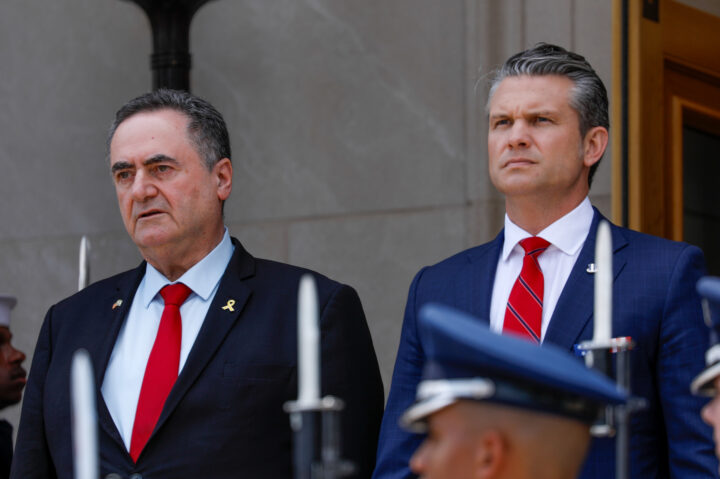
WASHINGTON DC, UNITED STATES - JULY 18 : U.S. Secretary of Defense Pete Hegseth (R) welcomes Defense Minister Israel Katz (L) during an official ceremony at the Pentagon in Washington, United States on July 18, 2025. (Photo by Yasin Ozturk/Anadolu via Getty Images)


 Add JewishInsider on Google
As Israel and the Trump administration negotiate the next U.S.-Israel memorandum of understanding, a new report from the Jewish Institute for National Security of America demonstrates how even among hawkish experts in Washington, the question is increasingly not how to preserve the traditional military aid model, but what should replace it.
The report, titled “Shifting the Center of Gravity: Transforming the U.S.-Israel Security Partnership,” recommends that the two countries sign one final 10-year MOU — a sea change for Israel supporters who previously wouldn’t have dreamt to advocate for the end of these kinds of agreements between Jerusalem and Washington, though they largely hope for it to be replaced with cooperative and enduring programs.
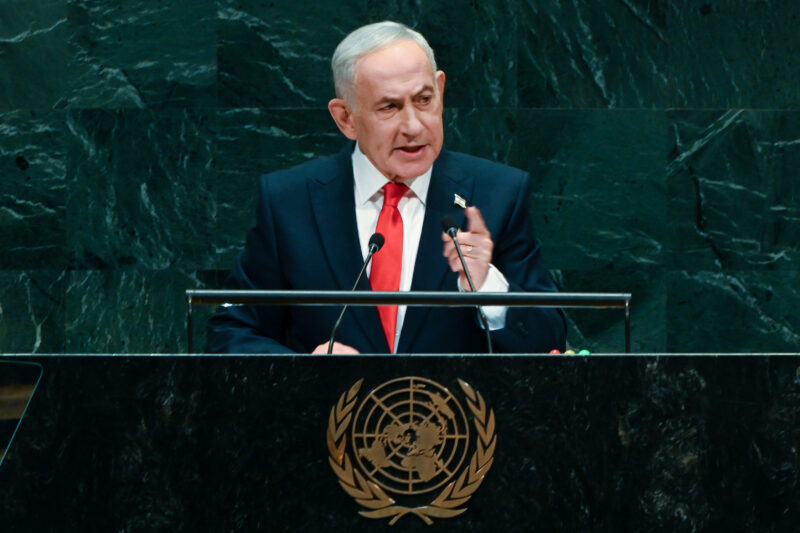
The report comes as Israeli Prime Minister Benjamin Netanyahu has himself championed the eventual end of direct U.S. aid to Israel and as elements of both parties become resistant to defense spending overseas, a new reality that is forcing a reassessment of how Washington can sustain its commitment to Israel without relying on the traditional aid model.
Blaise Misztal, JINSA’s vice president for policy, told Jewish Insider that the strategy is catered to “America’s benefit” and seeks to make the U.S.-Israel partnership “more effective for both countries.”
“Closer alignment and cooperation with Israel across military, technological and economic lines of effort will help make America safer abroad, more prosperous at home and one step ahead of its adversaries,” Misztal said. “One specific area where we believe this should happen immediately is with shifting the center of gravity of U.S. force posture in the Middle East to Israel.”
JINSA’s report calls for maintaining $3.8 billion in annual U.S. assistance through fiscal year 2038, while pairing that funding with a series of initiatives designed to deepen operational and strategic integration between the two militaries, including a larger U.S. military footprint in Israel, a permanent U.S. military presence at Israel’s Ovda Airbase, a deeper U.S.-Israeli defense industrial partnership and a limited U.S.-Israel mutual defense treaty (with a deliberately narrow threshold for activation).
At the center of JINSA’s proposal is an expanded U.S. military presence in Israel. Beyond Ovda Airbase, the report calls for expanding U.S. access to other Israeli air and naval bases and creating a forward CENTCOM headquarters in Israel for regional planning, mission command and oversight of U.S. forces, as well as establishing a U.S. prepositioned arsenal hub and expanding and modernizing the existing war reserve stockpile.
The strategy also envisions joint development and production of advanced weapons and critical munitions. It recommends formally incorporating Israel into the Trump administration’s Golden Dome missile-defense initiative and expanding U.S. procurement and coproduction of Israeli air- and missile-defense systems.
JINSA further recommends expanding intelligence sharing on Iran, its proxies and other shared adversaries, including China and Russia, while establishing a “Model Ally” status for Israel that would provide a framework for deeper joint research and development, co-production, reciprocal offsets and an updated assessment of Israel’s Qualitative Military Edge. The report argues that greater integration of the two countries’ defense industries would strengthen their respective industrial bases and supply chains.
The proposal would also elevate the political and military commitments underpinning the relationship. JINSA recommends deepening CENTCOM-led defense cooperation between Israel and key Arab states with the eventual goal of a limited, U.S.-led regional mutual defense arrangement conditioned on normalization with Israel.
“The question for policymakers is not what America owes Israel. It is what America gains from having Israel as an ally — and how much more both countries can gain by making that alliance stronger,” JINSA said in a statement accompanying the report.
The report argues that Israel’s recent cooperation with the United States in the war in Iran demonstrates the value of a more integrated partnership.
“Israel fought shoulder-to-shoulder with America, carrying an equal share of the combat burden and risk, with historic levels of joint planning, intelligence integration, and operational coordination, while hosting and protecting more than 100 U.S. military aircraft and thousands of American servicemembers,” the statement said. “It also deployed advanced air defenses and troops to help defend a U.S. partner, the United Arab Emirates.”
JINSA also points to Israel’s defense spending as evidence of its willingness to share the burden of regional security, arguing that the country’s defense spending of nearly 8% of GDP exceeds NATO’s new 5% benchmark and is roughly three times the share spent by many European countries.
More Stories
Daily Overtime
UAE puts Bibi visit on front page

MARYLAND MATTERS
Montgomery County, Md., rabbis accuse school district of failing to address antisemitism surge

Daily Kickoff
FlyDubai hero credits TV crash course
Daily Overtime
Trump says FlyDubai attacker likely linked to Iran

SECURITY SHORTFALL
Nonprofit Security Grant Program fulfills less than one-quarter of 2026 applications

CAMPAIGN OFFENSIVE
Rogers calls El-Sayed ‘threat to our national security’ in new ad
Please log in if you already have a subscription, or subscribe to access the latest updates.
 Continue with Google
 Continue with Apple