









































Gulf states slam Arab League countries for tepid response to Iranian aggression
Frustrated UAE leaders are questioning the ‘impotence’ of countries like Egypt — and warn that silence on Iranian aggression will push the Gulf closer to U.S., Israel
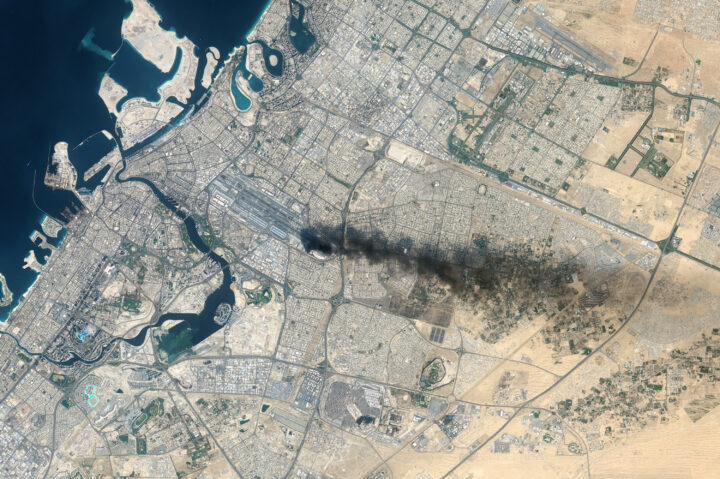
Gallo Images/"USGS/NASA Landsat data processed by Orbital Horizon"
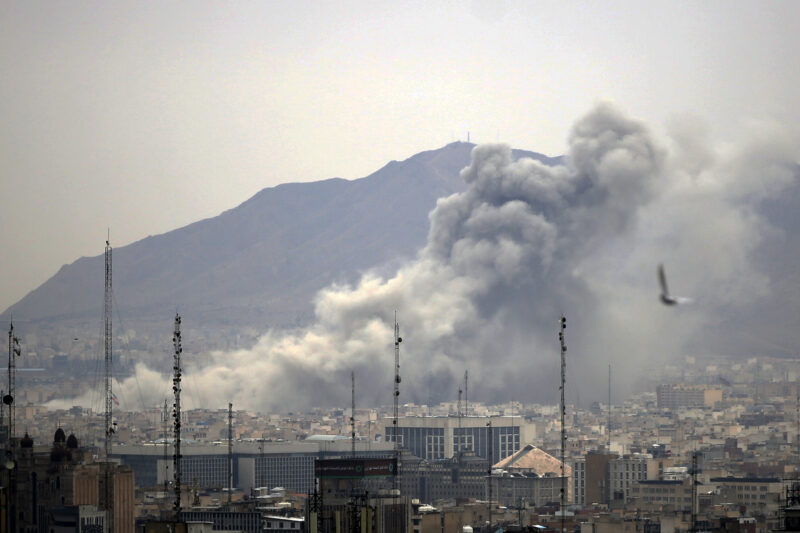
Satellite view of Dubai International Airport after a drone strike ignited a fuel tank fire. on March 16, 2026.


 Add JewishInsider on Google
The United Arab Emirates has been publicly expressing its disappointment in Arab League countries like Egypt for not showing or expressing very little support for Gulf states under attack from Iran, a dynamic playing out more quietly in other Gulf states, as well.
In a post on X on Sunday that received significant attention, Anwar Gargash, an advisor to the UAE President Mohamed bin Zayed, said that “Iran’s brutal aggression against the Arab Gulf carries profound geopolitical repercussions … and the result is to bolster our national capabilities and the joint security, as well as to solidify our security partnerships with Washington.”
When French former diplomat Gérard Araud criticized Gargash’s approach, writing on X that “it means deepening your dependence on a country that has led yours into a disastrous conflict without caring about your interests,” Emirati Foreign Minister Abdullah bin Zayed backed up Gargash, responding: “We will never be blackmailed by terrorists.”
In subsequent posts, Gargash not only said that Iran’s attacks are bringing his country closer to the U.S., but criticized other Arab countries for not aligning themselves with the Gulf.
“Where are the joint Arab and Islamic institutions, chief among them the Arab League and the Organization of Islamic Cooperation, while our countries and peoples are subjected to this treacherous Iranian aggression? And where are the ‘major’ Arab and regional countries? … The Arab Gulf states were a support and partner to all in times of prosperity… So where are you today in times of hardship?” Gargash wrote.
As such, he argued, “in absence and impotence, it is unacceptable later to speak of the decline of the Arab and Islamic role or to criticize the American and Western presence.”
On Wednesday, Gargash followed up by distinguishing “those who offered genuine support” from “those who settled for statements without action.”
“The Emirates has proven its ability to confront and endure, and it does not need equipment and troops as much as it needs clarity of positions and knowledge of who can be relied upon in times of hardship,” he added.
Hussain Abdul-Hussain, a research fellow at the Foundation for Defense of Democracies and author of The Arab Case for Israel, told Jewish Insider that the UAE is not the only Gulf state that is expressing resentment towards Arab League states at this time, saying that similar messages have been published in Qatari newspaper editorials and have come out of Kuwait.
Some of the targets of that anger, he said, are Egypt and the Arab League, whose secretary-general, Ahmed Aboul Gheit, is an Egyptian diplomat.
“Gulf governments expected more denunciations of Iran as an aggressor. It took [Egypt] five days to say a word. The Arab League hasn’t met; they usually hold emergency summits and haven’t called for one. The foreign ministers met over Zoom and issued a statement that was a nothingburger,” Abdul-Hussain said.
While Egyptian President Abdel Fattah El-Sisi denounced the Iranian attacks and visited the Gulf, his remarks came across as weak, while Aboul Gheit called the attacks “audacious,” stopping short of a full denunciation, Abdul-Hussain argued.
“Even the adjectives they’re using are soft” in the eyes of Gulf leaders, Abdul-Hussain said.
The media in Egypt and Algeria, Abdul Hussain said, are showing “happiness … that Israel is being pounded. They’re happy with what Iran is doing and no one really seems to care about the Gulf states. The Gulf took 84% of the [Iranian] missiles, as opposed to Israel, which took 16%, and they still can’t straightforwardly say Iran is a problem?”
While Gargash did not specifically mention Israel, Abdul-Hussain interpreted Gargash’s remarks as meaning, “If we in the Gulf can’t rely on you Arabs and Muslims, we will have to find other allies to defend ourselves. That clearly means the U.S. and Israel.”
“The Emiratis feel vindicated, that they were right to move forward and seek their interests with Israel, because look at [other Arab states] now,” he added.
Prominent Emirati media personality Jamal Al Mulla said in a recent episode of his podcast “Arab Cast” that “the Gulf is hurt and will not forget how fellow Arab countries let it down.”
Al Mulla compared the current conflict to the 1991 Gulf War, when only 12 out of 22 Arab League members voted to condemn Iraq for invading Kuwait — “six Gulf countries and the six others were bought off by wealthy Gulf governments.”
“This round, the line is even clearer since aggression is not by an Arab League member against another, but by a non-Arab foreign country against Arab countries, and yet, the Arab League is shameful and so are countries like Iraq, Algeria, Sudan’s Burhan government and western Libya’s government,” he said.
Al-Mulla said that “when any Arab government wants not to take a position on anything, it inserts the Palestinian cause into its statement.”
Arab countries are “always citing Palestine as a distraction,” he added, and recounted that, in 1991, Palestinian leader Yasser Arafat told the Arab League that “the Kuwaiti problem will be solved only after the Palestinian cause.”
“When the shooting stops, I expect a few Gulf countries to rush to normalization with Israel. My money is on Kuwait, perhaps Saudi Arabia too,” Al Mulla said.
Abdul-Hussain agreed with Al-Mulla that Kuwait would return to its past pro-American stance and normalize relations with Israel.
“People in the Gulf were expected to support the Palestinians at all times during the Gaza war, with money, humanitarian aid, politically and diplomatically, and they get nothing in return,” Abdul-Hussain said. “I think they’re really hurt.”
Abdul-Hussain said that Hamas and the Palestinian Authority have not robustly denounced Iran. After initially only condemning the U.S. and Israel, Hamas released a statement two weeks into the war against attacks on the Gulf by Iran — one of its patrons — under pressure from Qatar, another of its patrons. The Palestinian Authority released a statement on the first day of the war expressing solidarity with the Gulf states and calling for de-escalation.
“The thinking in the Gulf is that this time, it’s our turn. We’re the victims. The Palestinians can wait,” Abdul-Hussain said.
More Stories
MICHIGAN MOVES
Haley Stevens maintains support for Israel as her primary rivals battle over anti-Israel lane

FACULTY FURY
Emory University faculty leader outraged over departure of Iran security official’s daughter

Pennsylvania pitch
Obando-Derstine runs as pro-Israel immigrant advocate in crowded swing-district Pa. primary

BARAKA'S BACKING
In progressive pivot, N.J. congressional candidate Brian Varela secures Newark Mayor Ras Baraka’s endorsement

doha forum dispatch
Hillary Clinton reiterates concerns about anti-Israel ‘propaganda’ targeting American youth

exclusive
Schumer, Senate Democrats introduce resolution condemning Fuentes, Carlson
Please log in if you already have a subscription, or subscribe to access the latest updates.
 Continue with Google
 Continue with Apple