














































































Rep. Wesley Hunt, made a series of inflammatory remarks about Saudi Arabia during his military service and failed Senate bid that could complicate his confirmation
Tom Williams/CQ-Roll Call, Inc via Getty Images
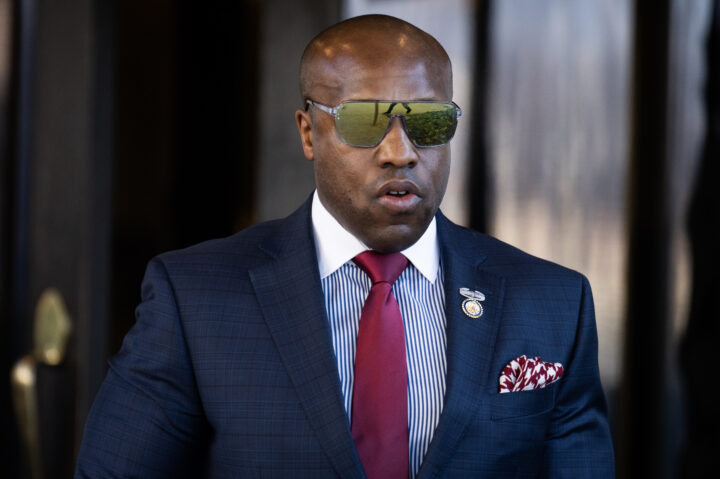
Rep. Wesley Hunt (R-TX) leaves a meeting of the House Republican Conference at the Capitol Hill Club on Wednesday, January 22, 2025.


 Add JewishInsider on Google
Before being nominated to be U.S. ambassador to Saudi Arabia earlier this week, Rep. Wesley Hunt (R-TX) pointed to his experience serving as a military diplomatic liaison to Saudi Arabia to offer strident criticisms of the U.S. ally.
The past comments could prove to be an issue in his confirmation process, or lead to a frosty reception if he is confirmed, a prospect that currently appears uncertain.
As previously reported by Jewish Insider, in 2022, Hunt suggested that he did not view Saudi Arabia as a “true ally” and highlighted the Saudi nationality of many involved in the 9/11 attacks.
“I learned a lot about what our interests need to be and who we need to be in the business of supporting for the future, because [Israel is] our one true ally in the region,” Hunt said during a virtual event with AIPAC.
He added that the U.S. “cannot let our guard down” with Middle East partners generally because “some of these countries are bad actors. They’re rogue nations, some of them.”
During his failed Senate campaign, Hunt — along with many other Texas Republicans — made his opposition to Islamic Sharia law a central element of his campaign, repeatedly pointing to his own experience in Saudi Arabia and Iraq as an example of its dangers.
“People who dismiss Sharia law as fear-mongering have never lived under it,” Hunt said. “I lived in Saudi Arabia. I lived in Iraq. I’ve seen what that system looks like in real life, not on cable news. Public beheadings happened there not long ago. Women couldn’t even drive when I was stationed there.”
Hunt also said, of Sen. John Cornyn (R-TX), “He’s been soft on this because he’s never faced what I’ve seen. He’s never stood face-to-face with evil in its purest form. He’s never witnessed the public beheadings, the brutal treatment of women, or the barbaric enforcement of Sharia law.”
He said that Sharia law “should be banned in America” and joined the Sharia-Free America Caucus, warning that Sharia law is on the rise in America, though no U.S. jurisdiction enforces the Muslim legal code.
Other U.S. officials have historically been critical of Saudi Arabia’s restrictive laws for women and other elements of the country’s judicial system, which have since been loosened.
Also during the Senate campaign, Hunt said he had not felt safe, during his time living in Saudi Arabia, from jihadi sympathizers following the killing of Osama bin Laden.
“These are our allies that we are working with every single day, and we were actually fearful of our lives,” Hunt said at the time. “Now, imagine letting people, with that mindset, come to our country, and you wonder why we are waking up to having dead national guardsmen … the mentality of these people never ended. It never stops. The jihad never ends. We are the infidel.”
Semafor reported on Thursday that some Republican senators harbor concerns about Hunt’s nomination and are unlikely to allow it to move forward quickly.
The congressman previously served as a military diplomatic liaison in the kingdom; it’s unclear whether the Senate will be able to process his nomination before the end of the current Congress
Tom Williams/CQ-Roll Call, Inc via Getty Images
Rep. Wesley Hunt (R-TX) leaves a meeting of the House Republican Conference at the Capitol Hill Club on Wednesday, January 22, 2025.
President Donald Trump on Monday informed the Senate that he plans to nominate Rep. Wesley Hunt (R-TX) as the U.S. ambassador to Saudi Arabia, moving toward filling one of the numerous Middle East ambassadorship posts that have sat vacant since the start of his second administration.
Hunt, a former Army officer and Apache helicopter pilot, served two deployments in Saudi Arabia as a military diplomatic liaison. He is serving his second term in the House, but lost a primary bid for Texas’ Senate seat earlier this year.
“It is the honor of a lifetime to accept President Trump’s nomination to serve as the next United States Ambassador to the Kingdom of Saudi Arabia,” Hunt said in a statement on X. “Having served in the region both in combat as an Army officer and for two years as a diplomatic liaison in the Kingdom, I understand the strategic importance of the partnership between the United States and Saudi Arabia and the profound responsibility of this position.”
Hunt said in 2022 during a virtual event with AIPAC that Israel is the “one true ally” of the United States in the Middle East, while noting that many of 9/11 hijackers, as well as Osama Bin Laden himself, were from Saudi Arabia.
“I learned a lot about what our interests need to be and who we need to be in the business of supporting for the future, because that’s our one true ally in the region,” Hunt said at the event.
Addressing the then-fledgling Abraham Accords, Hunt was supportive but cautious. “Some of these countries are bad actors. They’re rogue nations, some of them,” he continued. “Just because we have something set up like the Abraham Accords — which I think is good for the entire world, especially for the region — we cannot let our guard down.”
He recently joined a letter calling for a Department of Justice investigation into efforts by an official in New York City Mayor Zohran Mamdani’s administration to meet with the Iranian ambassador to the United Nations.
Hunt has been a co-chair of the Congressional Caucus on Black-Jewish Relations.
But he was one of just 21 House members who voted last year against a resolution expressing support for the State Department’s global guidelines on combating antisemitism. Antisemitism envoy Ambassador Yehuda Kaploun has been working to tackle antisemitism in Saudi Arabia, including stripping antisemitic content from the country’s school curricula.
During the AIPAC event, Hunt also described himself as the “energy congressman of the world,” given that he represents the offices of many major energy companies in Houston, making it part of his job to defend the energy industry — also a major industry for Saudi Arabia.
It will be logistically difficult for the Senate to consider Hunt’s nomination before the midterm elections, and with a slew of previous nominees still under consideration, it’s unclear whether the Senate will be able to process Hunt’s nomination before the end of the year. Should Democrats retake the upper chamber, Hunt’s confirmation would be more difficult.
The nomination comes at a highly sensitive time in the U.S.-Saudi relationship, as the two countries move toward a nuclear deal that would reportedly allow for nuclear enrichment inside Saudi Arabia, which is set to be reviewed by Congress in the coming months.
Saudi Arabia is also at a major crisis point with the Iran-backed Houthi terrorists in Yemen as hostilities have flared after several years of quiet. The Houthis this weekend seized critical port cities and islands along the coastline of the Red Sea and launched missiles from Iraq that disabled the pipeline that Saudi Arabia had been using to bypass the Strait of Hormuz.
President Donald Trump said he doesn’t plan to intervene, despite reported Saudi pleas.
The kingdom has also recently been recalibrating its regional position, with Saudi Arabia moving away from normalization with Israel, experiencing tensions with its regional rival the United Arab Emirates, forming new ties with Turkey and Pakistan and again allowing the promotion of Islamist extremism.
Please log in if you already have a subscription, or subscribe to access the latest updates.
 Continue with Google

 Continue with Apple