














































































Hours later, the Senate rejected a similar measure

Kevin Carter/Getty Images
The U.S. Capitol Building is seen at sunset on May 31, 2025 in Washington, DC.


 Add JewishInsider on Google
The House passed a second Iran war powers resolution on Thursday following the resumption of hostilities between the U.S. and Iran, with a handful of Republicans who have argued that continued operations violate the War Powers Act again siding with Democrats on the measure.
But hours later, the Senate blocked a separate resolution, also along narrow margins.
Reps. Tom Barrett (R-MI), Brian Fitzpatrick (R-PA), Thomas Massie (R-KY) and Warren Davidson (R-OH) again sided with all House Democrats to pass the resolution by a 214-208 vote.
Rep. Nancy Mace (R-SC) said prior to the vote that she planned to support the war powers resolution but ultimately did not.
The Senate resolution was blocked by a 49-47 vote, with Sen. Susan Collins (R-ME) voting with most Democrats in support of the resolution and Sen. John Fetterman (D-PA) voting against it.
The House and Senate previously passed a similar resolution attempting to end the war, which Democrats have cited to describe the renewed hostilities as illegal.
The measure passed in the House on Thursday was in the form of a concurrent resolution — as was the previous resolution passed by Congress — which is not presented to the president and is generally not seen as carrying the force of law, though Democrats have been working to explore avenues to enforce it.
Also on Thursday, Rep. Greg Meeks (D-NY), the ranking member of the House Foreign Affairs Committee, introduced a resolution demanding that House Speaker Mike Johnson (R-LA) initiate civil action in federal courts to enforce the previously passed war powers resolution directing the removal of U.S. forces from the Iran war.
The president implied that the renewed strikes reset the 60-day clock for operations without congressional authorization
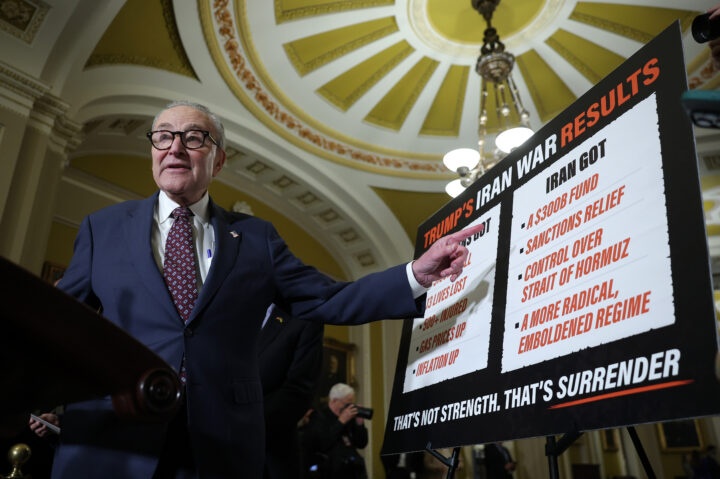
Photo by Kevin Dietsch/Getty Images
U.S. Senate Minority Leader Chuck Schumer (D-NY) speaks to reporters after the weekly Senate policy luncheons at the U.S. Capitol on June 23, 2026 in Washington.
Democrats on Monday slammed President Donald Trump’s resumption of hostilities against Iran, as well as the notion, implicit in Trump’s notification, that the operations mark a new conflict and therefore reset the 60-day window for military operations launched by the executive branch without congressional approval.
In a letter to congressional leaders on Friday notifying them that the war had resumed, Trump said that Iran repeatedly violated the memorandum of understanding by attacking commercial vessels on July 6 and 7, and that the U.S. had, as of July 7, commenced “defensive strikes against targets within Iran including missile launch sites, air defenses, military maritime assets, military support infrastructure, and command and control capabilities.”
Trump said that ground forces are not involved in the operations and are focused on protecting the U.S., but American forces “remain postured to take further action.” He added that he was notifying Congress pursuant to his obligation under the War Powers Act, the statute that lays out the 60-day timeline.
Critics of the war have argued consistently that the operations that began in February never actually concluded during the since-terminated ceasefire, despite the administration’s assertions otherwise.
“Trump’s rinse and repeat approach to the Iran war isn’t a strategy, it’s a recipe for utter disaster,” Senate Minority Leader Chuck Schumer (D-NY) said Monday. “It’s incredible what a fiasco this war is. Trump’s so-called understanding — lot of bull — with Iran fell apart faster than the ink could dry.”
Sen. Tim Kaine (D-VA), who has led war powers efforts in the Senate to end the conflict, said the U.S. has been at war, and argued that the administration is obligated to withdraw U.S. forces in response to the war powers resolution that Congress passed last month.
“The notion that [the 60-day clock] was paused before, I think, was sort of laughed out of the room. This has been an ongoing conflict, even during the midst of a ceasefire,” Kaine said. “There were still hostilities underway. So this is not a war that paused and restarted.”
He said he will continue to support war powers efforts but believes that Congress has already definitively declared the war illegal. The resolution that Congress passed came in the form of a concurrent resolution, which is not presented to the president, and its legal force is disputed.
Sen. Adam Schiff (D-CA) filed a new war powers resolution on Monday to oppose the war, which likewise argues that combat operations never ceased.
“We were promised the war would be over for months. And now in a matter of days we’ve gone from a bad U.S.-Iran deal to more strikes, another blockade, and added turmoil that will only drive prices higher,” Schiff said in a statement. “Any assertion by the Trump administration that he gets 60 more days to act without Congress has no foundation in law.”
Kaine and Sens. Andy Kim (D-NJ), Jeff Merkley (D-OR) and Chris Van Hollen (D-MD) cosponsored the resolution.
Rep. Adam Smith (D-WA), the ranking member of the House Armed Services Committee, “wholeheartedly condemn[ed]” Trump’s plans to take control of the Strait of Hormuz, arguing that it is impossible without significant escalation and would be “frankly, just wrong.”
“Iran has gained greater leverage, continues to destabilize the region, and has a younger and more hardline leadership than when this war started,” Smith said. “It is past time for [Republicans] to work with us to ensure the president finds a diplomatic solution to ending a war he never should have started and that threatens our national security and defense as well as that of our partners.”
Even some Republicans have expressed skepticism of the administration’s strategy, including over Trump’s plan to impose a toll on the Strait of Hormuz.
“I recall Secretary [of State Marco] Rubio saying that would not be proper for any country. … Am I wrong?” Sen. John Cornyn (R-TX) told reporters.
Additionally, given the recent sudden death of Sen. Lindsey Graham (R-SC) and the extended medical absence of Sen. Mitch McConnell (R-KY), Democrats may be able to more consistently pass war powers resolutions to oppose the war in Iran.
Many Democrats also say they plan to oppose a procedural vote this week to advance the 2027 National Defense Authorization Act in protest of the continued operations against Iran.
The resolution passed 50-48 with GOP Sens. Paul, Murkowski, Collins and Cassidy voting with Democrats in favor
Photo by Kevin Dietsch/Getty Images
U.S. Senate Minority Leader Chuck Schumer (D-NY) speaks to reporters after the weekly Senate policy luncheons at the U.S. Capitol on June 23, 2026 in Washington.
The Senate voted on Tuesday to pass a House-passed war powers resolution directing the administration to withdraw U.S. forces from Iran — a congressional rebuke of the administration over the war in Iran — though legally its effects are likely to be largely symbolic.
The resolution passed by a 50-48 vote, with Republican Sens. Rand Paul (R-KY), Lisa Murkowski (R-AK), Susan Collins (R-ME) and Bill Cassidy (R-LA) again voting in favor and Sen. John Fetterman (D-PA) voting against it. Ultimately, GOP absences enabled the resolution to go forward.
But the resolution, now passed by both chambers, came in the form of a concurrent resolution, which is not submitted to the president and, based on past court precedent, is not seen as carrying the force of law — though a House Democratic aide argued to CNN that the measure would be binding.
Rep. Greg Meeks (D-NY), the ranking member of the House Foreign Affairs Committee and lead Democratic sponsor of the war powers resolution, insisted in a statement, “Regardless of what President Trump says, this measure is binding under the War Powers Resolution, and I will explore all legal avenues to ensure the Executive complies with the will of Congress.”
Unlike previous efforts, however, the concurrent resolution did not require other procedural votes by the Senate, allowing Democrats to take advantage of the Republican absences and move directly toward final passage to deliver a message of rebuke to the administration.
The Senate still has other war powers resolutions pending, including one which passed an initial procedural hurdle, but currently lacks the support to pass through an additional procedural vote and final passage with full attendance. That legislation, which comes in a different form as joint resolutions, would be presented to the president if passed and set up a potential veto or other legal fight.
Republicans warned that adopting the resolution would send a further signal to Iran that it does not need to negotiate or make any compromises with the U.S. as part of ongoing talks.
House Democratic leadership opposed Tlaib’s resolution, but said they’ll support a different effort of hers to block U.S. support for Israeli operations against Hezbollah

Tom Williams/CQ-Roll Call, Inc via Getty Images
Rep. Rashida Tlaib (D-MI) attends the House Financial Services Committee on Wednesday, March 29, 2023.
The House rejected a war powers resolution by Rep. Rashida Tlaib (D-MI) on Thursday that aimed to block U.S. support for Israeli operations against Hezbollah in Lebanon, after House Democratic leaders publicly came out against the effort.
But the Democratic leaders said they would support a future effort by Tlaib along similar lines that will include carveouts for other U.S. operations inside Lebanon, indicating that Tlaib’s next effort is likely to pick up greater Democratic support.
The resolution failed by a vote of 324-92, with most votes in favor of the resolution coming from progressive House Democrats, though several more moderate lawmakers also voted in favor. The Congressional Progressive Caucus whipped in favor of the resolution. Rep. Thomas Massie (R-KY) was the only Republican who supported the effort, and 117 Democrats — a majority of the caucus — voted against it.
Reps. Betty McCollum (D-MN) and Derek Tran (D-CA) voted present.
Tlaib’s resolution, which directed the administration to “remove the United States Armed Forces from Lebanon” within seven days, aimed to cut off U.S. logistical and intelligence support for Israeli operations against Hezbollah. Tlaib has consistently ignored or downplayed Hezbollah’s role in the conflict, describing Israel’s operations as being against Lebanon and the Lebanese people writ large.
Democratic critics said that the legislation would also require the U.S. to remove military guards from its diplomatic facilities and U.S. servicemembers that train and advise the Lebanese Armed Forces. Tlaib insisted that other U.S. operations would be able to continue, in spite of the strict wording in her legislation that indicated they would be impacted.
House Democratic leaders Reps. Hakeem Jeffries (D-NY), Katherine Clark (D-MA) and Pete Aguilar (D-CA) said in a joint statement that they support efforts by the LAF to defeat Hezbollah — making no mention of Israel — and said that they “do not support any effort by the Trump administration to entangle the United States in a war in Lebanon or other parts of the Middle East.”
They said that, since there are no U.S. troops involved in hostilities in Lebanon, a more prudent path would be to pursue an alternative resolution Tlaib introduced, with support from Rep. Greg Meeks (D-NY), the ranking member of the House Foreign Affairs Committee.
The statement came after multiple days of behind-the-scenes wrangling and negotiations over the legislation.
Tlaib’s alternative resolution directs the administration to remove U.S. forces “from any hostilities in Lebanon” within seven days, and includes a specific carveout for diplomatic protection and cooperation with the LAF.
Despite introducing the alternative resolution herself, Tlaib said on X, “The people of Lebanon can’t wait another month for Congress to act.”
Rep. Brad Schneider (D-IL), who said Tlaib denied him the opportunity to speak on the House floor on the legislation, emphasized in a video statement that the legislation might impact U.S. support for the LAF and U.S. diplomatic security and highlighted that Hezbollah is a threat to the Lebanese people, in addition to attacking Israel since early February.
“We need to find a path where Lebanon and Israel can live in peace, and this resolution doesn’t help us. It doesn’t send a message to the president or the Trump administration. It doesn’t send a message to the Netanyahu government,” Schneider said. “It sends a message to Lebanon and Hezbollah that what they’re doing is acceptable. It sends a message to the Lebanese people that once more they’re pawns in someone else’s fight.”
Rep. Jared Moskowitz (D-FL) told Jewish Insider, “The United States is not at war with Lebanon nor is there any indication that we’re going to war with Lebanon. So it’s an unnecessary war powers vote.”
Debate over the resolution on Tuesday turned heated when Rep. Max Miller (R-OH) accused Tlaib of “advocat[ing] for terrorists on a daily basis” and of “hang[ing] out with” with Hezbollah “butchers.”
His remarks were struck from the congressional record with an objection from Tlaib, but he said in a statement read out on the House floor by a colleague that he stood by his remarks.
All but one of the four Democrats who had opposed the previous war powers effort flipped their votes in support

Graeme Sloan/Sipa via AP
The U.S. Capitol Building at sunset in Washington, D.C., on Saturday, March 6, 2021.
The House narrowly voted to block a Democratic resolution to force an end to the war in Iran by a vote of 214-213-1, with all but one of the four Democrats who opposed a similar effort in March changing their votes to support it on Thursday.
Rep. Greg Meeks (D-NY), the top Democrat on the House Foreign Affairs Committee, had held off on calling a vote on the resolution in hopes that he would be able to win over enough Democratic holdouts and Republican defectors to pass the legislation.
Reps. Greg Landsman (D-OH), Juan Vargas (D-CA) and Henry Cuellar (D-TX), who voted last month against a similar resolution, flipped their votes to support the war powers effort. But Rep. Jared Golden (D-ME), who is retiring at the end of his term, voted no again.
On the Republican side, Rep. Warren Davidson (R-OH), who voted for the war powers resolution last time, switched his vote to “present.” Rep. Thomas Massie (R-KY) was the only Republican who voted for the resolution.
A small number of Republicans who have expressed skepticism about the war effort and could have been potential swing votes, including Reps. Lauren Boebert (R-CO) and Nancy Mace (R-SC), did not vote.
Golden said in a statement that the war powers resolution would “weaken our hand” in negotiations with Iran.
“I believe we must maintain a strong negotiation position over Iran’s nuclear program, freedom of movement in the international waters at the Strait of Hormuz, and how to achieve a durable peace between our two nations,” Golden said in a statement.
Even after their fourth failed attempt, Democrats say they intend to continue forcing such votes weekly
Kevin Carter/Getty Images
The U.S. Capitol Building is seen at sunset on May 31, 2025 in Washington, DC.
An effort by Senate Democrats to force an end to the war in Iran was again blocked by Republicans on Wednesday, the fourth such failed attempt mounted by Senate Democrats since the war began in late February.
The measure failed by a vote of 52-47, with all Democrats except Sen. John Fetterman (D-PA) voting for a procedural motion on the war powers resolution, and all Republicans except Sen. Rand Paul (R-KY) voting against it. Sen. Jim Justice (R-WV) was not present for the vote.
Nevertheless, Democrats intend to continue their efforts. They have nine such resolutions that have been filed, and top Senate Democrats said this week they intend to continue forcing such votes weekly, in the hopes that more Republicans will change their votes as the war drags on.
Some Republicans have begun to express hesitation about the war, and top members of the caucus have said they hope it comes to an end soon. But thus far most have not been willing to openly break with President Donald Trump on the effort.
Separately, Sen. Bernie Sanders (I-VT) plans to call up a vote later on Wednesday on a pair of measures to block sales of bombs and bulldozers to Israel, which Sanders has also framed as referenda on the war in Iran. Twenty-seven Democrats have previously voted for such resolutions, and supporters of the effort expect that number to increase this time.
But at least one lawmaker, Sen. Kirsten Gillibrand (D-NY), who introduced a war powers resolution on Iran this week, for future consideration, said that she views the two issues differently.
“I think of them very differently,” Gillibrand told Jewish Insider during a virtual press conference on Wednesday. “I oppose the war in Iran, but I do not believe we should leave an ally who is being attacked without support,” she said, referring to Israel.
The group ranges from pro-Israel Democrats like Sen. Kirsten Gillibrand to anti-Israel members like Sen. Chris Van Hollen

Drew Angerer/Getty Images
Sen. Kirsten Gillibrand (D-NY) speaks at a news conference following a closed-door lunch meeting with Senate Democrats at the U.S. Capitol on October 31, 2023, in Washington, D.C.
A group of six additional Senate Democrats plan to file new war powers resolutions this week to halt the war in Iran, a move that would allow Democrats to continue forcing votes on the war for the foreseeable future.
Previously, a different group of six Democrats introduced similar resolutions, and Democrats have called up two of them thus far, with plans to call up a third this week. So far, the resolutions have all failed along mostly party lines, with all senators remaining consistent in their votes.
The latest group of lawmakers includes Sens. Jeff Merkley (D-OR), Kirsten Gillibrand (D-NY), Chris Van Hollen (D-MD), Mark Kelly (D-AZ), Raphael Warnock (D-GA) and Andy Kim (D-NJ).
The array of lawmakers involved in the latest effort spans from staunch progressives and critics of Israel to generally more pro-Israel members.
“President Trump chose to start a war knowing it was going to raise gas prices on Americans already struggling to get by,” Gillibrand said in a statement. “The president, and his party, just don’t care about anyone other than themselves. They lie, cheat and steal to enrich themselves and leave regular folks with the bill. It is long past time for Republicans in Congress to stand up and do their job.”
House Democrats also plan to call up a war powers resolution this week, which may pass given that some Democrats who previously opposed a war powers effort and a handful of Republicans have indicated they plan to change their votes.
The latest set of six resolutions will not be eligible for floor votes immediately, but Democrats can call up the other four resolutions introduced previously at will. Senate Democrats are also likely to force votes on matters related to the Iran war during the upcoming reconciliation process, which Republicans aim to use to fund immigration enforcement and other priorities.
Sen. John Fetterman was the only Democrat who opposed the resolution and Sen. Rand Paul was the only Republican who supported it

Drew Angerer/Getty Images
Sen. Tim Kaine (D-VA) speaks to reporters on his way to a classified all-Senate briefing.
The Senate voted down Sen. Tim Kaine’s (D-VA) war powers resolution that would have blocked additional U.S. military action against Iran on Friday evening, with nearly all Democrats voting in favor of the resolution, and almost all Republicans voting against it.
The resolution failed, 53-47, with Sen. Rand Paul (R-KY) being the only Republican to vote in favor and Sen. John Fetterman (D-PA) being the only Democrat to vote against.
Kaine said in an address prior to the vote that while he acknowledged the need for U.S. military engagement in certain instances, any offensive actions required the approval of the legislative branch.
“The United States needs to defend itself and it needs to work with allies to help them defend themselves,” Kaine said. “But our troops, our sons and daughters, deserve to have wise civilian leadership that only make the decision to send them into war on the basis of careful consideration and a debate before the entire public.”
The Virginia senator, who has long been a champion of enforcing Congressional war powers, argued the president does not have the authority “to go on offense against another nation or an entity like a terrorist group.”
In response, Sen. Lindsey Graham (R-SC), one of the most vocal supporters of the strikes in the Senate, said that requiring congressional approval would be a “disaster for the country” and upend the military command structure.
“Since the founding of this country, it’s been understood that the commander in chief can act, as the commander in chief, to protect our nation from threats — that he is in charge of the military. He’s the civilian in charge of the military, and it’s his decision to use military force,” Graham said. He noted that Congress has only declared war five times but engaged in hundreds of military actions, and said Congress can cut off funding for military operations if it does not agree with the executive.
“Just think of the chaos that would ensue in this country if there were not one commander in chief, but 535,” Graham reiterated, adding that the reaction from Congress to the strikes and conflicting intelligence about their efficacy shows that Congress would not be able to act decisively if consulted.
He said it would not be practical for the administration to have to wait for Congress to act in response to a future nuclear facility or threat to U.S. forces, “and that’s not what the founders meant.”
Several Senate Republicans who backed a similar resolution in 2020 following the U.S. strike that killed Islamic Revolutionary Guard Corps Gen. Qassem Soleimani voted, this time, against the resolution. That list included Sen. Todd Young (R-IN), Bill Cassidy (R-LA), Susan Collins (R-ME), Mike Lee (R-UT) and Jerry Moran (R-KS).
Collins noted in her statement that Iran had “threatened to attack Americans on our own soil and around the world” after Israel launched its operation to take out its nuclear program. She also said she supported the strikes and the subsequent ceasefire, both of which made it “the wrong time to consider this resolution and to risk inadvertently sending a message to Iran that the President cannot swiftly defend Americans at home and abroad.”
“I continue to believe that Congress has an important responsibility to authorize the sustained use of military force. That is not the situation we are facing now,” Collins said. “The president has the authority to defend our nation and our troops around the world against the threat of attack.”
Lee said that determinations around war powers are “heavily fact-dependent.”
“We got a classified briefing yesterday. The totality of the circumstances that they outlined, including the finality of the action they’d taken — there’s no ongoing operations there,” Lee said.
Sen. Jacky Rosen (D-NV), one of the Senate’s most vocal pro-Israel Democrats, said in a statement that she hopes the strikes are successful in the long-term, that Iran must be prevented from obtaining nuclear weapons, that the U.S. must defend its personnel and that she would “continue to back Israel should it need to respond to a break in the agreement.”
“At the same time, the U.S. Constitution gives Congress the power to declare war and authorize any offensive attacks on other sovereign nations,” Rosen said. “The decision to go to war and put our troops in harm’s way is one that cannot be made lightly, and must be made by Congress, which is why I voted today to advance the War Powers Resolution.”
Sen. Josh Hawley (R-MO), who has advocated for a more restrained approach to U.S. foreign policy, dismissed arguments that the War Powers Act was applicable to the strikes ordered by Trump, which he called “an Article II matter.”
“I think, probably, the War Powers Act is unconstitutional. Some parts of the War Powers Act are kind of closer questions, but I think this is actually not very hard. I mean, if a president, any president of any party, cannot order one-off, limited military strikes without the approval of Congress, why do we have Article II?” Hawley asked.
“Go back and read the debates, and exactly what the framers did not want was foreign policy by committee, so I think this is not a close question. You can be opposed to the strikes and still be like, ‘Wow, this is not a good idea, this resolution,’” he told JI, adding that Trump was “100%” acting within his constitutional authority.
Please log in if you already have a subscription, or subscribe to access the latest updates.
 Continue with Google

 Continue with Apple