














































































Some Jewish Affairs Caucus leaders say they weren’t consulted about the changes, which are meant to prevent issues around antisemitism that occurred at last year’s assembly

Robyn Stevens Brody/Sipa USA via AP Images
Protesters rally against proposed resolutions at the National Education Association meets in Philadelphia in August 2024.


 Add JewishInsider on Google
Following last year’s contentious assembly mired in allegations of antisemitism, the National Education Association — the nation’s largest teachers’ union — adopted new policies for its upcoming Denver convention aimed at preventing the same chaos, the NEA confirmed to Jewish Insider.
“Leading up to this year’s Representative Assembly, we are taking significant steps to ensure all of our members are respected and supported at the event based on extensive feedback and consultation with the Jewish Affairs Caucus, Jewish members, and partners in the Jewish community,” an NEA spokesperson told JI.
“We have strengthened policies for addressing discriminatory or harassing conduct, streamlined the complaint process, and are empowering event staff and leaders to remove those who violate NEA’s standards. There will also be an expanded security presence at the Representative Assembly and we will continue rigorous outreach and engagement with caucuses, including the Jewish Affairs Caucus, and external partners.”
The new rules for the July 3-7 Representative Assembly include stricter conduct enforcement for delegates, electronic voting to prevent shouting on the floor, de-escalation training for staff and regular public reminders of assembly rules, according to the Jewish Council for Public Affairs, which said it worked with the union’s Jewish Affairs Caucus to lobby the NEA for the changes.
At last year’s conference in Portland, thousands of delegates passed a measure that would have barred the union from using, endorsing or publicizing any materials from the Anti-Defamation League, though the decision was later overturned by NEA’s Board of Directors.
Several Jewish teachers who spoke out against the resolution at the RA told JI they were “harassed and shouted down during the proceedings.” Other delegates from the JAC said they were surrounded in what appeared to be coordinated disruptions, and one member who referenced the victim of an antisemitic firebombing in Colorado said other attendees then laughed and applauded.
The episode was widely criticized by Jewish educators and their allies as antisemitic, exacerbating concerns about the growing marginalization of Jews within the teachers’ union following the Oct. 7, 2023, Hamas terrorist attacks and the subsequent impacts in K-12 classrooms.
JCPA CEO Amy Spitalnick, who will lead a presentation titled “How Educators Can Confront Antisemitism & Hate and Defend Democracy” at the weekend convening, said that “as extreme voices on both ends of the political spectrum pit Jewish safety against democratic norms and values, it’s vital that we carve a different path forward.”
JAC Chair Alyson Brauning celebrated the NEA’s adoption of “clear standards for speech and conduct in all union spaces and promoting a greater understanding of the needs and concerns of Jewish members.
“We want to express our gratitude to NEA leadership for their work with the JAC on these new rules, and are expressing our hopes that these will be enforced as fully and fairly as possible,” she said.
Some NEA members, including incoming JAC leadership who say they were excluded from drafting the new policies, are reserving their judgment as to their efficacy.
Naomi Rodriguez, a math teacher in Pennsylvania and the incoming chair of JAC who will start her term on Aug. 1, told JI that despite being a “proud union member,” she believes the “NEA has significant work to do.”
“Unfortunately, I was not consulted about the agreement reached with JCPA,” said Rodriguez. “Our members should never have to choose between supporting our union and protecting themselves. The real test will be on the Representative Assembly floor: whether the experience of Jewish delegates is tainted by dehumanizing rhetoric and identity-based attacks, and how our NEA leadership responds.”
Josh Hirsch, an English teacher in Colorado and incoming vice chair of the JAC, told JI he was also not included in the discussions with JCPA and NEA.
“NEA has appropriately spoken up for racial justice and immigration issues, like George Floyd and ICE raids, but when a man firebombed a peaceful Jewish gathering in Boulder just up the road from this convention, and when gunmen opened fire on Jews celebrating Hanukkah at Bondi Beach in Sydney killing 15 people, NEA stayed silent. That silence is a failure of our values, and NEA must step up publicly and stop sitting on the fence.”
The ADL, which was targeted by the union, also criticized the manner in which the policies came about.
“We are extremely frustrated about a so-called ‘agreement’ with JCPA that was reached without all NEA JAC leadership and delegates at the table,” the ADL told JI. “Crafting commitments that affect Jewish educators without including their incoming representatives sends a troubling message. It risks reinforcing the very sense of exclusion that the changes are presumably meant to address.”
“NEA has a considerable amount of work to do to earn back the trust of Jewish educators after last year’s Representative Assembly, and in light of the unchecked rise of antisemitism within NEA and many state and local affiliates,” the antisemitism watchdog group continued. “NEA’s inconsistent enforcement of its own protections has sent an unmistakable message: Jewish educators are not a priority. That must change now.”
Spitalnick and the NEA disputed these accounts and insisted that JAC leadership was consulted. “Our team was keeping ADL and other Jewish organizations closely in the loop,” Spitalnick told JI. “[We’ve] been in close touch with the incoming [JAC] leaders.”
“Leadership represents the caucus in conversations like this,” she said.
Jay Goldfischer, a teacher in Los Angeles County who has been an NEA member for 26 years, told JI that “on paper, the changes are in the right direction.”
He added, “Actions will speak louder than words once we’re on the floor at the convention.”
Goldfischer said he is going into the RA prepared for “antisemitic and exclusionary policies [being] considered — and that continues to send the message that Jewish educators aren’t a priority.”
“What transpired at the Representative Assembly last year was really upsetting and I have serious concerns about what could happen this year,” he continued. “Last year was not a safe environment for Jewish delegates. I think it’s premature to claim that these new policies are going to ensure the safety of Jewish members and educators when already NEA’s enforcement has not been consistent in the past.”
“I’m still stuck on the fact that they shouldn’t have to make new rules to make an education convention safe for Jewish delegates,” he continued.
The Detroit convention also featured Abdul El-Sayed, a United Auto Workers-endorsed Michigan Senate candidate who has said the Israeli government is ‘just as evil as Hamas’
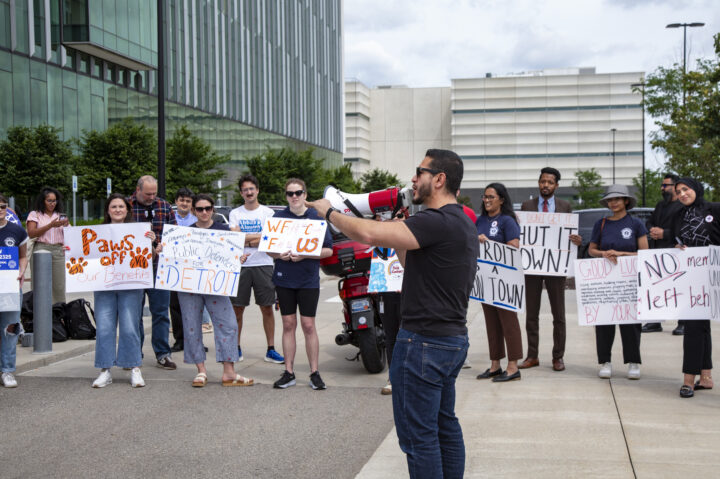
Jim West/UCG/Universal Images Group via Getty Images
Abdul El-Sayed speaks at a union rally in Detroit on June 17, 2026.
Delegates at the United Auto Workers convention in Detroit voted on Thursday to divest from Israel Bonds, citing the war in Gaza.
One of the largest unions in the country, the UAW previously held an estimated $400,000 to $700,000 in Israeli bonds and securities, according to the Detroit Free Press. It has not been disclosed how much money the divestment will affect or how many members voted to pass the resolution.
The annual convention also featured a speech from Abdul El-Sayed, a far-left, UAW-endorsed Democratic Senate candidate in Michigan who told Jewish supporters last month that he “often struggle[s]” to answer whether he believes Israel has a right to exist as a Jewish state. He said in an interview with CNN in April that he believes the Israeli government is just as evil as Hamas.
While UAW historically evokes imagery of assembly lines, picket lines and blue-collar solidarity, the union has increasingly drifted away from its core mission of representing autoworkers, largely driven by individuals pushing extreme political agendas that leave critics questioning their relevance to workplace issues.
In January, 30% of the 275 employees of the Israeli-owned Breads Bakery signed union authorization cards for UAW Local 2179, the percentage necessary to petition the National Labor Relations Board for a union election. The group, which calls itself “Breaking Breads,” said in a statement, “Workers are demanding a living wage, safe workplace, and basic respect.” But the group’s demands also included that the management of the New York-based bakery chain, CEO Yonatan Floman and founder Gadi Peleg, “halt use of bakery profit to materially support the Israeli occupation.” Breaking Breads also condemned the bakery’s participation in the Great Nosh, an annual Jewish food festival in New York City, and said it will not participate in baking cookies with an image of the Israeli flag.
A number of labor unions have seen a rise of antisemitism and anti-Israel activity since the Oct. 7, 2023, Hamas terrorist attacks, despite many being historically supportive of Israel, dating back nearly a century, when many American unions donated money to the Histadrut, Israel’s national labor union. Multiple groups — including the Louis D. Brandeis Center for Human Rights Under Law — have now taken legal action against UAW branches in response to certain campaigns, which some legal experts allege were discriminatory against Israelis and Jews.
UAW did not respond to a request for comment from Jewish Insider.
Pro-Israel union members say the organization violated its own rules in removing Amy Leserman, an outspoken Zionist activist, from its House of Representatives

Getty Images
Students in a classroom
Some pro-Israel members of the United Teachers Los Angeles House of Representatives are condemning the union for bypassing its own policies to expel a Jewish teacher and Zionist activist.
During a June 3 meeting held on Zoom, the union’s House of Representatives — the highest voting body in the union — voted to expel Amy Leserman, who retired as a Los Angeles public school teacher last year and now works at a local Jewish day school.
Leserman chairs JewTLA, a group that seeks to help Los Angeles students, teachers and families combat classroom antisemitism through legal filings and complaints. However, she remains a polarizing figure even among some pro-Israel members of the community, who say she has personally and publicly targeted individuals she considers antisemitic and pushed union members to resign.
Still, some of those same members argue her removal violated the constitution, alleging it stemmed solely from Leserman’s personal beliefs.
“Amy has done many things in her private time against those she perceives as antisemitic and anti-Israel. She’s done many things that I don’t agree with. She’s gone after people personally, holding them accountable for their antisemitic beliefs. However, in the House of Representatives, she was simply an observer. She was allowed to be there. She never opened up her mouth, she did nothing,” Scott Mandel, a Los Angeles Unified School District teacher for 41 years who has been on UTLA’s board of directors for almost two decades, told Jewish Insider.
“When the antisemites saw she was there, they demanded she be kicked out because of actions she took,” continued Mandel. “However, she broke no rules according to our constitution.”
Mandel, who attended the meeting, said he spoke up at the time, asserting that “if you want to start judging people because of actions in their personal life, you need to make new rules. Put that in the constitution.”
“If someone is taken out of a meeting because of what they’ve done on their own, you have to make new rules — but this is wrong. Amy is seen as very pro-Israel, so the antisemite coalition — which is big — said out with the rules and demanded her gone. For the first time in my 18 years, I saw somebody expelled for their personal beliefs.”
UTLA, the labor union of more than 35,000 public school educators in LA, did not respond to a request for comment from JI.
Leserman, who was a UTLA member for more than 20 years, also asserts the meeting suddenly became “an anti-Israel tirade” with participants “saying they felt threatened by my presence, they couldn’t have me there and that I was a danger to them by being in the meeting.”
She said “the president of the union let this go on for 30 to 40 minutes. [Then] they voted to expel me.”
“There are people in the union that really resent [my involvement with JewTLA]. I don’t mind them resenting that,” said Leserman, who told JI that the rise of antisemitism in district public schools following Hamas’ Oct. 7, 2023, terror attacks and ensuing war in Gaza did not factor into her decision to retire. She did not elaborate on what led to that decision.
The incident received condemnation from other Jewish union members — who also see Leserman as a controversial figure — as well as the regional chapter of the Anti-Defamation League, which called reports of the expulsion “deeply troubling.”
A pro-Israel source familiar with the union told JI the expulsion followed months of internal tension.
“The problem with Amy, and why she became toxic within UTLA is that when she retired she was explaining to people how to quit the union,” said the source. “She wound up getting entangled with Right to Work people, whether intentional or not. To the union as a whole, both pro-Israel and anti-Israel unionists, she became kind of toxic because of her association with Right to Work people. To what extent that played a role in what happened with the House of Representatives, it’s not clear. But it’s not black and white or that this came out of the blue.”
The source added: “She’s managed to get herself portrayed as the victim here. Everything the House of Representatives did is wrong, but the history [is important]. It’s not like she walked in as a longtime supporter of Israel and got smacked down. The anonymosity was there because of months and months of trying to get people to quit the union.”
“I think if people quit the union it just increases the strength of the Israel and Jew haters,” the source added.
Gregg Solkovits, a former UTLA officer and a retired teacher who has been a member of the union for 38 years, asserted that “without a doubt, it was wrong for the union to expel her.”
“What we have is intolerance from a radical minority of the union who espouses anti-Zionist rhetoric,” Solkovits, who was not on the call, told JI. “The union just elected an officer who is blatantly anti-Israel, and I say antisemitic. It’s wrong on a moral level and I think on a legal level [to expel her]. I don’t think UTLA followed its own procedures on this. It’s unfortunate that union leadership, from the president on down, chose not to say a word when it’s wrong.”
Mandel and Leserman both pointed to a pervasive anti-Israel obsession within the union.
“This is a group that for the last two years has voted every anti-resolution possible,” said Mandel. “They’ve gotten to the point where they voted that if any politician has ever voted for arms for Israel, UTLA cannot support them. Even if you have a politician who has been the most pro-education, pro-labor person, but one time in their career voted for arms for Israel, UTLA will no longer endorse them. That’s how ridiculous they’ve gotten. They put their personal feelings ahead of what’s good for the union.”
Leserman said, “The union does not currently have a teachers contract, the district hasn’t signed the one that they agreed on. That should have been the focus of the meeting. Instead, six out of 10 of the items on the schedule had to do with Israel and how bad Israel is. They need to deal with the problems on their doorstep — they’re about to have 6,000 teachers laid off. None of that was discussed.”
Los Angeles Unified School District, which serves more than 560,000 students across Los Angeles County, has been accused of failing to address antisemitism — including within teachers’ unions. The district was named in a February lawsuit that highlighted several complaints from Jewish parents and children in districts across California.
A cardiology fellow lamented that his union is engaging in systemic discrimination against Jews and Israelis, while he’s forced by federal law to help fund it
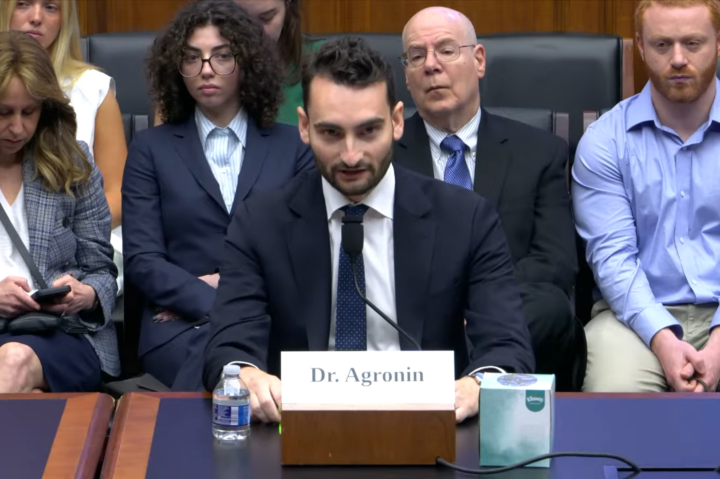
SCREENSHOT
Dr. Jacob Agronin speaks at the House Education & Workforce subcommittee hearing on May 20, 2026.
Speaking at a House Education & Workforce subcommittee hearing on Wednesday, a doctor accused his union of engaging in systemic discrimination against Jewish and Israeli health providers, supporting terrorist sympathizers and making “its obsession with a single geopolitical conflict a defining future of its identity” — all while he’ll be forced by federal law to fund it.
Dr. Jacob Agronin, a cardiology fellow at a major medical institution in Philadelphia, testified alongside several other experts on antisemitism at a hearing focused on anti-Jewish hate in the medical field — which both Jewish medical providers and patients report as a growing problem since Hamas’ Oct. 7, 2023, attacks on Israel.
The hearing focused in particular on the role of healthcare worker unions, such as the Committee of Interns and Residents, of which Agronin is set to be a member, in spreading antisemitism and their failures to stand up for Jewish union members.
CIR has adopted a series of resolutions condemning Israel for genocide and calling for divestment from Israel, including “human capital.” The organization has also offered its institutional support for a physician who expressed support for Hezbollah and for anti-Israel Columbia University activist Mahmoud Khalil.
“CIR has formally recommended that hospitals exclude my Israeli colleagues from employment, and then compels dues from those same colleagues to fund that position,” Agronin said. “If any employer in this country adopted that policy, we would call it what it is: discrimination.”
He said that members of the union feel afraid to speak out. Agronin also emphasized that his salary, which will help fund the union, comes in part from Medicare graduate medical education funding.
Eveline Shekhman, the CEO of the American Jewish Medical Association, said that her organization is encountering a new era in which “Jew hatred hides behind the guise of anti-Zionism.”
“We are seeing calls to fire Jewish doctors, the praising of terrorist groups in and outside of clinical settings, the refusal to treat patients because of their faith, national origin or Zionist identity, and the demand that Jewish colleagues renounce Israel as a condition of workplace acceptance,” Shekhman said. “This is antisemitism, this is discrimination, and it is a distraction. It has no place in medicine.”
Any disruption to the clinical environment can impact patient care, she said.
She added that employees should be able to rely on their unions to support them when their employers fail to do so in such an environment, but that many unions themselves “have created an environment where Jewish professionals no longer feel welcome” and where they are forced to fund such activities with which they disagree.
In addition to CIR, Shekhman said the National Nurses Union has also been advancing anti-Israel activity, including providing a guide for members to bring anti-Zionism into the clinical setting, where Shekhman argued such activity is irrelevant and has no place.
Deena Margolies, an attorney for the Louis D. Brandeis Center for Human Rights Under Law, said that efforts like these from healthcare unions place Jewish and Israeli professionals “in an impossible position: The union that is supposed to represent them is also helping to create the hostile work environment they must endure.”
“Antisemitism can be dressed as labor solidarity or political language, but the effect is the same. Jewish and Israeli healthcare professionals and patients are treated as morally suspect and unable to participate fully yet equally in clinical settings,” she continued.
Agronin told Jewish Insider after the hearing that there is a “fairly silent majority” that opposes the actions the union is taking but is afraid of backlash if they speak out.
Shekhman told JI that she appreciated that all of the lawmakers expressed concern about the trend of antisemitism in healthcare, and said that that is a promising sign of possibilities for progress going forward.
She said that lawmakers’ support can be helpful when working with institutions to address these issues, and said that the hearing can be the first of “a lot more conversations that need to be had.”
Agronin emphasized that “it’s not just a Jewish issue. This is really an issue that affects all Americans.”
“This is discrimination, as it would be for any other group of people by race, sexual orientation, national origin, anything,” he said. “None of us want to be forced to pay even a single dollar to this organization, especially when it … certainly doesn’t serve our interests — actually quite the opposite. So, I’d hope that there’s some solution to have an option for those that want nothing to do with unions.”
Throughout the hearing, Democrats questioned the motivation of the inquiry, accusing Republicans of weaponizing antisemitism as a cudgel against union organizing generally.
“It is irresponsible and unproductive to take the words and actions of a few and broadly categorize labor unions as fostering discrimination,” Rep. Mark DeSaulnier (D-CA), the ranking member of the subcommittee, said.
Jamie Beran, the CEO of the progressive Jewish group Bend the Arc, testified that antisemitism in the healthcare setting is “heartbreaking” and “leaves many Jews feeling isolated and unsure who to trust.” But she also attacked the Trump administration and descriptions of labor unions as institutionally antisemitic.
“The Trump administration is using Jewish safety as a pretext for policies that endanger our neighbors and our democracy, and as a Jewish leader, that angers me,” she continued. “Unions and professional organizations are engaged in the same debates happening across America. These disagreements are not inherently illegal antisemitism or harassment. … [T]o smear the institutions themselves as antisemitic because of what some members say is politically motivated. It’s gross governmental overreach to constitutionally protected speech among adults.”
Beran also condemned the administration for cutting funding for the Department of Health and Human Services’ Office of Civil Rights, and for restricting abortion access.
Shekhman and Agronin insisted to JI after the hearing that the issue should be a nonpartisan one, and that they’re not targeting unions broadly. Shekhman emphasized that it’s a “patient care crisis issue” that impacts all Americans, regardless of their background. And Agronin said he did not believe that similar behavior would be tolerated if other groups were being targeted.
Shekhman said she did not have the opportunity during the hearing to emphasize the “true impact of BDS on healthcare overall” — including a loss of access to research, technology and collaboration across a range of different areas, as well as losing the support of Israeli physicians.
She said that lawmakers and the public may not understand the scope and volume of the problem: in the past two weeks AJMA received 26 incidents of various natures, from a car being vandalized with a swastika in a hospital parking lot to a kippah being knocked off. And, she continued, most of the victims are afraid to discuss the issue publicly.
Agronin said that CIR’s protestations that it is anti-Zionist rather than antisemitic are a ruse, and that “anti-Zionism is 1940s Jew hatred that’s rebranded for the 21st century.”
The Association of Legal Aid Attorneys agreed to pay $315,000 and acknowledge misconduct after pushing an anti-Israel resolution shortly after Oct. 7, 2023
Alex Wong/Getty Images
The statue titled "Justice Delayed, Justice Denied" stands on the front of the Albert V. Bryan United States Courthouse in Alexandria, Va.
The Association of Legal Aid Attorneys, a union representing over 3,000 legal workers, has acknowledged “inappropriate” communication around Israel and antisemitism as part of a settlement reached on Thursday brought on behalf of three union members who sued to block an anti-Israel resolution proposed weeks after the Oct. 7, 2023, terrorist attacks.
Under the agreement, ALAA, part of Local 2325 of the United Auto Workers, will pay the plaintiffs $315,000 in monetary damages and will refer all disciplinary charges brought against members to the union’s outside counsel for review. The union also agreed to implement mandatory training for its executive board to understand its obligation to ensure its members rights are being protected.
“The training is not on antisemitism per se, but the expectation is that there will be discussions about how discriminatory animus could motivate violations of union members’ bill of rights,” Rory Lancman, director of corporate initiatives and senior counsel at the Louis D. Brandeis Center for Human Rights Under Law, told Jewish Insider.
The lawsuit was filed in September 2024 by the Brandeis Center. In their federal court complaint, plaintiffs described being targeted as “snitches,” “losers,” “disgusting,” “dictators in training” and “Zionist ghouls” in the ALAA’s internal discussion boards.
The resolution, which was passed by a majority of ALAA members in November 2023, called for an immediate ceasefire in the Israel-Hamas war, denounced Israel’s “colonial apartheid occupation” of Gaza, opposed “any future military aid” to Israel and called for the U.S. to cut ties with the Jewish state.
Plaintiffs said they were accused of “spreading lies and misinformation” by talking about “Jewish babies being murdered, and women being raped” on Oct. 7.
This settlement comes following a U.S. district court ruling in July that federal labor law claims brought by union members against the ALAA could proceed, rejecting the ALAA’s motion to dismiss.
The case is part of a larger trend of rising antisemitism and opposition to Israel in labor unions, many of which historically had been supportive of Israel, dating back nearly a century, when many American unions donated money to the Hisdarut, Israel’s national labor union.
In February 2024, the AFL-CIO, which represents more than 12 million workers, called for a ceasefire in Gaza.
Kenneth Marcus, chairman of the Brandeis Center, called the reversal of Israel support in labor unions a “bitter irony.”
“Labor unions are supposed to be advocates for social justice and workplace equality,” Marcus said in a statement. “To find the oldest hatred in such places is deeply antithetical to their mission. This settlement is a landmark in the fight against antisemitism in this sector. I am gratified by this outcome and resolved to support Jewish workers at any union around the country that is seeing this problem arise. Based on what we are hearing around the country, there will be more of these cases coming.”
Please log in if you already have a subscription, or subscribe to access the latest updates.
 Continue with Google

 Continue with Apple