




























As the president touts progress in talks with Tehran while escalating military pressure, analysts say the administration is keeping its options open — but will need to make a move soon
U.S. Navy via Getty Images
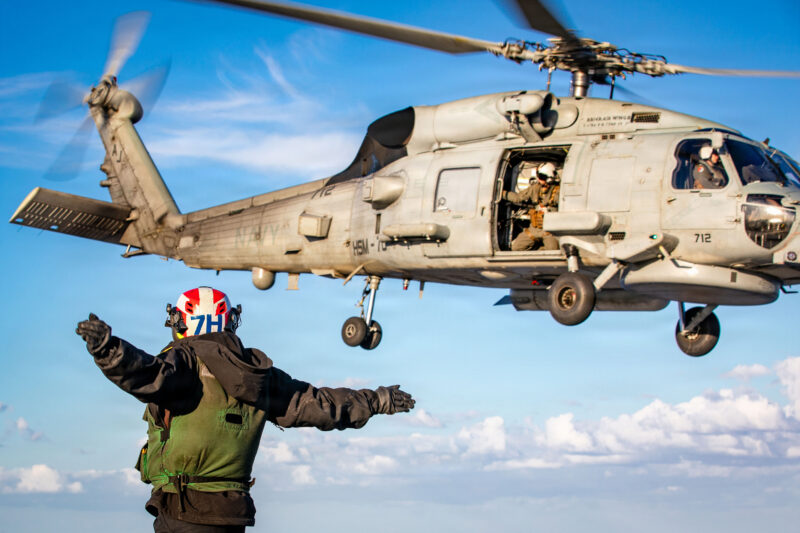
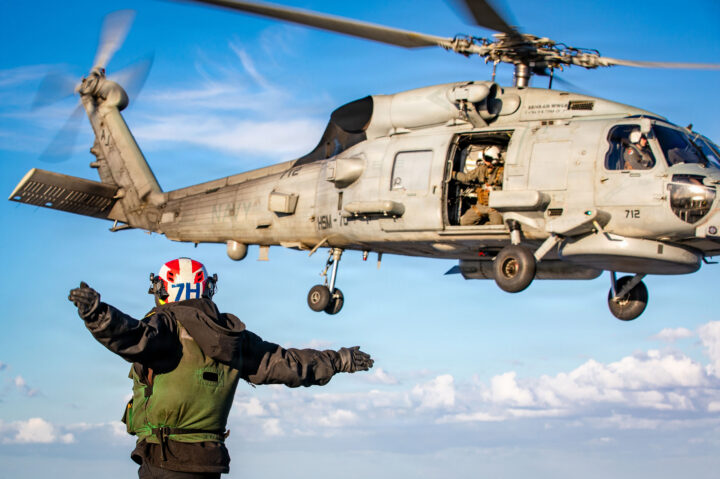
A U.S. Sailor signals the launch of an MH-60R Sea Hawk helicopter, attached to Helicopter Maritime Strike Squadron 70, on the flight deck of the world's largest aircraft carrier, USS Gerald R. Ford (CVN 78), while supporting Operation Epic Fury on February 28, 2026.


 Add JewishInsider on Google
The Trump administration’s conflicting posturing on the war in Iran — insisting on the one hand that a diplomatic deal is within reach while also threatening to escalate strikes and potentially deploy ground troops — has left experts and former administration officials uncertain about President Donald Trump’s next move.
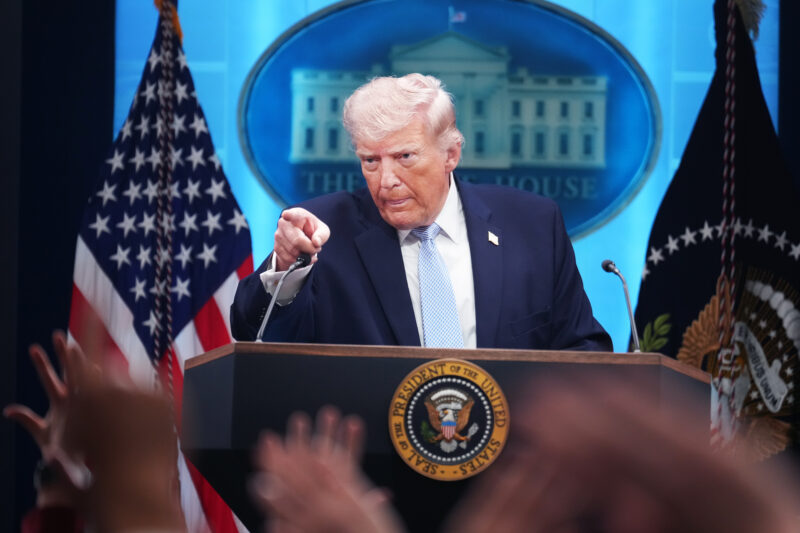
The president threatened in a post on his Truth Social platform on Monday morning to “conclude our lovely ‘stay’ in Iran by blowing up and completely obliterating all of their electric generating plants, oil wells and Kharg Island” if current talks fall apart and “the Hormuz Strait is not immediately ‘Open for Business.’”
But he wrote in the same post that the U.S. is engaging in “serious discussions” with Iran’s current leadership, which he described as a “new” and “more reasonable” regime than its predecessor, and said that “great progress has been made.”
Reached for comment, the White House referred Jewish Insider to Press Secretary Karoline Leavitt’s remarks at Monday’s briefing where she defended the president’s approach and repeatedly stated that Trump and his advisors are merely ensuring he has “maximum optionality” as he considers next steps.
“With respect to forces that are on the ground in the Middle East, it’s the job of the Pentagon to create maximum optionality for the commander-in-chief. It does not mean the president has made any additional decisions,” Leavitt said, adding that Trump has “decline[d] to rule … out” the use of ground troops.
On Capitol Hill, there are increasingly evident divides among Republican lawmakers about the prospect of boots on the ground. Some have argued that a ground operation would require explicit congressional authorization, and a number of otherwise-hawkish Republicans are hesitant about, if not outright opposed to, the idea of a ground operation.
In recent days, the U.S. has amassed over 3,500 more troops in the Middle East, including deploying the USS Tripoli aircraft carrier, which hosts around 2,500 Marines. Trump has also threatened to attack Iran’s oil and energy facilities and potentially escalate the war as a result of Iran’s blockade of the Strait of Hormuz — a vital passageway for the global oil trade.
Elliott Abrams, who served as Iran envoy under the first Trump administration and is now a senior fellow at the Council on Foreign Relations, told JI that the president’s decision to move more troops to the region and not exclude ground operations from future military plans is an effort to “keep his options open.”
“The massing of ground forces near Iran is both preparation for their possible use and a means of pressuring Iran to make concessions in the negotiations,” Abrams said. “There is no way of knowing what Trump will do if the negotiations fail.”
The administration is considering multiple options for the use of ground troops, including the seizure of Kharg Island, a vital economic artery for Tehran that accounts for roughly 90 percent of the country’s crude exports.
Cameron McMillan, a senior research analyst at the Foundation for Defense of Democracies, said that targets could also include the “seizure of key terrain — including relevant islands — in and around the Strait of Hormuz and securing Iranian highly enriched uranium.” However, he remained unsure whether the Trump administration would carry out such operations.
“Seizing or destroying the [highly enriched uranium] is a sensible goal if it is militarily feasible without too much risk,” Abrams said. “Taking the targets associated with the strait is, I think, both for bargaining purposes and perhaps meant to be given up only when traffic has moved through the strait freely for some time.”
Jonathan Ruhe, a fellow at the Jewish Institute for National Security of America, said that there are “real reasons to think ground operations could end up taking place.” He said that Iran “refuses to entertain Trump’s demands,” which could compel the administration to use elevated means of force in order to seize Iran’s highly enriched uranium, reopen the Strait of Hormuz or take Kharg Island “or other assets as bargaining chips.”
“The past month reaffirms that standoff air and naval power are insufficient by themselves to neutralize these targets or convince Iran to give them up,” Ruhe said. “Trump’s tendency is to employ the forces that he deploys overseas, as seen in both the Venezuela operation and the start of the current conflict. And there’s an opportunity cost to letting such well-trained U.S. forces idle indefinitely in the Middle East after pulling them from the Indo-Pacific or the homeland.”
Daniel Shapiro, a former U.S. ambassador to Israel under President Barack Obama and deputy assistant secretary of defense for the Middle East under President Joe Biden, said current talks between Washington and Tehran “look like a negotiation going nowhere.” He argued that Trump’s track record of pivoting to military action when diplomacy stalls, along with pressure to decide whether to use forces that cannot remain in the region indefinitely, suggest that ground operations could be looming.
“There is little chance that Iran, despite all punishment it has taken from U.S. and Israeli airstrikes, will make these concessions … If the [current] negotiations falter, it’s not hard to guess which way [Trump] will go,” Shapiro said.
Shapiro said that the current moment has a “similar feel to the military build-up Trump ordered throughout February” before he launched the war at the end of the month. Shapiro cautioned that any use of ground forces would indicate a “longer war” and signal that the objectives of the war are expanding “far beyond what negotiations in February were seeking to achieve.”
“With the ground forces available, they can’t just park in the region for long. Trump will, sooner than later, need to decide whether to use them or send them home,” Shapiro added.
Meanwhile, McMillan cautioned against ground operations, “especially those designed to secure and hold terrain.”
“I do not see any value in employing these forces to seize Iranian territory and would highly caution against ground operations,” McMillan said. “All of the desired objectives — with the exception of securing highly enriched uranium — can be secured through other means with substantially less risk. Seizing tankers is the most obvious if [the administration] is seeking to cut off Iran’s oil revenue.”
He also warned that the current forces being deployed might “not be enough for any large-scale ground operations for any long duration.”
“Simply deploying these units is unlikely to leverage Iran at the negotiating table, as the regime is fighting a total war that it views as existential,” McMillan continued. “Considering the profound impacts of U.S.-Israeli strikes on Iran’s ballistic missile, drone and naval capabilities, as well as its senior leadership, it is unlikely that a few more American battalions in the region will change that view or their will to continue fighting.”
Ruhe noted that Trump could be overlooking the potential costs of ground operations. He said that the president “has not adequately anticipated Iran’s retaliation” and is “discounting the uncertainties and risks of rolling the iron dice with ground operations.”
“And even if Trump is clear-eyed about the risks, he may accept them because getting the highly enriched uranium [HEU] and reopening the strait are such important goals,” he continued. Ruhe noted that such operations would likely be very complex.
“Seizing Iran’s HEU at Isfahan, Kharg Island or beachheads along the strait would be larger and more open-ended than raids on Maduro, al-Baghdadi or Bin Laden, which were in-and-out and occurred in much more tactically permissive environments,” Ruhe said. “Though Iran is being hit hard, it still has much greater military capabilities than ISIS, Venezuela or the Taliban.”
McMillan said that ground operations could also provide Tehran with leverage and risk further expanding the conflict. He also noted that any ground operation designed to seize and hold terrain in Iran is “more likely to become a liability than an asset and would draw the Trump administration closer to the war of attrition that it is trying to avoid.”
“Instead of the U.S. securing leverage, Iran would likely gain significant leverage against the U.S. by being able to employ a greater part of its arsenal against a vulnerable and isolated U.S. troop presence,” McMillan said. “If those troops were to take consistent casualties against threats that could not be removed from the air alone, expanded ground operations in the name of force protection would not be hard to imagine. That would require more forces, more resources and, in turn, likely more casualties.”
However, Richard Goldberg, a former Trump administration official, said that the use of ground operations does not necessarily signal that there will be an expanded presence and scope of U.S. involvement.
“People hear ‘boots on the ground’ and immediately think of Iraq, but we had boots on the ground in Venezuela as well — just in a very different way,” Goldberg said. “The U.S. would not be invading Iran in the sense of Iraq, but you could see a number of contingencies that might require special forces, airborne or marines for narrowly scoped missions with limited objectives, whether that’s securing nuclear material or neutralizing a threat that you can’t neutralize from the air for a variety of reasons.”
“It’s also important to remember that the military is preparing for contingencies, which may or may not ever be needed,” Goldberg added, noting that the U.S. “had Marines off of Venezuela but we didn’t use them.”
Jewish Insider’s senior congressional correspondent Marc Rod contributed to this report.
‘To the ayatollah: You need to understand, if you keep killing your people who are demanding a better life, Donald J. Trump is gonna kill you,’ Sen. Lindsey Graham said
Kamran / Middle East Images / AFP via Getty Images
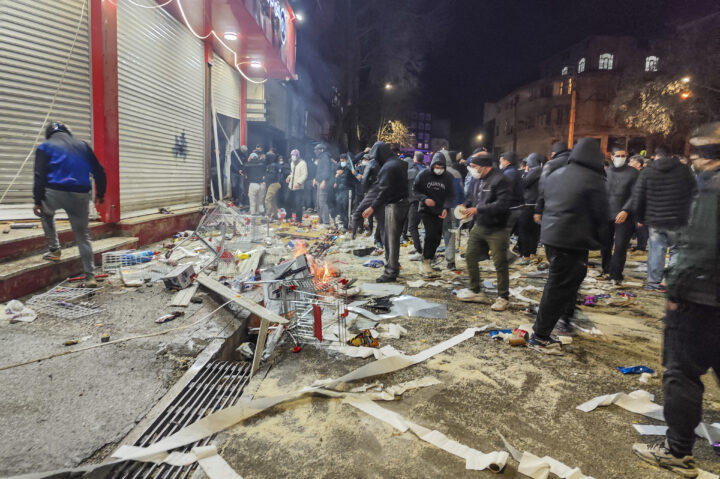
Iranians gather while blocking a street during a protest in Kermanshah, Iran on January 8, 2026.
Multiple Senate Republicans voiced support for President Donald Trump’s threat that the U.S. would intervene directly should the Iranian regime escalate its crackdown on the protests sweeping Iran — which appears to have already begun.
Trump warned in a post on his Truth Social platform last Friday that if Iran shoots “and violently kills peaceful protesters, which is their custom, the United States of America will come to their rescue. We are locked and loaded and ready to go.”
The president renewed that threat on Thursday on “The Hugh Hewitt Show,” saying, “If they start killing people, which they tend to do during their riots, they have lots of riots. If they do it, we’re going to hit them very hard.” But on Fox News’s “Hannity,” he said that “for the most part” the regime has not engaged in mass killings of protesters.
Asked on Thursday about the possibility of the U.S. helping the Iranian protesters, Vice President JD Vance expressed his support for the protesters but said he’d defer to Trump on what actions they would take. He also said the U.S. remains open to a “real negotiation” with Iran on its nuclear program.
“I’ll let the president speak to what we’re going to do in the future, but we certainly stand with anybody across the world, including the Iranian people, who are advocating for their rights,” he added.
Trump’s threat has been largely well-received by GOP lawmakers, but lawmakers from both parties have expressed support for the protesters generally.
“To the people of Iran: We stand with you tonight,” Sen. Lindsey Graham (R-SC) told Fox News on Tuesday evening. “We stand for you taking back your country from the ayatollah, a religious Nazi who kills you and terrorizes the world,” he said, referring to Supreme Leader Ali Khamenei “We pray for you. We support you. Donald J. Trump is not Barack Obama. He has your back. … Help is on the way.”
“And to the ayatollah: You need to understand, if you keep killing your people who are demanding a better life, Donald J. Trump is gonna kill you. Change is coming to Iran. It’ll be the biggest change in the history of the Mideast to get rid of this Nazi regime.”
“President Trump has been very clear: If the ayatollah harms the protesters, the consequences would be catastrophically painful,” Sen. Ted Cruz (R-TX) told Jewish Insider. “The regime should understand that the president is deadly serious and will enjoy strong support in Congress.”
Sen. Pete Ricketts (R-NE) told JI that “what the president said … [is] one of the things that we can do to help protect the Iranians who are protesting.”
Sen. John Fetterman (D-PA) told JI that the U.S. should act “in any possible way to support the Iranian protesters” and said he’d back any efforts in Congress to do so.
“That’s the real truth to power. They started to kill people there. Remember, they are now so desperate. They’re trying to offer people $7 a month. They’re that desperate,” Fetterman said. “How courageous those protesters are — and that’s a testament to the opportunities Israel and our strikes created — they inspire me. These are Iranian protesters. That is real courage and real — being willing to either get killed, beaten, tortured or disappeared, that’s what happens in true autocracies.”
Other senators spoke more broadly about offering U.S. support for the protesters without addressing direct intervention.
Sen. Richard Blumenthal (D-CT) noted that lawmakers haven’t engaged extensively about ways for Congress to support the protesters since returning from the holiday recess on Monday, but said it was important for them to express their support. “I’m open to any ideas. I think there’s been very little talk [among lawmakers] in specific terms,” Blumenthal told JI.
“We should speak out and support them in spirit,” Blumenthal said. “I don’t know how much we can do, practically speaking. I know the president has talked about some kind of measures if anyone is killed. I don’t know exactly what he has in mind, but we ought to be supporting the freedom fighters and brave protesters in any way we can.”
Sen. James Lankford (R-OK) said that the “biggest thing that we can do is actually have public officials speak out that our problem with Iran is not the people of Iran, it’s the Iranian regime. Our problem is the same problem the people of Iran have.”
“The regime oppresses them, prevents them from actually being [as] successful as they could be. The people of Iran [are] extremely well educated, extremely sharp people [and] could be a lot more prosperous than they are, but they’re trapped behind a regime that’s obsessed with terrorism, and so they’re holding back their entire country so they can fund Hezbollah,” Lankford said. “So people can’t get food, people can’t have a stable currency, because they want to fund terrorism. Until they have an ability to be able to pick new leaders that will actually represent their values, they’re stuck.”
Sen. Adam Schiff (D-CA) said it is “wonderful” to see the protests happening and that the U.S. “should support them diplomatically, technologically and in other ways, so that they can communicate.”
“But I think we should be very hesitant about expressing our willingness to use military force in yet another country for yet another reason,” Schiff added.
Other Democrats have also discouraged the use of U.S. military force in response to the protests.
Sen. Andy Kim (D-NJ) said the U.S. should “continue to show attention” toward Iran, “making sure we’re not just losing track of everything because of Venezuela, and just continuing to show that we want to make sure that the regime doesn’t crack down brutally as they have in the past.”
“I think that that’s an important sign right now, as this is continuing on,” Kim continued.
‘Let him go get a television network and say it so that people listen,’ the president said Monday

Chip Somodevilla/Getty Images
(L-R) Tucker Carlson, Rep. Byron Donalds (R-FL), former President Donald Trump, and Sen. JD Vance (R-OH) appear on the first day of the Republican National Convention at the Fiserv Forum on July 15, 2024 in Milwaukee, Wisconsin.
President Donald Trump dismissed Tucker Carlson at several points on Monday over Carlson’s comments opposing Trump’s support for Israeli strikes on Iran.
Trump, in recent days, has distanced himself from isolationist figures in the party who have condemned the strikes on Iran. Asked Monday at the G7 Summit in Canada about Carlson’s comments accusing Trump of being “complicit” in the war, Trump quipped, “I don’t know what Tucker Carlson is saying. Let him go get a television network and say it so that people listen.”
Trump later posted on his Truth Social platform, “Somebody please explain to kooky Tucker Carlson that, ‘Iran CAN NOT HAVE A NUCLEAR WEAPON!’”
Over the weekend, Trump had also criticized isolationists in his party,, declaring in an interview, “I think I’m the one that decides” what constitutes America First, adding, “For those people who say they want peace—you can’t have peace if Iran has a nuclear weapon.”
Carlson, who recently called for the U.S. to abandon Israel and to not provide any further funding or weapons, again criticized U.S. support for Israel in an appearance on former Trump advisor Steve Bannon’s show on Monday, and claimed that the administration was following direction from “foreign governments” aiming to enact “regime change” in Iran and who were dictating to the U.S. who its enemies should be.
While arguing that involvement in the conflict was not in the U.S.’ interests, neither Carlson nor Bannon mentioned or acknowledged Iran and its proxy forces’ role in the deaths of Americans across the Middle East in recent decades.
Please log in if you already have a subscription, or subscribe to access the latest updates.
 Continue with Google
 Continue with Apple