










































































Shoshan Haran, who survived 50 days in Hamas captivity, talks to JI about her new memoir and what she calls a campaign to invert the truth about Oct. 7.
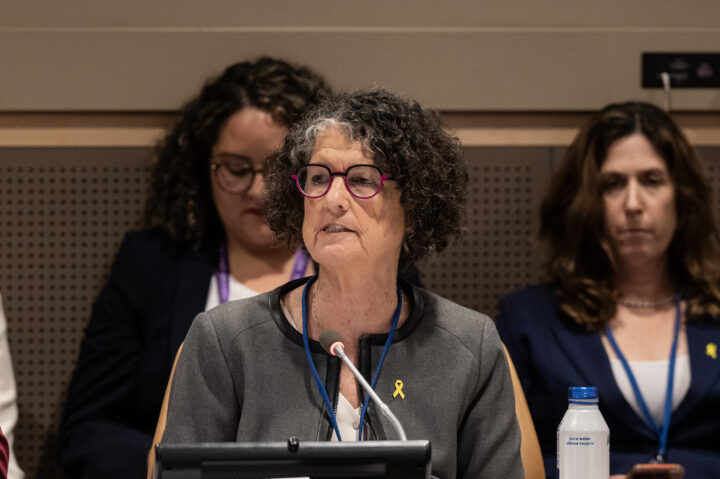
(Lev Radin/Pacific Press/LightRocket via Getty Images)
Shoshan Haran, who was kidnapped to Gaza along with her daughter, son-in-law, and their two children, and was released after 50 days speaks at arria-formula meeting on Hostage-Taking at UN Headquarters.


 Add JewishInsider on Google
For two years, Shoshan Haran thought of nothing except the hostages. After surviving 50 days in Hamas captivity, she spent much of the next two years traveling between the United States, Europe and Israel, meeting with lawmakers and government officials and pressing for the release of the remaining captives — including her son-in-law, Tal Shoham, who spent 505 days in Gaza, about half of that time in an underground tunnel.
Now, on the third anniversary of the Oct. 7, 2023, Hamas attacks and with every hostage either returned alive or brought home for burial, Haran is allowing herself to think about what comes next. “This is the first anniversary that we can start looking at the future,” she told Jewish Insider.
Her new memoir, Mission in Captivity: One Woman’s Struggle to Survive and Save Her Family in Gaza, is part of that next chapter — an effort to document what she experienced, mourn what she lost and make her voice heard about the events of Oct. 7 and their aftermath. Originally published in Hebrew, Mission in Captivity was released in English on Tuesday, one day ahead of the third anniversary of the attacks.
“I wrote the book so my voice will be heard,” said Haran, who was kidnapped from her home in Kibbutz Be’eri — the kibbutz her father founded after fleeing Nazi Germany and where she was born. Haran was taken alongside her daughter, Adi Shoham; her son-in-law, Tal; her grandchildren Yahel and Naveh (then aged 3 and 8); her sister-in-law Sharon; and her niece, Noam (then aged 12).The Shohams were visiting Haran to celebrate the holiday of Simchat Torah. Haran’s husband, Avshal Haran, and sister and brother-in-law, Lilach and Evyatar Kipnis, were murdered during the attack.
“It’s a platform and my way to communicate to the world,” Haran said of her book. She’s now living on a small kibbutz in northern Israel called Ma’ayan Tzvi, as Kibbutz Be’eri — where 101 civilians were murdered on Oct. 7, accounting for roughly 10% of the community’s population — is being rebuilt.
Haran initially assumed that Israelis did not need to be told what happened on Oct. 7. But writing the book changed her mind. “I was surprised because when I started to write the book, from my point of view, the goal was to address the world. I thought in Israel people knew what happened. But from the readers’ comments, I learned that it was not true.”
She also sees a vital global need for the book — particularly on Western college campuses, where distorted narratives about Israel have intensified since the attacks.
“For me what’s important is countering the inversion of the truth we are facing. The false campaign is working in a successful way to change the worldview of what happened. They depict the attackers as victims. This campaign started at 6:33 a.m. — four minutes after we heard the alarms on Oct. 7, they launched a heavily financed social media campaign saying Israel is doing genocide in Gaza. They twisted the worldview about what happened. There are two arms that are working against us — the terrorist jihadist arm led by Iran and its proxies: Hamas, Hezbollah, and the Houthis. And then you have soft jihad, spearheaded and financed by Qatar, which wages an awareness campaign designed to mislead the world.”
“I’m not afraid to talk to anyone, although I’m troubled by the aggression from those who call themselves liberals and progressives whenever they encounter facts that contradict their preconceived narrative,” said Haran, who is speaking to Jewish communities on her current book tour, but said she would like to do so at universities as well in the future.
In the book, Haran describes the period before Oct. 7 as one of “double blindness”: Israelis living near the Gaza border knew Hamas posed a threat, but could not imagine the scale of the danger, while the Hamas terrorists who held her captive, she said, had little understanding of why Jews live in Israel or the history of the Jewish people.
“We knew there was terror but we thought it was a small part of the population,” she said, describing life on Kibbutz Be’eri — about 3 miles from the Gaza border — as “98% paradise and two percent hell,” despite the constant missile threat. “Because of our own moral values, we were unable to comprehend that they really wanted to kill us,” she said. “As citizens, we didn’t see protection as our duty. This is the role of the IDF and Mossad.”
Her conversations with her captors revealed a similar gulf in understanding, she said. “They had no idea why Jews are living in Israel. They had no clue about the deep-rooted history of the Jewish people in Israel, and no clue about the Holocaust.”
Haran credits her work pre-Oct. 7, as an agronomist who founded the nonprofit Fair Planet to bring agricultural knowledge to farmers in Africa, for instilling in her the confidence to have those conversations with her captors — all while fighting not just for her own survival, but for the lives of her younger family members.
“At some point, I did tell the captors about Fair Planet,” she recalled. “They asked me, ‘Why don’t you come to help our farmers in Gaza?’ I told them I’d be glad to come once there is peace.”
“Being in Gaza with bombs all over us, with captors pointing guns at us, I was focused on the here and now,” she told JI. “I do think my life experience before Oct. 7 equipped me with the strength to look the captors in the eye and demand respect.”
Haran — who describes herself as someone who believed deeply in cooperation and peace — said her time in captivity changed the way she thinks about the possibility of peace, though she has not lost hope. “If we will be able to stop the funding of terror and change the education system in Gaza and the West Bank — which teaches children to hate Jews and trains them to be fighters from age 5 — peace could be possible. You need to address the roots that nourish the terror.”
“Many people ask me if I see any grounds for optimism,” she continued. “First of all, look at Israel’s Arab population; they make up about 20% of the country. They did not join the attack on Israel and since then, there has been a sharp rise in the number of young Israeli Arabs who join the civil service in Israel. Another reason for optimism is that quite a few Muslim nations are actively seeking ties with Israel. They recognize that ‘pro-Palestinian’ rhetoric often harms Palestinians, and they understand that Iran drives the region’s instability. I hope this momentum continues to build.”
Haran was released on Nov. 25, 2023, alongside Adi and her grandchildren, as part of a temporary ceasefire and hostage release agreement.
For Haran, the hardest part came after she returned home. During her 50 days in captivity, she had little understanding of the scale of the Oct. 7 attacks or what had happened to her husband, Avshal.
“During captivity we did not know the scope of the attack,” she said. “We didn’t know about the Nova music festival or other kibbutzim. And I didn’t know about my husband. I did suspect that my sister and her husband were murdered on the spot because their house was severely shattered. When we returned, we realized how hard it was going to be.”
“The second part is harder,” she said, referring to the aftermath of returning home. Her son-in-law Tal remained in captivity for another 455 days, until his release in February 2025. “That was my whole identity — the fight to release the hostages.”
Instead of being broken by catastrophe, Haran is determined to continue what she calls her “mission” — a nod to the book’s title. That mission now centers on a U.S. book tour speaking to Jewish audiences, which began on Sept. 30.
“I want the world to know what happened and how we got to this point,” she said. “I want readers to base their opinions and actions on facts and an understanding of the complexity of the issue; that’s why I wrote the book.”
Rabbi Arie Zeev Raskin, chief rabbi of Cyprus, said the Israelis stranded on the island amid Israel’s war with Iran are making ‘lemonade out of lemons’

Courtesy Chabad of Cyprus
Israelis stranded in Cyprus amid Israel's war with Iran gather at Chabad.
An American couple who were en route to Israel to celebrate their wedding but had their flight diverted. Two Israeli single mothers on holiday looking for a quick refresh, now stranded. A group of injured Israel Defense Forces soldiers on a healing retreat.
These are some of the nearly 2,500 Jewish people that Rabbi Arie Zeev Raskin, the chief rabbi of Cyprus, and his wife, Shaindel, unexpectedly found themselves hosting for Shabbat last Friday after at least 32 flights from the United States and Europe were diverted to the island in the Mediterranean amid Israel’s preemptive military campaign against Iran, which was launched early Friday morning.
“Everybody in the community gave a hand with cooking and preparing,” Raskin, who has run the local Chabad center in the port city of Larnaca since 2003, told Jewish Insider.
Shabbat at Chabad “was amazing, a crazy experience,” said Tzvi Berg, a Jerusalem resident who was flying home from a wedding in New York on Thursday night when — just moments away from landing in Tel Aviv — his flight was rerouted to Larnaca.
“When the pilot made the announcement, everyone went online and saw Israel was attacking Iran and instead of being upset, everybody was clapping,” Berg said.
But as Shabbat ended — with Israeli airspace still shuttered as Iranian missiles continued to strike in Tel Aviv and elsewhere — “the challenge began again,” Raskin said. Hotels on the island are overwhelmed. Tourists have exhausted their vacation funds. People with chronic illness can’t access medications.
And they are knocking on Chabad’s door looking for food and accommodations, as many Jews do in moments of crisis around the world.
“We have a few challenges at the moment,” Raskin said.
“People have started to lose patience. Parents want to get back to their kids,” said Berg, who on Tuesday traveled some 30 miles to the island’s other Chabad, located in the resort town of Ayia Napa, where he barbecued for the injured IDF soldiers.
The couple whose wedding is scheduled for Thursday remains hopeful they can still get to Israel via boat.
One of the single mothers who came to Cyprus on vacation has two children with special needs in southern Israel facing constant missile fire. “There’s a lot of tears and crying that she can’t get back to her kids,” Raskin said.
Still, Raskin said that most of those stranded are making “lemonade out of lemons” during their time on the picturesque island — which is a popular tourist destination for Israelis due to its proximity.
“The majority of the people here trust in God, so you see happy faces,” Raskin said. “They’re saying, ‘OK, we’re here on holiday, we have a place to stay and food, we’re happy.’”
Cypriot police said on Sunday that security measures would be increased for Israeli tourists following concerns that Iran or its proxies could attempt to target them abroad.
Israel’s Transportation Ministry announced on Monday it would launch Operation Safe Return to bring close to 150,000 Israelis stuck abroad back home. According to the Israeli airline El Al, 60,000 Israelis registered for rescue flights to return them to Israel within the first 90 minutes of the registration site going live on Monday.
Israeli carriers El Al, Arkia and Israir announced on Tuesday that they received permission from the Israeli government to organize repatriation flights to bring back Israelis stranded abroad. The first two flights from Larnaca, Cyprus, landed at Ben Gurion Airport on Wednesday morning.
“People are doing crazy stuff to get back,” Berg said, adding that while he looks forward to reuniting with his wife and children, who have been hunkered down in Jerusalem, the people in Cyprus “have been very hospitable and accommodating. They love Israelis.”
“I was here [on holiday] in the summer once, but this is a different experience,” said Berg.
Some Israelis, including Aliyah and Integration Minister Ofir Sofer, who was stuck in Azerbaijan, which borders Iran, were able to return home over the weekend by flying to Greece and then to Cyprus, from which they took a boat to Israel. Others, including civilians, have charted private flights from Larnaca to Israel through Sharm el-Sheikh, Egypt.
But Raskin advises displaced Israelis who are safe in Europe to “stay where you are if you have good accommodations.”
“Don’t rush to Cyprus because it won’t get you to Israel any faster.”
Tourists stranded in Israel are taking extreme measures to exit the country, navigating a labyrinth of WhatsApp scams, exorbitant prices and sold out tugboats

GIL COHEN-MAGEN/AFP via Getty Images
The empty departures hall at Ben Gurion Airport near Tel Aviv on June 13, 2025 after Israel closed its air space to takeoff and landing.
Last Thursday, Sam Heller went to sleep at a Tel Aviv hotel, thinking that any potential military action between Israel and Iran wouldn’t start until after his flight back to the U.S., scheduled for Saturday night.
He was wrong.
When Home Front Command alerts woke Heller at 3 a.m. on Friday, informing the nation that Israel had launched a preemptive attack on Iran’s nuclear facilities, he quickly booked the first flight out to Paris from Ben Gurion Airport.
“I went straight to the airport, and they locked the doors to Ben-Gurion, and they stopped letting people in,” Heller told Jewish Insider on Tuesday, safely back home in Cleveland. “They’re like, ‘We’re closing our airspace indefinitely. Your flight’s been canceled. All flights are canceled. You can’t get out.’”
Like some 38,000 other foreign visitors stranded in Israel after the country’s preemptive strikes on Iran prompted days of Iranian ballistic missile attacks on Israel, Heller began to try to think of creative ways to leave the country. First he called an Israeli shipping company and asked if he could travel as a stowaway on a cargo ship heading to Cyprus. They told him yes, at a cost of 87,000 Euros for 12 people. He said no.
Then Heller, who was visiting Israel as the last leg of a monthlong trip after graduating from the University of Michigan in May, called a sailing company from which he had rented a boat two years ago. They told him the only boat suitable for travel to Cyprus was out of commission. Another no. Next, a phone call to a company that offers helicopter tours of Israel, thinking helicopters might not be included in the ban on flying. Nope.
Finally, he tracked down a company that offers private security details in the Middle East. There, he identified a circuitous route out of Israel that took him 36 hours: departing Israel through the Taba border crossing to Egypt, being driven three-and-a-half hours to Sharm el-Sheikh and taking a flight from the Sinai resort town to Istanbul. He left Israel Saturday night after Shabbat and landed in Cleveland at 11 p.m. the next day. That’s a relatively fast trip compared to others who have made it out.
In the days since the Iran-Israel war started, a cottage industry has emerged to help ferry people from Israel to other destinations around the globe.
Israeli airspace was closed for five days and the U.S. Embassy said it was unable to assist Americans seeking to evacuate. After the Oct. 7, 2023, attacks, several State Department-led charter flights brought Americans to Athens — but charter flights were not an option following Israel’s attack on Iran and the ensuing war between the two countries. A State Department spokesperson declined to comment on Tuesday.
El Al canceled all flights out of the country through at least June 23, and foreign carriers pulled out of Israel for longer. Israeli carriers El Al, Arkia and Israir announced on Tuesday that they received permission from the Israeli government to organize repatriation flights to bring back Israelis stranded abroad. The first two flights from Larnaca, Cyprus, landed at Ben Gurion Airport on Wednesday morning.
The Israeli Tourism Ministry launched an effort on Tuesday to facilitate the departure of tourists from the country, distributing a digital registration form for departure flights from the country.
But until those flights begin, in WhatsApp threads, Facebook groups and private messages, Americans stuck in Israel are passing along any information they can find to try to help get themselves and their loved ones home. The details are hard to verify. The costs range from expensive to astronomical.
One graphic shared widely on WhatsApp advertises an emergency evacuation flight from Israel to New York, promising a Wednesday afternoon departure to Eilat and a bus transfer to Sharm el-Sheikh, followed by a charter flight to Milan and then a connection to JFK — “lavish meals included” and “security escorted” — for $2,200 a person. According to the travel company’s website, though, it was already sold out by the time the graphic circulated. Another message advertised a chartered flight from Aqaba, Jordan — near Eilat — to Paris, for $3,000 a person. Abraham Tours, a travel company best known for its hostels in Tel Aviv and Jerusalem, advertised a cross-border transfer to Amman for $438.
Adir Fischer is the vice president of marketing at Magnus Safety, a global search-and-rescue company based in Israel that is arranging boats to take people between Haifa and Larnaca, Cyprus. He can fit about 25 people on a tugboat for a 17-hour journey, costing between 1,000 and 2,000 Euros a person.
“If you have three kids and a husband, it’s around 7,000 Euros a trip. Not everyone has it liquid, and it’s prepaid,” Fischer told JI on Tuesday. That’s before adding in the cost of flights from Cyprus back to the U.S. Still, he has turned away over 100 people because there isn’t enough room on the boats.
One American woman who lives in Israel plans to depart on Wednesday on a small boat privately arranged by her husband’s company. They will be traveling with their six-month-old baby and two friends, at a cost of $15,000 for the five people.
“Either I’m brave, crazy or an idiot. I’m not quite sure yet. But we really want to get out,” she said, requesting anonymity to speak about sensitive travel details.
Early Sunday morning, Shira Raviv Schwartz woke up to a red alert. She was in Israel visiting her cousin, a trip she takes most summers. Soon after, her apartment building in Tel Aviv shook violently. In the morning, Schwartz saw that the next block had sustained a direct hit from an Iranian ballistic missile. She decided she needed to leave with her husband, their young adult son and her 84-year-old father-in-law.
“I can’t take another night anxious in the safe room,” Schwartz said from Amman, where the family awaits a flight to Cairo, then another to Athens and finally a flight home to Chicago.
Large tour groups have been luckier than individuals or families, who have to sort through the options themselves. Birthright Israel arranged for a private luxury cruise ship to bring 1,500 American young adults to Cyprus, where they boarded four planes back to the U.S. chartered by Florida Gov. Ron DeSantis.
Jonathan Schanzer, who was leading a delegation hosted by his think tank, the Foundation for Defense of Democracies, worked with the organization’s staff to get the group to Amman via the Allenby Bridge, the only border crossing between the West Bank and Jordan. (This is not an option for Israelis, who are not permitted to pass there.) He considered whether driving to Allenby amid the threat of incoming Iranian missiles was too dangerous but decided to risk it.
“Every security specialist warned me that the time in the war away from a shelter was the dangerous period, and I understood that,” Schanzer told JI. “But we were running out of programming for our participants and they were all sleep-deprived, as was I, from the incessant sirens every night. They didn’t sign up for this.”
Jerusalem travel agent Mark Feldman said the key is not to tell clients what to do, but to give them options.
“Let him or her make the choice. I would never want to be responsible for somebody taking a 24-hour boat to Cyprus, throwing up the whole way, and emailing me saying it was the worst time of their life,” Feldman, the CEO of Ziontours, told JI.
His business is at capacity simply trying to get existing clients into and out of Israel. His advice to those without a connection to a travel agent is to stick to trusted sources and avoid the “incredible amount of rumor-mongering.” Mostly, he is advising people to be patient, particularly those who do not have the appetite for a dayslong odyssey through multiple countries.
But those who are waiting until the airspace reopens are not going to have an easy time leaving, Feldman warned.
“Hard as it is just calming people down and relaxing them, the problem will come when the airport is open, and the thousands of people that are stuck here won’t have flights to get out,” said Feldman. If the airspace opens on June 23, the flights departing that day will be the ones that were initially scheduled for June 23 — meaning anyone with a June 23 ticket will have a confirmed seat. Everyone who has been stuck in Israel for days will be competing with each other for the empty seats.
“Many people assume, ‘Because I was bumped, I get first priority,’” said Feldman. “You don’t.”
Please log in if you already have a subscription, or subscribe to access the latest updates.
 Continue with Google

 Continue with Apple