










































































Rabbi Mordechai Lightstone: ‘When we ascribe human attributes — emotions, consciousness and soul — to AI, we risk transforming a sophisticated instrument into an idol’

Getty Images
Illustrative


 Add JewishInsider on Google
When Rabbi Joseph Potasnik, an Orthodox rabbi from Brooklyn, stepped up to the microphone in April to share his perspective on what Judaism has to say about artificial intelligence, his remarks resembled a sermon he might deliver on the bimah.
Except the audience for this talk was not congregants. It was interfaith religious leaders, and — more importantly — representatives of the Silicon Valley giants Anthropic and OpenAI.
Potasnik quoted the Book of Deuteronomy, when Moses delivers his final address to the Israelites before they cross into the Promised Land. “I call heaven and earth to witness against you today: I have put before you life and death, blessing and curse. Choose life, so that you and your offspring may live,” Moses says, channeling the words of God.
“Of course you’re going to choose life,” Potasnik said at the AI convening, comments he relayed to Jewish Insider this week. “But sometimes when you choose it, it also comes with certain dangers. If you look at the story of the Garden of Eden, for example, you are forbidden to eat of the tree of knowledge. Why? You can understand when you look at AI, because knowledge without guardrails, knowledge without a moral component, can be a very dangerous thing.”
Potasnik, who is the executive vice president of the New York Board of Rabbis, delivered this word of caution at the inaugural gathering of a new initiative called the Faith-AI Covenant, which argues that religious communities have something valuable to teach the companies developing the large language models that are reshaping the way many humans engage with knowledge and with the world around them.
A group of rabbis, educators and thinkers in the Jewish world is deeply engaged in considering related questions.
Some of them are theological, almost halachic: Should rabbis be allowed to use AI to write sermons? Can an AI chatbot be considered a havruta, or study partner, in place of an actual human? Should AI even be used for serious Jewish study?
DZ Kalman, a research fellow at the Shalom Hartman Institute who studies Judaism and technology, argued strongly against AI being used to write sermons. “I think people in religious communities would like to know that there’s at least one space in their lives when they are able to be free of machines, when they can actually just be humans interacting with other humans,” he said.
The Orthodox Union faced criticism from within its ranks after releasing a new app in March that uses AI to help people study Torah. Rabbi Netanel Wiederblank, an instructor of Talmud, halacha and philosophy at Yeshiva University’s rabbinical school, delivered a talk at YU where he criticized the app and said AI should not be used to resolve rabbinic debates.
“It’s true the OU says you shouldn’t rely on such an app for practical halacha, though one wonders what purpose there is in putting it out,” Wiederblank said.
Other questions are more philosophical in nature. How can Jewish wisdom guide people who are looking for meaning at a moment of massive technological and even societal upheaval, with the possibility of looming job loss? What is the value of God when AI comes across as all-knowing?
“We spent a few thousand years thinking really hard about what it means to be human and how to be human and how to live a purposeful life,” said Joshua Foer, the founder of Sefaria, an online library of Jewish texts. “At a moment when we’re going to be really challenged about how to be human, I think Judaism’s got a lot of compelling answers, and maybe this is the moment that we really need to stand up and be a light.”
And then there is the matter of whether LLMs should be shaped, in some way, by religion. They already are being built with certain parameters for morality.
Anthropic was created by several former OpenAI employees who were concerned about AI safety, and the company has built its brand on the idea that AI should be constructed responsibly. Anthropic employs Amanda Askell, a philosopher, to teach morality to Claude, Anthropic’s popular chatbot. In January, Anthropic published its 30,000-word “constitution” for Claude, which details how the company trained Claude and the values it hopes to imbue in the chatbot. “We want Claude to have good values,” the document states.
“A lot of people, I imagine, are very happy just to be told that they’re absolutely right, so I think that this could be an instance where potentially some Talmudic AI that’s more designed to offer a counter argument or multiple perspectives off the bat might be an interesting way to counter this default solipsism,” said Zohar Atkins, a rabbi and philosopher.
OpenAI also professes to value safety, and OpenAI founder Sam Altman told a Senate hearing in 2023 that people are “rightly anxious” about the technology. The company released a document in December described as its “model spec,” which discusses “our approach to shaping desired model behavior.” ChatGPT is taught to “love humanity,” and “humanity should be in control of how AI is used and how AI behaviors are shaped,” according to the model spec.
“All of [the chatbots] are interested in the question of how do you align the AI to not do bad things and to do good things, and then there’s obviously a lot of complexity under the hood of defining what the good is and what do you do when there’s ethical dilemmas,” Zohar Atkins, a rabbi and philosopher, told JI.
Atkins is building an AI chatbot called Yochai to help people engage with Jewish texts. Could there be a “Torah values AI,” he asked, where Jewish virtues like debate and humility are baked into the way a chatbot engages with users? He drew a contrast between that idea to the way most chatbots adopt a sycophantic approach, telling the user what they want to hear.
“A lot of people, I imagine, are very happy just to be told that they’re absolutely right, so I think that this could be an instance where potentially some Talmudic AI that’s more designed to offer a counter argument or multiple perspectives off the bat might be an interesting way to counter this default solipsism,” said Atkins.
This spring, Anthropic convened two major summits for faith leaders. The first, in March, was a two-day gathering for Christian leaders. Several weeks later, Anthropic hosted another two-day event featuring guests from several religious minorities: Confucian, Hindu, Jewish, Latter-day Saint, Sikh, Unitarian Universalist, African indigenous, Islamic and Taoist, according to Politico.
“As AI becomes more consequential for society, questions about the values and moral considerations that shape these systems are important ones, and we think they benefit from a wide range of perspectives,” an Anthropic spokesperson told Politico. (JI did not receive a response to a request for comment to Anthropic. OpenAI declined to comment for this article.)
“Increasingly powerful general purpose AI is not inevitable. It’s a choice, and moral choice as much as anything else. Just because you can build something, doesn’t mean you should build it,” said Alex Pascal, the executive director of Harvard’s Berkman Klein Center for Internet & Society and a former advisor to President Joe Biden on AI policy. “What I hope the faith leaders are communicating is that the potential impact of AI and the impact already of AI is gargantuan, and it’s really affecting almost everybody, and that the power to design and deploy the technology should not be in the hands of a very, very select few people.”
Kalman, who attended the April meeting, declined to share much, noting that it was conducted under the promise of privacy. But he described Anthropic as a new company that “has found itself with huge amounts of power and is trying to understand how to wield that power responsibly.” He entered the meeting with a good deal of skepticism, he wrote in a blog post afterward, but he left feeling hopeful.
Even if AI companies are engaging with the diverse users of their products in good faith, any guardrails placed on their LLMs come entirely at the discretion of the companies creating those products. That leads to potentially conflicting motivations — grow their product and build their bottom line, or err on the side of responsibility and safety?
“Right now, there’s gargantuan power asymmetry. It’s really a few people, at the end of the day, who are designing and deploying AI to all of us,” said Alex Pascal, the executive director of Harvard’s Berkman Klein Center for Internet & Society and a former advisor to President Joe Biden on AI policy.
“Increasingly powerful general purpose AI is not inevitable. It’s a choice, and moral choice as much as anything else. Just because you can build something, doesn’t mean you should build it,” Pascal continued. “What I hope the faith leaders are communicating is that the potential impact of AI and the impact already of AI is gargantuan, and it’s really affecting almost everybody, and that the power to design and deploy the technology should not be in the hands of a very, very select few people.”
Anthropic, for instance, recently said it would not release a new AI model called Mythos because it is too powerful, and runs the risk of severely undermining global security. But any decisions like this rest on the goodwill of the people running these companies, each of whom have their own biases and blind spots.
“The people creating this are going to introduce a certain level of their own worldview into what they’re creating,” said Rabbi Mordechai Lightstone, the director of Tech Tribe, a New York-based affiliate of Chabad Young Professionals that serves as a gathering place for Jews working in the tech sector.
Lightstone considers himself an advocate for the technology, but he has warned of the risks of putting too much faith in AI.
“When we ascribe human attributes — emotions, consciousness and ‘soul’ — to AI, we risk transforming a sophisticated instrument into an idol,” Lightstone wrote in a recent blog post. “Key to our harnessing AI is understanding it for what it is: A tool — an immensely powerful one — but not a being with a soul.”
One Jewish response to the almost-messianic belief that AI will usher in a utopia comes from Sefaria’s chief learning officer, Sara Wolkenfeld and Sam Arbesman, a scientist-in-residence at the venture capital firm Lux Capital. The pair wrote in Arc Magazine last month that a Jewish approach to AI might be rooted in the incremental approach of tikkun olam, repairing the world step by step.
They compared it to the Talmudic story of Rabbi Akiva, who “is said to have been inspired to reach for greatness after observing the power of water to wear away stone, drop by drop, as he drew water from the local well,” the Wolkenfeld and Arbesman wrote. “Therein lies the potential of artificial intelligence from a Jewish perspective — not as a far-off goal or panacea, but as a set of tools that provide each of us the means to chip away at barriers and obstacles and create an improved society.”
Last month, Pope Leo XIV released a 42,000-word document known as an encyclical that called for the safeguarding of human dignity as AI develops further and becomes even more integrated into people’s lives. Some rabbis have explored similar questions, but nothing has come close to exerting as much power or reach as the pope’s document. Some of that is by design; Judaism has no central leader of any kind. But some of it may be because many religious leaders have not fully comprehended the scope of the developing technology’s potential.
“A problem I’d say in the Jewish world right now is it’s not clear whose job it is to think about this,” Wolkenfeld told JI.
“I think the Jewish community needs to be actively grappling with a whole range of questions. What does it mean to be human? What are we outsourcing to technology versus retaining for ourselves? We’re going to be seeing massive job dislocation, and so what does that mean, first of all, socioeconomically in our communities?” Zvika Krieger, the rabbi of Chochmat HaLev, said. “Also, for so much of human history, people’s worth and their days were tied to their profession, and we’re seeing a fundamental change of how to build a meaningful life.”
Zvika Krieger is the rabbi of Chochmat HaLev, a progressive minyan in Berkeley, Calif. He does not have the typical resume for a rabbi: He was Facebook’s director of responsible innovation, and a State Department “ambassador” to Silicon Valley in the Obama administration. He now consults for Silicon Valley tech companies, including both Anthropic and OpenAI.
“Most of the leaders in the Jewish community don’t know much about AI, so it can feel like the blind leading the blind. I’m often the only person in the room for these conversations who’s actually worked in a tech company, and the knowledge gap limits how productive these conversations can be,” Krieger told JI.
He described AI as an “epochal technology that is going to fundamentally change the nature of humanity in a way that I think we haven’t seen since the printing press.”
“I think the Jewish community needs to be actively grappling with a whole range of questions. What does it mean to be human? What are we outsourcing to technology versus retaining for ourselves? We’re going to be seeing massive job dislocation, and so what does that mean, first of all, socioeconomically in our communities?” asked Krieger. “Also, for so much of human history, people’s worth and their days were tied to their profession, and we’re seeing a fundamental change of how to build a meaningful life.”
In some ways, conversations about AI are everywhere within the Jewish community — at congregations, at Shabbat dinner tables, at campus Hillels — because of how rapidly the technology has become a part of everyday life. But discussing how to best use specific tools is different than the biggest questions about life and society that AI prompts.
The Jewish conversation about AI needs to be “top-down and also bottom-up,” said Wolkenfeld. “I think every rabbi needs to be thinking about this.”
Potasnik, the New York rabbi who addressed the interfaith tech convening in April, agrees that AI is a transformative technology. But Potasnik, who is 79, remembers how other technological innovations have upended his rabbinate, too, a perspective he brings into his observations on AI.
“We used to think that the newspaper, the radio, those were the popular places for dissemination of information. Well, how many people listen to the radio for information [now]?” Potasnik said. “When I first became a rabbi, I said, ‘If you don’t know baseball, you can’t be a successful rabbi.’ Today, if you don’t know technology, you’re not going to be successful either. You’re going to be seen as ancient, not advanced.”
But Potasnik believes there is one thing that AI cannot replace that is at the heart of what it means to be Jewish.
“We have what’s called the theology of presence. You have to be present, you have to show up, that’s what people want,” Potasnik said. “I think AI cannot take that from us. We still need the human to hug, to hold. We need to see each other, listen and learn from each other. These are important, indispensable ingredients in our human relationships.”
The victims claimed they were targeted for speaking Hebrew; the Santa Clara district attorney said the case remains an ‘active investigation’
Stephen Lam/San Francisco Chronicle via Getty Images
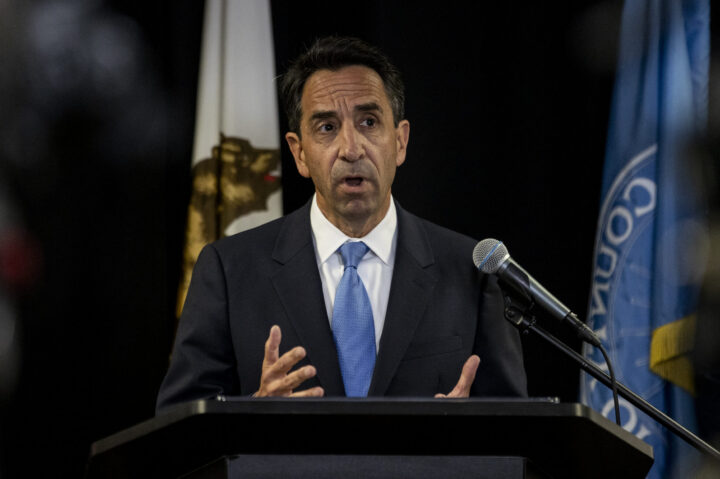
Santa Clara District Attorney Jeff Rosen speaks during a charge announcement to the participants of the 2024 Anti-Israel-Palestine war break-in and vandalism at Stanford University, in San Jose, Calif., Thursday, April 10, 2025.
Three men accused of assaulting two Israeli American men outside a restaurant in a Silicon Valley shopping mall last week were arrested on Monday, the Santa Clara County District Attorney’s Office announced. The alleged assailants were charged with both misdemeanor and felony offenses, but they were not charged with hate crime-related offenses.
On Sunday, March 8, videos show the two men being assaulted in the middle of the day as other diners and shoppers looked on. The victims, Lior Zeevi, 47, and Daniel Levy, 48, told The Jewish News of Northern California that the attack began after they were overheard speaking Hebrew, and that one of the assailants yelled “f***ing Jew.” According to a police report, a witness heard one of the perpetrators shout “Don’t f*** with Iran” as he ran away.
The charges filed “do not reflect allegations of a hate crime at this time. However, this remains an active investigation,” according to a statement from the Santa Clara DA. A spokesperson for the DA’s office declined to comment when asked why hate crimes charges were not filed.
The San Jose Police Department said last week that it was investigating the incident as a hate crime. The police report identified the attack as a hate crime in which the victims were targeted for their ethnicity or nationality.
The alleged attackers were named as Bruneil Henry Chamaki, 32, Roma Akoyans, 20, and Ramon Akoyans, 18. Chamaki appears to be an attorney who recently left a law firm in Sacramento, according to his LinkedIn. He is also the founder of Assyrian Advisors, an organization for the Assyrian community, a Christian ethnic group indigenous to Iraq, Iran, Turkey and Syria. A LinkedIn page for Roma Akoyans lists him as an intern for Assyrian Advisors.
“We won’t tolerate pummeling a victim on the ground in front of a restaurant or anywhere, and we will hold the perpetrators fully accountable,” Santa Clara DA Jeff Rosen said Monday.
Tech entrepreneur Ethan Agarwal: ‘He thinks being racist against Jewish people is going to help him win the American left. I don’t care if he’s right. I just think it’s unethical and immoral’
Courtesy
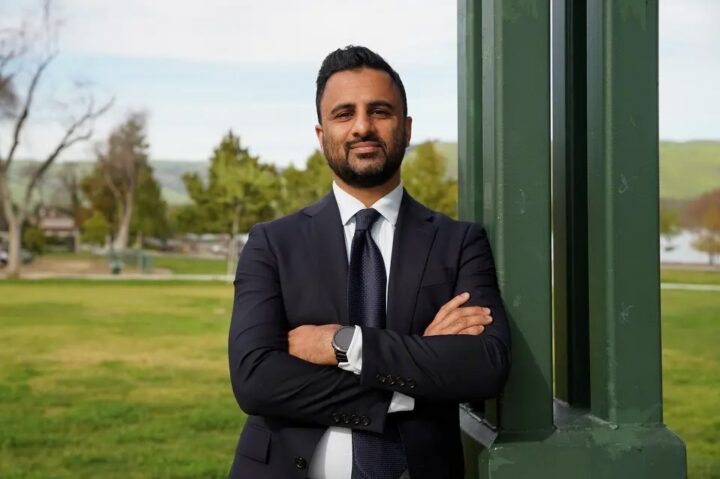
Ethan Agarwal
Rep. Ro Khanna (D-CA) has become one of the harshest critics of Israel in the House, in recent months associating with some of the leading anti-Israel figures within the Democratic Party — at one point proudly declaring his ties to a far-left antisemitic podcaster.
In his pushback to the U.S. war against Iran, he has caricatured those supportive of taking military action against the Islamic Republic as part the “Epstein class” — which critics have accused of being an antisemitic trope — while defending right-wing commentator Pat Buchanan from past charges of antisemitism.
As a result, he is facing a primary challenge from tech entrepreneur Ethan Agarwal, who is accusing the congressman of embracing far-left views to seek national attention for a potential presidential campaign — at the expense of focusing on constituents back home in the Silicon Valley-based district.
“The district is being represented by a guy who could not care less about the people in the district, and that’s frustrating because I supported Ro when he first ran back in 2012,” Agarwal told Jewish Insider on Friday. “He’s completely [turned around] on basically everything that he said to his supporters.”
Agarwal said he sees Khanna’s activities, including his opposition to the Iran war and outspokenness against Israel, as plays for national attention, rather than representing the district that elected him.
Khanna “just totally does not give a s*** about the district. He’s running for president, and he wants to run to the left on every issue,” Agarwal alleged. “The district needs a representative that’s focused on the district itself, and that’s why I’m running for Congress.”
Those allegations of political opportunism were echoed in a recent Washington Post column by writer James Kirchick, who reported that Khanna professed to being a strong ally of Israel and the Jewish community earlier in his career when he was seeking a role in the Obama administration. The op-ed framed Khanna as a relentless self-promoter willing to change his views for attention and career advancement.
Khanna, in response to the allegations that he’s lost focus on his district back home, told JI he was “proud of my record representing California’s 17th district,” pointing to his work to secure $13.5 million in funding this year for projects including affordable housing, veteran housing, safe routes for children to get to school, clean water and transportation. He added that he has held nearly 80 town halls, is regularly meeting with local community leaders and is in touch with anti-ICE activists, and touted his constituent services and endorsements from local leaders and groups.
“And I’m willing to take on powerful people when accountability is needed. When I called for the release of the Epstein files, many dismissed it and said no one in the district would care. They were wrong. Constituents raise it with me regularly because they want transparency and justice for survivors,” Khanna added.
Agarwal’s criticisms go beyond hitting Khanna for putting national issues ahead of local ones. He accused the congressman of engaging in shoot-from-the-hip social media commentary that has inflamed antisemitism at a time of heightened fears within the Jewish community.
“Even if you weren’t running for Congress or trying to run for president — what is wrong with you?” Agarwal said. “If the congressperson of the district is advocating these kinds of things publicly, it stokes and it inflames the culture on the ground.”
“He thinks being racist against Jewish people is going to help him win the American left,” Agarwal added. “I don’t care if he’s right. I just think it’s unethical and immoral.”
Khanna responded that he has “consistently condemned antisemitism in all forms,” including speaking out specifically against various recent incidents, that he has been “been clear in my support for Israel as a Jewish and democratic state,” that he has worked with Jewish leaders and visited synagogues within the district.
“This issue is personal for me. My nieces and nephews are Jewish through my brother’s marriage, which has deepened my understanding of why it is so important to speak out against antisemitism in any form,” Khanna continued.
Defending his affiliation with New York City Mayor Zohran Mamdani, Maine Senate candidate Graham Platner and far-left influencer Hasan Piker, Khanna said, “I do believe like Franklin Roosevelt and President Obama that we need to build a big tent, and Mayor Mamdani and Graham Platner are part of that. I also engage with media across the political spectrum, from Hasan Piker to Shawn Ryan to Theo Von to Sean Hannity, because we shouldn’t shy away from debates or discussions with people with different ideologies. We must engage.”
Agarwal has publicly linked Khanna’s rhetoric to an assault on two people speaking Hebrew in a San Jose restaurant earlier this week. The attack took place within Khanna’s district.
“It doesn’t take a genius to draw a line between those two things,” Agarwal said.
“We MUST capture and punish the perpetrators. Beyond that, we HAVE to turn down the dial of anti-Israeli rhetoric. [Khanna] acknowledge your role in this, and apologize for inflaming tensions,” he urged the congressman on X last week. “Take responsibility for creating the environment that enables these lunatics.”
In response, Khanna called the assault “horrific” and said it has “no place in our community,” adding that he had “unequivocally condemned” the attack and pushed for the attackers to be prosecuted.
“I’ve taken concrete steps to confront antisemitism locally. I’ve held multiple town halls and meetings with members of the Jewish community across the district to hear directly about their concerns and make sure they feel safe,” Khanna said.
He also highlighted his move two years ago to appoint a staffer in his office to serve as a point of contact for community members on antisemitism and a recent town hall he held with a local Jewish Democratic group.
“My focus has been making sure that when antisemitism occurs, our community knows it will be taken seriously and addressed immediately,” Khanna continued.
While he didn’t weigh in on the broader strategic goals of the U.S. operation in Iran, Agarwal has argued that it’s an unequivocal good for the Iranian people and the world that Iranian Supreme Leader Ayatollah Ali Khamenei, who was killed on the first day of the joint U.S.-Israel operation, is dead, and criticized Khanna for trying to prevent or stop the U.S. operation against Iran.
“I am in support of the murder of Ali Khamenei because he was a brutal dictator and 20,000 Iranian Americans in [this] district — I spoke to many of them — agree with that,” Agarwal said. “I don’t know what happens from here. I think there’s open questions. I think there’s a good path, and there’s mistakes that can be made, but what I do know is that Iran is better off without him, and I think America is better off without him being alive.”
Khanna stood behind his advocacy for the war powers resolution, emphasizing the support it received among House Democrats, including Minority Leader Hakeem Jeffries (D-NY) and two moderate Jewish Democrats who initially opposed it. He said that the issue is a matter of constitutional authority.
“I have been clear that the Iranian regime is brutal and destabilizing, as we have seen in its repression of its own people and the killing of thousands of protestors. But launching a war of choice in the Middle East without fully understanding the risks to our servicemembers or the potential for wider escalation has been reckless,” Khanna said. “People in my district understand the cost of these endless wars and oppose them. They expect their representative to stand up for the Constitution and to ensure that decisions are made carefully and with accountability.”
Agarwal has also blasted Khanna for his comments linking the Iran war to the Epstein case.
“What does [Jeffrey] Epstein have to do with the war in Iran? … aside from these being two topics he thinks are going to help him get elected president,” Agarwal said, adding that he believes that Khanna is using “Epstein class” as a broad pejorative to smear his political enemies, Israelis and the Jewish people.
Khanna told JI, “The ‘Epstein class’ refers to a group of wealthy and powerful elites who use their wealth and connections to operate as if they are above the law and not subject to the same accountability as everyone else. The phrase reflects the reality that Jeffrey Epstein and the people around him were able to operate for years without consequences,” and said “many prominent Jewish Americans” including Sen. Jon Ossoff (D-GA) and columnist Bill Kristol “have used the phrase after I coined it.”
“Attempts to twist the meaning of that phrase into something else is an empty political attack to distract from the real issue, which is accountability for powerful people who believe the rules do not apply to them, including rules of war,” Khanna said.
Agarwal also didn’t expound at length on Israel policy — emphasizing that his first responsibility in Congress would be on local issues in his district. He did say, however, that he believes that Israel is “our strongest ally in the Middle East” and that a stronger relationship between the two countries is good for the U.S., the U.S. economy and the district.
With a nearly decade-long record in Congress, a prominent profile and $15.5 million in donations on hand as of the end of the year, Khanna is strongly favored to win re-election. In the previous election, Khanna picked up 63% of the vote in the all-party primary, rising to 68% in the general election against a Republican challenger.
But with some prominent figures in Silicon Valley’s tech scene getting behind Agarwal, he might have a chance at making Khanna work harder for his re-election.
Agarwal argues that Khanna is also taking the election for granted, and that his alleged lack of attention to local issues will backfire on him, as well as his support for a wealth tax and his breaks with the local Israeli, Jewish, Iranian and other immigrant communities.
“I’m going to win this election by listening to the people in the district and being their advocate, as opposed to focusing on my national profile,” he said, pointing to Khanna’s national travel to 2028 presidential primary states.
The new initiative, backed by both governments, seeks to formalize innovation and investment partnerships across sectors like AI, cyber, and education
Haley Cohen
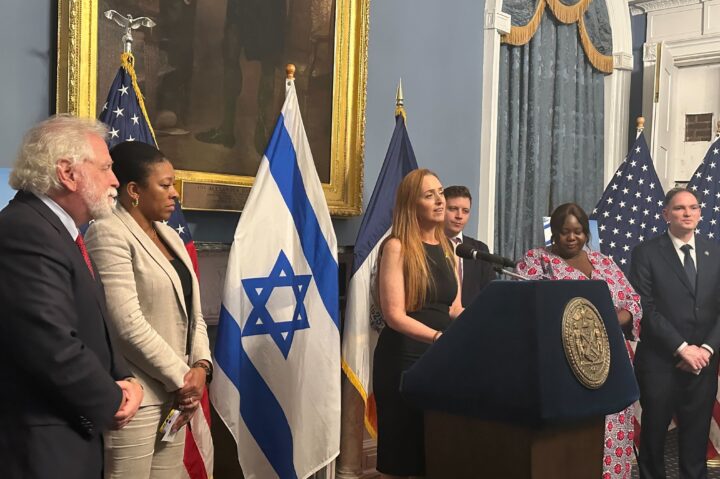
Anat Katz speaks at the NYC-Israel Economic Council launch at City Hall, August 6th, 2025
The New York City-Israel Economic Council, a new joint initiative between the two governments aimed at building economic ties, hosted its launch event on Wednesday at New York City Hall.
The council is a reflection of “the long relationship we’ve had with [New York City],” Anat Katz, the outgoing head of Israel’s economic mission in the U.S., told the crowd, which included representatives from American and Israeli companies including Google and Electra as well as Israeli venture capitalists. “This group is the embodiment of these strong ties,” Katz said. “It’s not political. It’s not Jewish. It’s a place for people to engage and get things done.”
New York City and Israel are the second and third largest technology hubs in the world, respectively, after Silicon Valley. While the relationship between the two has been strong for years, Katz said, the council was formed as a way to ensure “that systematically we are connected.” The council’s focus will include partnerships in economic development, emergency management, education and technology. In the fall, the council — which is currently seeking advisors — plans to coordinate delegations focused on AI and cybertechnology.
A declaration of intent to establish the council was initially signed in May by New York City Mayor Eric Adams and Israeli Economy Minister Nir Barkat. The mayor’s Office for International Affairs will lead the program.
The launch comes as Adams, who is running for reelection as an independent, has stepped up his outreach to the city’s Jewish voters as he faces off against Zohran Mamdani, the Democratic nominee. Mamdani said in June that if elected mayor, he would discontinue the council.
Randy Mastro, New York City’s first deputy mayor, also addressed the audience at Wednesday’s event, which neither Adams nor Barkat attended.
Please log in if you already have a subscription, or subscribe to access the latest updates.
 Continue with Google

 Continue with Apple