













































































Ossoff also defended his votes on arms sales to Israel, saying Israel had a right to go to war with Hamas but U.S. lawmakers must ensure compliance with American and international law
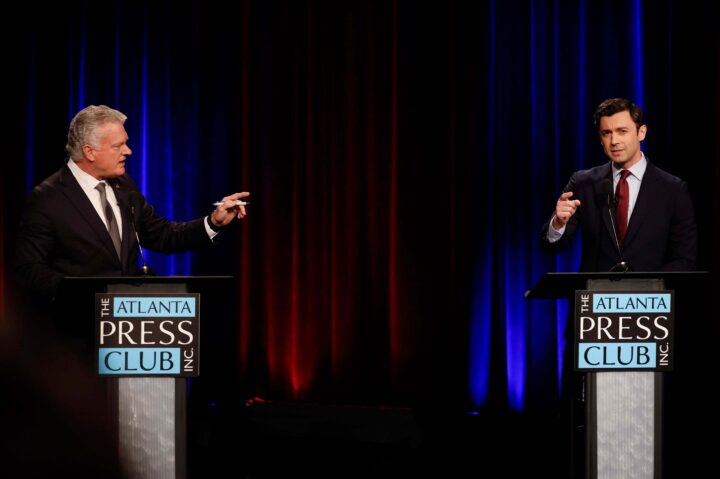
(Miguel Martinez/Atlanta Journal-Constitution via AP)
Republican U.S. Rep. Mike Collins, left, debates incumbent Democratic U.S. Sen. Jon Ossoff during the Loudermilk-Young Senate Debate Series at the Georgia Public Broadcasting studio in Atlanta on Tuesday, Oct. 13, 2026.


 Add JewishInsider on Google
Rep. Mike Collins (R-GA) on Tuesday dodged a question about his son-in-law, a white nationalist influencer who has apparently recorded and posted antisemitic and white nationalist videos while living on Collins’ property, at the second Georgia Senate debate.
Sen. Jon Ossoff (D-GA) had hammered Collins on the issue, and Collins’ other ties to extremist figures including former congressional staff, at a previous debate last week, accusing Collins of hiring “half of the Third Reich.”
Asked by the debate moderator about Ossoff’s accusations and his former staff, Collins said that he condemns “any sort of hate speech, antisemitism, hate of any kind, it’s abhorrent. I fire people when things happen.”
Asked about Sen. Jon Ossoff’s comments accusing him of hiring “half of the Third Reich," Rep. Mike Collins condemned “any sort of hate speech, antisemitism, hate of any kind" and said, "I fire people when things happen.” Read @marcrod97’s full coverage: https://t.co/t3PxpEE2kO https://t.co/s6C2upomiQ
— Jewish Insider (@jewishinsider) October 14, 2026
“I’ll tell you, young people on both sides, Republicans and the whole DSA wing of the Democrat Party, we do have a problem with antisemitism and hate around the world,” Collins said. “These young people feel like they’ve been forgotten, and they’re just lashing out. And this hate speech has got to stop. We’ve got to educate them. We’ve got to help them by giving them opportunities.”
Ossoff responded by pressing Collins to commit to ensuring that no more neo-Nazi propaganda would be shared from his home before the election.
“I’m a little tired of this, Jon,” Collins responded. “There’s a crazy person in jail right now because of your rhetoric — threatened my son-in-law, threatened to kill me. Had another threat just yesterday. That’s because of you and your rhetoric that you’re out there spewing, just vitriol, hate.”
Collins sought to turn the tables on Ossoff, emphasizing his support for Michigan Senate candidate Abdul El-Sayed, and El-Sayed’s connections to antisemitic streamer Hasan Piker and the Democratic Socialists of America.
“Mike, if any of those folks were based in my house, then I’d understand you’d ask me to take responsibility for them,” Ossoff shot back. “What I asked you, Mike, was can you commit for just three weeks to stop the production of neo-Nazi propaganda from your home? We all know what’s happening. Why can’t you stop it? Why won’t you commit right now to stop it?”
The two continued to talk over each other until moderators forced them to move on.
Collins also defended his support for the Iran war, praising the administration for having the “leadership” to send in U.S. forces to prevent Iran from obtaining nuclear weapons.
“My opponent and the Democrats, all they’re interested in is sending more money to Iran,” Collins said. “We’re in Iran to make sure they don’t get a nuclear bomb and destroy America, because that’s what they want to do. And I’ve got kids and grandkids, and we want to make sure that they have a future.”
Ossoff, for his part, called Secretary of State Marco Rubio, whom he voted to confirm, a “deep disappointment” and said that Secretary of Defense Pete Hegseth “has lied repeatedly about the war in Iran.”
Asked by a moderator about his stance on U.S. aid to Israel, Ossoff largely repeated an answer he offered at a previous debate, standing by his votes on resolutions to block arms sales to the Jewish state while emphasizing that he wants security for both Israelis and Palestinians.
“When it comes to selling weapons or giving weapons to a foreign government, we should assess in every case whether that foreign government is acting consistent with our interests, our laws and our values,” Ossoff said. “Israel had every right to go to war with Hamas after the despicable Oct. 7 terrorist attack. I also believe that it’s right for U.S. senators to ensure that American laws and international laws are being respected by those who fight with our weapons.”
One Jewish community leader said that the debate had ‘reinforced’ Jewish community members’ ‘deep concern’ about El-Sayed and his political ideology
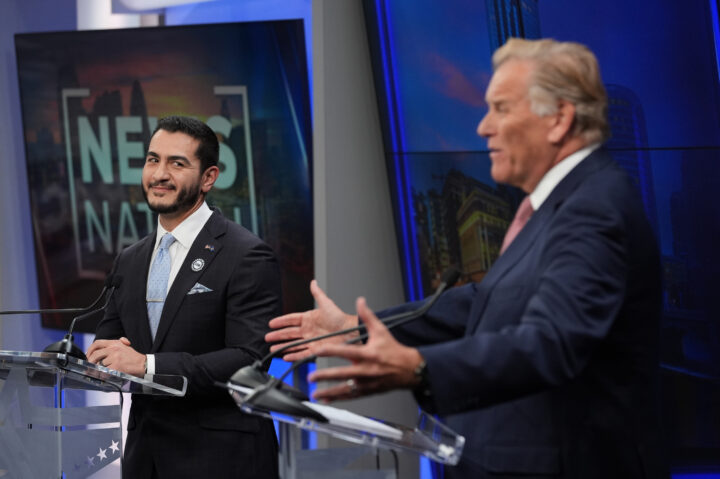
Paul Sancya, Pool/AP
Republican nominee for U.S. Senate Mike Rogers, right, speaks during a televised debate with Democratic nominee for U.S. Senate Abdul El-Sayed on Oct. 8, 2026, in Grand Rapids, Mich.
Last Thursday’s Michigan Senate debate, where Democratic nominee Abdul El-Sayed framed Israel as a threat to the United States comparable to Iran and said he would not vote to send defensive aid to Israel even if it were under fire, proved to be a breaking point for some Jewish Democrats who were holding out hope that the Democratic nominee would moderate his views in the general election.
Community leaders said that they’re hearing from some previously undecided Jewish Democrats that, after they debate, they now plan to back Republican Mike Rogers.
“I think for a lot of pro-Israel Jewish Democrats, Abdul has made it easy. He’s not really made any accommodations whatsoever, and the debate was just the latest example,” said David Kramer, a prominent Michigan Democratic fundraiser and vice chair of the Michigan Democratic Jewish Caucus.
He told Jewish Insider he’s heard from members of his community that they felt the debate demonstrated that El-Sayed is “not giving an inch and he’s absolutely showing who he is.”
Kramer had previously said he wasn’t willing to vote for El-Sayed without changes to his rhetoric and platform.
“I’ve talked to a couple of people who were wrestling with the same choice as I am, who have said that based on the debate, that was kind of a final straw, and they are going to vote for Rogers,” Kramer told JI.
Another Michigan Jewish Democrat told JI that they are hearing similar feedback in their network.
El-Sayed’s campaign did not respond to a request for comment.
Kramer said, “I think there were well-intentioned voters and community leaders, and even elected officials, who were hoping we’d get him to a better place, and he’ll need us, and he’ll want to embrace us, and it’s quite evident, at this point, that he’s not doing anything.”
Joan Lowenstein, a member of the Michigan Democratic Party Central Committee and president of the Jewish Federation of Ann Arbor, said she’s also heard from people in her community that the debate was a turning point. “I think people who did watch the whole thing really didn’t get anything new about what El-Sayed thinks, or what he was willing to do for Jewish safety — not at all.”
Lowenstein said the debate had “confirmed what I think about El-Sayed,” describing him as evasive and lacking in substantive policy proposals. On Israel, she said that his responses show a “lack of understanding that you would expect a senator to have” about foreign policy issues.
Kramer and Lowenstein are members of the Nonnegotiable Michigan campaign that has sought to pressure El-Sayed to make commitments to supporting Israel’s right to exist as a Jewish state and to Jewish safety in the United States.
Dennis Bernard, the national chair of government relations at the Jewish Federations of North America, who supported both Rep. Haley Stevens (D-MI) and Rogers in their respective primaries, said that El-Sayed’s response on whether Israel or Iran is more dangerous to the United States was “the defining moment for our community. … It’s an astounding comment.”
“At this point, if you still haven’t decided that there is enough out there as a Democrat not to vote for him, nothing’s going to convince you,” he said. “There were still a lot holding out. … After that debate, those who will go for Rogers have made their decision. El-Sayed did not help himself in our community. It was not a good performance. He had to have a better answer.”
Anecdotally, Bernard said that there’s intense discussion in the Jewish community about the race, with his social circle unanimously questioning how any Jewish voter at this point could support El-Sayed. Bernard said that he’d spoken to six lifelong Democrats on Saturday who were all planning to vote for Rogers. Bernard also said he’s never heard so much discussion in the Jewish community about ticket splitting.
Rabbi Aaron Starr, of Congregation Shaarey Zedek in Southfield, Mich., speaking in his personal capacity, said the debate left him “frustrated and sad” with both candidates spending more time “criticizing each other with personal attacks than helping us understand how they will help us work toward a better tomorrow for our children.”
“Dr. El-Sayed’s inability to affirm my basic needs has led me, and many others in my community, to confidently decide we simply cannot vote for him,” Starr continued, referring to the Nonnegotiable campaign’s core principles. Starr is a leading organizer of the Nonnegotiable petition.
He said that El-Sayed’s comments during the debate “reinforced” Jewish community members’ “deep concern about his candidacy, and reminded us that if Dr. El-Sayed’s position takes hold in the Democratic Party, Israel’s enemies will be emboldened, American Jews will be even more vulnerable, and America will be pulled into even more war –– not less, as Dr. El-Sayed claims to want.”
Starr said that he was “horrified, though not surprised” at El-Sayed’s hostility toward Israel and “refusal to condemn the Iranian regime and its proxies.” He added that “Dr. El-Sayed gave voice to centuries-old libels against the Jewish people by suggesting Israelis somehow manipulated an otherwise innocent America into a war. In this way, he denies America’s agency in choosing to defend itself and its allies against nuclear threats and belligerency.”
Zach Nessel, the secretary of the Michigan Democratic Jewish Caucus, who spoke to JI in his personal capacity, said that he thought El-Sayed’s answer to the question about Israel and Iran showed he is “not really taking our national security seriously” and “doesn’t want to upset people who don’t have America’s national security interests top of mind.”
Nessel, the son of Michigan Attorney General Dana Nessel, who is supporting El-Sayed, said he’s still undecided and doesn’t believe in sitting out elections, but feels “unenthusiastic” about both candidates.
He said he also found El-Sayed’s frequent attacks on AIPAC and its donors to be hypocritical when he has refused to address his own donors’ and associates’ support for groups including Hamas and Hezbollah, something that Rogers repeatedly hammered him on during the debate.
El-Sayed denied Sunday that any of his family have ties to the Muslim Brotherhood, and asserted that Rogers had only raised the issue to stoke Islamophobia.
“Now, I don’t think one man is perfectly represented by his donors, but it seems to be certainly very problematic,” Nessel said.
Decky Alexander, the chair of the Michigan Democratic Jewish Caucus, who plans to vote for El-Sayed, said she was broadly disappointed by the debate, calling it “a lot of theater” rather than a substantive exchange of ideas.
She acknowledged that many in the Jewish community did not think the “rhetoric around Israel and Iran in particular was helpful in this moment, particularly for Jews that are on the fence.” She said she was also “uncomfortable” with what she heard at the debate but said that the debate does not tell the “whole story.”
She added she thinks that El-Sayed’s joint event with Sen. Elissa Slotkin (D-MI) the previous weekend was ultimately more impactful for Jewish Democratic voters than the debate. “They want to hear from somebody … that affirms their own perspectives and values,” she said, describing Slotkin as a strong “ambassador” for El-Sayed.
Alexander said she and others in the community feel that the current political moment is existential in two respects: both for the pro-Israel Jewish community and for other elements of American society.
Lowenstein also said that she had received the anti-El-Sayed mailer that AIPAC’s United Democracy Project began circulating to Michigan Jews at the end of last week, describing it as an effective and targeted message, particularly coming in tandem with the debate.
But others take a different view, and said they haven’t heard much movement — in either direction — following the debate.
“From the people that I’ve spoken to, they all said that Rogers didn’t say anything new,” said Rabbi Asher Lopatin, who said previously that he’s voting for Rogers but is no longer discussing his personal views on the race, given his nonpartisan role as director of community relations at the Jewish Federation of Greater Ann Arbor. “On the other hand, the people that have reservations about Abdul El-Sayed, they also feel he avoided questions … he didn’t change his opinion at all. So there wasn’t any real movement on either side and it really hadn’t changed anything.”
He said that people who were struggling with their votes prior to the debate are still struggling, and some are still holding out hope for a change from El-Sayed.
Several Jewish Democrats also said that El-Sayed’s explanation that he didn’t issue a statement honoring the third anniversary of the Oct. 7, 2023, Hamas attacks on Israel to avoid turning the event into “political theater” was unsatisfactory.
“It was a sorry excuse not to stand up for our community three years after the Oct. 7 attack,” Nessel said, adding that El-Sayed’s failure to speak up cast doubt on other comments asserting that he wants to protect and stand up for the Jewish community. “It’s a really simple ask, just to remember the tragedy of Oct.7 and condemn Hamas for killing 1,200 Jews and kidnapping 200 more.”
He said he thinks that El-Sayed stayed silent because “I don’t think anything he would say would have been true to his values and probably would have been inflammatory.”
Starr offered a somewhat different view.
“While at first I felt resentment at his lack of communication on Oct. 7, I actually appreciate Dr. El-Sayed’s explanation about why he chose not to address the Jewish community,” Starr said. “He recognized that because he couldn’t say anything that spoke to the anguish in Jewish hearts, he was better off not saying anything at all. That said, his inability to speak genuinely with sympathy to us on that heartbreaking day does reinforce why so many Jewish Michiganders are unable to vote for him.”
Alexander said that she called El-Sayed’s campaign to ask about the lack of a statement on Oct. 7 and said she hoped for a “recognition of the impact of this day on his Jewish constituents” but also said that it was likely a “no-win situation for him” politically.
“Is it the thing that is going to deter me from not voting for him?” she continued. “No, because I also understand he’s in this really complicated, political space that I am just not in.”
Lowenstein told reporters before the debate that she had been looking for Rogers to make commitments on civil rights and other issues she sees as tied to her Jewish values, and emerged somewhat encouraged by his responses, including his willingness to reform Immigration and Customs Enforcement and to separate from the Trump administration’s stance on tariffs.
Nessel said he was disappointed in the performance of both candidates, saying that neither had done a good job of arguing their points or explaining their policy positions. He said that the debate could have been a “productive conversation and it just simply didn’t happen,” though he credited Rogers as being more willing and able to discuss policy specifics than El-Sayed.
“I might not agree with his ultimate conclusions when it comes to certain policies, but the fact that he expresses working knowledge and being able to at least understand the issues and explain it to the public is helpful,” Nessel said.
Bernard said he felt that El-Sayed appeared off balance and unwilling to address specifics, though he said that he “also would have liked to see Mike a little more senatorial.”
Lopatin said that hearing Rogers make a clearer declaration that he will not be a “rubber stamp for Donald Trump,” particularly when it comes to defending democracy and the Supreme Court, could be helpful to Rogers in reassuring Jewish Democrats still hesitant to pull the lever for him.
Ossoff also hammered Rep. Mike Collins as a bigot in ‘cahoots with some of the most notorious white supremacists in America’ allowing antisemitic propaganda to be spread under his own roof
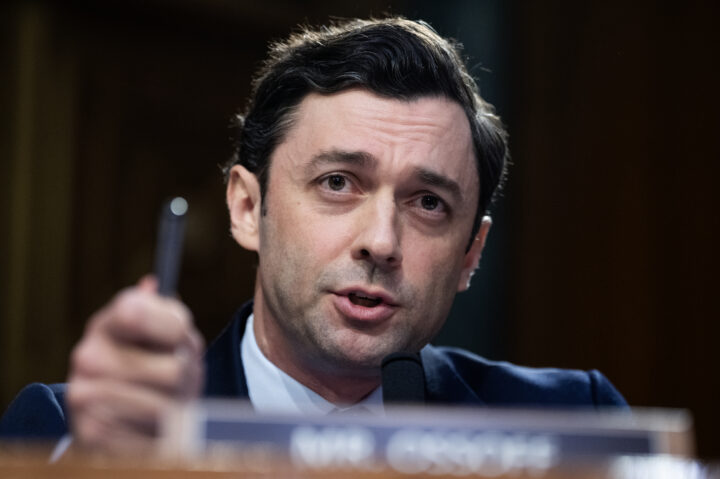
Tom Williams/CQ-Roll Call, Inc via Getty Images
Sen. Jon Ossoff (D-GA) in the Senate Select Intelligence Committee on July 15, 2026.
In Georgia’s first Senate debate on Thursday, Sen. Jon Ossoff (D-GA) said he would defer to the International Criminal Court on whether Israel has committed genocide in Gaza, but said that he believes Israel has violated international law.
Ossoff also repeatedly hammered his opponent, Rep. Mike Collins (R-GA), as a bigot who had hired, amplified and even welcomed into his home and family antisemitic and white supremacist figures.
Collins’ official congressional account amplified an antisemitic post from a white nationalist Twitter account, his former chief of staff was a member of a group chat with white nationalists where he discussed using congressional authority to free a Holocaust denier from prison and his son-in-law is a white nationalist influencer.
“The question of genocide is a question of whether a government has the specific intent to destroy a national ethnic group, and that is a question for the International Criminal Court,” Ossoff said at the debate. “There is no doubt in my mind that Israeli forces prosecuting the war in Gaza violated the law of armed conflict and international humanitarian law.”
Neither Israel nor the U.S. are members of the ICC.
Ossoff said that he “care[s] deeply about the security of the Israeli people,” including some members of his own family, as well as about innocent Palestinians, and said that he stands by his votes to halt arms sales to the Jewish state.
He went on to attack Collins for voting to sanction the ICC.
“His view is there should not be accountability for crimes against humanity, no matter who commits them, and that’s because the congressman is deeply disconnected from our state’s tradition of civil rights and human rights,” Ossoff said.
Sen. Jon Ossoff said during last night’s debate that whether the IDF committed genocide in Gaza "is a question for the International Criminal Court," but he has "no doubt" that Israel violated international law in the course of the war. https://t.co/SDjI8Cplgn
— Jewish Insider (@jewishinsider) October 9, 2026
Collins responded by accusing Ossoff of being a far-left extremist, highlighting his support for Michigan Democratic Senate candidate Abdul El-Sayed, and antisemitic streamer Hasan Piker’s backing — since retracted — for Ossoff. He also accused Ossoff of hating Israel and loving Iran.
Collins, for his part, faced grilling from both Ossoff and the debate moderators over his ties to various antisemitic and white nationalist figures, including his own son-in-law.
“You’ve hired half the Third Reich to staff your congressional office and you have promoted neo-Nazi content online,” Ossoff said. “Imagine running for the U.S. Senate while neo-Nazi propaganda is disseminated to an audience of millions from your home. That’s Mike Collins.”
Ossoff continued: “Mike Collins’ office intervened at the Department of Justice on behalf of a Holocaust denier, while his office was in cahoots with some of the nation’s most notorious white supremacists. Mike Collins is a bigot, and it’s disqualifying for a candidate for the U.S. Senate.”
Ossoff suggested that, had the Civil Rights Movement been happening today, Collins would have been personally involved in brutalizing protesters.
Asked by moderators about what conversations he’s had with his daughter and son-in-law about the latter’s online activity, Collins suggested that Ossoff’s attacks on him have endangered his family.
“That’s my family. That’s the craziness that John Ossoff has been spewing out there,” he said. “I actually had a crazy person get put in jail this weekend because he not only wanted to kill my son-in-law, but he wanted to kill me.”
He went on to say that he’s condemned racism, antisemitism and hate, regardless of the source, and said he’s told his son-in-law that as well, and said he’s fired staff with problematic ties when made aware of them.
“It’s wrong. We have no place in this world for that,” Collins said, going on to say that Ossoff has failed to condemn figures like El-Sayed and Piker. (Ossoff belatedly condemned Piker in August after Piker suggested that American Jews were responsible for inciting antisemitic attacks on themselves, months after Piker named him as among his favored candidates for the 2028 presidential election.)
Ossoff also attacked Collins over his support for the war in Iran and its impacts on gas and other prices domestically.
Ossoff said that the U.S. was “lied into” the war. “They told us last year that they obliterated Iran’s nuclear program. This year they told us it posed an imminent threat. So on top of the tariffs now, we have eight months of war, 18 Americans killed in action, hundreds wounded. Iran still has its uranium. Iran still has its drones and missiles,” Ossoff said.
Collins said that President Donald Trump “had every right to go in there and make sure that Iran does not get a nuclear weapon,” pointing to warnings from the International Atomic Energy Agency that Iran was approaching nuclear weapons capability.
He said that Iran, were it to obtain nuclear weapons, would attack both Israel and the United States, and that it has been attacking and killing Americans for 47 years.
A super PAC supporting Rogers ran an ad during the debate featuring a mother whose child attended school at Temple Israel and said she couldn’t vote for El-Sayed
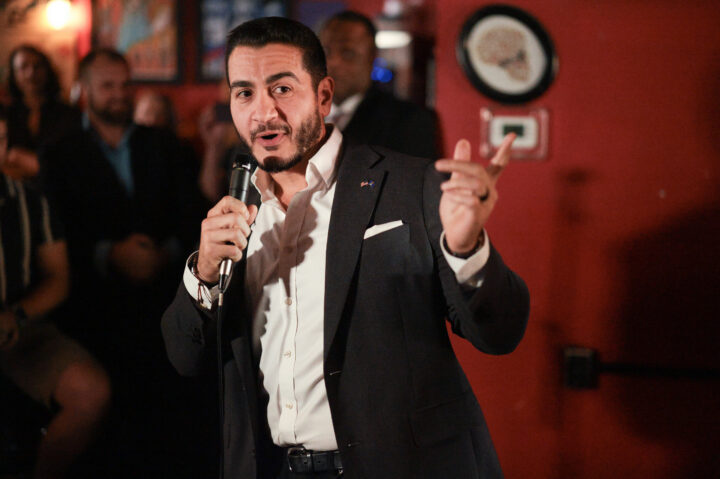
Chip Somodevilla/Getty Images
Michigan Democratic Senate candidate Abdul El-Sayed campaigns at The Meanwhile Bar on October 8, 2026 in Grand Rapids, Michigan.
In the first debate of the general election for Senate in Michigan, former Rep. Mike Rogers (R-MI) repeatedly hit Democratic nominee Abdul El-Sayed over his supporters’ ties to and support for terrorist groups and El-Sayed’s comments on the Temple Israel terrorist attack — accusations that El-Sayed largely did not respond to during the deeply acrimonious exchange.
El-Sayed, for his part, said he would not support defensive aid to Israel even if it was under attack, framed Israel as a threat to the United States comparable to Iran, defended his decision not to issue a statement honoring the anniversary of Hamas’ Oct. 7, 2023, attacks on Israel and continued to sidestep questions on Iran’s persecution of its own civilians.
“He has taken money from groups in support of the Muslim Brotherhood. He has taken money from individuals on his campaign who openly support Hamas, Hezbollah, al-Qaida,” Rogers said several times throughout the debate, and accused El-Sayed of failing to condemn terrorist groups and attacks.
“The prattling and repetition of his argument does not solve the dismantling of terrorist networks that America demands,” Rogers added, framing himself — with a military and FBI background — as the clear choice for those concerned about national security, while El-Sayed repeatedly dinged Rogers as a war hawk who had been an avid cheerleader for the war in Iran and other conflicts.
At one point, Rogers suggested that El-Sayed opposed federal counterterrorism programs because people in El-Sayed’s family were tied to terrorism, leading El-Sayed to goad him, “Go ahead and say that I’m a — go ahead and say it. You’ve been tiptoeing around it the whole time. Just say it.”
Though he fired back at most of the attacks Rogers leveled throughout the debate, El-Sayed offered no direct response or rebuttal to Rogers’ barbs about his ties to terrorism. “He wants this to be about anything but his own record … going after my mom, my sister, got nothing to actually say about me. I’m a dad and a doctor,” the Democratic nominee said.
El-Sayed’s mother worked for the Islamic American Relief Agency, which was designated as a terrorist organization for supporting al-Qaida, and his sister-in-law sued to be removed from a federal terrorism watchlist, according to recent reports.
He also insisted that he had condemned the Temple Israel attack. (El-Sayed apologized for his initial response to the attack, which many in the Jewish community saw as justifying or excusing it, as he tried to appeal to Jewish voters this summer.)
Asked whether he considered Israel or Iran a bigger threat to the United States — a question he dismissed earlier this week when asked by a reporter — El-Sayed again called the question a “ridiculous hypothetical.”
“Our ostensible ally in Israel has lobbied us to go to war with Iran. We have watched as Iran has responded by bombing all kinds of countries in the Middle East, and then choking off the world’s energy supply,” he continued. “I think both of them have proven dangerous in their own way, one at risk of attacking us, one getting us into wars we have no business fighting.”
El-Sayed said he would not support providing defensive weapons to Israel if it were attacked by Iran or another state, and framed Israel as the aggressor against Iran, with the aim of drawing the U.S. into the Iran war and annexing southern Lebanon.
Abdul El-Sayed would not vote to provide defensive military weapons to Israel if it were under attack, the Michigan Democratic Senate nominee said during last night’s debate. Read more: https://t.co/HzcvnWB5Fg https://t.co/RbMKkzJwbf
— Jewish Insider (@jewishinsider) October 9, 2026
When Rogers raised the fact that El-Sayed had not issued a statement to commemorate the third anniversary of the Oct. 7 attacks — describing in detail some of Hamas’ atrocities — El-Sayed responded, “I’m not somebody who tries to make political theater out of other people’s pain.”
Later, in the post-debate spin room, El-Sayed reportedly said, “Let me make a clear point here: I learned that when people are grieving, don’t step on their grief, and I know that how much things were being watched that this was going to be — whatever I said — it was going to feel like politicizing that moment. So I decided not to say anything.”
Pressed during the debate on whether he would condemn the Islamic Revolutionary Guard Corps, El-Sayed broadly said he “will condemn any use of force against a diplomatic population abroad,” but focused his response primarily on condemning the war in Iran.
El-Sayed said that he believes that the U.S. can end the war in Iran without reopening the Strait of Hormuz or ensuring Iran cannot produce nuclear weapon and address those issues diplomatically after the end of the fighting.
Rogers, who has recently urged an end to the Iran war, said the conflict cannot end if Iran maintains the capability to produce nuclear weapons, but argued that Iran’s nuclear program has been set back 20 years so that is not a relevant concern at this point.
He also said that the use of nuclear weapons would be the only red line that Israel could cross that would cause him to withdraw support for the Jewish state.
Asked whether he would welcome public support from AIPAC, given reporting that his allies had urged the group not to get openly involved in the general election, Rogers sidestepped the issue but said that he would welcome anybody “that wants to help my campaign stop a guy who can’t condemn terrorism in our own country because he’s so close to the people who are supporting the Muslim Brotherhood.”
A newly formed super PAC, Together for Michigan, ran an ad during the debate featuring comments from Taylor Weintraub, a mother of a student at the Temple Israel preschool that was attacked by a terrorist earlier this year.
“Since I could vote, [I] have been a Democrat and have considered myself a Democrat. When Abdul El-Sayed said, ‘Hurt people hurt people,’ it allows people to believe that this is acceptable,” Weintraub said in the ad. “It was justification as to why a terrorist would want to hurt all of these children. … He put the words out there and he cannot take them back.”
“Mike Rogers is here to listen to us and here to help us feel safe,” Weintraub continued.
The ad directed viewers to a website for Democrats supporting Rogers.
Ahead of the debate, members of the Nonnegotiable Michigan campaign, which has been pressuring El-Sayed to make commitments to Jewish safety and Israel’s right to exist, held a call with reporters on Thursday to urge both candidates to address their concerns during the debate.
Organizers said that thousands of people have now signed onto the movement, but they still haven’t received sufficient responses from El-Sayed’s campaign.
“If anything, he’s only given a lot of Jewish Michiganders reasons not to vote for him,” Rabbi Aaron Starr, one of the organizers of the effort said. “It’s been very alarming to see that he hasn’t shown more support.”
But Starr emphasized that members of his community aren’t just choosing between Rogers and El-Sayed — some are also considering writing in a candidate or sitting out the Senate race altogether.
Two leaders of the group, Rabbi Josh Whinston and Joan Lowenstein, a member of the Michigan Democratic Party Central Committee and president of the Jewish Federation of Ann Arbor, said that — despite Rogers’ public appeals and private outreach to members of the Jewish community — they haven’t heard from Rogers or his camp directly about trying to secure their backing.
Lowenstein noted that she’s a longtime AIPAC club member, “so I’m definitely on a list if he was going to reach out — and I have not gotten anything.”
Some other leaders of the campaign have been in touch with Rogers’ team, however: another leader of the Nonnegotiable campaign told Jewish Insider Rogers had reached out to them, while El-Sayed had not. Starr did not say specifically which candidates he had met or spoken with, but told JI that he had “outreach from a variety of candidates, both Democrat and Republican.”
The Nonnegotiable organizers also emphasized that their message is not just one for the Michigan Senate race, but also for the Democratic Party as a whole and the 2028 presidential field. Starr said that, even if El-Sayed wins, the difference in the margin of victory between himself and other statewide Democratic candidates will also be a significant message to the party.
The Nonnegotiable members said they were disappointed by El-Sayed’s failure to issue a statement on Oct. 7, particularly given that he has been consistent in honoring other Jewish holidays in the past month.
“His lack of communication is noticeable, and it comes back to what we’ve been saying — I’ve been saying now for a while is — when he communicates, he often communicates out of both sides of his mouth, and when he doesn’t communicate, it also becomes noticeable,” Starr said.
Members of the Nonnegotiable group emphasized that they wanted to hear from Rogers at the debate not only about support for Israel and the Jewish community, but also about standing up for other priority issues including civil rights, democracy, abortion rights, the Supreme Court and other issues they consider to be Jewish values.
Several Jewish university students in Michigan also joined Thursday’s press call, having publicly signed onto the Nonnegotiable petition.
Jacob Reich, a sophomore at the University of Michigan, said that he is organizing for and supporting Democratic candidates in other states, but in Michigan feels “torn between both my Jewish identity and supporting the Democratic candidate in my state.”
“We don’t have a candidate who supports all of my beliefs,” Robert Kashan, a freshman at the University of Michigan, agreed.
Reich emphasized that he saw multiple people on his campus on the Oct. 7 anniversary wearing Hamas T-shirts, but “I expect a lot more from a leader, especially someone who would be representing me in the Senate … so I would expect at least a statement memorializing Oct. 7.”
Meanwhile, Rep. Haley Stevens avoided a question about receiving support from pro-Israel donors, while Abdul El-Sayed blamed rising antisemitism on white supremacy
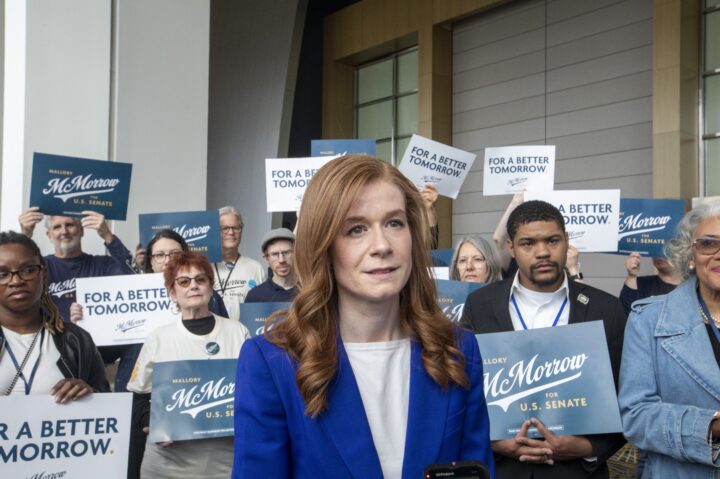
Jim West/UCG/Universal Images Group via Getty Images
Mallory McMorrow, a candidate for U.S. Senate, campaigns at the Michigan Democratic Nominating Convention
State Sen. Mallory McMorrow offered a straightforward answer when asked at a debate on Thursday, alongside the other two Democrats vying for an open Senate seat in Michigan, whether there is an antisemitism problem in the Democratic Party.
“There is,” said McMorrow. She told the story of an attendee at last month’s Democratic Party convention in Detroit who yelled an antisemitic slur at her Jewish husband, in front of their young daughter.
“That is terrifying. We need to be able to state very clearly that what the Netanyahu government is doing is wrong, that the violence needs to end, that we need to bring about long-term peace and security for Palestinians and for Israelis, and that turning that into not an anti-Netanyahu, but an anti-American Jewish message is dangerous,” McMorrow said, earning applause from the room.
The other two candidates — Rep. Haley Stevens (D-MI) and former public health official Abdul El-Sayed — did not directly address the question about Democrats.
Stevens condemned “rising political violence and extremism,” including the attack at Temple Israel in West Bloomfield, in her district, which she said was carried out by a “homegrown terrorist.” She described herself as a lawmaker who is “leading on combating antisemitism in a bipartisan way. That does not have to be a partisan thing.”
El-Sayed said he understands discrimination because he has faced it himself. He blamed antisemitism in the U.S. on white supremacy.
“I know that antisemitism and Islamophobia tend to go hand in hand, and the real issue when it comes to either of them is the scourge of white supremacy,” he said, while arguing that respecting American Jews does not require supporting Israel.
The Democratic primary for the open Senate seat in Michigan is one of the most contentious in the country, and antisemitism has become a major issue, alongside U.S. foreign policy and support for Israel. It is perhaps the most high-profile seat where debates about the role of AIPAC might actually have an impact on the outcome.
Stevens, a longtime ally of the pro-Israel group, was the early frontrunner in the race but has faced attacks from her opponents for not criticizing AIPAC.
Presented with an opportunity on Thursday in a primary debate to help voters understand why she continues to receive support from the pro-Israel advocacy group, Stevens chose not to speak about the group at all.
“You take money from AIPAC. Walk us through what that money means and what it buys, and maybe what it doesn’t,” one of the debate’s moderators asked Stevens, as part of a question about how much influence individual donors have over their decisions.
“Michiganders are frustrated because we have not done comprehensive campaign finance reform. Mike Rogers will not vote for comprehensive campaign finance reform like I have in the House of Representatives,” Stevens said, referring to former Rep. Mike Rogers (R-MI), the expected GOP nominee for Senate. “We squarely need to put people at the front of our agenda.”
She also said she is “deeply proud to have grassroots support coming from grocery clerk workers to retired teachers to factory workers and the like,” and named some of the politicians who have endorsed her, including former Rep. Brenda Lawrence (D-MI), former Sen. Debbie Stabenow (D-MI) and former Gov. Jennifer Granholm.
When asked about her views on foreign policy, Stevens attacked President Donald Trump for the “harmful and ridiculous” steps he took to pare back U.S. humanitarian aid abroad, and pledged to focus on peace.
“We need to see the United States work with our allies to achieve lasting peace between Russia and Ukraine, between the people of Israel and Palestine and of course between China and Taiwan,” said Stevens. “But when you remove the tools from our tool kit, you fail this country and you fail us, to allow us to work alongside our allies.”
Both McMorrow and El-Sayed used Thursday’s debate to remind voters that they do not accept donations from AIPAC. (AIPAC has not made an endorsement in the Senate race, but it has encouraged its supporters to donate to Stevens’ campaign.)
“I have not taken a dime of corporate PAC donations. I have not taken a dime of AIPAC donations,” said McMorrow, who is endorsed by the progressive Israel advocacy group J Street.
El-Sayed, who regularly accuses Israel of genocide and has said he struggles with the question of whether Israel has the right to exist as a Jewish state, slammed Stevens for taking AIPAC supporters’ donations.
“Let me tell you what absolutely would not shape my perception [of foreign policy]: it’s AIPAC money,” said El-Sayed.
Please log in if you already have a subscription, or subscribe to access the latest updates.
 Continue with Google

 Continue with Apple