














































































Only 20% of the more than 8,000 institutions that requested funding ultimately received it

Emil Lippe/Getty Images
A Colleyville Police officer is parked in Good Shepherd Catholic Community church on January 15, 2022, in Colleyville, Texas, as police respond reports of a man with a gun was holding hostages at the nearby synagogue.


 Add JewishInsider on Google
Nonprofit groups, including religious institutions, requested more than $1.3 billion in funding from the Nonprofit Security Grant Program in 2025, around five times the $266 million that was ultimately available, a Federal Emergency Management Agency spokesperson told Jewish Insider.
In total, more than 8,000 institutions applied for funding, and around 1,600 — roughly 20% — received it.” FEMA initially disclosed in a press release last week that state-level administrative agencies had forwarded 6,000 applications to FEMA for federal review, but the spokesperson told JI that the state level agencies had received more than 8,000 total applications.
“For the Fiscal Year 2025 Nonprofit Security Grant Program, states and territories received more than 8,000 applications from nonprofit institutions. The total amount requested was more than $1.3 billion dollars,” a FEMA spokesperson said. “This demand far exceeded the amount Congress appropriated to FEMA for the program.”
The total funding requested and number of applications were the highest of any year in recent memory. In 2024, the program received 7,584 applications requesting a total of $973 million in funding. Critics have consistently emphasized that funding provided by Capitol Hill for the program has failed to keep pace with the demand at a time of heightened threats to Jewish and other communities.
Advocates for the program on and off the Hill said that the severe funding shortfall demonstrates the need for a significant increase in funding, including by passing the Jewish American Security Act, which would authorize $1 billion annually for the program, though that funding would still have to be matched in the appropriations process each year.
“Our nation is facing an epidemic of antisemitism — increasing the fear in Jewish communities as we enter the fall and the High Holidays. We need funding to match the growing demand from synagogues and community centers to help keep them safe and secure,” Sen. Jacky Rosen (D-NV) said in a statement to JI. “That’s why I introduced my bipartisan Jewish American Security Act to, among other things, authorize $1 billion for the Nonprofit Security Grant Program so we are able to meet the demand. I will continue working with my colleagues on both sides of the aisle in the Senate to pass my bill.”
Rosen is a lead sponsor of JASA and also led a call with other senators for $750 million in funding for the NSGP in the 2027 Appropriations process.
“As we continue to see increased violence and hateful threats impacting nonprofits and religious institutions, we must increase funding for the Nonprofit Security Grant Program. It is simply unacceptable that only 20% of groups seeking this mission critical grant have received funding,” Rep. Gabe Amo (D-RI) told JI. “I will continue to aggressively push to fund the NSGP at $1 billion so we can protect more communities so they can worship, gather, and support our neighbors without fear of harm.”
Amo helped lead a letter in the House urging $1 billion for the program in 2027.
“This demonstrates the need for increased funding for NSGP,” Nathan Diament, the executive director of the Orthodox Union Advocacy Center, said. “Synagogues, churches, and other faiths’ institutions are making it crystal clear and Congress must provide more funding for NSGP. That’s what their constituents are demanding.”
Lauren Wolman, senior director of government relations and strategy for the Anti-Defamation League, told JI that the new data “underscores that the need for security has never been greater.”
“More than 8,000 nonprofits sought $1.3 billion in security funding, yet only about 20 percent received grants. Demand continues to far outpace available resources,” Wolman said. “Congress should respond by passing the Jewish American Security Act, which would authorize the Nonprofit Security Grant Program at $1 billion annually to better protect at-risk religious institutions and other at-risk nonprofits.”
Rachel Dembo, the director of policy and government relations for the Jewish Federations of North America, said that the new data “confirms what we are seeing in the Jewish community every day: the need for security funding is urgent. With current funding levels only able to cover 20% of the $1.3 billion in Nonprofit Security Grant Program requests, Congress must dramatically expand the appropriations for this life-saving program and pass the Jewish American Security Act.”
Rabbi A.D. Motzen, the national director of government affairs for Agudath Israel of America, reiterated concerns he expressed to JI last week.
“Every grant means another institution and community that is better prepared to prevent a terror attack,” Motzen said. “The fact that more than three quarters of grant applicants were turned away due to lack of funds, however, highlights the need for additional funding, especially with the terror attack at a West Bloomfield [Mich.] synagogue still fresh in our minds.
The 41 signatories to the letter — including three Republicans and 38 Democrats — mark the highest number of lawmakers to make such a request
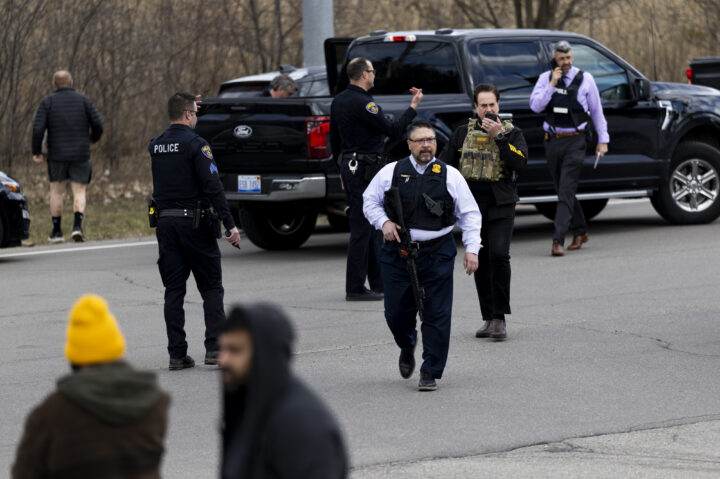
Emily Elconin/Getty Images
Law enforcement respond near Temple Israel following reports of an active shooter on March 12, 2026 in West Bloomfield, Mich.
Saying that funding to protect synagogues and other religious-based nonprofits “has not kept pace to meet the moment,” 41 senators — almost entirely Democrats — wrote to leaders of the Senate Appropriations Committee urging members to provide $750 million in funding for the Nonprofit Security Grant Program in 2027.
That figure amounts to a substantial increase in funding over current levels, as well as over Senate lawmakers’ request from last year.
The program was funded in 2025 at $274.5 million, which has not yet been disbursed, and the still-stalled 2026 Homeland Security funding bill includes $300 million for the program. Yet, in 2024, the program fulfilled just 43% of requests, even with additional funding provided through a national security supplemental bill that year. Jewish and interfaith groups, as well as House lawmakers, have been pushing for up to $1 billion for the program.
Last year, 33 senators requested $500 million for the program, a record-high request at the time. This year’s request represents a new high-water mark, both in terms of the funding requested and the number of lawmakers who signed the bipartisan letter in support.
“The threat of violence is unfortunately increasing at places of worship across our country at alarming rates. In the past few years, there has been an increase in hoax bomb threats and attacks against houses of worship that are intended to interrupt services and intimidate worshippers. In particular, there has been an increase in antisemitic incidents across the country following the October 7th attack on Israel,” the senators wrote. “Nationwide, there have been countless acts of violence against religious communities.”
The lawmakers also urged the Appropriations Committee to “maintain separate line-items for this program,” amid reports that the administration has been pushing to convert Federal Emergency Management Agency grant programs, under which NSGP falls, into a broad state-by-state block grant.
The administration also called for cuts to non-emergency FEMA grants, a category that includes NSGP, without making any specific line-item request for the NSGP.
“[F]unding has not kept pace to meet the moment,” the lawmakers added, highlighting a litany of attacks on religious institutions and the funding shortages in 2024.
The letter was led by Sens. Kirsten Gillibrand (D-NY), James Lankford (R-OK), Gary Peters (D-MI) and Jacky Rosen (D-NV). Only two Republicans other than Lankford joined the effort: Sens. Kevin Cramer (R-ND) and Josh Hawley (R-MO).
“As we continue to work with Congress to secure Jewish communities, the bipartisan consensus in the Senate around $750 million for the Nonprofit Security Grant Program is a monumental step toward our community’s $1 billion goal,” Eric Fingerhut, the CEO of the Jewish Federations of North America, said. “At a time of rising antisemitism and an escalating security crisis facing vulnerable communities across the country, demand continues to far outpace available funding.”
Fingerhut said that JFNA plans to bring Jewish activists from across the country to lobby Congress on the issue next month “and urge them to act with urgency and resolve to ensure at-risk institutions have the resources they need before the next incident, not after.”
Lauren Wolman, the Anti-Defamation League’s senior director of government relations and strategy, said, “At a time of sustained and evolving threats, this program remains a critical lifeline for houses of worship and nonprofit institutions working to protect their communities. Demand continues to far outpace available resources, and we urge Congress to ensure funding levels reflect the reality on the ground.”
Nathan Diament, the executive director of the Orthodox Union Advocacy Center, said, “The need for increased NSGP funding remains critical. We are thankful to the large bipartisan group of Senators who signed onto this letter.”
“OU Advocacy will keep pressing on all fronts to deliver the funding our Shuls and schools need to stay safe,” Diament continued.
The lawmakers said NSGP funds should not be used ‘to reinforce other policy priorities’ as new conditions may require organizations to cooperate with immigration enforcement and curb DEI programs

Kevin Carter/Getty Images
U.S. Capitol Building on January 18, 2025 in Washington, DC.
A bipartisan group of 82 House lawmakers wrote to Homeland Security Secretary Kristi Noem on Thursday urging her to roll back new conditions placed on applications for the Nonprofit Security Grant Program amid rising antisemitic attacks.
The bipartisan support for the letter is particularly notable given that, while Democrats have been raising concerns about the conditions for months, Republicans have, publicly, been comparatively quiet.
“We are writing to you today to express our desire to ensure that the NSGP is adequately funded and unimpeded by new requirements that are unrelated to the security of grant recipients and their communities,” the letter, led by Reps. Max Miller (R-OH), Brad Schneider (D-IL), Josh Gottheimer (D-NJ) and Michael McCaul (R-TX), reads. “Insufficient funding or unnecessary obstacles to obtaining grants could undermine the right of every religious community to freely and peacefully worship and congregate without fear.”
The letter states that new conditions issued by DHS in April 2025 “create new compliance requirements for recipients that will divert limited funds and restrict the religious conscience of synagogues, schools, and other institutions pivotal to our communities.”
The new conditions may compel religious institutions to cooperate with immigration enforcement activities and eliminate diversity, equity and inclusion programs.
“We encourage DHS to work to make compliance with NSGP requirements as simple and streamlined as possible. We also request that DHS ensures NSGP remains a program designed to protect the security of houses of worship, not to reinforce other policy priorities,” the lawmakers wrote. “In this time of rising antisemitic terror attacks and violence against diverse faith-based institutions, we believe it is crucial that NSGP remains a critical resource for all who seek to worship in safety and free from partisan politicization.”
They called on Noem to issue new guidance that “waives any terms and conditions that do not directly relate to the grant’s purpose, which is to help qualified institutions improve their security against increasing threats.”
The lawmakers emphasized the clear need for and lifesaving impact of NSGP funds in a time of increased hate-motivated violence. They also thanked Noem for her “ongoing support” for the program.
DHS has not yet awarded grants from the 2025 grant cycle, and lawmakers have accused the administration of withholding critical information about which institutions have received funding under separate grant rounds. Democrats have alleged the department is mismanaging the program.
Funding for the grants in 2026 — thought to be finalized just weeks ago — was again thrown into question last week when lawmakers agreed to reopen negotiations over the Department of Homeland Security funding package for the year following the deadly shootings by immigration agents of two U.S. citizens in Minneapolis.
“The Nonprofit Security Grant Program is one of the most vital programs protecting the Jewish community. We continue to encourage every Jewish institution with heightened security needs to apply for these funds,” Jewish Federations of North America CEO Eric Fingerhut said. “We have also heard from our community that the current terms and conditions have had the unintended effect of deterring some organizations from applying, which is why we believe they should be updated appropriately.”
“At a time of rising violence and hatred targeting houses of worship, NSGP is an essential lifeline for synagogues and other faith-based institutions seeking to protect their congregants,” said Lauren Wolman, ADL’s senior director of government relations and strategy. “We are grateful for the bipartisan effort to ensure DHS requirements remain clear, consistent, and focused on what matters most — helping at-risk nonprofits protect themselves from threats. Organizations must be able to access these resources quickly, with confidence, and without unnecessary delays.”
“Jewish and other communities facing violent threats deserve to know that the government is prioritizing their safety, not politicizing it,” Amy Spitalnick, the CEO of the Jewish Council for Public Affairs, said. “Yet the chaos created by these new terms and conditions has only created more vulnerability for communities, who are worried that they’ll be forced to choose between their core religious beliefs and their basic security — a concern we’ve been raising for months.”
“We appreciate Reps. Miller and Gottheimer for helping lead this important bipartisan call to clarify that NSGP should not be used for anything other than the security of our communities,” Spitalnick continued.
Please log in if you already have a subscription, or subscribe to access the latest updates.
 Continue with Google

 Continue with Apple