










































































The app, built by a Jewish founder drawing on his upbringing, lets users block distracting apps for one day of the weekend
Clara Margais/picture alliance via Getty Images
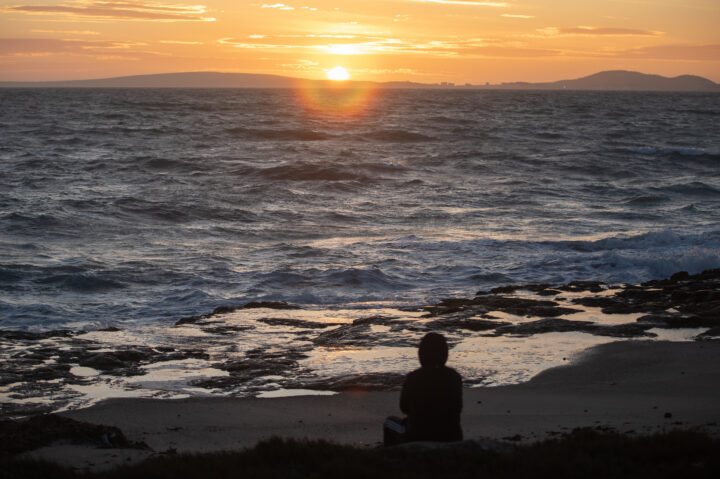
A person looks out to sea on a windy day on Mallorca's Es Carnatge beach in Palma.


 Add JewishInsider on Google
A new app called Sabbath is selling an ancient pitch to a modern, phone-addicted crowd: lock technology away for one sacred day a week.
The app, launched earlier this month by Dig Wells — the makers of the reading app Matter and the habit tracker Halo — is designed to help users unplug from sundown to sundown on either Saturday or Sunday. Users pick the apps they wish to block at no cost, while a paid tier adds custom weekday blocks, such as a daily 5-7 p.m. family time or an hour for morning meditation.
Founder Ben Springwater told Jewish Insider the app draws inspiration from Shabbat. “I’m Jewish and I grew up celebrating Shabbat with my family,” he said. His family didn’t keep a strict Sabbath — they drove and used electronics — but Friday night dinner and prayers was “a cornerstone of my life growing up” and “a way to anchor the week,” he recalled. Springwater has since built a similar Shabbat practice with his wife and two young children.
“I have a startup, I work hard and I’m always online. I’m on X a lot. I’ve increasingly been feeling like I need a way to introduce some boundaries and a little bit of rest and recovery into my life,” Springwater told JI.
He said that notion drew him to the idea of observing Shabbat beyond a Friday night meal —- though he wasn’t ready to go full in.
“I like having my phone with me on the weekends and being able to communicate with my friends,” said Springwater. “I don’t want to create impositions that don’t allow me to enjoy the day. But I don’t want to be checking X when I’m out at the park with my family. The rule that I created for myself was no X and no work apps, the ones I compulsively want to turn to.”
Already, there were several popular apps on the market that have built businesses around tracking screentime and helping people block distracting social media. There are also physical devices, such as Brick, that disable apps of a user’s choosing.
“We didn’t want to just add another stone to the pile, but I had gone on my own journey with the Sabbath and saw there was something very simple, powerful and easy about this ancient system of taking one day of rest. So what if we created an app totally oriented around that practice?” said Springwater.
The name Sabbath “popped to mind immediately,” he told JI. “We did talk about how explicitly we want to make this app about religion. Where we came was that we want to connect with the religious tradition. There should be religious undertones but we don’t want to make it denominational.”
The Sabbath app — which Springwater calls “Shabbat with training wheels” — offers an accessible experience for everyone from culturally observant Jews to wellness enthusiasts who may miss the Jewish reference.
“It helps someone who is Sabbath-curious but can’t make that big of a commitment,” said Springwater. “It’s trying to make a bigger tent, get more people to experience some of the benefits and virtues of what Shabbat offers.”
Springwater’s idea has received support even from Jews who already keep Shabbat.
“The world of technology continues to evolve and change at breakneck speeds,” said Rabbi Mordechai Lightstone, the director of Tech Tribe, a New York-based affiliate of Chabad Young Professionals that serves as a gathering place for Jews working in the tech sector. “Even while the trajectory it propels us into continues to remain unknown, I firmly believe that as a society we are capable of using tech — be it social media, AI or whatever else comes our way — for positive and uplifting purposes.”
“But to do that, it’s critical that we align our own internal system with positive and redemptive forces,” Lightstone told JI. “Taking a break from the digital distractions that surround us, as Ben’s App Sabbath encourages, is a key step towards recentering our inner algorithm around the core values that we need to properly channel technology: Community, family, study and meaningful spiritual connection — to very literally touch grass.”
The launch of the Sabbath app arrives just as observing a weekly day of rest — whether Jewish or Christian — has recently gained viral popularity.
Facing terminal stage 4 pancreatic cancer, former U.S. Senator and University of Florida President Ben Sasse shared in recent interviews that he regrets not better honoring the Christian Sabbath. Supermodel Karlie Kloss, who converted to Judaism before marrying businessman Joshua Kushner, shared on a recent podcast that she does not drive or touch her phone on Shabbat. Outside of the religious sphere, tech entrepreneur and longevity biohacker Bryan Johnson frequently posts on X about digital minimalism, advocating for multi-day phone and social media fasts to improve health.
Springwater said the role of his app is not to offer community or shape how people spend their time, but it does include a feature where users can add “friends,” the equivalent of Facebook connections, in order to create some accountability and mutual support.
If a user wants to check Instagram while using Sabbath, they open the app and press “pause,” which requires them to type in a reason. “It introduces this friction so you can’t just open it in the heat of the moment, but you can still do it. There’s a balancing act, you don’t want to make it so impossible because in some cases someone might have to circumvent it,” said Springwater.
“The reason that you type in to end your Sabbath is then visible to your ‘friends’ on [the app]. At the end of Sabbath, you can see if someone had a perfect Sabbath or if they took two breaks. The social features are for accountability and support but they don’t facilitate some sense of community on the Sabbath,” he said.
Springwater said that while fighting antisemitism by building cultural bridges was not the original goal for his app, that idea has grown on him since its launch.
“One of the things that is so hopeful to me about the Sabbath is how crosscutting and universal it is. I’ve observed that a lot of different types of figures across the religious and cultural spectrum have been resonating with this idea. You can come at it with a very explicitly religious value system or a more secular value system, but you can find common cause in what this practice has to offer,” he said.
“There are very few things that so many different types of people can agree on and think is a good thing and all get behind,” continued Springwater. “The World Cup was one of them — it feels like the practice of Sabbath is another.”
Many Jewish Trump administration staffers are expected to attend the White House’s official reception in the Indian Treaty Room
Getty Images
Washington, D.C., will be buzzing with events on Friday evening bringing in Shabbat 250, a national Sabbath marking the 250th birthday of the United States.
Several Jewish organizations have been planning celebratory gatherings, both in Washington and across the country, to commemorate Shabbat 250 since President Donald Trump encouraged Jewish Americans to observe Shabbat this weekend in his Jewish American Heritage Month proclamation.
The proclamation marked the first time a U.S. president had called for a national Shabbat, prompting some Jewish leaders to rush to organize events.
“There will be a number of events taking place around town for Shabbat 250,” Rabbi Levi Shemtov, the executive vice president of American Friends of Lubavitch (Chabad), told Jewish Insider. “In observance of the Sabbath, I’ll need to walk everywhere, so I hope to make it to as many gatherings as possible.”
Shemtov said the message he’s taken from his conversations with fellow Jewish leaders going into this weekend is one of gratitude toward the president for including the national Sabbath in his JAHM proclamation and of hope that the venture would prompt more Jewish Americans to keep Shabbat.
“I’m obviously delighted by the president’s call to observe Shabbat, because this reinforces Jewish identity with Jewish observance and tradition. I hope those who don’t yet observe Shabbat will choose to do so, and those who already observe will choose to share with a friend who doesn’t yet know about this beautiful cornerstone of our heritage,” Shemtov said. “I would imagine that those Jewish people who were in America 250 years ago could not have imagined our good fortunes today and must be kvelling.”
“Some Jewish leaders have said that much like Shabbat gives us a break from the week for renewal and recalibration, their hope is that this Shabbat will be a moment of reprieve from partisan political battles for even just one day,” he continued.
The most difficult ticket to snag is the White House’s official Shabbat 250 reception, which is slated to take place at 6 p.m. ET in the Indian Treaty Room. While Trump and Vice President JD Vance are not expected to be in attendance, Trump administration staffers have been invited to and are expected at the gathering.
Several invite-only dinners are taking place around D.C. after the White House event concludes and before sundown on Saturday. Details for many events are being kept under wraps due to security concerns.
One of those receptions is being co-sponsored by the American Association of Jewish Lawyers & Jurists and the Combat Antisemitism Movement. The gathering, titled, “Shabbat 250 Dinner: A Celebration of the President’s National Sabbath,” will feature a “family style” Sabbath meal and an afterparty dubbed “Farbrengen 250,” according to an invitation obtained by JI.
An event organizer described the gathering to JI in a statement as an “off-the-record dinner” bringing together “Jewish members of the administration, Capitol Hill staff, media and policy professionals in celebration of the president’s National Sabbath.” The organizer told JI that guests will receive “the usual kippot and benchers” and copies of Charlie Kirk’s book on Shabbat. The wine served at the event will be donated by Psagot Winery, the Israeli vineyard located in the West Bank.
“We were incredibly moved by President Trump’s call for a national Sabbath as part of the USA250 commemorations,” Arie Lipnick, advisory board chairman of the Combat Antisemitism Movement, told JI in a statement. “In that spirit, CAM is excited to help bring together more than a hundred Jewish members of the administration, Hill staff, media and policy professionals in celebration of America and Shabbat.”
Please log in if you already have a subscription, or subscribe to access the latest updates.
 Continue with Google

 Continue with Apple