












































































The New York governor’s decision is likely to build momentum for other Democratic governors to join the program

(Howard Schnapp/Newsday RM via Getty Images)
New York Governor Kathy Hochul speaks at Westbury Middle School on Jan. 10, 2024 in Westbury, New York


 Add JewishInsider on Google
Gov. Kathy Hochul announced Friday that she will opt New York into the new federal scholarship tax credit program, making her the second Democratic governor to do so since the administration published formal regulations for the program.
Hochul’s decision bucks intense opposition from teachers’ unions, but has won her support from the Jewish community, which has been urging governors to opt in. She had previously said that she was inclined to support the program but was waiting to see if the regulations contained any poison pill provisions.
Given New York’s substantial Jewish population, her decision to join the program will be one of the most consequential for the Jewish community. It could prompt action by other Democratic governors as well. Colorado Gov. Jared Polis had been the only Democrat — until Hochul’s decision — to opt into the program.
“I’ve been clear from the start that New York would participate in the federal scholarship tax credit program if, and only if, all schools and students, including those in our public schools, could benefit,” Hochul said in her Friday statement. “After a careful review of the federal regulations, we believe this program has the potential to bring millions of additional dollars to New York students and families without taking a single dollar from public schools or our state or local budgets.”
She said that she would not “leave money on the table when it could help our kids” and that she has been “directly engaging with business leaders, who have committed to use this program to support public school students and their academic needs.”
The program will allow taxpayers to deduct up to $1,700 from their federal taxes through donations to scholarship granting organizations. Some Jewish community groups are supporting scholarship organizations to help students attend Jewish schools, but the scholarships can also help support public school students.
Hochul insisted that her “commitment to public education has not changed, and it never will.” Teachers’ unions have insisted that the program amounts to a federal private school voucher program and will sap funding from public education.
“We thank Governor Hochul for putting New York kids first,” Teach NYS, the New York branch of the Teach Coalition, said in a statement. “This is a historic moment for New York students and a testament to the power of collective advocacy.”
The group thanked the UJA-Federation of New York, Agudath Israel of America and various other groups, including the Catholic community, that have been advocates for the program.
Yeruchim Silber, the director of New York government relations for Agudath Israel of America, said it was a “tremendous day for education in New York.”
“This decision opens the door to millions of dollars in additional educational resources and opportunities for students in public and nonpublic schools alike, without taking a dollar away from public education,” Silber continued. “[Agudath Israel] is deeply grateful to the Governor and her team for recognizing the importance of this opportunity and ensuring that New York’s children and families will be able to benefit.”
Meanwhile, United Federation of Teachers president Michael Mulgrew condemned Hochul and vowed to work to roll back the policy.
“Giving up local control of public education to the federal government through the Trump administration’s private school voucher scheme is a failure of leadership. Gov. Hochul will bear the responsibility, but our students, educators, and families will bear the price,” Mulgrew said.
More than 40 clergy members called on Superintendent Thomas Taylor to require antisemitism-specific teacher training and consequences for hateful social media posts
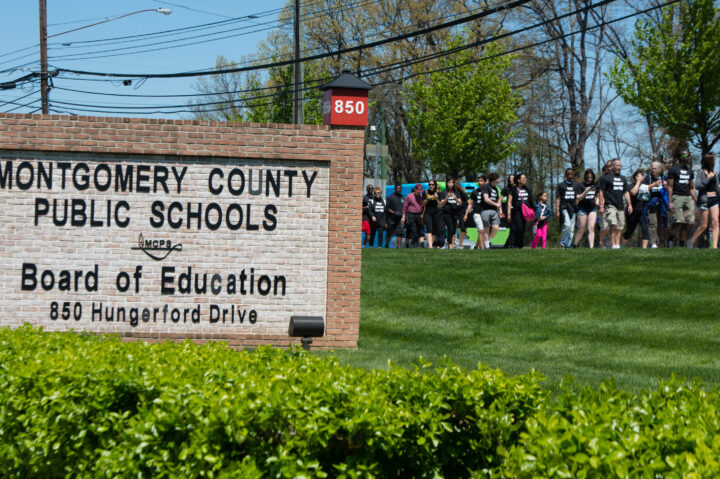
Sarah L. Voisin/The Washington Post via Getty Images
Montgomery County Public Schools building on April 27, 2014.
More than 40 rabbis and cantors in Montgomery County, Md., warned in a letter Monday that public school leaders have failed to address a rising tide of antisemitism in local classrooms, urging officials to implement new teacher training and stricter social media rules.
In the letter, addressed to Montgomery County Public Schools Superintendent Thomas Taylor, the clergy — representing dozens of Montgomery County synagogues across denominations — wrote that they are “alarmed that the lack of a meaningful response by MCPS has led to an increase in the normalization of antisemitic attitudes, language and behaviors in our schools.” They called on the district to incorporate specific antisemitism training previously suggested by the Jewish Community Relations Council of Greater Washington, including implementing teacher training specific to antisemitism and enforcing consequences for hateful social media posts.
The letter was organized by the JCRC after rabbis expressed concern following an antisemitism town hall that Taylor held at Temple Beth Ami in Rockville last spring, the organization told Jewish Insider.
Incidents in recent months, according to the JCRC, include inflammatory anti-Israel messaging at Olney Elementary School’s cultural night; “Heil Hitler” gestures and speech occurring at middle school events; and “physical threats and harassment directed toward Jewish students at multiple schools.”
In May, the JCRC called out the uniquely high rate of antisemitic incidents in the school district, which is just outside of Washington, D.C.
According to the Anti-Defamation League, Maryland is ranked 5th in the nation for school-based antisemitism, and 84% of those incidents are in Montgomery County, which is home to more than 35 active synagogues and has the largest Jewish population in the state.
The rise of antisemitism in the county extends beyond school based incidents. Montgomery County recorded 121 antisemitic incidents in 2025. By comparison, neighboring Fairfax County, Va., recorded 49 antisemitic incidents during the same period in 2025, according to the ADL.
MCPS did not respond to a request for comment from JI about the letter.
The Georgia Solidarity Network and Reps. Esther Panitch and Houston Gaines spearheaded the effort after a report was released documenting Qatari funding of Georgia’s public schools

Julia Beverly/Getty Images
The Georgia State Capitol building is seen on July 08, 2025 in Atlanta, Georgia.
Following a report spotlighting Qatari funding in Georgia public schools, the state’s General Assembly became the first in the country to pass legislation requiring the disclosure of foreign government funding in statewide K-12 schools.
The Foreign Funding Transparency and Accountability Act, HB 1379, requires public school districts, public universities and technical colleges to report funding of $10,000 or more from foreign countries or entities, naming specifically Qatar and Saudi Arabia — the two largest foreign funders of American universities.
The bill — which passed both chambers of the Assembly earlier this month and now awaits Republican Gov. Brian Kemp’s signature — was spearheaded by Democratic state Rep. Esther Panitch, the only Jewish member of the Georgia Statehouse, as well as Rep. Houston Gaines and the pro-Israel Georgia Solidarity Network.
In January, the Foundation for Defense of Democracies published a report showing that the Qatari royal family’s U.S. philanthropy arm, Qatar Foundation International, had spent at least $281,000 on education in Georgia — including K-12 teacher trainings, Arabic textbooks for young students and student trips to Qatar.
Panitch told Jewish Insider she tweeted the findings, only to be surprised by a direct and hostile response from the Qatari ambassador to the U.S. and his deputy chief of mission on X, who allegedly told her she was spreading misinformation “like you people always do.”
“Why did they care what a legislator from Georgia thinks? It was weird. I started engaging back and this went on for days,” said Panitch. The back and forth eventually resulted in her involving the FBI. “The moment he responded to me was the moment I knew FDD was on to something right,” she said.
“We were all caught off guard after [the Oct. 7, 2023, terrorist attacks]. I think Qatar had a lot to do with the responses on college campuses. Parents had no idea that some of their kids were being radicalized. I hope we get more answers, but this will definitely help,” continued Panitch.
The Georgia Solidarity Network, a two-year-old bipartisan political action committee supporting pro-Jewish and pro-Israel causes, proposed legislation crafted by co-founder Alli Medof, which Panitch filed a couple weeks after the report’s release.
“We didn’t want to make it loud and attract the attention of people who might object,” Panitch told JI. “I didn’t want Qatar to come in and hire a lobbyist. We went to committees and didn’t get much pushback.”
There was, however, some pushback from colleges and schools “in an operational sense, asking how they are supposed to carry this out,” said Panitch.
The bill also faced scrutiny in the state Senate, according to Panitch, who said some lawmakers “didn’t seem to care that Qatari money had seemingly resulted in teachers saying that [late Hamas leader] Yayha Sinwar was to be commended or that suicide bombing is okay.”
Ultimately, the bill passed the Senate 31-20 and the House 139-16. Kemp has 40 days to sign the bill into state law. If he doesn’t veto it, it goes into law automatically.
“I wouldn’t presume anything” in terms of whether the governor will sign the bill, said Panitch, adding she has not heard anything that implies he would veto it.
A second bill establishing a K-12 statewide Title VI coordinator, also crafted by the Georgia Solidarity Network, simultaneously passed. The bill authorizes the withholding of state funding from institutions that fail to correct violations within 30 days — an enforcement mechanism absent from comparable laws in Tennessee, Oklahoma and California.
The legislative session also secured $3 million in state security funding for the rest of 2026 for nonprofit organizations at elevated risk of attack, with an additional $5 million budgeted for Fiscal Year 2027.
“The Title VI bill was kind of similar because we were also dealing with schools and universities,” Panitch told JI. “There was a part that mentioned antisemitism that we ended up taking out. The preamble still mentions antisemitism but we didn’t want anyone to think this was only for the Jews. It was the Jewish community that brought it forward because we’ve been dealing with this, but essentially it’s a civil rights bill for kids and everyone wants to protect their kids, so it passed, not difficultly.”
Six months ago, foreign funding transparency was “not on the roadmap or priority list” of many Georgia legislators, GSN co-founder David Zalik said. There was already evidence of foreign funding in university systems, he said, but “when we went back to the legislators and showed them documentation [regarding the same for K-12], they were stunned and surprised.”
Following the legislative session, Zalik sees the bill as “a model” for adoption beyond the Peach State.
“Other leaders in other communities reached out,” he told JI. “We crafted new language that other states want to emulate. Georgia is a state that clearly takes this very seriously.”
Medof added, “We’re incredibly proud of the impact this is going to make, and not just on the Jewish community. I think every one of these measures are going to improve the quality of life of students and Georgians. Foreign funding impacts curriculum, ideology, faculty and research [for all students]. It’s not just anti-Jewish or anti-Israel, it’s anti-American ideology that’s coming in. The more we can do to shine a line on that, the better it is for all Georgia students.”
Ben Shuldiner, who is Jewish, is bringing his progressive politics to a school district facing a spike in antisemitism

Getty Images
Seattle Skyline with the Space Needle and Mount Rainier, Washington
As Ben Shuldiner begins his tenure as superintendent of Seattle Public Schools, he’s got his hands full: The district is dealing with, among other things, a sharp decline in enrollment, a roughly $100 million budget deficit and serious gun violence issues, including the deaths of two students who were killed in a shooting outside a district high school on Friday.
Adding to his plate, SPS has also made headlines in recent years with a series of high-profile antisemitic incidents, and Shuldiner, who is Jewish, knows he will likely be called to account for them. “What I’d say to Jewish readers, or anyone who wants to be an ally: if you see something bad, tell us. And we must act. If something is brought to me and we don’t deal with it, that’s on me. You should come after me — just give me a couple days to find a place to live first,” he told The Cholent, a local Seattle blog, in November.
Shuldiner, 48, who took the helm at SPS on Feb. 1, comes from a family of New York educators. “From the earliest days of my life, my secular humanist Jewish faith has been both a personal anchor and a guide for my public service. The values, rituals and historical consciousness I carry have deeply shaped the way I approach my work in education. I do not separate who I am from how I lead,” he wrote in an essay for The School Superintendents Association in November.
“Perhaps the most visceral and powerful concept in our faith is tikkun olam, repairing the world,” he continued. “In the context of public education, it means working to make our schools places of justice and equity and teaching students that their learning is connected to making the world better.”
Shuldiner, who previously served as superintendent for Lansing School District in Michigan, told Jewish News Syndicate in December about moving to deeply progressive Seattle, “Politically, it’s a lot better for me. I can say words like ‘equity’ and not look over my shoulder too often.”
When questioned about antisemitism, he often takes a broader view of combating hate. Asked about his approach to anti-Jewish hate, Shuldiner told The Cholent, “I’ve already received emails highlighting all sorts of concerns. I’ve heard the same about sexism and racism. What you’re describing seems part of a larger issue: people being attacked or maligned not getting the district’s full protection. … If antisemitism has been shoved under the rug, that’s horrible and needs fixing. But I’m hearing similar concerns across multiple identities.”
“And let’s be clear: when Black kids are suspended at five times the rate of white kids, that’s a systemic issue too, just like antisemitism. SPS needs to address all of this in a pointed, specific way and not downplay it as ‘not that bad’ or ‘you’re privileged.’ Bigotry is unacceptable in any form,” he continued.
He told JNS on the same topic, “If somebody is feeling unsafe, if somebody is feeling attacked, then you have to look at that and decide if that is true or not. At the end of the day, all I can tell you is I would want every child in the district to feel safe and secure and be able to go to class unencumbered and go to school unencumbered. That would be for a Jewish child, a Muslim child, an East African child, a kid that lives down the street.”
Jewish families at SPS have faced an increasingly hostile environment since the Oct. 7, 2023, Hamas terror attacks in Israel, including student walkouts last October protesting the war in Gaza where students burned Israeli flags and held signs reading “Power grows from the barrel of a gun” and “Long Live Operation Al Aqsa Flood,” referencing Hamas’ name for the Oct. 7 attacks.
In a statement to Jewish Insider on Shuldiner’s first days as superintendent, a spokesperson said he had “met with student journalists, some of whom asked about his views on student walkouts and protest activity. In response, he emphasized students’ constitutional right to free expression, while also underscoring the importance of keeping students in school and engaged in learning. He noted that the district’s responsibility is to strike an appropriate balance that honors students’ rights while maintaining safe, supportive learning environments.”
One Jewish family is suing the district over claims that it failed to respond to antisemitic harassment their daughter experienced that started shortly after the Oct. 7 attacks and eventually led her to leave Nathan Hale High School, including an incident in May 2024 in which 20 students allegedly tried to assault her before a teacher locked her in a classroom for protection.
In another incident, the chair of the social studies department at an SPS high school was placed on paid administrative leave for a year over a video in which he questioned the validity of accusations of sexual violence by Hamas on Oct. 7 and said, in reference to women being killed at the Nova music festival, “I think resistance against Israel is justified.” The district has now moved to terminate him.
Asked about the latter incident, Shuldiner told JNS that “everybody gets due process. That’s kind of the deal. I would hope that if I was ever accused of something, I would be afforded due process as well.”
Still, Jewish leaders are hopeful that any shakeup of SPS will bring better outcomes.
Aviad Benzikry, a Jewish SPS parent and board member of The Kids Table, a PAC in Washington state supporting what it describes as “pro-Jewish candidates,” said he’s “cautiously optimistic after seeing superintendent after superintendent cycle through SPS.” Shuldiner will be the district’s third superintendent in the past year.
But, Benzikry told Jewish Insider, “action [or] inaction will tell. We have seen student and faculty (mis)behavior swept under the rug across Seattle when it comes to antisemitism in particular. That said, my family has been fortunate and we are grateful for the teachers our children have had who have consistently supported their proud Jewish identity.”
State Sen. Lisa Wellman, a Jewish Democrat who chairs the state Senate’s Early Learning & K-12 Education Committee, said she’s requested a meeting with Shuldiner as he assumes his role and is “looking forward to meeting him and understanding how he intends to handle issues of antisemitism, as well as ‘other-ing’ generally at a time when young people need to feel included.”
“Attention needs to be paid to creating an atmosphere where all feel seen, heard and valued,” Wellman, whose district includes the Jewish community of Mercer Island, told JI.
Shuldiner was confident he’ll be able to bridge the gap with Jewish families. “You’ll see as I start my job that there’s going to be a kind of clarion call to bring the community back into the schools to start tutoring and mentoring and creating those relationships. And I think once you do that, much of the disconnect that might be felt will dissipate. Now, I don’t believe that it all goes away. I mean, people have hated the Jews forever, but we’re in this together,” he told The Cholent.
And he doesn’t plan to disconnect from his Jewish roots: “Education, action, questioning — it’s all Judaism to me, as much as a bagel from the Upper West Side.”
This story was updated on Feb. 5 with comment from Superintendent Shuldiner’s spokesperson.
Please log in if you already have a subscription, or subscribe to access the latest updates.
 Continue with Google

 Continue with Apple