














































































A source told JI they expect discussion on humanitarian aid and the Palestinian technocratic government in Gaza; it remains to be seen how Israel and Hamas will respond to the board's directives
Chip Somodevilla/Getty Images
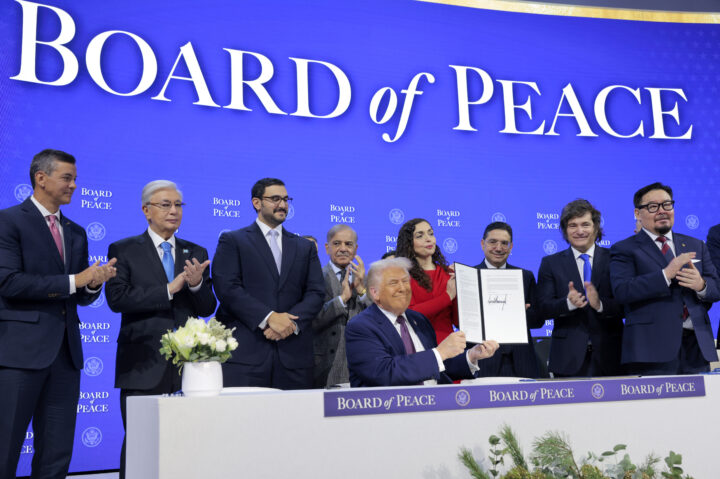
President Donald Trump holds up his signature on the founding charter during a signing ceremony for the “Board of Peace” at the World Economic Forum (WEF) on January 22, 2026 in Davos, Switzerland.


 Add JewishInsider on Google
After a splashy debut at the World Economic Forum in Davos last month, President Donald Trump’s Board of Peace will convene for its first meeting on Thursday in Washington.
The new international body now faces a test of its ability to operationalize its goals: Observers will be watching whether the board makes any significant announcements toward its goal of implementing Phase 2 of Trump’s peace plan, which is focused on rebuilding Gaza and securing the enclave.
A source familiar with Thursday’s meeting told Jewish Insider that it is “not just pomp and circumstance,” and that they expect discussion about topics including humanitarian aid and the Palestinian technocratic government in Gaza. “It’s not window dressing at all,” the source said of the board’s work.
Trump has assembled a roster of regional heavy hitters on the Board of Peace, including Saudi Arabia, the United Arab Emirates, Qatar, Turkey, Jordan and Israel. Many European nations, including France, have so far declined the invitation, wary that it intrudes on the United Nations’ authority and that its mandate is not clearly confined to Gaza.
According to a senior Trump administration official, speakers at the event will include Trump, Secretary of State Marco Rubio, Jared Kushner, former U.K. Prime Minister Tony Blair, U.S. Ambassador to the U.N. Mike Waltz, White House Special Envoy Steve Witkoff and Nickolay Mladenov, the former U.N. Middle East envoy now serving as the high representative for Gaza on the Board of Peace. Little has been shared publicly about what the format will be.
Hungarian Prime Minister Viktor Orban, a close ally of Trump, said he plans to attend, as will the leaders of Armenia, Azerbaijan, Indonesia, Vietnam, Cambodia, Pakistan, Kazakhstan and Uzbekistan. Several countries, including Israel, Egypt and Turkey, are sending senior ministers in place of their heads of state. A European Union commissioner is expected to attend Thursday’s meeting as an observer, alongside observers from some other nations who have not joined the board, including South Korea.
“President Trump is proud to welcome representatives from over 40 nations to the Donald J. Trump Institute of Peace on Thursday for a big announcement on Board of Peace actions to establish an enduring peace in the Middle East,” White House principal deputy press secretary Anna Kelly told Jewish Insider, arguing that the board will be “the most consequential international body in history.”
The gathering of Middle East and global leaders will also come against the backdrop of U.S.-Iran nuclear negotiations and speculation that Trump is seriously considering military action against Iran, with the U.S. building up military assets in the region this week.
Trump announced on Sunday that member countries have pledged $5 billion toward rebuilding the war-torn enclave and will commit thousands of personnel to the International Stabilization Force, which has not yet been launched. He did not detail which member nations were making the pledges for funds or troops, though Indonesia said it was readying up to 8,000 personnel to deploy to Gaza by this summer. The estimated cost to rebuild Gaza is $70 billion.
The White House said the media had been too skeptical of Trump’s plans but declined to offer specifics about the source of the $5 billion or how the money would be deployed.
“We’re talking about reconstructing Gaza. I remember when those words came from the president’s lips in the East Room many months ago and all of you in the press were bewildered at how the president could have such an ambitious goal of rebuilding Gaza, which is obviously a place that has been just turmoiled by violence and chaos for many many years,” White House Press Secretary Karoline Leavitt said at a Wednesday press briefing. “But we’re well underway in doing that.”
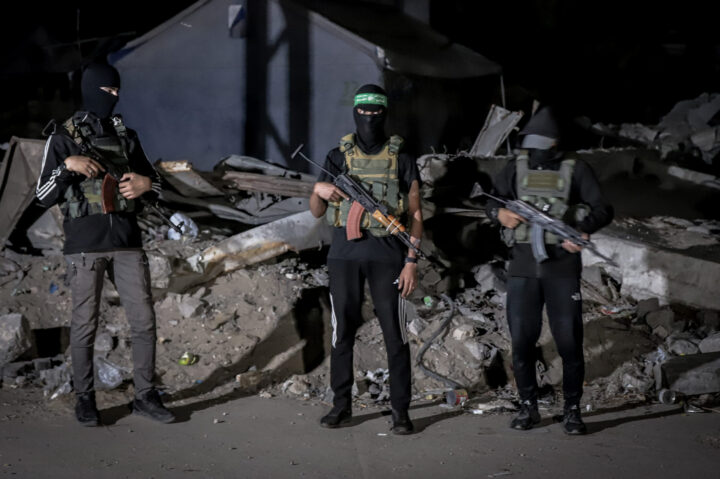
The key question facing the body is whether it can actually make progress toward addressing the most intractable issue in Gaza: Hamas’ continued control over large parts of the Strip and the terror group’s refusal to disarm.
“What will come out of it besides rhetoric is some financial commitments and troop commitments. But the troop commitments are limited. No one will agree to disarm Hamas,” Elliott Abrams, who served as an Iran envoy in Trump’s first term, told JI. “Reconstruction won’t really begin until Hamas is disarmed and fighting has ended.”
While Trump has repeatedly indicated that disarming Hamas is a top priority, the International Stabilization Force tasked with keeping the peace in Gaza is not expected to take on Hamas militarily. The White House has not laid out a plan for how the ISF will take over control from Hamas, which is thus far unwilling to relinquish governance. It is also not clear how Israel and Hamas will respond to the board’s directives.
“The three core questions that the board is examining are, who’s going to govern Gaza, who is going to provide security for Gaza and then number three, how is Gaza going to be reconstructed?” said Aaron David Miller, a former State Department negotiator. “The board can’t answer those questions. It can provide the resources that could supplement good answers, but those decisions lie in Jerusalem and in Gaza and on the part of Hamas’ external leadership.”
The options for demilitarization ‘strike me as not feasible from a military point of view and certainly not practical from a political point of view,’ says the Carnegie Endowment’s Aaron David Miller
Saeed M. M. T. Jaras/Anadolu via Getty Images
Israeli hostages are handed over to the International Committee of the Red Cross (ICRC) by the Al-Qassam Brigades, the armed wing of Hamas, as part of the ceasefire agreement in effect in Gaza City, Gaza on October 15, 2025.
The White House launched Phase 2 of President Donald Trump’s 20-point Gaza peace plan last month, intending to transition the enclave toward demilitarization, technocratic governance and reconstruction. But before those plans can move forward, the administration still needs to confront a central reality on the ground: Hamas remains armed and unwilling to cooperate.
During the World Economic Forum in Davos, Switzerland, in January, the Trump administration unveiled the National Committee for the Administration of Gaza (NCAG), a committee of technocrats intended as a post-Hamas governing authority, alongside an outline for reconstructing the enclave.
That vision, however, was quickly challenged by Hamas’ leadership. Speaking at the Al Jazeera Forum in Doha, Qatar, this past weekend, Hamas leader Khaled Mashaal, who is under U.S. indictment on terrorism-related charges, rejected the U.N. Security Council–backed plan for Gaza — a move that could complicate disarmament and Phase 2 efforts.
Experts told Jewish Insider that the administration’s expectation that Hamas can be persuaded to voluntarily hand over its weapons is detached from the group’s incentives and its perception of the war’s outcome.
“Without first disarming Hamas, progress on every other facet of Phase 2 will be minimal at best,” said Jonathan Ruhe, a fellow at the Jewish Institute for National Security of America. “The U.S. needs to adapt its strategy, which remains stuck on convincing Hamas to hand over its weapons.”
Ruhe said Hamas believes it “won the war” and therefore “can’t be incentivized to give up” power. He added that, absent voluntary disarmament, the administration may need to consider using well-vetted and tightly overseen “private military contractors” to carry out the task, a suggestion also recently put forward by former special envoy for Iran and Venezuela Elliott Abrams and JINSA’s Eric Edelman and Rena Gabber.
Other experts were similarly skeptical that Hamas would relinquish control voluntarily. Michael Koplow, chief policy officer at the Israel Policy Forum, warned that Hamas is not going to “want to voluntarily give up their weapons without real guarantees,” adding that the group’s incentive to comply is “not very high.”
“If you’re going to get [Hamas to comply with the plan], it’s going to have to involve some sort of guarantees for the group and guarantees for the leadership, which are going to be very difficult for the Israelis to swallow,” said Koplow.
Aaron David Miller, a senior fellow at the Carnegie Endowment for International Peace, said Hamas is also unlikely “to surrender the actual administrative control of Gaza.” He outlined what he described as a narrow and unattractive set of options for disarmament.
“There are only two ways to fundamentally demilitarize Hamas,” Miller said. “There are only two forces capable of doing it. One would be the IDF, and you’ve seen how that has gone over the course of the last 2 ½ years. The second would be the deployment of thousands of American combat forces, which would take a while and result in a permanent occupation of Gaza by the U.S. military. Both of these strike me as not feasible from a military point of view and certainly not practical from a political point of view.”
Miller added that any disarmament process would likely need to be accompanied by an Israeli withdrawal from additional areas in Gaza. The IDF currently controls more than half of the territory, demarcated by what officials refer to as a “yellow line.”
Until Hamas is disarmed, Miller said Israel is unlikely to permit large-scale reconstruction, given concerns that materials such as cement and metal tubing could be diverted for tunnel construction and weapons production.
Koplow also noted military means as an option for disarmament, but said the Trump administration appears to be leaning toward a “DDR” process — disarmament, demobilization and reintegration — an alternative to military force in which Hamas would give up heavy weapons first, transition away from armed activity and then reintegrate former fighters into civilian life.
“The idea is that you’re not going in and destroying the group,” Koplow said. “You’re first getting rid of their weapons, you’re then trying to transform the group itself into something different and then you’re reintegrating the group’s members back into society. Historically, that’s the way that terrorist groups like this are disarmed.”
Koplow cautioned that any such effort would be slow and contentious. “Hamas is going to make it difficult,” he said, adding that demilitarization will be “a long and drawn-out and very difficult process if it has any chance of working.”
“After all these months, the ISF still lacks a clear mandate,” Jonathan Ruhe, a fellow at the Jewish Institute for National Security of America, said. “If Hamas disarmed voluntarily, as Trump’s plan envisions, any number of countries would contribute troops for relatively safe peacekeeping duties like safeguarding humanitarian aid, police training and border patrol. But because Hamas won’t disarm peacefully, Arab and other Muslim countries consistently refuse to put their forces in harm’s way.”
Under Trump’s original 20-point plan, a U.S.-led International Stabilization Force (ISF) was envisioned as a “long-term internal security solution.” Last month, Trump appointed Maj. Gen. Jasper Jeffers as commander of the ISF, and Israeli media reported on Monday that thousands of Indonesian soldiers were expected to deploy to southern Gaza in the coming weeks as part of the first foreign contingent.
Despite those moves, experts say the ISF remains constrained. No other countries have formally joined the force, and efforts to assemble it have been complicated by reluctance among potential contributors and Israeli security concerns over which countries would be permitted to participate. Analysts also say the ISF still lacks a clearly defined mandate and could be limited to a supporting role rather than directly confronting Hamas.
“After all these months, the ISF still lacks a clear mandate,” Ruhe said. “If Hamas disarmed voluntarily, as Trump’s plan envisions, any number of countries would contribute troops for relatively safe peacekeeping duties like safeguarding humanitarian aid, police training and border patrol. But because Hamas won’t disarm peacefully, Arab and other Muslim countries consistently refuse to put their forces in harm’s way.”
Miller said the ISF would most likely deploy in areas already under Israeli control, rather than Hamas-held territory. “I see the stabilization force as exactly what its name implies,” he said. “It would be an after-the-fact deployment to monitor and stabilize. The heavy work of actually decommissioning weapons is going to take a very long time.”
Even if demilitarization were achieved, Miller said the question of whether and how Hamas members could be integrated into future governance remains unresolved. The group maintains an extensive bureaucratic apparatus in Gaza, including tens of thousands of civil servants and police officers, whose future role would need to be addressed.
“It’s probably going to involve making distinctions between Hamas fighters and Hamas bureaucrats, and making some very difficult choices about what level of reintegration, if any, you’re willing to allow for former Hamas members,” Michael Koplow, chief policy officer at the Israel Policy Forum, said.
“Hamas has 40,000 civil servants and 10,000 police,” Miller said. “Those people would be under the administration of whom?”
Koplow suggested that the group be completely dismantled and barred from maintaining governing authority.
“Hamas as a group, and certainly not as it’s currently constituted, can’t responsibly be given any role in future Gaza governance,” said Koplow.
“It’s probably going to involve making distinctions between Hamas fighters and Hamas bureaucrats, and making some very difficult choices about what level of reintegration, if any, you’re willing to allow for former Hamas members,” Koplow added. “Then the question is, does anybody who’s ever had a Hamas affiliation have to be hunted down and eliminated over time, or is there a world in which they can, as individuals, be integrated into whatever future Gaza governance and society looks like?”
Please log in if you already have a subscription, or subscribe to access the latest updates.
 Continue with Google

 Continue with Apple