














































































The Democratic lawmaker’s comments suggest he’s leaning towards voting against a war powers resolution on Iran
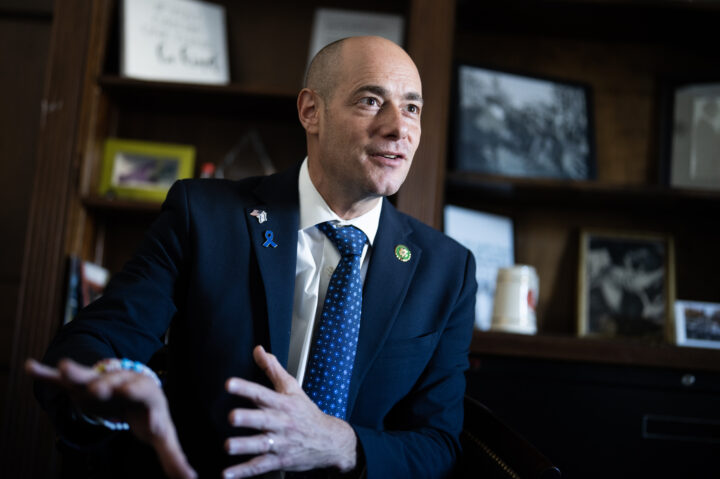
Tom Williams/CQ-Roll Call, Inc via Getty Images
Rep. Greg Landsman (D-OH) is interviewed by CQ-Roll Call, Inc via Getty Images in his Longworth Building office on Friday, November 3, 2023.


 Add JewishInsider on Google
Rep. Greg Landsman (D-OH) said that the U.S. and its allies “may very well need to take defensive action, targeting military assets in Iran,” in a statement shared with Jewish Insider on Wednesday.
While Landsman didn’t explicitly say in the statement that he intends to oppose the war powers resolution on Iran that may come to a vote before the House next week, his position suggests that he’s skeptical of that effort. Two House Democrats — Reps. Josh Gottheimer (D-NJ) and Jared Moskowitz (D-FL) — have already expressed outright opposition to the war powers resolution.
“Targeted strikes on known ballistic missiles and rocket infrastructure and other weapons depots, including nuclear assets, may very well save lives,” Landsman said. “The region and world would be a much safer place if the regime’s military capacity was leveled. These targeted strikes could prevent war, which should be the goal of any effort.”
“If targeted, defensive strikes are necessary, and these strikes are successful, the prospect of war and further violence is diminished. That’s what we should all want: an end to decades of bloodshed and mayhem by this regime. We should continue to work to weaken the regime’s ability to do harm,” Landsman added.
Emphasizing Iran’s long-standing pattern of terror throughout the region, including killing more than 30,000 demonstrators in two days last month, in addition to hundreds of Americans and fueling violence throughout the region, Landsman said that the U.S. has an opportunity to “end the bloodshed and mayhem.”
“For most of my life, the regime in Iran has caused bloodshed and mayhem. At some point, we have to say enough is enough, and begin to destroy its ability to kill innocent people, including its own citizens,” Landsman said. “If it weren’t for the regime, Yemenis, Iraqis, Lebanese, Palestinians, and Persians might all be free.”
Though the administration continues efforts to negotiate with Iran, Landsman said that the regime has “yet to show any interest in disarming or pulling back from funding violence and terror in the region. Instead, the regime is threatening further attacks on Americans and our allies.”
Landsman said that, in the case of any military action, the administration has an obligation to remain in close touch with senior congressional leaders and make its case to the American public. “This is true for targeted strikes on military assets, even if the purpose is to prevent war and further violence,” Landsman said.
“Going to war, which would be boots on the ground and an extended or ongoing military engagement, does require congressional approval,” he continued.
The gathering, ostensibly focused on the disarmament of Hamas and the establishment of a peace-aligned administration in the Gaza Strip, comes as the U.S. moves dozens of fighter jets and support aircraft to the region

Chip Somodevilla/Getty Images
U.S. President Donald Trump gives a speech at the World Economic Forum (WEF) on January 21, 2026 in Davos, Switzerland.
High-level foreign officials, top diplomats and heads of state will gather in Washington today for the first in-person convening of the Trump administration’s Board of Peace — as U.S. military assets flow into the Middle East and President Donald Trump mulls a potentially weekslong sustained military campaign in Iran.
The gathering, ostensibly focused on the disarmament of Hamas and the establishment of a peace-aligned administration in the Gaza Strip, comes as the U.S. moves dozens of fighter jets and support aircraft to the region — reportedly the largest buildup in military air power since the 2003 invasion of Iraq.
It’s a split screen befitting the president — who said at his inauguration last year that his “proudest legacy will be that of a peacemaker,” and who has claimed success in negotiating an end to numerous conflicts, as well as the release of the remaining Israeli hostages from Gaza last year — even as the U.S. has used force to enact political change, such as in Venezuela.
But a U.S. operation in Iran would differ significantly from what took place in Venezuela last month. In the place of ousted President Nicolás Maduro is Delcy Rodríguez, the former vice president who is now working with the Trump administration. No such natural successor to Iranian Supreme Leader Ayatollah Ali Khamenei exists. Behind the supreme leader is a laundry list of equally — if not more — radical hard-liners eager to take the ailing Khamenei’s place. Reza Pahlavi, the son of the deposed shah of Iran, who has spent most of his life living in exile, has sought to return to Iran to usher the Islamic Republic into a new democratic era — but does not appear to have the on-the-ground support as well as enough legitimacy among Iran’s vast diaspora community.
The Trump administration continues to signal publicly that it wants to find a diplomatic resolution to the situation in Iran, with White House Press Secretary Karoline Leavitt saying as much at yesterday’s press briefing.
But the White House is continuing to move forward with preparations for a military confrontation, which could include anything from targeted strikes on Iran’s nuclear facilities to a move toward regime change. Trump met on Wednesday with Secretary of State Marco Rubio, White House Special Envoy Steve Witkoff and Jared Kushner to discuss options for Iran.
Rubio is set to travel to Israel on Feb. 28, an announcement that could signal that strikes are not imminent — or that could be a ruse by the administration.
Recall that in June, Trump gave Iran a two-week deadline to resume talks, choosing to strike the country’s nuclear facilities just three days later.
Meanwhile, Russian Foreign Minister Sergey Lavrov — whose country is participating in military exercises with Iran’s Islamic Revolutionary Guard Corps today in the Strait of Hormuz — warned against renewed strikes targeting Iran.
Iran is also preparing for a potential military conflict, fortifying its nuclear sites and reviving a chain of command that empowers lower-level military officials.
A month ago, as the world teetered on the edge of another U.S.-Iran military confrontation, diplomacy won out, and the parties agreed to talks. Now, Washington and Tehran — as well as Jerusalem — find themselves again on the brink. The next big decision belongs to Trump.
Please log in if you already have a subscription, or subscribe to access the latest updates.
 Continue with Google

 Continue with Apple