









































































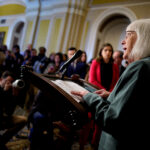

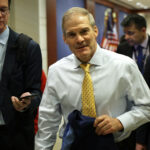


Miller is being accused of abuse by his ex-wife Emily Moreno, daughter of Sen. Bernie Moreno, who on Sunday said Miller is unfit for office

Anna Moneymaker/Getty Images
Rep. Max Miller (R-OH) leaves for a break during a House Republican Steering Committee meeting at the U.S. Capitol Building.


 Add JewishInsider on Google
Sen. Bernie Moreno (R-OH) publicly accused Rep. Max Miller (R-OH), his former son-in-law, of domestic abuse on Sunday and said Miller is unfit for office. Moreno’s comments came in response to a video address by Miller denying wrongdoing amid growing scrutiny of the allegations of domestic violence and abuse by his ex-wife Emily Moreno, the senator’s daughter.
Recent polling and reports indicate that the unfolding scandal could lead Miller, one of the few Jewish Republicans in the House to lose his House seat. The New York Times reported last week that Miller’s polling is slipping in the wake of the recent allegations about his past conduct, with a Democratic internal poll showing him just one point ahead of his Democratic challenger, progressive Brian Poindexter, despite the district favoring Republicans.
Another poll conducted by a Republican firm last week reported by NOTUS found Poindexter leading Miller by five points, with Miller’s favorability 15 points underwater.
The allegations against Miller include repeated physical abuse of both Emily Moreno and their daughter.
Democratic aides told the Times they intend to target the district, which the Cook Political Report rates as “likely Republican.” The handicapper already increased Democratic chances of winning the seat as the abuse allegations gained increasing attention.
White House officials are concerned that Miller’s continued candidacy endangers Republicans’ chances of holding the House, according to the Times. Miller, in a statement, vigorously denied to the newspaper that he was in any danger of losing his seat.
Miller released a video on Sunday denying the abuse allegations against him, also posting what he claimed was exculpatory evidence. He has argued that his ex-wife suffers from mental health issues, is fabricating her claims and is a danger to him and their child, repeating allegations he has made in other public interviews. Miller said in the video address he intends to stay in the race and continue campaigning.
He has emphasized that he has never been charged with or convicted of wrongdoing and has been permitted to maintain joint custody of their 2-year-old daughter.
A spokesperson for Emily Moreno called the statement “shameful” and “a bizarre and lie-filled rant about his ex-wife to desperately try to save his political career.”
After previously withholding comment, Moreno said in a lengthy statement that the past two years since his daughter’s divorce from Miller have been “hell” and that his priority has been keeping the matter private to protect his family but that Miller’s “increasingly erratic and dangerous behavior has made that impossible.”
He called Miller a “danger” to his daughter and granddaughter and said that he fails to meet any “basic standards of character” to serve in office and “should not continue to be free” until he receives psychological help.
Miller dismissed Moreno’s claims and accused him of trying to “hide from your own media circus” and of only speaking out for political reasons, as well as questioning why he had not spoken out earlier.
Some of Miller’s colleagues in Ohio’s congressional delegation were muted in their reactions to Moreno’s accusations against him, with no members of the House Republican Conference calling for Miller’s resignation.
Rep. Mike Turner (R-OH), the former chairman of the House Intelligence Committee and a fellow Ohio Republican, declined to answer several questions on the accusations against Miller on Sunday, telling CBS’ “Face the Nation” that the matter should be handled “in a courtroom” as opposed to the court of public opinion.
“This is a matter of litigation. This is best handled in a courtroom and not in a TV studio,” Turner told the network. “This is an issue that is currently part of a divorce and part of litigation that’s in a courtroom, and the court should be handling this, which is clearly ongoing, and that’s where this needs to be.”
Miller, while in office, has been a close ally of Ohio’s Jewish community and active on various issues of interest to the Jewish community including supporting Israel and combating antisemitism. He has also faced harassment, threats and violence for being a Jewish member of Congress.
He serves on the House Foreign Affairs Committee.
Miller also helped lead the charge to oust former Rep. George Santos (R-NY) from the House, during which time Santos alluded to allegations of domestic violence against Miller. That reference was to a separate, earlier allegation: in 2021, Stephanie Grisham, a former White House press secretary who dated Miller before his marriage to Emily Moreno, publicly accused him of physically abusing her during their relationship. Miller denied those allegations as well.
Miller’s challenger Poindexter is an ironworker, union organizer and Brook Park, Ohio city, councilmember whose record on Israel and other issues of interest to the Jewish community is largely undefined.
“No one credibly accused of holding a gun to his wife’s head and breaking their two-year-old daughter’s collarbone belongs in the halls of power,” Poindexter said on X on Sunday.
He has been endorsed by the Congressional Progressive Caucus PAC and Our Revolution, the progressive campaign group founded by alumni of Sen. Bernie Sanders’ (I-VT) presidential campaign.
The two pro-Israel and one anti-Israel lawmakers join the panel which features outspoken voices on both sides of the Israel policy debate
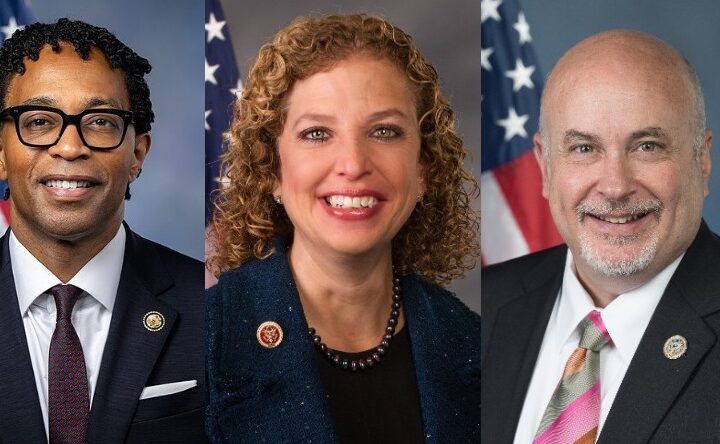
Wikimedia Commons/U.S. Congress/U.S. House Office of Photography
Reps. Wesley Bell (D-MO), Debbie Wasserman Schultz (D-FL) and Mark Pocan (D-WI)
House Democrats are set to name Reps. Wesley Bell (D-MO), Debbie Wasserman Schultz (D-FL) and Mark Pocan (D-WI) to the House Foreign Affairs Committee, Jewish Insider has learned.
Bell and Wasserman Schultz are both strong supporters of Israel, while Pocan is an outspoken critic, joining a panel that features outspoken voices on both sides of the Israel policy debate. None of the three offices responded to requests for comment.
Rep. Max Miller (R-OH), a Jewish Republican and strong supporter of Israel, also recently joined the panel.
Wasserman Schultz is a senior member of the House Appropriations Committee who has long been deeply involved in foreign policy issues, particularly in support of Israel. She is also a co-chair of the House Abraham Accords Caucus.
Bell, first elected in 2024, also serves on the House Armed Services Committee. Bell defeated anti-Israel former Rep. Cori Bush (D-MO) with support from the Jewish and pro-Israel communities both in St. Louis and nationally, and faces a primary challenge from her this year.
Pocan has long been among the most vocal critics of Israel in the House. He was a lead sponsor of the Block the Bombs Act when it was first introduced a year ago, and voted against supplemental aid to Israel in 2024. He also frequently sparred with AIPAC on social media, at times invoking antisemitic tropes accusing Israel and its supporters of relishing in the deaths of civilians and children.
The bill would create criminal and civil penalties for individuals who attempt to intimidate or obstruct access to houses of worship within a 100-foot zone
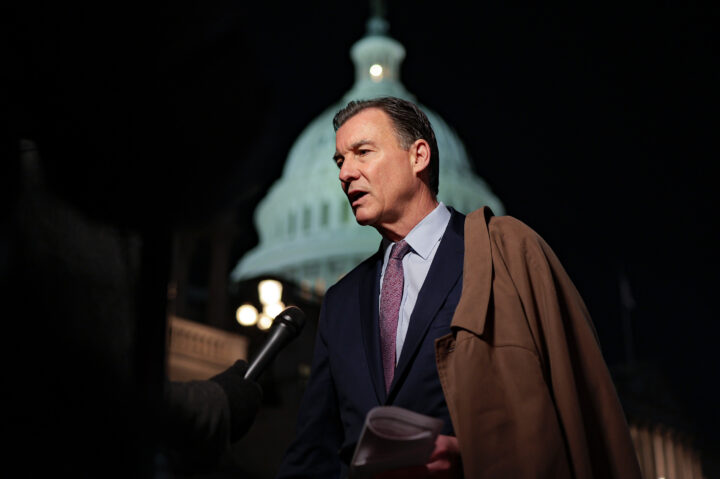
Heather Diehl/Getty Images
Rep. Tom Suozzi (D-NY) speaks with members of the media outside the U.S. Capitol on December 17, 2025 in Washington, DC.
Rep. Tom Suozzi (D-NY), joined by Rep. Max Miller (R-OH), introduced the SACRED Act this week, a new bill aimed at protecting attendees at religious institutions from harassment and threats by demonstrators — a phenomenon seen repeatedly outside synagogues that has spurred “buffer zone” legislation in New York and elsewhere.
The bill, which applies within 100 feet of a religious institution, would create criminal and civil penalties for individuals who attempt to intimidate or obstruct someone in a manner that causes reasonable fear for physical safety to prevent them from entering or exiting a place of worship. It also applies — within that 100-foot zone — to individuals who intentionally approach within eight feet of a person seeking to exercise their freedom to worship, for the purpose of intimidating or harassing them.
The bill builds on the existing FACE Act, invoked by the Trump administration in recent lawsuits, which bans the use of force, threats or physical obstruction to prevent an individual from exercising their religious freedom at a place of worship.
Unlike some legislation at the local and state level, the bill would not ban all protests within the 100-foot buffer zone, specifically permitting peaceful picketing and other non-disruptive demonstrations.
First offenders would be subject to fines or up to one year in prison, with repeat offenders subject to greater fines and up to three years in prison. The bill would also create a civil right of action for both victims of harassment as well as the Department of Justice and state attorneys general.
Suozzi told Jewish Insider the bill was prompted by constituents from various religious communities who have expressed concern about “aggressive action” against them at their places of worship.
The spate of incidents outside synagogues has been “very disturbing,” Suozzi said, adding that he’s been hearing an unprecedented amount of fear and concern from Jewish friends and supporters since the Oct. 7, 2023, Hamas attacks — ”[they] have said things to me that I never heard before, things like ‘We don’t know what to do? What would we do if they came for us?’ People are genuinely scared, and we see this hateful behavior not just [against] Jews but against other religious minorities as well.”
He described the bill as a delicate, and carefully crafted, balance designed to uphold First Amendment rights to both freedom of speech and freedom of religion.
“This is a very, very sensitive topic that involves First Amendment rights and also people’s concern about their safety and their not only their right to free speech, but also their right to worship,” Suozzi said. He added that he had consulted with a constitutional scholar, Erwin Chemerinsky, dean of Berkeley Law School, in drafting the bill, who said it is compliant with the First Amendment.
“If you’re doing a peaceful protest and you’re leafleting or something like that — we don’t have a problem with that. It’s with these people that are going up to people and yelling at them and saying meanspirited, awful things with an intent to try to physically stop them from entering into their religious institution [that are the issue],” Suozzi continued, adding that even offensive but peaceful speech like opposing a religion or Zionism would be permitted.
“It would be [banned] if you came up close to people and you start yelling in their faces and saying, ‘you’re a Zionist pig,’ or something like that — trying to intimidate them,” he explained.
Miller said in a statement, “Every American deserves to practice their faith free from fear, intimidation, or harassment.”
“The SACRED Act ensures that people can access their place of worship safely and without obstruction, while still preserving First Amendment protections for peaceful expression,” he continued. “This commonsense legislation draws a clear line: intimidation and threats have no place in our communities.”
Suozzi emphasized that the bill is different from other recent state- and local-level buffer zone legislation, and he took pains to avoid modeling the bill after a Massachusetts law that was struck down in court which had banned all protests within a 35-foot zone. The eight-foot “floating buffer zone” was based on a Colorado law that was upheld by the Supreme Court, he said.
And, he said, “we’re only focused on people’s conduct, not their speech.”
In New York City, a slice of which falls within Suozzi’s district, the City Council recently passed buffer zone legislation for educational and religious facilities, but Mayor Zohran Mamdani is reportedly considering a veto. He has until the end of the week to do so, or the legislation will become law by default.
Suozzi said he sees much of the harassment at synagogues as linked to social media, which rewards extremism, and deliberate efforts by adversaries like Iran, China, Russia and North Korea to enhance division in the country.
“So we have to take new actions to try and address that. And this is a way to say, ‘You can disagree. You can protest. You can disagree completely with what I think — even though I think that you’re wrong, you’re completely allowed to do that, but you’re not allowed to come close to a person and try and scare them and try and prevent them from feeling safe to go practice their religion,’” Suozzi said.
Suozzi is set to be joined by Anti-Defamation League CEO Jonathan Greenblatt for a press conference on the bill at the Holocaust Memorial and Tolerance Center of Nassau County on Friday morning.
“No one should have to face harassment or intimidation as they are trying to pray in peace at a place of religious worship,” Greenblatt said in a statement. “This important and much-needed legislation reflects both the urgency of this moment and the fundamental principle that every person should be able to practice their faith freely and safely.”
Leaders from several communities impacted by antisemitic violence lobbied in favor of the bill on Capitol Hill earlier this week.
It’s also being backed by the American Jewish Committee, Orthodox Union, Hadassah, Hindu American Foundation, Islamic Society of North America, Jewish Federations of North America, UJA-Federation of New York, the Holocaust Memorial and Tolerance Center and Agudath Israel of America.
In a statement, AJC CEO Ted Deutch emphasized that the group’s recent national survey found that more than a quarter of American Jews said that an institution with which they are affiliated has been targeted in the last five years, and more than half have changed their behavior out of fear of antisemitism.
“At a time of rising threats against Jewish institutions, we applaud Representatives Suozzi and Miller for introducing the bipartisan SACRED Act to ensure safe access to houses of worship,” Deutch continued.
“Houses of worship are sacred spaces and visitors gathering there to pray or attend communal events should be free from harassment. The SACRED Act helps protect communities by creating a buffer zone around places of religious worship and individuals and imposes penalties for violations of this law,” Rabbi A.D. Motzen, the national director of government affairs for Agudath Israel, said in a statement.
“Unfortunately, recent incidents in front of synagogues around the country highlight the need for additional protections,” Motzen continued.
Eric Fingerhut, the CEO of the Jewish Federations of North America, said, “Every American deserves to practice their faith free from intimidation, harassment, or fear at the doors of their place of worship. With incidents targeting synagogues and other houses of worship continuing to rise, we need this federal legislation to protect our fundamental right to religious freedom.”
“Intimidating and harassing people exercising their right to worship is unacceptable — anytime, anywhere,” said Carol Ann Schwartz, national president of Hadassah. “Hadassah has heard from Jewish women who are afraid to display symbols of their faith and who constantly watch their synagogue doors for attackers. The antisemitism these women face reflects the erosion of public safety at every place of worship, and we must act to keep sacred spaces safe.”
The Jewish Republican had previously expressed concerns about his personal safety in the wake of the Oct. 7 Hamas attacks on Israel
Anna Moneymaker/Getty Images
Rep. Max Miller (R-OH) leaves for a break during a House Republican Steering Committee meeting at the U.S. Capitol Building.
Rep. Max Miller (R-OH), one of four Jewish Republicans in the House, said on Thursday that his car was run off the road by a pro-Palestinian activist who threatened his and his family’s lives, earlier in the day.
“If you have an issue with a legislator, your city councilman, your mayor, anyone like that, the appropriate thing to do is to reach out to them for a phone call to set up a meeting at one of our district offices,” Miller said in an angry video posted on Thursday afternoon on X. “What is not OK is to assault anyone, whether you’re a member of Congress or anybody else within our district while you are driving to work.”
Miller said in the video that on his way to work in his district on Thursday morning, an “unhinged, deranged man” leaned on his car horn and ran Miller off the road “when he couldn’t get my attention, to show me a Palestinian flag, not to mention ‘death to Israel, death to me’ — that he wanted to kill me — and my family.”
He explained in the X post that the man threw a Palestinian flag out of his car before driving off and threatened his life and his family’s lives. Miller did not specify what the individual said.
Miller said that he had reported the incident to local and U.S. Capitol Police, and that the individual had been identified and would face consequences. Local and Capitol Police did not respond to requests for comment and no announcements of any arrests have been made so far.
“We will not hide, and I will continue to fight against antisemitism, Islamophobia and all other forms of hate,” Miller said. “You have an issue? Take it to our office. You want to run me off the road? That’s a different story.”
The incident comes just days after a man shot two Minnesota state lawmakers and their spouses at their homes, killing Minnesota House Speaker Melissa Hortman and her husband Mark, impersonating a law enforcement officer; the man carried with him what authorities have characterized as a target list containing the names of lawmakers, including numerous House Democrats, from Minnesota and other nearby states.
It also comes amid a string of violent antisemitic attacks by anti-Israel extremists that have targeted Pennsylvania Gov. Josh Shapiro, an American Jewish Committee event at the Capital Jewish Museum in Washington and a hostage awareness event in Boulder, Colo.
Multiple Jewish House members, including Miller, have expressed concerns for their personal safety since the Oct. 7, 2023, attacks, and the Minnesota shootings have sparked broader concerns about lawmaker safety this week.
House leaders condemned the incident.
“What happened to Max this morning is yet another outrageous example of unhinged rhetoric inspiring unstable people to threaten and attack elected officials who are serving their communities,” House Speaker Mike Johnson (R-LA) said. “We must turn down the temperature in this country.”
“We condemn in the strongest possible terms the attack on Congressman Max Miller and his family and are thankful they are safe,” Democratic leaders Reps. Hakeem Jeffries (D-NY), Katherine Clark (D-MA) and Pete Aguilar (D-CA) in a joint statement. “The rise in political violence in this country is unacceptable. This is a moment of crisis that requires Congress to act decisively in order to ensure the safety of every single Member who serves in the People’s House.”
Please log in if you already have a subscription, or subscribe to access the latest updates.
 Continue with Google

 Continue with Apple