









































































About 120 of the rockets and missiles crossed from Lebanon into Israel during the Wednesday night barrage, with those not intercepted mostly striking Israel’s north
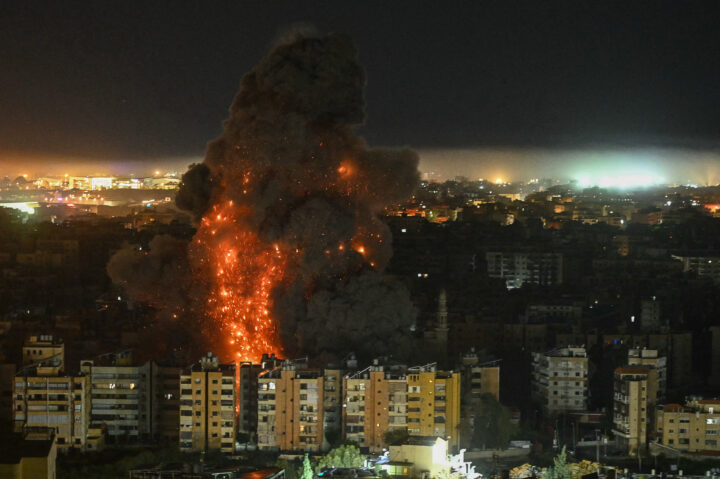
FADEL itani/AFP via Getty Images
A fireball rises from the site of an Israeli airstrike that targeted an area in Beirut's southern suburbs overnight March 10 to 11, 2026.


 Add JewishInsider on Google
Israel continued extensive strikes on Lebanon on Thursday morning, after Hezbollah shot about 200 projectiles at northern Israel the night before.
About 120 of the rockets and missiles crossed from Lebanon into Israel during the Wednesday night barrage, with those not intercepted mostly striking Israel’s north.
The Magen David Adom emergency service treated two individuals with mild injuries following the missile fire from Lebanon.
A home, with the exception of its safe room, was destroyed, and two others were damaged in Moshav Haniel in Emek Hefer, a region of Israel 70 miles from the Lebanon border.
Soon after, Iran launched missiles at Israel, a move officials said likely indicated that the two Wednesday night barrages were coordinated between Tehran and Beirut.
A senior Israeli official briefed the media on Thursday morning that a significant expansion of operations in Lebanon would soon take place, but did not say whether that would include a broad ground invasion.
Shortly after Wednesday night’s barrage began, the IDF announced “a large-scale wave of strikes on Hezbollah infrastructure in the Dahieh area of Beirut” while “interception efforts [were] ongoing.”
As part of that wave, the IDF struck 10 Hezbollah sites within 30 minutes, including an intelligence base and headquarters of the elite Radwan unit. On Thursday morning, the IDF reported launching 200 munitions from air and sea at 70 Hezbollah targets in Beirut.
“The Hezbollah terrorist organization has embedded its terrorist infrastructure in the heart of Beirut under the cover of the civilian population,” the IDF Spokesperson’s Office said.
IDF Spokesperson in Arabic Avichay Adraee posted evacuation warnings on social media throughout the night and morning. Over half a million residents of Lebanon have evacuated since Hezbollah joined the war on Iran’s side last week.
In addition, troops of the IDF’s Mountain Brigade operated in Lebanon near the border with Israel to locate and destroy rocket launchers and weapons storage facilities.
The IDF reported “a wide-scale wave of strikes in Iran” on Thursday. In addition, according to Israeli and other Middle Eastern media, Israeli drones have been striking checkpoints manned by Iranian paramilitary militia Basij. The checkpoints had been set up on central arteries throughout Iran to try to suppress an uprising and limit movement.
The IDF intercepted Iranian missiles headed for Jerusalem on Thursday.
In addition to the two mild injuries from Lebanese missiles, Magen David Adom treated 45 people who were injured on their way to shelters or suffered from anxiety on Wednesday.
Since the start of Operation Lion’s Roar, MDA reported 759 physical casualties, of which 169 were caused by missile fire, including 12 fatalities.
Iran struck an oil tanker off the coast of the United Arab Emirates on Thursday, the sixth such ship targeted in the Gulf over two days, after attacking two vessels in Iraqi waters overnight, killing one. Iranian drones struck an oil facility in Bahrain, an airport in Kuwait, an Italian military base in Iraqi Kurdistan and a tower in Dubai on Thursday morning. The Saudi Defense Ministry said it intercepted a UAV targeting an oil field.
Also Thursday, Israeli Education Minister Yoav Kisch said that schools in northern Israel and the coastal strip, including Tel Aviv, are not expected to reopen in the coming days, while in other areas, school may reopen gradually, starting Monday.
In Lebanon, two IDF soldiers were killed over the weekend by a missile fired by Hezbollah
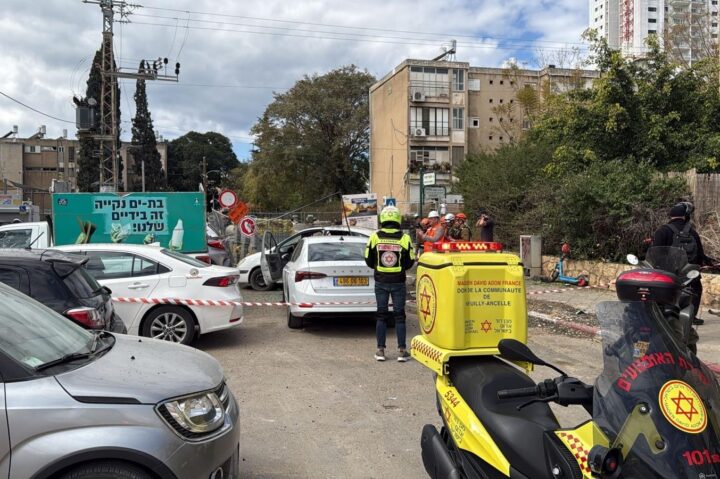
Magen David Adom
The site of a missile strike in central Israel, March 9, 2026
One person was killed in an Iranian missile attack that struck a construction site in the city of Yehud in central Israel, volunteer emergency service Magen David Adom reported on Monday.
MDA pronounced the victim, a man who appeared to be about 40 years old, dead at the scene. Another man, believed to be around the same age, was evacuated to the nearest hospital in serious and unstable condition. Both were foreign workers.
“It was a difficult scene,” MDA paramedic Liz Goral said. “The two casualties were lying unconscious and suffering from severe shrapnel injuries to their bodies. After performing resuscitation efforts, we had to pronounce the death of a man, approximately 40 years old, and we evacuated the second casualty in serious condition.”
The Hatzalah volunteer emergency services reported three additional injuries in the area.
Missile strikes on Israel caused significant property damage over the weekend in Tel Aviv and Rishon LeZion, a large city in central Israel. Overnight Sunday, a woman in the Rishon Lezion area was treated for a head injury after being hit by flying rocks.
Since the beginning of Operation Lion’s Roar, there have been 13 fatalities. Emergency service Magen David Adom has treated 622 injured people, the majority of whom were injured making their way to shelter or in traffic accidents related to stopping suddenly for missile sirens.
IDF International Media Spokesperson Nadav Shoshani said in a briefing on Monday that though “the amount [of missiles] in each barrage is going down, they are still dangerous. We have seen what one missile can do … some of them carry warheads that weigh a ton. We have seen Iran use weapons that constitute war crimes – cluster munitions – almost on a daily basis.”
Saudi Arabia had its first two fatalities from the Iranian attacks over the weekend: an Indian national and a Bangladeshi national, both of whom were in residential areas when they were killed. The State Department ordered diplomats at the U.S. Embassy in Riyadh, which faced several attacks by Iran last week, to leave the Gulf state.
In Lebanon, two IDF soldiers were killed over the weekend by a missile fired by Hezbollah. The soldiers were retrieving a vehicle from a position in southern Lebanon at the time they were killed, the IDF Spokesperson’s Office said. One soldier, combat engineer Maher Hatar, 38, was the first Druze soldier killed in the war. The second soldier’s identity has not been cleared for publication.
Shoshani said that in the week since Hezbollah joined Iran’s attacks on Israel, they have launched hundreds of rockets and UAVs at Israel.
“Hezbollah is present in southern Lebanon,” Shoshani said. “The IDF is standing between the terrorists and [Israeli] civilians. … Hezbollah has spent decades amassing weapons, and even though we spent the last 2.5 years degrading those weapons, they still are able to threaten our civilians.”
The IDF conducted a raid in southern Lebanon on Sunday night, Shoshani said, emphasizing that it was limited and “not the beginning of a ground maneuver.”
The IDF also struck Islamic Revolutionary Guard Corps Quds Force commanders based in Beirut over the weekend.
Also over the weekend, IDF soldiers unsuccessfully searched a cemetery in Lebanon for the remains of Ron Arad, an Israeli Air Force navigator who disappeared in 1986. The IDF said that there were no clashes with Hezbollah and that soldiers were not fired upon, while Lebanon’s health ministry reported that dozens of people were killed in the operation.
Israeli Prime Minister Benjamin Netanyahu said that “the operation … did not yield the findings we were looking for, but the commitment of the state of Israel and my own commitment to complete all the missions regarding our captives and missing is absolute and constant. So it has been and so it shall be.”
Arad’s widow, Tami, expressed misgivings about the operation in a Facebook post: “Our desire to know what happened to Ron stops as soon as there is a risk to IDF soldiers. In our view, the sanctity of life comes before the commitment to return the remains of a fighter for burial. This is our worldview regarding our loved one who disappeared some 40 years ago. … We appreciate the state of Israel’s commitment and at the same time we ask … do not instruct [to begin] operations with even a minimal risk to the fighters.”
White House Special Envoy Steve Witkoff and Jared Kushner, President Donald Trump’s informal advisor, are set to visit Israel on Tuesday, a Trump administration source confirmed to Jewish Insider overnight. Later, unconfirmed reports on Monday said that the trip was called off.
The scheduled visit comes after Israel bombed Iranian oil facilities over the weekend. Israel notified the U.S. in advance of the strikes, but Washington reportedly misunderstood the extent of the planned attacks, which went further than the White House expected.
Shoshani said that the fuel depot was connected to the IRGC.
Over the weekend, the IDF also struck an Iranian Internal Security command center in Isfahan, as well as a base used by the IRGC, IRGC police and the Basij paramilitary force. In another wave of strikes, the IDF hit the IRGC Space Agency, which included the command-and-control structure for the Khayyam satellite used to monitor Israel.
“The strikes were completed as part of the phase of deepening the damage to the core arrays and foundations of the Iranian regime,” the IDF Spokesperson’s Office said.
In addition, the IDF struck F14 fighter jets at Isfahan airport, along with detection and air defense systems and two major ballistic and cruise missile production sites in Parchin and Shahrud.
The IDF also killed Abu al-Qassem Baba’iyan, head of the military office of the Iranian supreme leader and the chief of staff of the emergency command, who was responsible for coordinating between the Iranian regime’s military groups to attack Israel. His predecessor, Ali Shadmani, was killed by Israel in last year’s war with Iran.
The Islamic Republic officially confirmed on Sunday that Mojtaba Khamenei, a son of assassinated Supreme Leader Ayatollah Ali Khamenei, would succeed his father. Trump said last week that appointing the younger Khamenei was “unacceptable,” and that he would play a significant role in choosing the country’s next leader. Israeli Defense Minister Israel Katz has said that “any leader appointed by the Iranian terror regime will be a clear target for elimination.”
This post has been edited to correct the number of fatalities that occurred on March 9.
Tehran also attacked Azerbaijan for the first time, launching drones that injured two at Nakhchivan International Airport
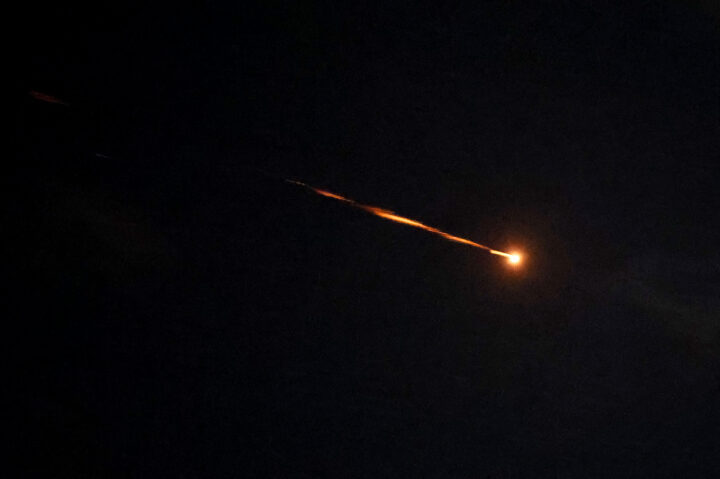
JACK GUEZ/AFP via Getty Images
Rocket trails are seen in the sky above the Israeli coastal city of Netanya amid a fresh barrage of Iranian missile attacks on March 5, 2026.
Some of the first repatriation flights carrying Israelis who had been stranded abroad were briefly held mid-flight on Thursday morning as Iranian missiles were fired at central Israel.
El Al, Arkia, Israir and Air Haifa repatriation flights began taking off for Israel on Wednesday evening from dozens of destinations in Europe, the U.S. and Thailand, and began landing Thursday morning.
Several flights needed to briefly detour while en route to Ben Gurion Airport after Iran shot missiles toward central Israel. The flights are expected to continue through the weekend.
The Magen David Adom emergency service said that no casualties from the missile barrage had thus far been reported. Social media footage showed a crater in the ground, believed to be from falling missile fragments, in an open field near houses in central Israel.
As Iran launched missiles at Israel on Thursday morning, it also attacked Azerbaijan for the first time, launching drones that injured two at Nakhchivan International Airport.
Italy, Spain, France and the Netherlands said they would send naval vessels to Cyprus, after an Iranian UAV struck a British base on the island state.
The IDF has been preparing for the possibility that the Houthis will begin striking Israel as they have done sporadically since the Oct. 7, 2023, Hamas attacks on Israel, Israeli media reported. The Houthis have threatened to fire at Gulf States if they attack Iran, and Saudi Arabia increased security for Crown Prince Mohammed bin Salman in case of a Houthi attack, according to Israeli public broadcaster KAN.
Overnight between Wednesday and Thursday, the IDF struck an underground site in Iran used to store missiles. Amid the strike, an IAF jet detected Iranians loading a missile into a launcher and struck it.
The IDF completed a wide-scale attack on an Iranian military compound that featured the headquarters of the Islamic Revolutionary Guard Corps, Basij paramilitary force, Quds Force, cyber warfare, and internal security, including the unit for suppressing protests, the military said on Wednesday.
According to the Institute for National Security Studies in Tel Aviv University, over 1,000 people have been killed in Iran. Israel has struck over 600 targets and the U.S. has struck over 2,000, in addition to over 300 air-defense systems and ballistic-missile assets. The U.S. additionally destroyed 20 Iranian vessels and submarines.
There have been over 120 waves of Iranian attacks on Israel, including 200 missiles and over 120 UAVs, with 10 significant impacts. There have been 941 UAV attacks, 189 ballistic missiles and eight cruise missiles targeting the UAE, 92 UAVs and 74 missiles aimed at Bahrain, 41 UAVs and 112 missiles targeting Qatar, among other attacks, according to the INSS.
In addition, the INSS found that there have been 62 attacks launched from Lebanon toward Israel and six from Lebanon to Cyprus. Israel has struck over 250 targets in Lebanon since Hezbollah joined the war over the weekend.
Israel has eliminated more than 40 senior figures in Iran, 14 of whom the INSS characterizes as very senior, and 16 in Lebanon.
MDA reported 44 people injured as a result of missile strikes on Israel on Wednesday. Most were injured making their way to shelter. Since the start of Operation Lion’s Roar, MDA has treated 458 casualties; there have been 12 fatalities.
Israeli Defense Minister Israel Katz spoke with Defense Secretary Pete Hegseth on Wednesday, thanking the U.S. for its support for Israel and saying the countries’ leaders are “changing regional and global history.”
Hegseth praised the cooperation between the militariess and said “keep going to the end; we are with you,” according to Katz’s office.
Israeli Prime Minister Benjamin Netanyahu’s diplomatic advisor, Ophir Falk, pushed back against the claim that the U.S. or Israel attacked a girls’ school in Iran on Saturday, killing at least 168, according to Iranian reports. Falk said the claim was being investigated, but that it appears that a misfired Iranian missile struck the school.
“From what I understand, that was clearly an Iranian strike; it’s a misfire from the Iranians,” Falk told CNN. “Those are Iranian missiles that misfired. Some 30% of their missiles are misfiring.”
Falk noted that similar incidents took place during the war in Gaza, adding: “For us, every civilian casualty is a tragedy. We do everything to prevent civilian casualties. … For [Iran], it’s a strategy. … I am 100% sure the American military did not intentionally kill civilians.”
A missile hit in Beit Shemesh killed at least nine people on Sunday; two died in Tel Aviv late Saturday
Amir Levy/Getty Images
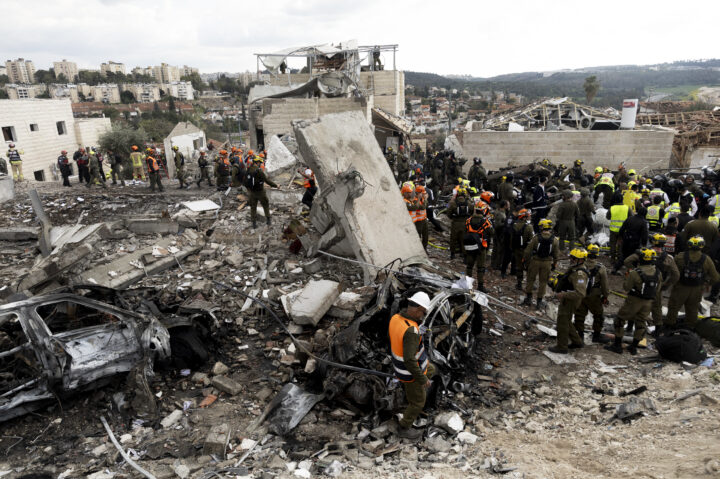
Israeli emergency and rescue personnel recover casualties from an Iranian missile site on March 1, 2026 in Beit Shemesh, Israel.
At least nine people were killed in an Iranian missile strike on a residential neighborhood in Beit Shemesh, about 35 miles west of Jerusalem, the Israeli emergency medical service, Magen David Adom, reported on Sunday, bringing the Israeli death toll from the war with Iran launched a day earlier to 12.
Another 28 people, including young children, were injured, with two in serious condition.
The missile barrage on the mostly Orthodox Jerusalem suburb directly struck a public bomb shelter under a synagogue, among other sites.
Yehuda Shlomo, an MDA EMT, said that when he arrived on the scene, he saw “heavy structural damage, smoke in the air and a great deal of chaos with dozens of frightened casualties emerging from the damaged buildings.”
Another EMT, Tzvi David, said that he rescued a woman in her 60s trapped under a slab of concrete and that firefighters extricated three children from a locked room.
Photos and videos taken by MDA show buildings destroyed to their foundations, others heavily damaged, and burned-out cars.
IDF International Media Spokesperson Lt.-Col. Nadav Shoshani posted on X that “since the beginning of Operation ‘Roaring Lion’ the Iranian regime has been targeting civilians, we know that this is their strategy. In their recent attack they killed many civilians in the community of Beit Shemesh. The Iranian regime is a terror regime.”
“I send my deepest condolences to the families. We will continue to do everything we can to remove these capabilities from this bloodthirsty terror regime,” Shoshani stated.
Late Saturday night, a missile strike in the Tel Aviv area killed two women, one a Filipina caregiver aged 32 and the other aged 68 who died of respiratory issues while moving to a shelter, and injured 121 people.
A 102-year-old man in Ramat Gan, east of Tel Aviv, also died after falling down the stairs on his way to a protected space during an incoming missile siren, Ichilov Hospital announced Sunday.
About 40 buildings in Tel Aviv sustained damage from the missile strikes, with one deemed uninhabitable, the municipality stated. Over 200 residents were evacuated to hotels in the city.
The most heavily damaged building did not have its own safe room and most residents had evacuated to a public bomb shelter, Israel’s Home Front Command said.
Israeli President Isaac Herzog visited the impact site in Tel Aviv and called on the people of Israel and the region to “stay strong.”
“This is a historic effort to change the trajectory in the Middle East to a different future — a future of peace,” Herzog said. “We’ve been confronted by an empire of evil for a generation.”
Iranian Supreme Leader Ayatollah Ali Khamenei, whom Israel killed on Saturday, “spent a whole generation taking his people’s resources and directing them towards terror, bloodshed, pain and horror. And what we are doing here, together, all the allies, the United States, leading this effort … towards a vision of peace in the region,” Herzog said.
Please log in if you already have a subscription, or subscribe to access the latest updates.
 Continue with Google

 Continue with Apple