














































































The announcement came following a meeting between Netanyahu, Jared Kushner and BOP head Nickolay Mladenov; the parties agreed that no reconstruction will begin in Gaza before demilitarization is complete

Shalev Shalom
Israeli President Isaac Herzog meets with Jared Kushner and Board of Peace representatives in Jerusalem on Aug. 17, 2026.


 Add JewishInsider on Google
Israeli Prime Minister Benjamin Netanyahu’s office announced on Monday that Israel and the U.S.-led Board of Peace will launch two working groups to address key issues in the board’s plan for disarming Hamas and reconstructing the enclave.
The PMO announced the developments in a readout following Netanyahu’s “deep and constructive discussions” with Jared Kushner and Board of Peace High Representative Nickolay Mladenov, as well as their respective teams, in Jerusalem. Mladenov and Kushner had met a day earlier in Cairo with Hamas leaders and Turkish, Egyptian and Qatari mediators.
Also participating in the Jerusalem meeting were former British Prime Minister Tony Blair and Board of Peace senior advisors Aryeh Lightstone and Liran Tancman.
One working group will focus on disarmament and demilitarization in Gaza, the PMO said, “which both Israel and the Board of Peace are determined should be prompt and completed before any reconstruction happens in Gaza.”
The second working group will focus on “sanitation, clean water and other public health issues for the people of Gaza and which also impact the people of Israel,” the statement continued.
Kushner, Mladenov, Blair, Lightstone and Tancman also met on Monday with Israeli President Isaac Herzog at his official residence in Jerusalem. Herzog expressed gratitude for Kushner and Mladenov in a statement following the meeting “for their ongoing efforts to advance to the next stages in Gaza,” and said he “was impressed that Israel’s security interests are an important and central element of their plan.”
Hamas leaders have agreed to a phased disarmament that would only take place after Israel’s complete withdrawal from Gaza, contrary to the roadmap’s timeline that calls for Hamas’ complete disarmament before any IDF withdrawal begins. Due to these and other concerns, Netanyahu announced last month that Israel would not agree to the deal.
During the summit in Cairo, Hamas officials detailed what they described as Israeli violations of the ceasefire in Gaza, while Kushner asked Hamas representatives to move ahead with disarmament, according to The New York Times.
'At the end of the day, the Board of Peace is a game for Washington, and life or death to Israel,' Danielle Pletka, a senior fellow at the American Enterprise Institute, told JI
Prime Minister's Office
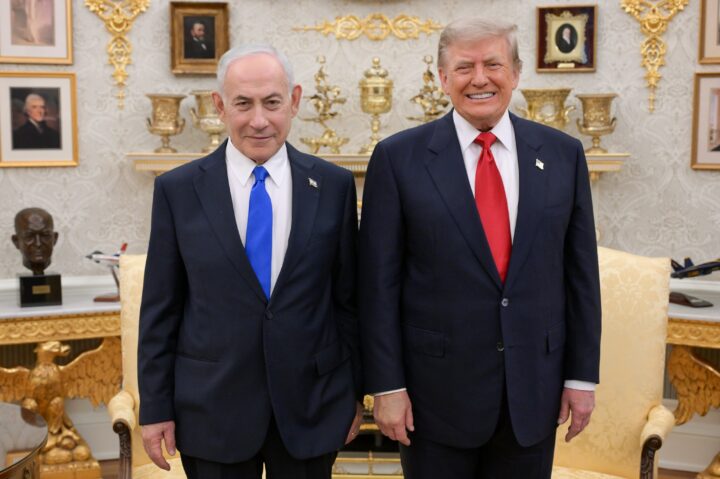
Israeli Prime Minister Benjamin Netanyahu meets with President Donald Trump in the Oval Office on July 28, 2026.
Israeli Prime Minister Benjamin Netanyahu on Sunday said Jerusalem “does not accept the 15-point document” agreed to last month by the U.S.-led Board of Peace and Hamas that would see the eventual disarmament of the terror group and withdrawal of the IDF from the Gaza Strip — a rare public break with the White House, which has touted the plan since it was announced.
In comments to his Cabinet on Sunday, Netanyahu said Israel “would not carry out any withdrawal until Hamas is disarmed.”
The White House and Jerusalem have largely been in lockstep on issues related to Gaza. The rupture over Hamas’ disarmament is one of the more significant policy breaks between President Donald Trump and Netanyahu.
Trump announced in late July what he described on his Truth Social site as a “HISTORIC” agreement, saying that the parties, through mediation by Qatar, Turkey and Egypt, had achieved a “critical step towards Gaza finally being governed by a new Palestinian government that will work closely with the Board of Peace to help the Palestinian people.”
Jonathan Conricus, a former IDF spokesperson who is now a senior fellow at the Foundation for Defense of Democracies, told JI that the mediating countries benefit from Hamas’ continued rule in the Gaza Strip and have no urgency to press for the terror group’s disarmament.
That lack of seriousness, he added, makes it unlikely that Hamas will take the necessary steps to disarm. “It’s all a show, it’s a charade, a spectacle,” Conricus said. “The only way that Hamas really ceases to control the Gaza Strip is if all of their weapons are handed in — not stored, not temporarily safeguarded somewhere else, but actually handed in, and if that is verified. As long as we won’t see that happening, I don’t think that Israel is going to agree with any charade.”
The agreement released by the Board of Peace states that none of Hamas’ weapons “shall be transferred or handed to Israel or non-Palestinian parties” and they will instead “be decommissioned and stored” by the Palestinian technocratic government in Gaza.
Conricus described the dynamic as “a very unfortunate diplomatic situation” in which Israel is being “presented as the side that is turning down the 15-point deal, [at the same time as] Hamas appears to be getting away with not implementing the deal.”
But Netanyahu’s response, Conricus said, “reeks of petty Israeli politics” and was “much more political posturing for local politics than anything else.”
Danielle Pletka, a senior fellow at the American Enterprise Institute, told JI that the break between Trump and Netanyahu was “inevitable” — and that Jerusalem and Washington have differing approaches to the future of the Gaza Strip.
“U.S. policy in the region is a circus, with grifters, diplomats, terrorists and a few well-intentioned bit players all making occasional appearances,” she said. “At the end of the day, the Board of Peace is a game for Washington, and life or death to Israel.”
Similarly to Iran, Pletka continued, “Israel is in it to win it. The Trump administration’s intentions are less clear. As a result, there are going to be public breaks, reconciliations and more breaks. Each country will pursue its interests as it sees them. That’s the way it has always been, and it isn’t going to change.”
Netanyahu is also running up against the deadline of the Oct. 27 election in Israel, walking a political tightrope as he aims to preserve his close public ties with the White House while running a reelection campaign.
The Israeli leader, Israel Policy Forum senior analyst Dan Rothem told JI, “is carefully maneuvering between Trump and the constraints of Israeli politics.
“The sequencing in the 15-point roadmap on withdrawal and disarmament does not directly contradict the 20-point plan [Netanyahu] endorsed in October 2025, and Israel was briefed throughout the negotiations,” Rothem said. “Yet three years of a ‘total victory’ narrative, combined with the political pride taken in the IDF’s control of roughly 60% of Gaza, has sharply narrowed his room to maneuver. Publicly rejecting the document lets him signal toughness to his base ahead of elections while still keeping channels open with Washington.”
Rothem added that the on-the-ground reality will matter more than election-season rhetoric. “The public rejection [by Netanyahu] serves clear electoral needs,” he said, noting that Israel had scaled back its attacks in Gaza in recent days following a meeting between Netanyahu and Board of Peace head Nickolay Mladenov, and that the Israeli Cabinet signed off on the framework for the Board of Peace’s International Stabilization Force.
The terror group has reportedly rejected a Board of Peace proposal to disarm
Omar AL-QATTAA / AFP via Getty Images
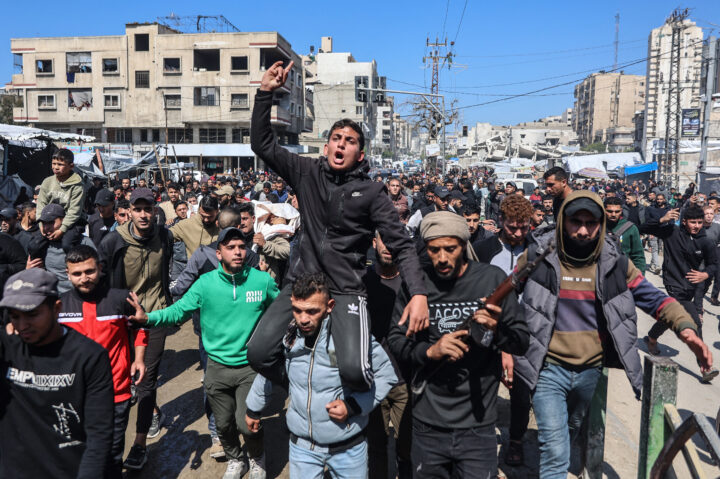
Mourners react at a funeral in Gaza City's Shujaiya neighbourhood on March 28, 2026.
As Hamas reportedly continues to reject the U.S.-led Board of Peace’s disarmament framework and fails to comply with key demilitarization deadlines, the future of the fragile Gaza peace process remains uncertain.
Disarming Hamas is a central pillar of President Donald Trump’s 20-point peace initiative, which secured the release of the remaining Israeli hostages and included a partial Israeli military withdrawal from eastern Gaza. Its second phase has hinged on Hamas laying down its arms — a step that is expected to pave the way for further IDF withdrawal from the enclave and a transition to governance by the 15-member National Committee for the Administration of Gaza, led by Ali Shaath and operating under the Board of Peace.
Last month, Nickolay Mladenov, the Board of Peace’s high representative for Gaza, presented a framework for demilitarization and set a deadline for the end of last week for Hamas to disarm. Reports indicate the group rejected the proposal, accusing Mladenov of bias toward Israel and blaming Jerusalem for not completely fulfilling its obligations under the first phase of the plan.
U.S. and Hamas negotiators held the first direct talks between the parties since the announcement of the Gaza ceasefire in October 2025 on Tuesday night, CNN reported. Senior U.S. advisor Aryeh Lightstone and Mladenov met with Khalil al-Hayaa, a chief Hamas negotiator, in Cairo, where Mladenov communicated that Hamas must accept the terms of the demilitarization agreement “or face a return to war.”
Former White House officials are split over the path forward and whether the Trump administration should escalate pressure on Hamas or stay the course.
Dan Shapiro, who served as U.S. ambassador to Israel under President Barack Obama and was appointed by then-President Joe Biden in 2021 to serve as special liaison to Israel on Iran, said Hamas is unlikely to disarm voluntarily, arguing the group would only do so “under duress.” One potential avenue, he said, would be renewed Israeli military action, though he emphasized that such a move would be both costly and unlikely.
“[Israeli military action] would come at an enormous price in civilian casualties, given Hamas’ embedded position within Gaza’s population,” Shapiro said, adding that it is “highly unlikely the Trump administration would lend its support to such an operation” and that it would deal “further blows to Israel’s international support.”
Instead, Shapiro pointed to regional pressure as a more viable path, particularly from Qatar and Turkey, which he said have previously used their leverage to influence Hamas.
“The other source of pressure on Hamas would be the threat of Qatar and Turkey to withdraw their political, financial and hosting support of the organization,” Shapiro said. “They were the parties who used their unique leverage with Hamas after the Israeli strike in Doha to convince Hamas to release all hostages. Trump should engage their leaders, as he did in that period, to convince them to use their leverage again, this time to pressure Hamas to disarm.”
However, Shapiro cautioned that the war in Iran has diverted U.S. attention and “may have reduced Trump’s ability to influence key regional leaders, like [Turkish President Recep Tayyip] Erdogan and the emir of Qatar, to take this necessary action on Hamas disarmament.”
Elliott Abrams, a former Iran envoy under the first Trump administration, similarly noted that Hamas “hasn’t changed its spots.” He said that Hamas leaders “obviously think a disarmed Hamas is a dying Hamas; without ‘armed struggle’ they believe they will disappear and become just another political party.”
“What Mladenov and the U.S. government need to figure out is what happens to the Board of Peace and to U.S. policy if Hamas won’t disarm,” Abrams said. “I think the answer is to prevent any arms and money from being smuggled into the half of Gaza that Hamas still controls, and to develop the half of Gaza under Israeli control.”
“No one seems to want to invade and conquer western Gaza, including the IDF,” Abrams added. “Perhaps over time, Gazans will begin migrating to the parts of Gaza where life can be lived without Hamas.”
Meanwhile, Alexander Gray, former chief of staff to the National Security Council during Trump’s first term, offered a more supportive view of the administration’s current strategy, calling it “realistic.”
“While we must continue to work with Israel to ensure Hamas is unable to wage war against our partners and allies and terrorize the region, we must also be realistic about the nature of the organization and its leadership,” Gray said. “The administration’s vision for a prosperous Gaza and secure Israel must continue apace, while appropriate and realistic steps are taken to prevent Hamas from acting true to its charter and perpetrating further death and destruction.”
Please log in if you already have a subscription, or subscribe to access the latest updates.
 Continue with Google

 Continue with Apple