

































An Israeli diplomatic source told Jewish Insider that Ecuador and Paraguay are expected to join the Isaac Accords
Kobi Gideon (GPO
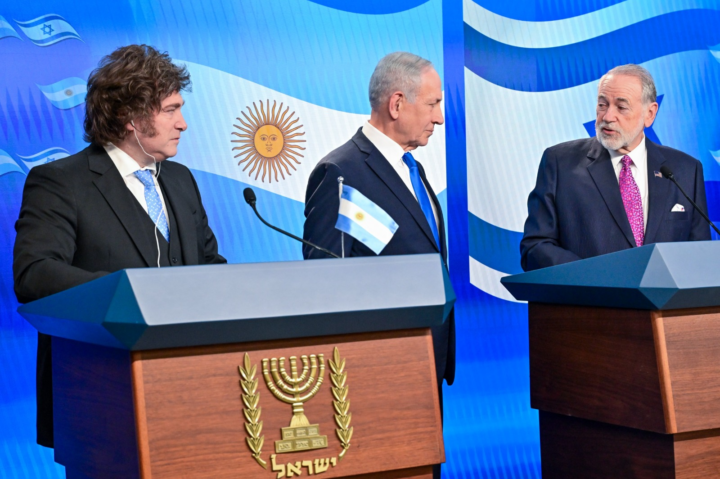
Argentinian President Javier Milei, Israeli Prime Minister Benjamin Netanyahu and U.S. Ambassador to Israel Mike Huckabee take part in the launch ceremony of the Isaac Accords


 Add JewishInsider on Google
Argentine President Javier Milei began an event-packed visit to Israel on Sunday, which will include receiving a Presidential Medal of Honor and lighting a torch in Israel’s Independence Day ceremony on Tuesday.
Milei and Israeli Prime Minister Benjamin Netanyahu launched the “Isaac Accords” on Sunday, an initiative conceived by Milei to encourage closer cooperation between Israel and Latin American countries.
An Israeli diplomatic source told Jewish Insider that Ecuador and Paraguay are expected to join the Isaac Accords. Israeli media have reported that Costa Rica, Panama and Uruguay have also expressed interest.
Milei described the launch of the initiative as “a historic moment for our nations. It will not only strengthen the relationship between Argentina and Israel, united by shared values, but also represents a step toward a freer and more prosperous hemisphere.”
“Isaac, the son of Abraham, represents an initiative to extend the model initiated by President [Donald] Trump in the Middle East to Latin America, addressing challenges such as terrorism, antisemitism, and drug trafficking, while inviting other nations to join,” Milei said. “Nations that share values have a mission to work together. With the support of the United States, we have the opportunity to bring about transformative change.”
The accords are “a new strategic framework aimed at strengthening cooperation between Argentina, Israel and like-minded partners in the Western Hemisphere, the descendants of Isaac and nations of the Judeo-Christian tradition, in defense of freedom and democracy, and in the fight against terrorism, antisemitism, and drug trafficking,” according to Israel’s Foreign Ministry.
Milei suggested launching the accords in a meeting with Israel Foreign Minister Gideon Sa’ar, whose father was from Argentina. The Israeli foreign minister was the main Israeli catalyst pushing for the agreement, including in his most recent meeting with Secretary of State Marco Rubio last summer, during which they established a working group to advance the matter, an Israeli diplomatic source told JI.
Netanyahu said that he sees “great hope vis-à-vis the Latin American continent. We see the beginnings of change, certainly we’ve seen enormous change in Argentina, but I think that this is also a compass and a map for other countries, not only for their internal reforms but also for their external reforms, that is coming back to the alliance of freedom. It begins with the two of us and with the support that is always there of the United States for free societies.”
U.S. Ambassador to Israel Mike Huckabee took part in the launch ceremony, and called Milei and Netanyahu “two of President Trump’s greatest friends” who seek to “bring back the values that are the underpinning of Western civilization and Judeo-Christian values upon which our nations were built.”
Sa’ar described Milei as “one of the boldest leaders of our age. … We will continue to strengthen this close friendship! Viva Argentina! Viva Israel!”
Earlier Sunday, Milei visited the Western Wall with Argentinian Ambassador to Israel Axel Washnish, a rabbi with whom he learned Torah for years before becoming president.
Israel and Argentina also announced direct flights between the countries. The first El Al flights to Buenos Aires are expected to start in November.
The bill allows for countries in the region to be classified as ‘terror sanctuaries’ based on material support of the terror group

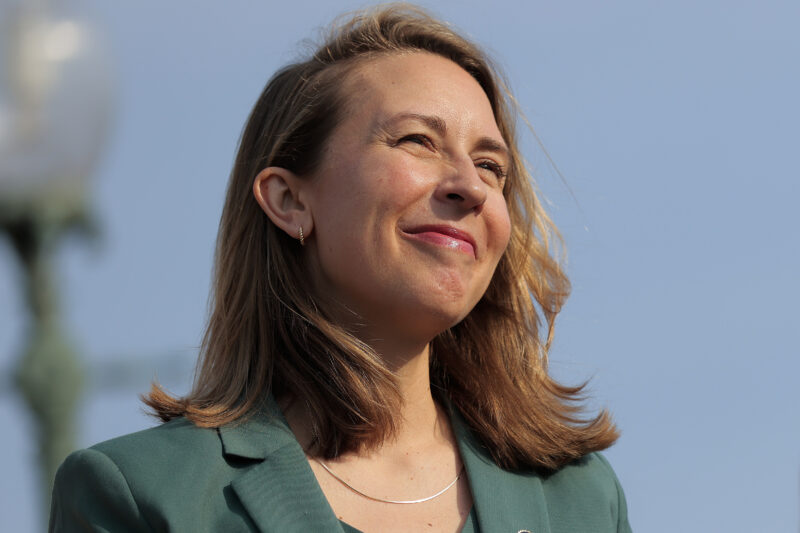
Sens. Jacky Rosen (D-NV) and John Curtis (R-UT)
KEVIN DIETSCH/GETTY IMAGESETHAN MILLER/GETTY IMAGES
Sens. John Curtis (R-UT) and Jacky Rosen (D-NV) introduced legislation this week directing the federal government to assess Hezbollah’s ability to conduct terrorist activities in Latin America and determine ways to counter its influence in the region.
The No Hezbollah in Our Hemisphere Act requires the secretary of state, in coordination with the director of national intelligence, attorney general, homeland security secretary and treasury secretary, to determine whether any country or region in Latin America qualifies as a terrorist sanctuary under U.S. law and sanction entities that collaborate with Hezbollah.
The bipartisan bill would implement visa bans and travel restrictions on foreign government officials and financial actors found to be materially supporting Hezbollah. Any current visas issued to individuals found to be in support of the terrorist organization would be immediately revoked, unless they were to take verifiable actions to begin combating Hezbollah’s influence. The legislation would also allow the president to waive these restrictions for law enforcement purposes or to remain in compliance with U.S. global obligations.
“Hezbollah is directly responsible for the murder of hundreds of Americans. For too long, this Iranian-backed terrorist group has used Latin America as a safe haven for illicit financing, recruitment, and other criminal activities — fueling drug trafficking at our southern border and posing significant threats to our national security,” Sen. Curtis said in a statement, noting that the legislation “directs the United States to take action on Hezbollah’s alarming presence in Latin America to keep us and our allies, including Israel, safe from their terrorist ambitions.”
“Iran-backed Hezbollah is a terrorist organization that has operated in the Western Hemisphere for decades to raise funds for its destabilizing activities around the globe,” Sen. Rosen said. “This is a threat to U.S. national security and cannot be tolerated. That’s why I’m proud to introduce this bipartisan bill to make clear that we will not accept countries turning a blind eye to Hezbollah’s harmful actions.”
Tyler Stapleton, director of government relations at FDD Action, the sister organization of the Foundation for Defense of Democracies, said in a statement that, “Despite Hezbollah’s military leadership being thoroughly degraded, the terror group maintains a global illicit finance network that could help the organization reconstitute itself, especially with the backing of terrorist sponsors like Iran. This is acutely felt in Latin America, where Hezbollah’s infrastructure continues to operate and threaten the United States and our allies.”
“Few countries in the region have designated Hezbollah a terrorist organization or placed significant restrictions on its operations, and some countries even openly provide it with material support. The No Hezbollah in Our Hemisphere Act seeks to address the permissive environment for Hezbollah in the region through a comprehensive assessment of Latin American countries to determine whether they meet the criteria of a terrorist sanctuary under U.S. law,” Stapleton continued.
Hernández believes that other Latin American countries will follow Honduras' lead
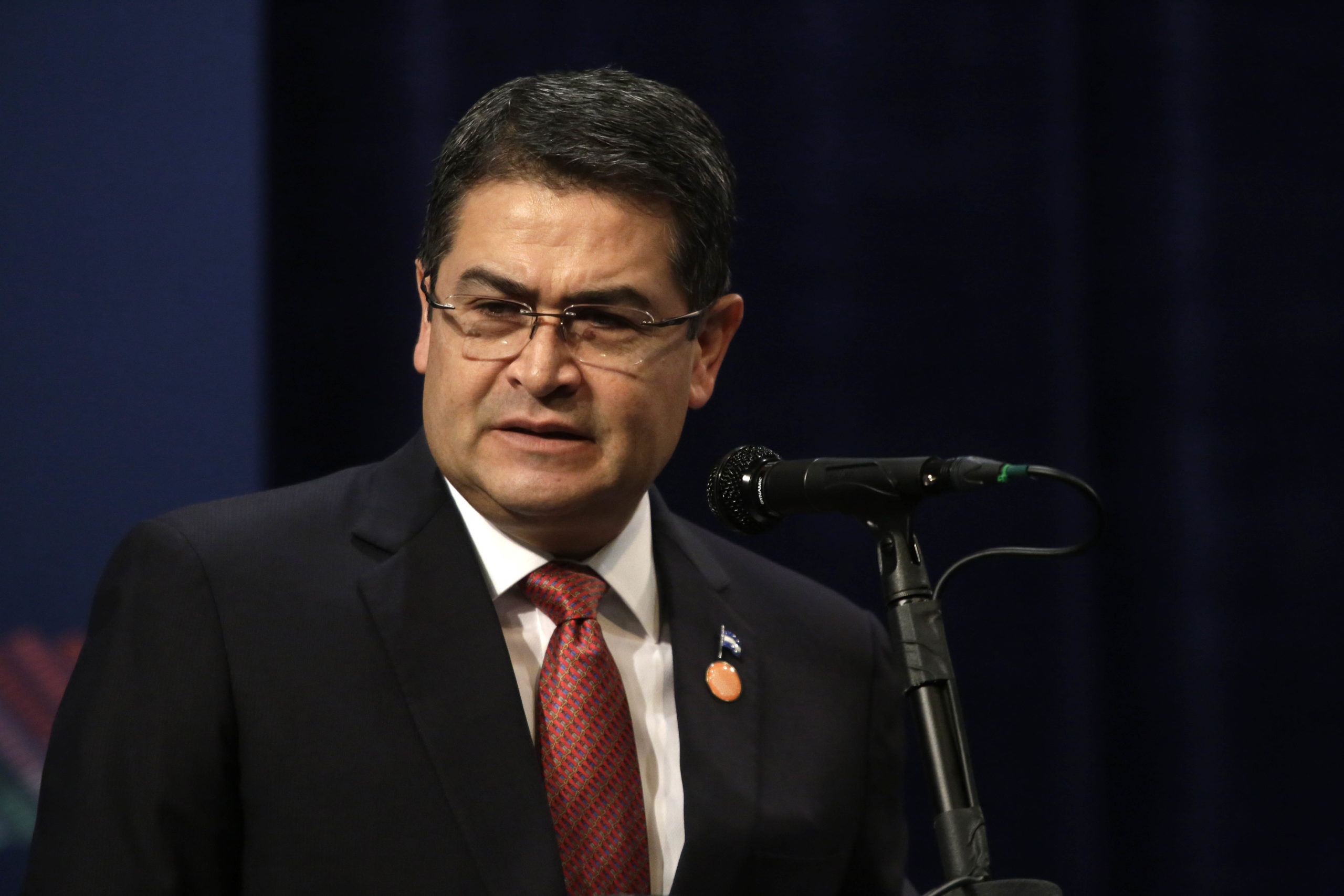
Honduras is working to forge a strategic alliance with Israel, the U.S. and key Latin American allies, President Juan Jose Orlando Hernández told Jewish Insider in an exclusive interview Saturday.
Hernández’s strategy, unveiled for the first time while the president is in the U.S. for the annual Israeli-American Council National Summit, is especially significant for Israel as it comes at a critical time in South and Central America, where the political tides are seemingly turning both for and against the Jewish state.
Hernández envisions a coalition in which like-minded Latino countries including Guatemala, which opened its embassy in Jerusalem in 2018, enjoy strong relationships with Israel and the U.S., cooperating tightly on economic, security and cultural issues. He believes Brazil, Colombia, Panama and others will also join the bloc.
The president said relations with Israel have already proved beneficial.
He credits Israeli “law enforcement technology” for significantly reducing the murder rate in Honduras, which used to be among the highest in the world. Hernández also noted that Israel is helping to provide solutions to ecological challenges faced by the Central American nation due to climate change.
However, progress in deepening relations, which includes moving the Honduran embassy to Jerusalem, has stalled due to the political deadlock in Israel, where the prospect of a third election in a year looms on the horizon.
Honduras opened its diplomatic mission in Jerusalem in September 2019. Hernández said that as part of the reciprocal process, Israel needs to open an office with similar status in Tegucigalpa before the embassies can be established. Israel’s diplomatic office covering Honduras is in Guatemala.
Hernández said that since the trade office opened, there has been a sharp increase in Israeli investment interest in Honduras in the tourism, health, agriculture and technology and logistics industries.
He explained that Honduras is establishing special legal, economic, administrative and political jurisdictions for investment and job creation, structurally similar to Macau .
The president said he is committed to having an embassy in Jerusalem despite domestic pressure. The country is home to 150,000-200,000 individuals of Arab descent, a majority of them Palestinian. In 2011, Honduras officially recognized the state of Palestine.
“We have a population of Palestinian heritage who are very economically powerful. They operate communications, media, energy and commerce, close to 60 percent of the national economy,” he said.
He said some Palestinian officials visited the community and after their mission, advertisements appeared in Honduras media against the embassy move.
“We continue…because we believe it’s the best thing to do,” Hernández said.
Hernández credits his affinity to Israel to his time in the country on a scholarship from Israeli development agency Mashav in 1991.
“From that time, it created a very strong relationship with me and Israel,” he said. “When I became president in 2014, we began to change the voting posture of Honduras with respect to Israel in the United Nations and in other forums.”
Leah Soibel, CEO of Fuente Latina, a non-partisan group that works to empower global Hispanic media to accurately cover Israel, said sentiments like those of the Honduran president must be heard.
“Israel has incredible friends in the Hispanic world and we must engage with them better,” said Soibel who helped facilitate the president’s presence at the IAC gathering in Florida this weekend.
President Hernández spoke with President Donald Trump privately before the latter took the stage at the conference Saturday night. During his speech, Trump thanked Hernández for his support.
Speaking to JI, Hernández stressed that for the alliance to succeed, long- term relations between Israel and Honduras and other Latin American countries must be maintained and nurtured.
Bolivia has begun to resume diplomatic relations with Israel a decade after La Paz angrily severed ties with Jerusalem, citing fighting between Gaza’s Islamic militant rulers and the Jewish state. The turnaround came after Bolivia’s anti-American, pro-Iran president Evo Morales was forced to step down and a new interim government took power.
Former Argentinian president and current vice president-elect Cristina Kirchner is making a political comeback in the South American country despite charges she helped cover up Iran’s role in the 1994 bombing of a Jewish center in Buenos Aires that killed 85 people and wounded hundreds more. The bombing remains the largest terror attack to ever hit the continent. Some members of her incoming cabinet want to pursue a closer relationship with Tehran and undo its designation of Hezbollah as a terror organization.
The alliance with its common interests and common adversaries helps stabilize the region and strengthen the U.S. and Israel, Hernández said. “We hope that the friends of Israel in the United States and around the world understand what is really happening in Latin America.”
“Very important attention needs to be paid to what is going in Latin America,” he said. “We have an opportunity — an important one — but if we don’t attend to that opportunity, it could be terrible.”
Please log in if you already have a subscription, or subscribe to access the latest updates.
 Continue with Google
 Continue with Apple