














































































Speaking at a House Foreign Affairs Committee hearing, Republican and Democratic lawmakers highlighted ongoing abuses by the Syrian government

Samuel Corum/Getty Images
Rep. Brian Mast (R-FL) speaks during a House Committee on Foreign Affairs hearing on Capitol Hill on January 11, 2024 in Washington, DC.


 Add JewishInsider on Google
House members on both sides of the aisle raised concerns about the new Syrian government’s recent moves against minority groups, particularly the Kurdish-led Syrian Democratic Forces, in some cases questioning whether Damascus is complying with lawmakers’ expectations after the Caesar Act sanctions on Syria were lifted.
Speaking at a House Foreign Affairs Committee hearing, Republican and Democratic lawmakers highlighted ongoing abuses by the Syrian government, with some appearing to argue that there might be cause to revisit the imposition of U.S. sanctions on Syria. Some, particularly Republicans, had been hesitant to back full sanctions repeal, but did so under pressure from the Trump administration.
Rep. Brian Mast (R-FL), the committee chair, said that no one expected the transition away from the Assad regime to be seamless, “but we’ve already seen too many incidents, in my opinion, too many incidents of sectarian violence against religious and ethnic minorities.”
He called the Syrian government’s advances against U.S. allies in the SDF “unacceptable” and criticized Russia’s ongoing presence in Syria. He said the recent ceasefire agreement between the government and the SDF is a positive step but emphasized that several such agreements have been signed and not enforced in the past.
Mast said the country is “nowhere near where it needs to be today” and he is “not satisfied with the progress that [Syrian President Ahmad al-Sharaa] has made yet” and sees “many of his actions as steps backward.”
Mast, who was one of the final obstacles to full repeal of the Caesar Act sanctions, said that al-Sharaa “does not have a blank check from the United States of America” and that the repeal came with an expectation — albeit not formally binding — that Syria would meet various conditions, including protecting minorities.
Rep. Greg Meeks (D-NY), the ranking member of the committee, said he is “optimistic in support of the Syrian people working toward the future,” but also “deeply concerned” by the ongoing sectarian violence and the Syrian government’s attacks against the SDF. He said al-Sharaa needs to show a commitment to implementing the January deal with the Kurds and to stop abuses by elements of his government.
“While I stand for Syrian people and turning the page toward a new future, we must see President al-Sharaa keep to his word of being a president for all Syrians and ensure Syria’s ethnic and religious minorities are safe and fully represented,” Meeks said.
Rep. Michael McCaul (R-TX), the former committee chair, said that, while he wanted to see al-Sharaa succeed, the Syrian government has not complied with the conditions attached to the repeal of the Caesar sanctions. He said that the images emerging from the Syrian government-aligned forces’ attacks on the Druze echoed those of ISIS-controlled areas of Syria a decade ago.
McCaul said he was particularly concerned that the Syrian government offensive led to ISIS prisoners being released from SDF-guarded prison camps in eastern Syria, some of whom remain unaccounted for. “That is a nightmare scenario, from a national security perspective,” McCaul, who also previously chaired the Homeland Security Committee, said.
Rep. Mike Lawler (R-NY), who had pushed for specific binding conditions on sanctions relief, said in a statement following the hearing, “The United States lifted sanctions on Syria to give al-Sharaa a chance to prove where he stands, despite his terrorist ties,” adding that the non-binding provisions in the final sanctions repeal bill, “were not met, and the trajectory of Syria under al-Sharaa is deeply concerning.”
Following the hearing, Rep. Tim Burchett (R-TN) also said he’s not prepared to normalize relations with Syria and is open to leveraging U.S. economic pressure.
Rep. Brad Schneider (D-IL) praised Mast for pushing to include reporting measures and non-binding conditions in the final repeal legislation, criticizing the administration for its push for unconditional sanctions relief.
“When the White House and Senate leadership pushed a hand to Damascus a clean, unconditional sanctions lift, you pushed back and insisted the repeal come with at least some benchmarks and reporting requirements, and at least a skeleton accountability, which I think is critical,” Schneider said. “I want the record to reflect that this committee, on a bipartisan basis, rejected the administration’s reckless instinct to give away our leverage for nothing in return.”
Rep. Bill Keating (D-MA) highlighted a recent op-ed by former Secretary of State Mike Pompeo that criticized the U.S. for tacitly allowing the Syrian offensive against the SDF, described Trump as overly optimistic about al-Sharaa and criticized the administration’s push to remove sanctions.
“It seems to me that there’s just such a rush to somehow having another peace agreement there that [Trump] is overlooking what the former secretary said, quite strongly, was it’s overly optimistic. And, to take all the sanctions, not using the sanctions as leverage going forward is a mistake,” Keating said.
Rep. Dina Titus (D-NV) said she was also “not in such a big hurry to take away some of the sanctions and the [terrorist] status of the president when he transitioned from so-called terrorist to so-called leader of all the Syrians.”
Rep. Johnny Olszewski (D-MD) highlighted concerns about changes to the Syrian education system, which has “removed references to women, to love, to pre Islamic culture and to even human evolution, sending a chill message to religious and ethnic minorities,” adding that Syria “can’t replace one form of intolerance with another.”
Multiple Republicans also cast doubt on whether al-Sharaa had actually reformed, characterizing him as still being a committed Islamist terrorist, who is now pretending to be a moderate reformer for Western audiences.
“I think I’m hopeful that something great can happen with Syria in the United States ought to be part of that, but giving all our leverage in advance, to me, doesn’t seem a good idea and a good way to make sure that happens,” Rep. Scott Perry (R-PA) said.
“I generally believe that once a Muslim terrorist, always a Muslim terrorist,” Rep. Randy Fine (R-FL) added.
Several lawmakers raised particular concerns about Turkey’s influence in Syria. Some linked the Syrian government’s offensive against the SDF to Turkey’s longtime enmity toward the Kurds, and others said that they see Syria as the first step in an attempt by Turkish President Recep Tayyip Erdoğan to build a regional empire.
“Right now in Turkey, they are increasingly an Islamic dictatorship. The chief opponent to Erdoğan is in jail. He will not get out prior to the elections, I don’t believe,” Rep. Keith Self (R-TX) said. “Erdoğan is overturning the secular state that Atatürk set up, and I think that that is going to set up, between Turkey and Israel, a future conflict.”
Self said he thinks Turkey aims to replace Iran as a regional power in the Middle East.
Rep. Josh Brecheen (R-OK) highlighted that Erdoğan publicly aspires to restore the Ottoman Empire, which, he noted, requires “driving all the way to Jerusalem,” and said that al-Sharaa has not appeared to cross Turkey at any point.
“My real belief is that Erdoğan’s desire to have a re-establishment of the Ottoman Empire, that al-Sharaa is not being fully truthful to what his real goal is,” Brecheen said. “My great concern is that we are enabling the prosperity of Turkey, we are enabling the prosperity of Russia, and al-Sharaa is not being truthful to us. And that years down the road, if prosperity comes — it’s not going to change the jihadist mentality.”
He suggested that he does not believe that Amb. Tom Barrack, who serves as the U.S. ambassador to Turkey, should be serving simultaneously as the U.S. envoy to Syria, to ensure that the U.S. can “play hardball in Syria” while Barrack maintains good relations with Turkey.
Nadine Maenza, the former chair of the U.S. Commission on International Religious Freedom, said that she does not believe that Barrack’s dual role is serving the U.S. well and emphasized that the State Department appears to be deferring to Barrack on Syria policy. She also said the U.S., and Barrack, should not “reward” the Syrian government with economic deals after atrocities by government-aligned forces.
Witnesses who testified before the committee were divided, with some witnesses urging pressure on the Syrian government to ensure it implements and sustains protections for the Kurds and other minorities and suggesting the U.S. continue to align most closely with its longtime partners in the SDF, while others defended al-Sharaa as an imperfect but reliable partner who had covertly worked with the United States for years.
Several Republican lawmakers threatened to reimpose sanctions on the Syrian government if it fails to protect the Kurds
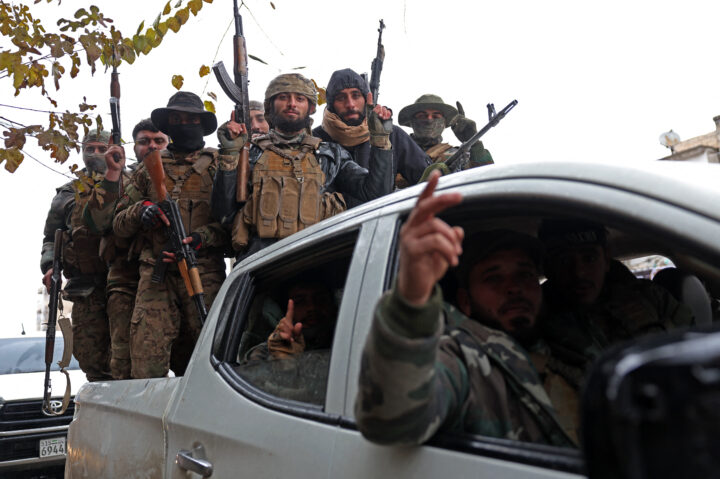
OMAR HAJ KADOUR / AFP via Getty Images
Syrian government troops patrol through the streets of Tabqa on January 18, 2026 after Kurdish-led forces withdrew from Syria's largest oil field.
U.S. officials and GOP legislators are raising concerns about the Syrian government military offensive against territory held by the Kurdish-led Syrian Democratic Forces, which has been a close U.S. ally.
Several Republican lawmakers said the Syrian government is failing to meet expectations that Damascus would protect minority rights — which was their impetus to agree to repeal the Caesar Act sanctions on Syria just months ago.
The lawmakers are now threatening to reverse course — but re-imposing those sanctions would be a difficult task.
The Syrian military, assisted by local tribal militias, has advanced into areas of northern Syria long held by the SDF, pushing them out and taking control of major power-generation facilities and oil and gas fields. Despite certain agreements made between Syrian Kurds and the government, the SDF said the government had not offered them sufficient concessions or autonomy.
On Sunday, the Syrian government announced a new agreement with the SDF, which would involve further significant concessions by the SDF to the Syrian government.
“The United States commends the Syrian government and the Syrian Democratic Forces (SDF) for their constructive efforts in reaching today’s ceasefire agreement, paving the way for renewed dialogue and cooperation toward a unified Syria,” U.S. Ambassador to Turkey Tom Barrack, who also serves as Syria envoy, said in a statement.
Barrack said that the Syrian government had “affirmed that the Kurds are an integral part of Syria, and the United States looks forward to the seamless integration of our historic partner in the fight against ISIS with the Global Coalition’s newest member, as we press forward in the enduring battle against terrorism.”
He said that work would have to continue to finalize a “comprehensive integration agreement.”
On Saturday, some U.S. officials had expressed concerns about the Syrian government offensive.
“We welcome ongoing efforts by all parties in Syria to prevent escalation and pursue resolution through dialogue. We also urge Syrian government forces to cease any offensive actions in areas between Aleppo and al-Tabqa,” Adm. Brad Cooper, who leads U.S. Central Command, said in a statement on Saturday. “Aggressively pursuing ISIS and relentlessly applying military pressure requires teamwork among Syrian partners in coordination with U.S. and coalition forces. A Syria at peace with itself and its neighbors is essential to peace and stability across the region.”
Several prominent GOP lawmakers also expressed concern about the developing situation and threatened to reimpose sanctions as a result.
“The Kurdish people have long fought for a better future for Syria and have been steadfast American partners,” Rep. Brian Mast (R-FL), the House Foreign Affairs Committee chair, said in a statement. “It is time for Syrian President [Ahmad] al-Sharaa to follow in their footsteps and work for his country’s future, rather than fighting the Kurdish people.”
Mast had been a skeptic of fully repealing the Caesar sanctions, but ultimately acquiesced.
“If there is use of military force by the new Syrian government against Syrian Kurds and the SDF, that would create tremendous instability in Syria and the region and would tell me all I need to know about this new regime,” Sen. Lindsey Graham (R-SC) said. “If military action is taken by the Syrian government, I will do everything in my power to revive the Caesar Act sanctions, making them even more bone crushing.”
Graham fought, unsuccessfully, to place binding conditions on the repeal of the sanctions. He and Mast ultimately both pushed for non-binding conditions to be included in the repeal, which recommended the administration reimpose sanctions if the Syrian government fails to protect minority rights.
Lawmakers faced intense pressure, including from the Trump administration as well as from Syrian diaspora groups, to agree to a full and unconditional repeal of the sanctions. Restoring a sanctions regime similar to Caesar now would likely require renewed action by Congress.
“Amidst numerous brutal attacks on religious and ethnic minorities in Syria — including Christians, Druze, and Kurds — I call on the Syrian government to do more to stop the violence immediately,” Rep. Michael McCaul (R-TX), the former Foreign Affairs Committee chairman, said. “Congress’ repeal of Caesar Act sanctions should not be misconstrued as indifference to the government’s actions, but as an expectation that they will form a better future in which all Syrians can live in peace.”
McCaul, like Graham, suggested that Congress would act to reimpose sanctions if the Syrian government does not change course in protecting minorities and following through on an agreement to integrate the SDF into the state armed forces.
“I am also deeply concerned by reports that armed forces are advancing against the Syrian Democratic Forces in Aleppo. I would remind the Syrian government that the Caesar Act repeal included requirements on protecting ethnic minorities and upholding the March 10th integration agreements with the SDF,” McCaul continued. “The government must immediately de-escalate and protect vulnerable communities to ensure the stability of the region. Congress — and the United States — is watching closely.”
Rep. Marlin Stutzman (R-IN) said that the Syrian government has the “responsibility” to stop any violence in Syria and “must protect all Syrians from [being] attacked — no matter their religion.”
“The outcome of this situation is going to determine how America approaches Syrian diplomacy in the future. If Al-Sharra needs help putting a stop to the violence, he should ask for help!” Stutzman, one of the first lawmakers to travel to Syria after the fall of the Assad regime, said. “Sanctions can be reversed!!”
Please log in if you already have a subscription, or subscribe to access the latest updates.
 Continue with Google

 Continue with Apple