







































































The candidates’ views on Israel did not define the mayoral race, but they were a throughline in the background
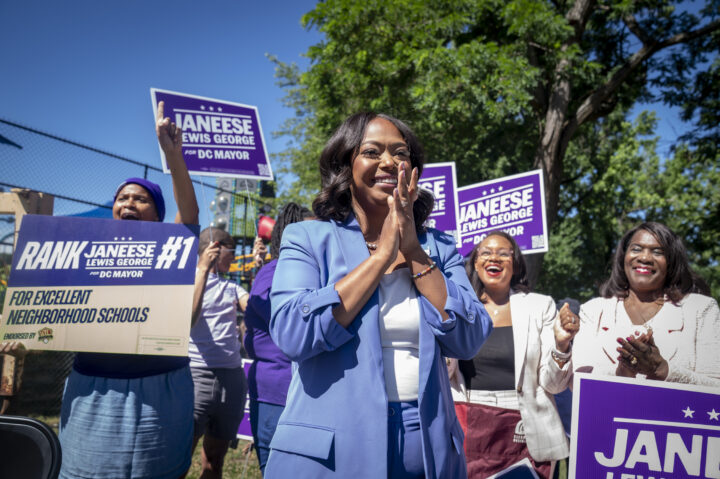
Maxine Wallace/The Washington Post via Getty Images
Janeese Lewis George volunteers continue to campaign for her at the Benning Stoddert Recreation Center on June 16,2026 in Washington, DC.


 Add JewishInsider on Google
Voters in Washington, D.C., appeared poised to select Councilmember Janeese Lewis George to be their Democratic nominee for mayor, all but guaranteeing that she will be elected in November to replace Mayor Muriel Bowser, who is not seeking another term after 12 years in office. The race has not been called, but Lewis George leads by more than 15,000 votes with 64% of the votes counted.
Lewis George, a 38-year-old member of the Democratic Socialists of America, ran a campaign powered by local labor unions that was focused on cost-of-living issues and countering President Donald Trump. She is on track to defeat Kenyan McDuffie, a former councilmember who ran on a more pragmatic platform that eschewed DSA’s brand of radical politics.
The candidates’ views on Israel did not define the race, but they were a throughline in the background. Lewis George filled out a DSA endorsement questionnaire early in the campaign in which she pledged to avoid engaging with “the Israeli government or Zionist lobby groups.” Later, she promised to stand firm in fighting antisemitism while also supporting Palestinian human rights. McDuffie tried to use the comments to appeal to anti-DSA voters and Jewish Washingtonians.
Lewis George will represent a shift from Bowser, a moderate Democrat who in 2019 led a trade mission to Israel and who regularly addressed the annual AIPAC policy conference in Washington before AIPAC canceled the event after 2020.
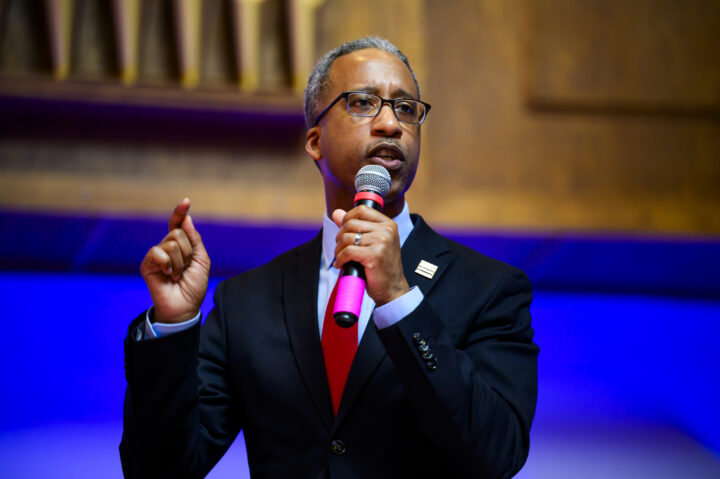
Elsewhere in Washington, Councilmember Robert White was elected in the Democratic primary to serve as Washington’s delegate to Congress, a nonvoting role. He’ll succeed Rep. Eleanor Holmes Norton, who is retiring after 35 years.
Aparna Raj, a DSA-backed candidate for D.C. Council, appeared likely to win the Democratic primary for Ward 1, a district that includes the neighborhoods of Adams Morgan and Columbia Heights. She told the D.C. Jewish Community Relations Council in a voter guide released last month that she “will not work with AIPAC or organizations whose mission is to lobby for pro-Israel policies.”
Meanwhile, it was a short night in Georgia, where Rep. Mike Collins (R-GA) quickly claimed victory over former college football coach Derek Dooley in a Senate primary runoff. Collins picked up a last-minute endorsement from President Donald Trump, while Dooley’s backing by Gov. Brian Kemp wasn’t enough to push him to victory.
Collins ultimately finished the race around 10 points ahead of Dooley, a similar margin as in the primary election earlier this year. Dooley dominated in Atlanta and Athens, Ga., home of the University of Georgia, while Collins led around the rest of the state.
Dooley was widely seen as the more moderate and more electable of the two Republicans, as compared to Collins, who has been trailed by a series of scandals. Republicans may struggle to reclaim the seat from Sen. Jon Ossoff (D-GA) with Collins as their standard-bearer in the race.
The race may also present a difficult choice for Jewish voters in the state, many of whom have been frustrated by Ossoff’s leftward turn on Israel issues and repeated votes to block arms sales. Some Jewish Ossoff donors sought, earlier in the cycle, to recruit Kemp to run for the seat.
But Collins might not be a palatable alternative for some Jewish voters, having endorsed a post by an antisemitic X account attacking a reporter for being Jewish. His current chief of staff was also recently revealed to be part of a group chat with several white nationalists, where he discussed his efforts to use his congressional influence to free a Holocaust denying far-right activist from prison. He also opposed the Antisemitism Awareness Act.
Many prominent Jewish conservatives supported Dooley in the primary, but could line up behind Collins for the general, given his consistently pro-Israel voting record in the House.
Already, some commentators are discussing the possibility that a decisive victory by Ossoff in the critical swing state could massively boost the rising Democratic star’s chances in the 2028 presidential primary, should he decide to throw his hat in the ring.
If elected mayor of Washington, D.C, Janeese Lewis George’s victory would hand a major win to Washington’s Democratic Socialists of America chapter
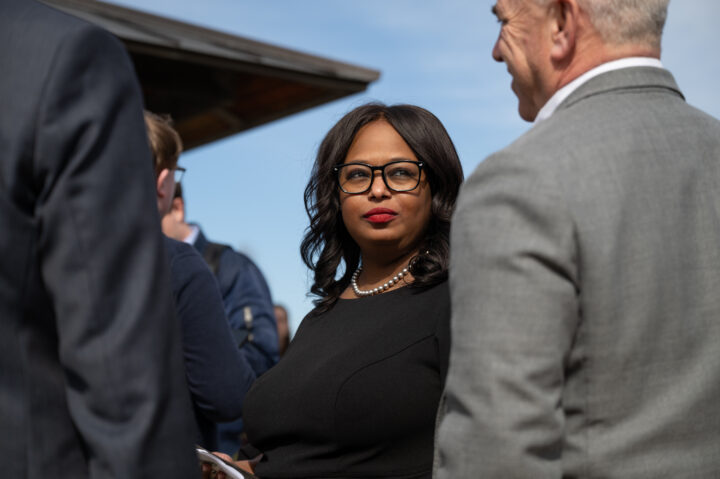
Craig Hudson for The Washington Post via Getty Images
D.C. councilmember and mayoral candidate Janeese Lewis George is seen on Capitol Hill for a press conference in Washington, DC on March 10, 2025.
The open race for mayor of Washington, D.C., has been largely uneventful ahead of next month’s primary — so much so that the first TV ads run by the leading candidates, Kenyan McDuffie and Janeese Lewis George, sound nearly identical. Both candidates tout affordability and safety on the campaign trail, with promises to build more housing and stand up against President Donald Trump.
But if elected, Lewis George’s victory would mark a significant shift away from the centrist brand of politics espoused by outgoing Mayor Muriel Bowser over the last 12 years, and would instead hand a major win to Washington’s Democratic Socialists of America chapter, of which Lewis George has been a member for years.
Lewis George has faced criticism throughout the campaign from some in the Jewish community for comments she made on a DSA endorsement questionnaire pledging to boycott events that “promote Zionism” and criticizing Jewish activists’ approach to combating antisemitism. Ron Halber, CEO of the Jewish Community Relations Council of Greater Washington, on Tuesday called DSA an “evil” organization that seeks “to make being Jewish unacceptable in polite society.”
DSA has activated its small but growing membership to knock on doors for Lewis George, a member of the D.C. Council, tapping into a grassroots energy that they hope translates into success at the ballot box. Rep. Rashida Tlaib (D-MI), one of two DSA members currently serving in Congress, attended a recent DC DSA rally alongside Lewis George.
DSA’s Metro DC chapter is relatively small. Yet its current roster of roughly 3,400 members represents a massive increase from its pre-2016 nadir of just 200 members — and mirrors DSA’s growing clout nationally.
“For most of the ‘80s and ‘90s and 2000s, DSA was a small organization with maybe 5,000 or 8,000 people at the most. I would say the average age was probably over 60, maybe higher than that,” said Peter Dreier, an emeritus professor of politics at Occidental College in Los Angeles. “Then Bernie [Sanders] ran for president in 2016 and started talking about democratic socialism in a way that made sense to, particularly, a lot of young people, and he kind of opened the door to people to be in DSA.”
Overall, DSA is still a small organization on the fringes of Democratic politics. Even the highest membership counts — adding up DSA’s local chapters — don’t top 100,000. But the unexpected popularity of Sanders’ 2016 presidential run sparked a resurgence of interest in democratic socialism not seen in generations, and that has continued well past his two campaigns. A 2025 Gallup poll found that 42% of Democrats have a positive image of capitalism, down from 54% a decade ago, while 66% have a positive view of socialism.
“If [young people] don’t remember the Cold War, then what do they think when they hear the word socialism? There’s still a battle over that, but they’re more likely to think, ‘Oh, countries that have more equality, or students that get free or almost free higher education, everybody has access to healthcare,’” said Dreier.
“We are going to raise money and develop a plan over the course of the next few months to try to make them toxic, to make it unacceptable for major figures in the party or anybody actually running for office to be affiliated with the DSA, the way it should be unacceptable to be affiliated with [neo-Nazi influencer] Nick Fuentes if you’re running as Republican,” Third Way’s senior vice president for public affairs, Matt Bennett, said.
The key question now facing capital-D Democrats — one they sound unsure of how to answer, or perhaps unwilling — is how to handle an insurgent faction that has galvanized people over its straightforward messaging on corporations (bad), taxing the rich (good) and Medicare for All (necessary), while at the same time promoting far-left positions like prison and police abolition that are nowhere near the Democratic mainstream. The group has long promoted the Boycott, Divestment and Sanctions movement, as well as calling for an arms embargo on Israel, and its members passed a resolution last year affirming their commitment to anti-Zionism. On Oct. 7, 2023, DSA released a statement holding Israel accountable for the Hamas attacks and calling on members to take to the streets to protest U.S. support for Israel.
The centrist Democratic group Third Way plans to launch a major PR campaign against DSA in the coming months, one of the group’s executives told JI, arguing that its far-left positions and incendiary brand of politics will be harmful for the party’s electoral prospects.
“We are going to raise money and develop a plan over the course of the next few months to try to make them toxic, to make it unacceptable for major figures in the party or anybody actually running for office to be affiliated with the DSA, the way it should be unacceptable to be affiliated with [neo-Nazi influencer] Nick Fuentes if you’re running as Republican,” Third Way’s senior vice president for public affairs, Matt Bennett, said.
In the decade since Sanders’ 2016 campaign, DSA has had an outsized impact on national politics. The 2018 congressional victory of Rep. Alexandria Ocasio-Cortez (D-NY), a DSA member, raised the group’s profile. A steady stream of more than 200 DSA-aligned candidates have been elected to state and local offices since, culminating with the election of DSA member Zohran Mamdani as mayor of New York City last year.
“To the degree that people need to pay attention to DSA, it’s because they built this kind of political machine,” said Micah Sifry, a journalist focused on left-wing political organizing. “In a time when people are, for the most part, not very organized, the ability of any small group, relatively speaking, to punch above its weight grows.”
Perhaps unsurprisingly, New York has the largest bench of DSA-affiliated state lawmakers. The group has slowly but steadily been gaining electoral power in state and local offices in some unexpected places, too, like Minnesota, Colorado, Delaware and Wisconsin. The group’s largest foothold is in city council races, where a small but committed cadre of volunteers can swing elections in low-turnout races.
National Democratic leaders are divided about how to treat the small but vocal socialist minority in the party.
House Minority Leader Hakeem Jeffries (D-NY) declined to support Mamdani in the primary election but ultimately endorsed him ahead of the general election last year. Weeks later, Jeffries voted in favor of a Republican-led resolution condemning socialism. He has been skeptical of the left-wing ideology throughout his political career: “There will never be a moment where I bend the knee to hard-left democratic socialism,” he said in 2021. A spokesperson for Jeffries declined to comment this week when asked if he believes Democrats should be welcoming socialists into the party.
Democratic National Committee Chair Ken Martin has been more open-minded about socialists. Asked by Fox News last year whether progressives like Mamdani and Ocasio-Cortez make his job harder, he said no.
“The party is a big tent. But just like we have to believe it’s a big tent, the DSA also has to believe it’s a big tent, and I’m not sure they do,” Brian Romick, CEO of Democratic Majority for Israel, said. “Democratic leaders want to win elections, and that means a big tent, and that means that Democratic base voters and pro-Israel voters and moderate people who maybe voted for [Donald] Trump sometimes because they’re concerned about prices have to be in the tent.”
“I don’t think they make it difficult at all,” Martin said in August 2025. “The difference between the Democratic Party and the Republican Party is that we’re a big tent. We have lots of people in that tent from all of the different ideological wings, from conservative Democrats, to centrists, to progressives, to these new leftists.” A DNC spokesperson did not respond to multiple requests for comment this week.
Brian Romick, CEO of Democratic Majority for Israel, told Jewish Insider this week that he is concerned about the inroads DSA is making in the party. He agreed with Martin that the Democratic Party should be a big tent, but noted that DSA members — who are at times intent on putting litmus tests even on would-be allies — don’t extend the same understanding to more moderate members of the party.
“The party is a big tent. But just like we have to believe it’s a big tent, the DSA also has to believe it’s a big tent, and I’m not sure they do,” Romick said. “Democratic leaders want to win elections, and that means a big tent, and that means that Democratic base voters and pro-Israel voters and moderate people who maybe voted for [Donald] Trump sometimes because they’re concerned about prices have to be in the tent.”
The questionnaire Lewis George filled out in Washington to earn DSA’s endorsement reveals how important hard-line opposition to Israel is to the organization, which requires even candidates for local offices with no connection to foreign policy to all but disavow the Jewish state. Most voters who support DSA-aligned candidates likely are not drawn to them because of their views on the Middle East; Mamdani’s message was first and foremost about affordability. But DSA’s growing reach among Democrats gave a foothold to anti-Israel views that may have once been rare, though global attention on the war in Gaza also contributed to shifting Democratic orthodoxy on the conflict. (Other far-left groups like Justice Democrats have played a role, too.)
Zach Shartiag, a Jewish Democratic campaign operative from Chicago, told JI that Democrats he has talked to who support DSA candidates generally do not do so because of DSA’s stance on Israel, even if the activists are themselves critical of Israel.
“People might be very anti-Israel now, but at the same time, it’s like, what does that have to do with local politics?” said Shartiag, who is currently working on a congressional campaign in Hawaii. “I’ve talked to a lot of people, just in general, normal humans, and it’s like, ‘Yeah, I might be against what Israel’s doing, but what does that have to do with the local and the city and the state?’”
The full picture of DSA’s influence in the party will not be known until all the votes are tallied at the end of this year’s midterm elections. A number of DSA-affiliated candidates are gaining ground in congressional primaries, such as Pennsylvania state Rep. Chris Rabb, who has garnered progressive endorsements in a Philadelphia-area open seat, and New York state Assemblymember Claire Valdez, who has Mamdani’s backing for her congressional campaign.
Still, the election outcomes in states across the country this year will present only a partial picture of where the Democratic Party is moving. In the same year that Mamdani won in New York City, for instance, Democratic moderates Abigail Spanberger and Mikie Sherrill won gubernatorial races in Virginia and New Jersey, respectively.
The only certainty, then, is that the battle between centrists and socialists will continue into 2028.
“I think you’re going to have a real mixed verdict, with us yelling about our side and the left yelling about their side,” Third Way’s Bennett acknowledged. “So what that means is, unsurprisingly, we’re going to go into the presidential primary season with the two camps demanding that they are right.”
‘I didn't seek, nor would I accept, the endorsement of Democratic Socialists of America,’ McDuffie told JI in an interview
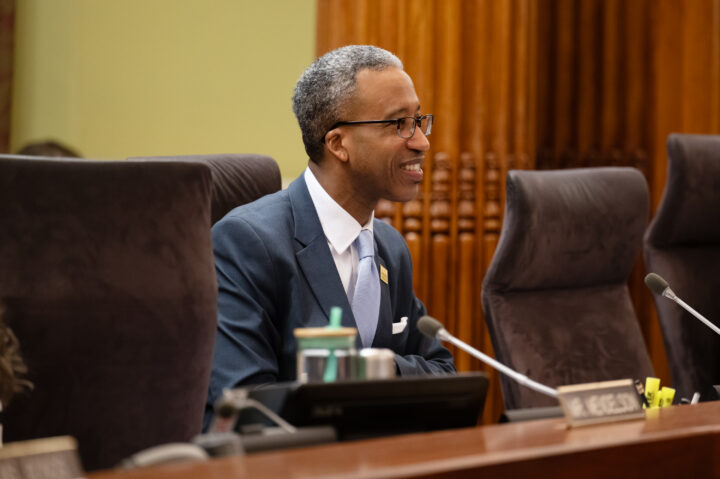
Craig Hudson for The Washington Post via Getty Images
Council member Kenyan R. McDuffie (I-At Large) is seen before Mayor Muriel E. Bowser (D) testifies to the DC City Council outlining the Fiscal Year 2025 Budget in Washington, D.C., on April 03, 2024.
As Washington, D.C., voters get ready to elect their first new mayor in more than a decade, the two leading candidates — former colleagues on the Council of the District of Columbia — are proposing drastically different visions for the city’s future: political moderation or democratic socialism.
In an interview with Jewish Insider this week at his campaign headquarters in Northeast Washington, former Councilmember Kenyan McDuffie drew a direct contrast between his campaign and that of his Democratic Socialists of America-endorsed rival, Janeese Lewis George.
“I didn’t seek, nor would I accept, the endorsement of Democratic Socialists of America, or any organization, for that matter, that requires some sort of divisive pledge to exclude people that are a part of the fabric of the community of the District of Columbia,” McDuffie said.
He was referring to a DSA endorsement questionnaire that asked candidates not to engage with “the Israeli government or Zionist lobby groups.” Lewis George, a longtime DSA member, vowed not to attend events that promote Zionism when she filled out the questionnaire, which earned her the DSA endorsement.
Lewis George’s responses sparked concern among many in the Jewish community, and she apologized in a closed-door meeting with rabbis in March. But she has not offered any public remorse.
“I think it’s important for elected officials to have the courage to say in public things that they say in private,” McDuffie said. “Any message that depends on taking a pledge to exclude entire communities as a condition of a political endorsement is extraordinarily divisive and disturbing.”
Amid the controversy surrounding her DSA questionnaire and the meeting with rabbis, Lewis George released a statement last month pledging to stand firm in both her opposition to antisemitism and her support for “Palestinian human rights.” McDuffie told JI that he did not see the mayoral race as a place to litigate debates about the Israeli-Palestinian conflict.
“I think a mayor’s responsibility is to look out for all of its residents, particularly our most vulnerable residents,” said McDuffie. “At a time where the Jewish community is seeing rising antisemitism worldwide, and even the District of Columbia, it’s important that they understand that their elected officials are going to use every tool possible to protect them.”
“I didn’t bring those issues into this race. My opponent did it when she sought the endorsement of Democratic Socialists of America,” McDuffie said. “I’m not running for Congress. I’m not engaging in the crafting of foreign policy. I’m running for mayor of Washington, D.C., the most beautifully diverse city in America, and I’m running to fight and deliver for all D.C.”
McDuffie is actively courting votes in the Jewish community. He will appear next week at a meet-and-greet with Jewish young professionals in the District.
“I think a mayor’s responsibility is to look out for all of its residents, particularly our most vulnerable residents,” said McDuffie. “At a time where the Jewish community is seeing rising antisemitism worldwide, and even the District of Columbia, it’s important that they understand that their elected officials are going to use every tool possible to protect them.”
McDuffie pledged to speak out against antisemitic violence and rhetoric so that the District’s Jewish residents “understand that they have a mayor and elected leadership who’s going to strongly oppose those kinds of activities and threats and do everything humanly possible to protect them.” He called the city’s nonprofit security grant program, which provides funding to several local synagogues to pay for security expenses, a “nonnegotiable,” even if the city faces other budget challenges.
Born and raised in Northeast Washington, McDuffie entered politics circuitously. He worked as a mail carrier for the USPS before ultimately going to college and law school, in a career pivot he said was inspired by witnessing the death of two friends to the crack cocaine epidemic of the 1980s and 1990s. He spent a few years as a prosecutor, in Maryland and at the Justice Department, before running for Council in 2013. McDuffie represented Ward 5, which includes the neighborhoods Bloomingdale, Eckington, Brookland and Fort Totten, until being elected to a citywide at-large position in 2022 where he served until January.
His message now is about affordability, a buzzword brought into style last year by New York City Mayor Zohran Mamdani, a DSA member like Lewis George. The way to make the city more affordable, according to McDuffie, is “economic growth with guardrails” — a contrast to the sweeping changes promised by Lewis George, the viability of which McDuffie has questioned.
“They want experience. They want vision. They want bold. They want change. What they don’t want is more empty promises,” said McDuffie. “What they don’t want is rhetoric that isn’t supported by an actual plan. What they don’t want is somebody who engages with organizations seeking to divide residents, and what we think we have as an advantage is both a vision that is about building a big tent and inviting people in and a record.”
“We’re the nation’s capital. We can walk and chew gum,” McDuffie said. “I think that’s important for people to understand, that we can have innovative, transformational policies at the same time that we’re delivering core services on time and within a budget that doesn’t default to raising taxes on hard-working residents.”
McDuffie seemed to recognize that pushing a vision of pragmatism may not be as seductive as promises powered by major spending increases. For instance, both Lewis George and McDuffie want to build new housing in the city, but Lewis George has promised to build 72,000 new units compared to 12,000 suggested by McDuffie, The Washington Post reported. But McDuffie argued that voters want honesty.
“They want experience. They want vision. They want bold. They want change. What they don’t want is more empty promises,” said McDuffie. “What they don’t want is rhetoric that isn’t supported by an actual plan. What they don’t want is somebody who engages with organizations seeking to divide residents, and what we think we have as an advantage is both a vision that is about building a big tent and inviting people in and a record.”
Though McDuffie and Lewis George are widely viewed as the frontrunners in the race, they are not the only candidates running in the Democratic primary which, in deep blue Washington, will almost certainly decide the eventual victor. Other candidates in the June 16 primary include real estate developer Gary Goodweather and former Councilmember Vincent Orange.
Kenyan McDuffie did not name his rivals, though Janeese Lewis George recently said she would avoid events ‘promoting Zionism’
Pete Kiehart for The Washington Post via Getty Images
Mayoral candidate Kenyan McDuffie speaks during the Free DC candidate forum on March 14, 2026 in Washington, DC.
Washington, D.C., mayoral candidate Kenyan McDuffie criticized his Democratic primary opponents for pledging to avoid campaigning with elements of the Jewish community — an apparent jab at Democratic Socialists of America-endorsed rival Janeese Lewis George, who is facing backlash from Jewish leaders over her pledge to boycott events she described as promoting Zionism.
“Recent reporting has raised serious concerns about how some candidates for office in DC have pledged not to engage with the majority of Jewish organizations in exchange for political support,” McDuffie wrote in a campaign email on Tuesday. “That is wrong. Full stop.”
McDuffie did not mention Lewis George or any specific candidates in his email.
Lewis George, who earned the endorsement of the Metro D.C. chapter of Democratic Socialists of America, wrote in a DSA questionnaire that she would not attend events focused on “promoting Zionism and apartheid.” She met last week with rabbis and local Jewish leaders who were concerned about her posture toward the Jewish community, Jewish Insider reported on Monday.
She privately apologized for her responses and blamed them on a staff member, but has not expressed that sentiment publicly.
“There is no place in this city for shutting out any community — especially in pursuit of political gain,” McDuffie wrote. “Not antisemitism. Not Islamophobia. Not racism. Not sexism.”
The DSA questionnaire also asked candidates to refrain from affiliating with the Israeli government and “Zionist lobby groups.” In her responses, Lewis George defended her appearance at a Jewish Community Relations Council of Greater Washington meeting in December, but said she was there to talk about immigration enforcement.
She said she did not align with JCRC’s stance on Israel and Zionism, and that she disagrees with the organization’s “definition of anti-semitism that criminalizes dissent, and their attacks on activists.”
“Leadership matters in moments like this,” wrote McDuffie. “As your next mayor, I will bring people together across lines of difference. I will engage every community in this city, especially when it is not easy or politically convenient.”
Washington, McDuffie said, “must be a city where every resident — regardless of faith, race, gender, or identity — feels safe, respected and heard.”
Please log in if you already have a subscription, or subscribe to access the latest updates.
 Continue with Google

 Continue with Apple