










































































The group ranges from pro-Israel Democrats like Sen. Kirsten Gillibrand to anti-Israel members like Sen. Chris Van Hollen

Drew Angerer/Getty Images
Sen. Kirsten Gillibrand (D-NY) speaks at a news conference following a closed-door lunch meeting with Senate Democrats at the U.S. Capitol on October 31, 2023, in Washington, D.C.


 Add JewishInsider on Google
A group of six additional Senate Democrats plan to file new war powers resolutions this week to halt the war in Iran, a move that would allow Democrats to continue forcing votes on the war for the foreseeable future.
Previously, a different group of six Democrats introduced similar resolutions, and Democrats have called up two of them thus far, with plans to call up a third this week. So far, the resolutions have all failed along mostly party lines, with all senators remaining consistent in their votes.
The latest group of lawmakers includes Sens. Jeff Merkley (D-OR), Kirsten Gillibrand (D-NY), Chris Van Hollen (D-MD), Mark Kelly (D-AZ), Raphael Warnock (D-GA) and Andy Kim (D-NJ).
The array of lawmakers involved in the latest effort spans from staunch progressives and critics of Israel to generally more pro-Israel members.
“President Trump chose to start a war knowing it was going to raise gas prices on Americans already struggling to get by,” Gillibrand said in a statement. “The president, and his party, just don’t care about anyone other than themselves. They lie, cheat and steal to enrich themselves and leave regular folks with the bill. It is long past time for Republicans in Congress to stand up and do their job.”
House Democrats also plan to call up a war powers resolution this week, which may pass given that some Democrats who previously opposed a war powers effort and a handful of Republicans have indicated they plan to change their votes.
The latest set of six resolutions will not be eligible for floor votes immediately, but Democrats can call up the other four resolutions introduced previously at will. Senate Democrats are also likely to force votes on matters related to the Iran war during the upcoming reconciliation process, which Republicans aim to use to fund immigration enforcement and other priorities.
The votes may draw increased Democratic support amid party criticism of the war with Iran

Kevin Dietsch/Getty Images
Sen. Bernie Sanders (I-VT), joined by fellow senator Sen. Jeff Merkley (D-OR) (R), speaks at a news conference on restricting arms sales to Israel at the U.S. Capitol on November 19, 2024 in Washington, DC.
The Senate is set to hold another round of votes on blocking U.S. arms transfers to Israel, as Sen. Bernie Sanders (I-VT) filed three new joint resolutions of disapproval against $658.8 million in sales of 500- and 1,000-pound bombs to Israel and “defense articles” for 250-pound bombs.
“Given the horrific destruction that Israel’s extremist government has wrought on Gaza, Iran and Lebanon, the last thing in the world that American taxpayers need to do right now is to provide 22,000 new bombs to the Netanyahu government,” Sanders said. “No more weapons to support an illegal war.”
The effort is being co-sponsored by Sens. Chris Van Hollen (D-MD), Jeff Merkley (D-OR) and Peter Welch (D-VT).
Sanders emphasized that the administration had sidestepped normal congressional review procedures using emergency authorities in advancing the arms sales earlier this month.
Sanders and other progressive Democrats have forced votes on similar efforts to block arms sales to Israel on three previous occasions since the war in Gaza began, with a majority of the Democratic caucus — 27 lawmakers — voting to block at least one arms sale in July of last year, a significant jump in support from similar efforts in November 2024 and April 2025.
Israel’s standing among Democrats has worsened since last July, with even some Democrats who supported continued arms sales at that time blaming Israel for dragging the U.S. into the war in Iran. Polls show registered voters now see Israel more negatively than positively.
Some senators have argued the U.S. should have threatened to cut off military support to prevent an Israeli attack on Iran.
Van Hollen, Merkley and Welch, in statements, all framed the bomb sales as proxy votes on the war in Iran, and a vote to block the sales as a step toward ending the war. Senate Democrats have voted nearly unanimously as recently as yesterday to bring an immediate end to the war in Iran.
“With the bombs already provided to Israel by American taxpayers, Israeli forces are unleashing a campaign of total war in Iran with the clear and deliberate intention to eviscerate Iran’s economy and society,” Welch said in a statement. “I support these joint resolutions to make sure that we do not send another 20,000 bombs to Israel that will result in further destruction in Iran and Lebanon. We must end this war, and we must not send these bombs.”
On the other hand, some Democrats who had voted in favor of previous arms sales flipped in the July 2025 vote to express frustration with the ongoing war and humanitarian crisis in Gaza.
With the war in Gaza now in a ceasefire, humanitarian aid restored and efforts toward reconstruction slowly starting, that motivation for blocking arms sales may no longer be salient for some Democrats.
The resolution was led by Sen. Jeff Merkley and comes in conjunction with plans by several U.S. allies to recognize a Palestinian state and alongside a similar push from progressive House lawmakers
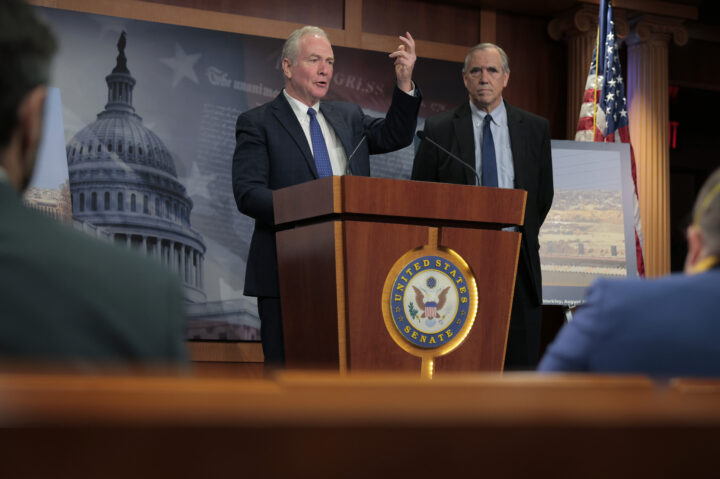
(Photo by Chip Somodevilla/Getty Images)
Sen. Chris Van Hollen (D-MD) and Sen. Jeff Merkley (D-OR) talk to reporters about their seven-day trip to the Middle East during a news conference at the U.S. Capitol on September 11, 2025 in Washington, DC.
A group of seven Senate Democrats introduced a resolution on Thursday calling for the U.S. to unilaterally recognize a Palestinian state.
The resolution was led by Sen. Jeff Merkley (D-OR) and co-sponsored by Sens. Chris Van Hollen (D-MD), Tim Kaine (D-VA), Bernie Sanders (I-VT), Peter Welch (D-VT), Tina Smith (D-MN), Tammy Baldwin (D-WI) and Mazie Hirono (D-HI).
The resolution came in conjunction with plans by several U.S. allies to recognize a Palestinian state and alongside a similar push from progressive House lawmakers. Merkley and Van Hollen recently traveled to Israel and released a scathing report accusing Israel of deliberate ethnic cleansing and collective punishment.
“Recognition of a Palestinian state is not only a practical step the United States can take to help build a future where Palestinians and Israelis can live in freedom, dignity, and security, but it is the right thing to do. America has a responsibility to lead, and the time to act is now,” Merkley said in a statement. “The goal of a Palestinian state can’t be put off any longer if we want the next generation to avoid suffering from the same insecurity and affliction.”
The resolution’s sponsors claimed that it constitutes a reaffirmation of long-standing U.S. support for a two-state solution.
The legislation highlights that “administrations of both political parties in the United States have long affirmed that a negotiated two-state solution is the only viable path to an enduring peace in the region” — but does not acknowledge that policymakers have traditionally seen unilateral recognition as contrary to that principle of a solution negotiated between the Israelis and Palestinians.
Kaine said that the Israeli government’s rejection of a two-state solution should cause the U.S. to change its own policies.
“Since July 2024 when the Israeli Knesset voted to deny a path to Palestinian statehood and made clear that Israel would not accept Palestinian autonomy, I have believed the U.S. should no longer condition recognition on Israeli assent but rather on Palestinian willingness to live in peace with its neighbors,” Kaine said. “We must redouble our efforts to work toward a future where Israelis and Palestinians alike can live in peace, security, and dignity.”
Welch said in a statement that “recognizing a two-state solution is long overdue and the only way forward — something Republican and Democratic Administrations have agreed on for decade. … This resolution signals Congress’ continued commitment for an enduring two-state solution for peace for the people of Israel and Palestine.”
Though the U.S. has supported a two-state solution, no previous administration has backed unilateral recognition of a Palestinian state.
Van Hollen said in a statement that Congress should assert its own stance on the issue because “the Netanyahu government has obstructed that goal [of a two-state solution] and the Trump Administration has abandoned it.”
The resolution condemns the Hamas attacks on Oct. 7 and the group’s rejection of Israel’s right to exist and calls for Palestinian elections, as well as noting that some Arab states have conditioned normalization with Israel on a path to a Palestinian state.
“Failure to advance a two-state solution risks entrenching an unacceptable permanent occupation, further destabilizing the region, and undermining United States interests and values,” the legislation states.
It calls on Hamas to surrender and release the hostages and on Israel to end the war in Gaza.
J Street supported the resolution.
Please log in if you already have a subscription, or subscribe to access the latest updates.
 Continue with Google

 Continue with Apple