






































































The bill, named after the late Sen. Lindsey Graham, includes a five-year extension of the Iran Sanctions Act of 1996, which was set to expire in 2026

GETTY IMAGES
A general view of the U.S. Capitol Building from the National Mall, in Washington, D.C., on Thursday, May 29, 2025.


 Add JewishInsider on Google
Despite objections from leading Democrats, the House on Wednesday passed a bipartisan bill to sanction Russia and extend existing sanctions on Iran, named for the late Sen. Lindsey Graham (R-SC), who spent his final months negotiating the legislation.
The bill now heads to the White House to be signed into law. It includes a five-year extension of the Iran Sanctions Act of 1996, which was set to expire in 2026, a late-stage addition to the bill in the Senate after President Donald Trump demanded that the bill include provisions related to Iran.
The legislation received a significantly different reception from Democrats in the House than it did in the Senate, where the bill passed with strong bipartisan support. Fifty-eight House Democrats voted for the bill, while 152 voted against it. Seven Republicans opposed the legislation. The final tally was 262-159.
Democrats who opposed the bill generally raised concerns about the waiver authorities that the administration could use to avoid placing sanctions on Russia — arguing that Trump can’t be trusted to crack down on President Vladimir Putin — and about the tariff provisions included in the bill to target importers of Russian oil.
Democrats have warned that Trump could misuse those tariff authorities to target U.S. partners in trade disputes, unrelated to the war in Ukraine.
“The manner in which this bill has been written doesn’t require the president of the United States to impose sanctions on Russia,” House Minority Leader Hakeem Jeffries (D-NY) said on the House floor. “In fact, there are so many loopholes written into the bill, I believe, that it’s very unlikely that the sanctions … contemplated in the legislation will ever see the light of day. That’s particularly the case because President Trump has shown great reluctance over the [past] 10 years … to actually side with the Ukrainian people.”
“Worse yet, what this legislation will do is give Donald Trump perhaps unfettered authority to unleash tariffs on the American people in ways that have already cost everyday Americans thousands of dollars in additional expense per year,” Jeffries continued, questioning why Congress would give Trump “unfettered authority to visit more tariffs on the world.”
Other top Democratic leaders, including Reps. Katherine Clark (D-MA), Pete Aguilar (D-CA) and Greg Meeks (D-NY), also opposed the bill.
But several prominent Democrats, including former Democratic leaders Reps. Nancy Pelosi (D-CA), Steny Hoyer (D-MD) and Jim Clyburn (D-SC), supported the bill.
“Nobody in this House believes that I am a defender of Donald Trump’s failure to address this issue head on and effectively. No one has opposed his tariff policies any more than I have,” Hoyer said earlier this week.
But he emphasized that “nothing we do to pass this bill or defeat this bill” will encourage or discourage Trump from going “far beyond his legal strictures.”
He said the bill will be “a statement by the Congress of the United States” — “‘This is what ought to happen. Sanctions ought to be imposed, tariffs or penalize countries who are funding Russia’s ability to make war,’” declaring clearly that Congress supports Ukraine even if Trump’s support is unreliable.
“If we do not pass this bill, there will be great joy in the Kremlin and great devastation in Kyiv, who will see something that they thought they had in hand — a strong statement by the United States of America’s Congress — disappear because of a fight over tariffs,” Hoyer said. “Their morale will tank and we will be still, since April 2024, having not taken the action.”
House Republicans celebrated the bill’s passage.
“House and Senate Republicans are placing maximum pressure on Vladimir Putin and the Russian war machine,” House Speaker Mike Johnson (R-LA) said in a statement. “This legislation strengthens economic sanctions against the Russian government, its financial institutions, and the foreign governments that aid Russian aggression against Ukraine by purchasing cheap Russian oil and gas and helping the Kremlin evade other sanctions.”
AIPAC also praised the bill’s passage, noting, “The Iran Sanctions Act underpins most sanctions on the Iranian regime and was set to expire this year.” The pro-Israel group also urged Congress to quickly pass the Enhanced Iran Sanctions Act, which passed the House earlier this year.
The American Jewish Committee, which has advocated strongly for Ukraine in addition to Israel, applauded the bill’s passage as well.
“We welcome the House’s passage of the Lindsey O. Graham Sanctioning Russia and Iran Act of 2026, advancing legislation that would significantly increase economic pressure on Russia over its ongoing illegal war against Ukraine while extending sanctions against Iran,” the AJC said in a statement. “Russia and Iran continue to pose threats that extend far beyond their borders, including through their military cooperation and support for destabilizing actors.”
“This bipartisan action by Congress sends a clear message that the Russian and Iranian regimes must be held accountable for activities that threaten international security and stability,” the statement continued.
The five-year extension of the Iran Sanctions Act of 1996 was included into the hard-fought bill at Trump’s urging

Tim Graham/ Getty Images
U.S. Capitol Building
The Senate on Tuesday advanced a major Russia sanctions package, negotiated and championed by Sen. Lindsey Graham (R-SC) before his death, to which lawmakers added a provision extending longstanding sanctions on Iran, currently set to expire at the end of the year.
The addition of the five-year extension of the Iran Sanctions Act of 1996 to the package is a relatively minor change to the hard-fought bill, which will extend a key piece of the U.S. economic pressure campaign on Iran and address President Donald Trump’s late-stage demands that threatened to upend a bipartisan agreement.
Lawmakers have been working for years on a bipartisan basis to extend the Iran sanctions past 2026 and they have been extended on a bipartisan basis in the past.
“We are proud to announce an agreement on legislation to stop purchasers of Russian oil and gas from fueling Putin’s war machine and to continue restricting the Iranian regime’s ability to support terrorism and build its nuclear program,” Sens. Jim Risch (R-ID), Richard Blumenthal (D-CT), Darline Graham (R-SC), Katie Britt (R-AL), Jeanne Shaheen (D-NH) and Roger Wicker (R-MS) said in a joint statement on Tuesday. “There is no greater way to honor Senator Graham’s legacy than to move forward with this bipartisan agreement, and we look forward to today’s vote.”
The bill advanced by an 86-12 procedural vote. Sens. Bernie Sanders (I-VT), Elizabeth Warren (D-MA), Maggie Hassan (D-NH), Jon Ossoff (D-GA), Lisa Blunt Rochester (D-DE), Andy Kim (D-NJ), Mazie Hirono (D-HI), Ed Markey (D-MA), Alex Padilla (D-CA), Ron Wyden (D-OR) and Rand Paul (R-KY) voted no.
Blumenthal, the lead Democrat on the bill, had initially reacted negatively to Trump’s efforts to include Iran sanctions, warning against further changes to the bill, which took months to negotiate.
The bill “was the result of painstaking, sometimes painful negotiation involving leadership here, the White House, the U.S. trade representative over many months. I personally would like to see it passed as is,” Blumenthal said earlier this month after Trump initially began pushing for changes. “There may be other provisions that are worthwhile which should be passed separately.”
Asked Tuesday about the decision to add the Iran sanctions provisions, Blumenthal told Jewish Insider, “Darline Graham asked us — asked me — to do it. And by the way, that Iran provision was in the bill as originally written, so restoring it was a pretty simple yes.”
Blumenthal also told reporters that, during a closed-door meeting with senators shortly before the vote, Ukrainian President Volodymyr Zelensky emphasized the role that Ukrainian drone technology has been playing in assisting the U.S. with defending its bases from Iranian attacks.
Prominent House Democrats have raised concerns about the bill, which provides tariff authority to the administration to target importers of Russian oil, concerns shared by some of the bill’s Senate opponents, even as some of them expressed strong support for Ukraine. Critics worry that the bill would allow Trump to impose punishing tariffs on the U.S.’ European allies, but Democratic supporters insist that the authority is carefully tailored and limited.
Alexandria Paolozzi Moore, the senior director of government relations at FDD Action, said the extension is “a critical, bipartisan win. ISA is a foundational tool for countering Iran’s WMD proliferation, ballistic missile program, and support for terrorism.”
Sens. Blumenthal and Shaheen said the late Sen. Lindsey Graham never sought to include Iran sanctions in the legislation he spent months negotiating before his death
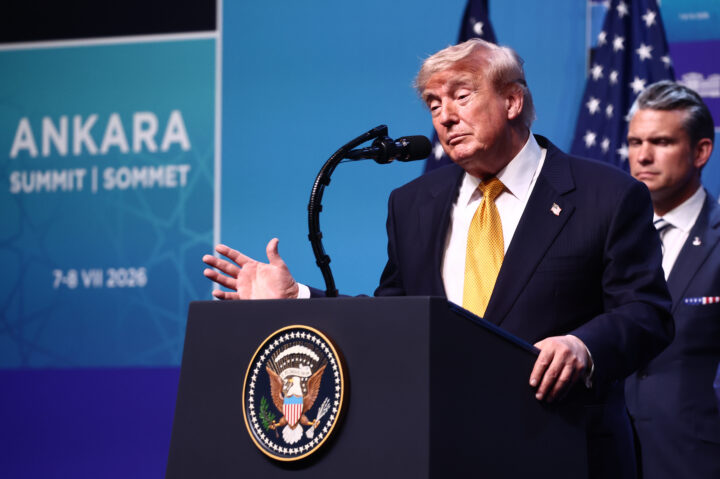
Jakub Porzycki/NurPhoto via Getty Images
President Donald Trump during the press conference at the NATO Summit in Ankara, Turkiye on July 8, 2026.
President Donald Trump’s call for Republicans to incorporate sanctions against Iran into the late Sen. Lindsey Graham’s (R-SC) bipartisan legislation sanctioning Russia and countries that buy Russian oil was met with confusion by some of the Democrats supporting the bill.
The legislation, which was renamed in the late senator’s honor, places sanctions on Russia and secondary sanctions on countries that buy Russian oil and gas in an effort to cut off Russian President Vladimir Putin’s ability to finance his war in Ukraine. It also codifies sanctions against Russia that have already been implemented via executive order, preventing a future president from easily terminating them.
Trump wrote on his Truth Social platform on Sunday that, “Republicans should add Iran to the Russian Sanctions Bill. That’s what Lindsey wanted to do, and it was going to happen.”
His comments come less than a week after he said that Republicans would “like to add Iran and they’d like to add Hezbollah” to the sanctions package. “That’s what I’m hearing,” the president told reporters at the White House on Tuesday.
“This is in honor of Lindsey,” Trump said when asked if he will sign the Russia sanctions bill if it reaches his desk. “This was his thing, he wanted this more than any other thing. You know how he felt.”
The president’s comments came as a surprise to the Democrats who worked with Graham on the legislation, who noted that the late senator had never sought to add sanctions on Iran or its proxies into the package.
“Our Russia sanctions bill was meticulously crafted during painstaking, sometimes painful negotiations over many months,” Sen. Richard Blumenthal (D-CT), who spearheaded the effort alongside Graham for over a year, told Jewish Insider in a statement. “This bill should move forward as quickly as possible — as is — without additional provisions, which can be done separately.”
Sen. Jeanne Shaheen (D-NH), the top Democrat on the Senate Foreign Relations Committee, told Bloomberg’s “This Weekend” on Sunday that, “Sen. Graham never raised the concern about putting Iranian sanctions on the bill.”
“The fact is, we have significant sanctions on Iran. When the war started, we put additional sanctions on Iran. I think if the president wants to do that, let’s do it in a separate bill, but this bill is moving,” Shaheen said. “It’s targeted in a way that is important and it comes on the heels of the G7 conference, where everyone, including President Trump, signed on to a communiqué that said we need to support Ukraine and put more pressure on Putin. That was echoed at the NATO summit.”
“We know that that’s what it’s going to take to get Vladimir Putin to the table,” she continued. “So far, we have not been successful at getting him to the negotiating table. Let’s put more pressure on him to do that.”
Sen. Katie Britt (R-AL), a cosponsor of the sanctions legislation and an ally of both Graham and Trump, did not rule out Trump’s idea to add Iran sanctions to the bill during a joint appearance with Shaheen on “Fox News Sunday.”
“I think Lindsey Graham was clear-eyed about this,” Britt said. “He knew what Iran was capable of, and he knew that when they chanted, ‘Death to America,’ that they meant it. Look, he believed in President Trump and knew that President Trump had what it takes to create a resolution to what is happening there”
“Being able to move this bill across the finish line — [along with] the bipartisan support that we have gotten to hold Putin accountable, to give President Trump the flexibility and the tools he needs and the economic firepower to bring Putin to the table to create peace and resolution here — will ultimately have a lasting impact across the globe, making sure that those who are funding bad actors, whether it be Russia or those in Iran, will be held accountable,” the Alabama senator continued.
Graham and Blumenthal first introduced their legislation last April. By May, the duo had accumulated more than 80 cosponsors in the Senate for the bill, which was repeatedly stalled last year as the late senator worked to secure Trump’s support. Despite the bipartisan support, a number of Democrats and other critics, including the Wall Street Journal editorial board, expressed concern about the legislation over the fact that its language grants sweeping tariff authorities to the president.
After being sworn in last Tuesday, Sen. Darline Graham (R-SC), the late senator’s sister who was appointed to serve out the remainder of his term, sponsored a revised version of the legislation, which was renamed to honor her late brother. The bill has since collected 62 cosponsors.
Recent FDD reports found that Iranian oil exports have remained near peak levels in spite of U.S. sanctions, which the think tank attributed to a failure of enforcement

Florence Lo-Pool/Getty Images
Chinese President Xi Jinping speaks at the opening ceremony of the China-CELAC Forum ministerial meeting at The Great Hall of People on May 13, 2025 in Beijing, China.
A new bipartisan and bicameral bill is pushing for greater accountability and transparency on China’s violations of U.S. oil sanctions on Iran.
China is the largest importer of Iranian oil, in spite of the sweeping U.S. sanctions regime targeting the Iranian oil and gas industry, as well as newer sanctions that target importers of that oil, which have been recently applied to some firms in China.
Recent reports by the Foundation for Defense of Democracies have found that Iran oil exports, primarily to China, have remained near their peak level in spite of U.S. sanctions, which FDD has attributed to a “failure of U.S. sanctions enforcement.”
The new bill, led by Sens. Richard Blumenthal (D-CT) and Lindsey Graham (R-SC) and Reps. Raja Krishnamoorthi (D-IL) and Ben Cline (R-VA), requires the administration, within a year of the bill’s passage, to determine whether the People’s Republic of China is conducting sanctionable activities with regard to Iran.
In advance of that determination, the bill requires the administration to report to Congress within 180 days on China’s purchases of Iranian oil, including how China is using shell companies and other methods to dodge sanctions, as well as on Chinese efforts to sell or transfer chemical precursors to Iran to support its ballistic missile program.
Recent reports have found that Iran has been importing materials from China to rebuild its ballistic missile program, an effort that has prompted concern on Capitol Hill.
“China’s growing purchases of Iranian oil and its support for Iran’s ballistic missile program are not just violations of U.S. sanctions—they are direct threats to regional stability and to our allies,” Krishnamoorthi said in a statement, adding that the legislation “gives Congress the intelligence and transparency needed to expose how the PRC enables Iran’s most dangerous activities.”
“By bringing these transactions into the light, we strengthen our ability to enforce sanctions and hold malign actors accountable,” Krishnamoorthi continued.
Krishnamoorthi is mounting a bid for the U.S. Senate in his home state.
“China’s continued purchases of Iranian oil and its role in enabling Iran’s missile program to pose a direct threat to U.S. national security and to the stability of our allies in the Middle East,” Cline said. He called the legislation and the reporting it requires “a necessary step toward exposing how the PRC uses shell companies, transshipment schemes, and other avenues to evade sanctions.”
“This report will give Congress and the Treasury Department the insight needed to strengthen enforcement, close loopholes, and ensure that hostile regimes, and those who bankroll them, are held accountable,” Cline continued.
Blumenthal said that China’s purchases of oil are “providing significant financial support for Iran’s terrorist activities in the Middle East and beyond.”
“Transparency is the first step towards accountability, which is why our bill would require a full report on China’s oil and ballistic missile-related transactions with Iran. This information will support robust sanctions enforcement and provide a path forward for additional legislative action,” Blumenthal said.
Graham called the bill “the first step in fully understanding how China and other nations prop up the Ayatollah’s war machine.”
Please log in if you already have a subscription, or subscribe to access the latest updates.
 Continue with Google

 Continue with Apple