


































Rabbi Mordechai Lightstone: ‘When we ascribe human attributes — emotions, consciousness and soul — to AI, we risk transforming a sophisticated instrument into an idol’
Getty Images
Illustrative


 Add JewishInsider on Google
When Rabbi Joseph Potasnik, an Orthodox rabbi from Brooklyn, stepped up to the microphone in April to share his perspective on what Judaism has to say about artificial intelligence, his remarks resembled a sermon he might deliver on the bimah.
Except the audience for this talk was not congregants. It was interfaith religious leaders, and — more importantly — representatives of the Silicon Valley giants Anthropic and OpenAI.
Potasnik quoted the Book of Deuteronomy, when Moses delivers his final address to the Israelites before they cross into the Promised Land. “I call heaven and earth to witness against you today: I have put before you life and death, blessing and curse. Choose life, so that you and your offspring may live,” Moses says, channeling the words of God.
“Of course you’re going to choose life,” Potasnik said at the AI convening, comments he relayed to Jewish Insider this week. “But sometimes when you choose it, it also comes with certain dangers. If you look at the story of the Garden of Eden, for example, you are forbidden to eat of the tree of knowledge. Why? You can understand when you look at AI, because knowledge without guardrails, knowledge without a moral component, can be a very dangerous thing.”
Potasnik, who is the executive vice president of the New York Board of Rabbis, delivered this word of caution at the inaugural gathering of a new initiative called the Faith-AI Covenant, which argues that religious communities have something valuable to teach the companies developing the large language models that are reshaping the way many humans engage with knowledge and with the world around them.
A group of rabbis, educators and thinkers in the Jewish world is deeply engaged in considering related questions.
Some of them are theological, almost halachic: Should rabbis be allowed to use AI to write sermons? Can an AI chatbot be considered a havruta, or study partner, in place of an actual human? Should AI even be used for serious Jewish study?
DZ Kalman, a research fellow at the Shalom Hartman Institute who studies Judaism and technology, argued strongly against AI being used to write sermons. “I think people in religious communities would like to know that there’s at least one space in their lives when they are able to be free of machines, when they can actually just be humans interacting with other humans,” he said.
The Orthodox Union faced criticism from within its ranks after releasing a new app in March that uses AI to help people study Torah. Rabbi Netanel Wiederblank, an instructor of Talmud, halacha and philosophy at Yeshiva University’s rabbinical school, delivered a talk at YU where he criticized the app and said AI should not be used to resolve rabbinic debates.
“It’s true the OU says you shouldn’t rely on such an app for practical halacha, though one wonders what purpose there is in putting it out,” Wiederblank said.
Other questions are more philosophical in nature. How can Jewish wisdom guide people who are looking for meaning at a moment of massive technological and even societal upheaval, with the possibility of looming job loss? What is the value of God when AI comes across as all-knowing?
“We spent a few thousand years thinking really hard about what it means to be human and how to be human and how to live a purposeful life,” said Joshua Foer, the founder of Sefaria, an online library of Jewish texts. “At a moment when we’re going to be really challenged about how to be human, I think Judaism’s got a lot of compelling answers, and maybe this is the moment that we really need to stand up and be a light.”
And then there is the matter of whether LLMs should be shaped, in some way, by religion. They already are being built with certain parameters for morality.
Anthropic was created by several former OpenAI employees who were concerned about AI safety, and the company has built its brand on the idea that AI should be constructed responsibly. Anthropic employs Amanda Askell, a philosopher, to teach morality to Claude, Anthropic’s popular chatbot. In January, Anthropic published its 30,000-word “constitution” for Claude, which details how the company trained Claude and the values it hopes to imbue in the chatbot. “We want Claude to have good values,” the document states.
“A lot of people, I imagine, are very happy just to be told that they’re absolutely right, so I think that this could be an instance where potentially some Talmudic AI that’s more designed to offer a counter argument or multiple perspectives off the bat might be an interesting way to counter this default solipsism,” said Zohar Atkins, a rabbi and philosopher.
OpenAI also professes to value safety, and OpenAI founder Sam Altman told a Senate hearing in 2023 that people are “rightly anxious” about the technology. The company released a document in December described as its “model spec,” which discusses “our approach to shaping desired model behavior.” ChatGPT is taught to “love humanity,” and “humanity should be in control of how AI is used and how AI behaviors are shaped,” according to the model spec.
“All of [the chatbots] are interested in the question of how do you align the AI to not do bad things and to do good things, and then there’s obviously a lot of complexity under the hood of defining what the good is and what do you do when there’s ethical dilemmas,” Zohar Atkins, a rabbi and philosopher, told JI.
Atkins is building an AI chatbot called Yochai to help people engage with Jewish texts. Could there be a “Torah values AI,” he asked, where Jewish virtues like debate and humility are baked into the way a chatbot engages with users? He drew a contrast between that idea to the way most chatbots adopt a sycophantic approach, telling the user what they want to hear.
“A lot of people, I imagine, are very happy just to be told that they’re absolutely right, so I think that this could be an instance where potentially some Talmudic AI that’s more designed to offer a counter argument or multiple perspectives off the bat might be an interesting way to counter this default solipsism,” said Atkins.
This spring, Anthropic convened two major summits for faith leaders. The first, in March, was a two-day gathering for Christian leaders. Several weeks later, Anthropic hosted another two-day event featuring guests from several religious minorities: Confucian, Hindu, Jewish, Latter-day Saint, Sikh, Unitarian Universalist, African indigenous, Islamic and Taoist, according to Politico.
“As AI becomes more consequential for society, questions about the values and moral considerations that shape these systems are important ones, and we think they benefit from a wide range of perspectives,” an Anthropic spokesperson told Politico. (JI did not receive a response to a request for comment to Anthropic. OpenAI declined to comment for this article.)
“Increasingly powerful general purpose AI is not inevitable. It’s a choice, and moral choice as much as anything else. Just because you can build something, doesn’t mean you should build it,” said Alex Pascal, the executive director of Harvard’s Berkman Klein Center for Internet & Society and a former advisor to President Joe Biden on AI policy. “What I hope the faith leaders are communicating is that the potential impact of AI and the impact already of AI is gargantuan, and it’s really affecting almost everybody, and that the power to design and deploy the technology should not be in the hands of a very, very select few people.”
Kalman, who attended the April meeting, declined to share much, noting that it was conducted under the promise of privacy. But he described Anthropic as a new company that “has found itself with huge amounts of power and is trying to understand how to wield that power responsibly.” He entered the meeting with a good deal of skepticism, he wrote in a blog post afterward, but he left feeling hopeful.
Even if AI companies are engaging with the diverse users of their products in good faith, any guardrails placed on their LLMs come entirely at the discretion of the companies creating those products. That leads to potentially conflicting motivations — grow their product and build their bottom line, or err on the side of responsibility and safety?
“Right now, there’s gargantuan power asymmetry. It’s really a few people, at the end of the day, who are designing and deploying AI to all of us,” said Alex Pascal, the executive director of Harvard’s Berkman Klein Center for Internet & Society and a former advisor to President Joe Biden on AI policy.
“Increasingly powerful general purpose AI is not inevitable. It’s a choice, and moral choice as much as anything else. Just because you can build something, doesn’t mean you should build it,” Pascal continued. “What I hope the faith leaders are communicating is that the potential impact of AI and the impact already of AI is gargantuan, and it’s really affecting almost everybody, and that the power to design and deploy the technology should not be in the hands of a very, very select few people.”
Anthropic, for instance, recently said it would not release a new AI model called Mythos because it is too powerful, and runs the risk of severely undermining global security. But any decisions like this rest on the goodwill of the people running these companies, each of whom have their own biases and blind spots.
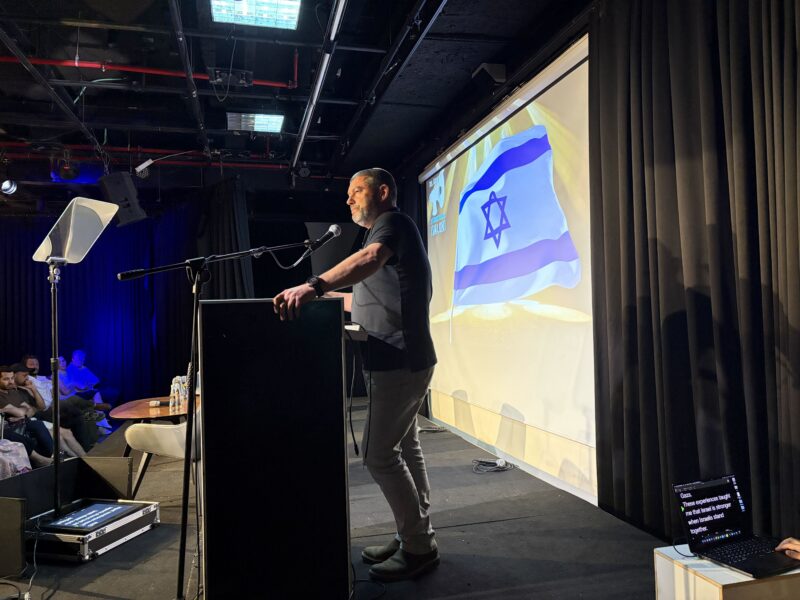
“The people creating this are going to introduce a certain level of their own worldview into what they’re creating,” said Rabbi Mordechai Lightstone, the director of Tech Tribe, a New York-based affiliate of Chabad Young Professionals that serves as a gathering place for Jews working in the tech sector.
Lightstone considers himself an advocate for the technology, but he has warned of the risks of putting too much faith in AI.
“When we ascribe human attributes — emotions, consciousness and ‘soul’ — to AI, we risk transforming a sophisticated instrument into an idol,” Lightstone wrote in a recent blog post. “Key to our harnessing AI is understanding it for what it is: A tool — an immensely powerful one — but not a being with a soul.”
One Jewish response to the almost-messianic belief that AI will usher in a utopia comes from Sefaria’s chief learning officer, Sara Wolkenfeld and Sam Arbesman, a scientist-in-residence at the venture capital firm Lux Capital. The pair wrote in Arc Magazine last month that a Jewish approach to AI might be rooted in the incremental approach of tikkun olam, repairing the world step by step.
They compared it to the Talmudic story of Rabbi Akiva, who “is said to have been inspired to reach for greatness after observing the power of water to wear away stone, drop by drop, as he drew water from the local well,” the Wolkenfeld and Arbesman wrote. “Therein lies the potential of artificial intelligence from a Jewish perspective — not as a far-off goal or panacea, but as a set of tools that provide each of us the means to chip away at barriers and obstacles and create an improved society.”
Last month, Pope Leo XIV released a 42,000-word document known as an encyclical that called for the safeguarding of human dignity as AI develops further and becomes even more integrated into people’s lives. Some rabbis have explored similar questions, but nothing has come close to exerting as much power or reach as the pope’s document. Some of that is by design; Judaism has no central leader of any kind. But some of it may be because many religious leaders have not fully comprehended the scope of the developing technology’s potential.
“A problem I’d say in the Jewish world right now is it’s not clear whose job it is to think about this,” Wolkenfeld told JI.
“I think the Jewish community needs to be actively grappling with a whole range of questions. What does it mean to be human? What are we outsourcing to technology versus retaining for ourselves? We’re going to be seeing massive job dislocation, and so what does that mean, first of all, socioeconomically in our communities?” Zvika Krieger, the rabbi of Chochmat HaLev, said. “Also, for so much of human history, people’s worth and their days were tied to their profession, and we’re seeing a fundamental change of how to build a meaningful life.”
Zvika Krieger is the rabbi of Chochmat HaLev, a progressive minyan in Berkeley, Calif. He does not have the typical resume for a rabbi: He was Facebook’s director of responsible innovation, and a State Department “ambassador” to Silicon Valley in the Obama administration. He now consults for Silicon Valley tech companies, including both Anthropic and OpenAI.
“Most of the leaders in the Jewish community don’t know much about AI, so it can feel like the blind leading the blind. I’m often the only person in the room for these conversations who’s actually worked in a tech company, and the knowledge gap limits how productive these conversations can be,” Krieger told JI.
He described AI as an “epochal technology that is going to fundamentally change the nature of humanity in a way that I think we haven’t seen since the printing press.”
“I think the Jewish community needs to be actively grappling with a whole range of questions. What does it mean to be human? What are we outsourcing to technology versus retaining for ourselves? We’re going to be seeing massive job dislocation, and so what does that mean, first of all, socioeconomically in our communities?” asked Krieger. “Also, for so much of human history, people’s worth and their days were tied to their profession, and we’re seeing a fundamental change of how to build a meaningful life.”
In some ways, conversations about AI are everywhere within the Jewish community — at congregations, at Shabbat dinner tables, at campus Hillels — because of how rapidly the technology has become a part of everyday life. But discussing how to best use specific tools is different than the biggest questions about life and society that AI prompts.
The Jewish conversation about AI needs to be “top-down and also bottom-up,” said Wolkenfeld. “I think every rabbi needs to be thinking about this.”
Potasnik, the New York rabbi who addressed the interfaith tech convening in April, agrees that AI is a transformative technology. But Potasnik, who is 79, remembers how other technological innovations have upended his rabbinate, too, a perspective he brings into his observations on AI.
“We used to think that the newspaper, the radio, those were the popular places for dissemination of information. Well, how many people listen to the radio for information [now]?” Potasnik said. “When I first became a rabbi, I said, ‘If you don’t know baseball, you can’t be a successful rabbi.’ Today, if you don’t know technology, you’re not going to be successful either. You’re going to be seen as ancient, not advanced.”
But Potasnik believes there is one thing that AI cannot replace that is at the heart of what it means to be Jewish.
“We have what’s called the theology of presence. You have to be present, you have to show up, that’s what people want,” Potasnik said. “I think AI cannot take that from us. We still need the human to hug, to hold. We need to see each other, listen and learn from each other. These are important, indispensable ingredients in our human relationships.”
The organizations cited the ‘unprecedented and escalating threat environment’ facing religious communities
Emily Elconin/Getty Images
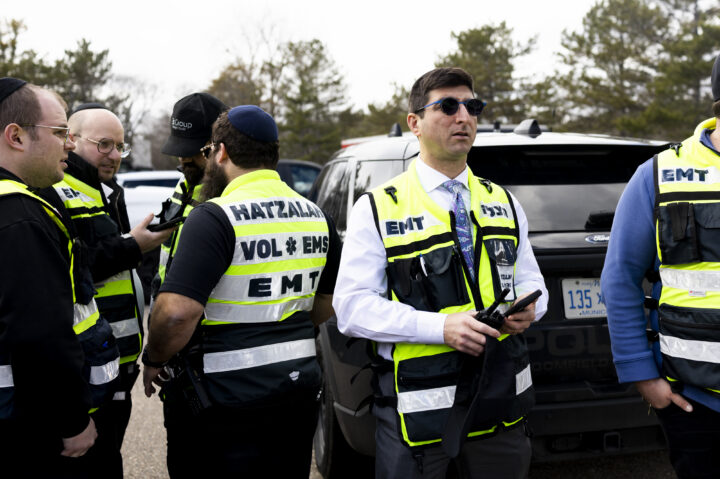
Members of Hatzalah of Michigan, a Jewish volunteer emergency medical service survey the area near Temple Israel following reports of an active shooter on March 12, 2026 in West Bloomfield, Michigan.
Citing an “unprecedented and escalating threat environment facing religious communities and institutions” across the country, a coalition of Jewish groups, joined by organizations representing a range of other faiths, is urging Senate and House leaders to significantly expand funding for the Nonprofit Security Grant Program.
“We write as a broad coalition of faith-based and cultural organizations to express our deep concern about the unprecedented and escalating threat environment facing religious communities and institutions across the United States. This threat is not abstract; it is very real and felt by the communities we represent on a daily basis,” the groups wrote in a letter, led by the American Jewish Committee, to the top leaders of each chamber.
They said that faith-based institutions “should be able to solely focus on serving and strengthening their communities, but in this heightened threat environment, they instead must also worry about the next attack and whether they have the resources to stay safe,” and that members of targeted religious communities are forced to “weigh the risk of violence against the act of worship.”
The letter urges Congress to provide “up to $1 billion” for the NSGP — a significant expansion of funding from its 2025 funding level of $274.5 million, and the proposed 2026 funding level of $300 million.
“Previous funding has not kept pace with demand,” the groups wrote. “More must be done to bolster this program; therefore, we encourage you to engage with communities in your district and to encourage the same of your respective caucuses. We have no doubt you’ll hear about the fear and threats our communities are facing at this moment, and therefore, we urge you to allocate appropriate resources to address this threat.”
The religious organizations also urged swift passage of the long-gestating Pray Safe Act, which would create a centralized federal clearinghouse to provide security guidance to religious institutions, including training resources and information about available grant opportunities.
Additional Jewish organizational signatories included the Anti-Defamation League, the Conference of Presidents of Major American Jewish Organizations, Hillel International, the JCC Association of North America, the Jewish Federations of North America, the Rabbinical Assembly, the Union for Reform Judaism, the Orthodox Union and the United Synagogue of Conservative Judaism.
They were joined by groups representing the Muslim, Lutheran, Greek Orthodox, Hindu, Evangelical, Seventh-day Adventist, Sikh and Catholic communities.
Over 1 million congregants at Hindu temples and Christian churches are expected to take part in ‘Stand Up Sunday’ on Sept. 7

Chris Unger/Getty Images
New England Patriots owner Robert Kraft
Congregants of a Hindu temple on Long Island that was vandalized last year and worshippers of a Methodist Church in Oklahoma City, who last year put on a musical production of “Fiddler on the Roof” to learn about Jewish culture, may not appear to have much in common.
But this Sunday, both houses of worship — together with an expected crowd of nearly 1 million congregants around the country — will join forces for the inaugural “Stand Up Sunday,” a show of force in the fight against antisemitism and all faith-based violence.
As part of the effort, spearheaded by Robert Kraft’s Foundation to Combat Antisemitism and the Appeal of Conscience Foundation, founded by Rabbi Arthur Schneier, organizers said each congregation “will dedicate their services to raising awareness about the sharp increase of antisemitism and all forms of hate against religious communities in the United States by standing together on September 7.”
FCAS’ Blue Square pins will be distributed to attendees “as a visible display of solidarity across faiths,” the group said. Congregational leaders will deliver remarks on antisemitism and faith-based hate in their sermons and houses of worship will place signs and posters throughout their buildings.
The solidarity project comes less than two weeks after a mass shooting at the Annunciation Catholic Church and School in Minneapolis, in which two students were killed and 21 others injured. Since 2021, the number of religious-based hate crimes has doubled, according to the FBI. The FBI’s 2024 crime statistics show a record number of hate crimes against Jews in particular, accounting for nearly 70% of all religious-based hate crimes.
Bawa Jain, an Indian advocate for interfaith dialogue, told Jewish Insider that the participation of 11 Hindu temples around the country was a “no-brainer.”
“People [aren’t aware] that Hindu temples are also vandalized. The media doesn’t cover it to the extent that other acts of violence are covered,” said Jain, secretary-general for the World Council of Religious Leaders and the founder and president of the Centre for Responsible Leadership.
As Hindu temples across the U.S. have seen a surge of vandal attacks over the past year, Jain said that “the Hindu and Jewish communities share a similar past. We are constantly targeted. Any crime against one of us is a crime against all of us,” adding that in his 35 years as a religious leader, he has “never seen a time where Hindu communities were targeted in such a way. We must stand together.”
“One of the things I hope comes out of this is that people realize other communities are being targeted too, even if you don’t hear about it,” said Jain. “When I was approached to get the Hindu community behind this, it was a no-brainer. [Sunday’s] program will focus on incidents of hate, supporting each other and how we must educate our communities. Our hope is that through this first launch, next year more than 120 temples across the country will participate in Stand Up Sunday.”
Participants in the day-long event include the Churches of the Catholic Archdiocese of New York, New Jersey and the Diocese of Brooklyn, the Greek Orthodox Archdiocese of America, Armenian Diocese of America, National Council of Churches of Christ, and numerous Christian, African Methodist Episcopal, Episcopal, Presbyterian Churches as well as the Akshardham BAPS Swaminarayan Hindu Temple USA. Synagogues are not taking part.
For Pastor Bob Long, head of St. Luke’s Methodist Church in Oklahoma City, speaking out against antisemitism goes back to the immediate aftermath of the 2018 Tree of Life synagogue shooting in Pittsburgh, where 11 congregants were shot dead during Shabbat morning services.
Following a visit to the synagogue with other pastors, Long reflected that he “became aware of a Catholic church in the area that put up a sign that said ‘Love your neighbor, no exception.’”
“That became a theme for us in 2020 and 2021 when we gave away thousands of shirts” with the phrase, he told JI.
Last year, the church dedicated its annual “St. Luke’s on Broadway” musical production to learning about Jewish heritage by putting on “Fiddler on the Roof.” St. Luke’s also hosted a pilot version of Stand Up Sunday last year.
“Every Sunday, we have banners at our welcome center that say ‘St. Luke’s stands up to Jewish hate’ and ‘St. Luke stands up to all hate.’ For us, this is something we keep in the forefront all year long,” Long said.
But he called this Sunday “a special lift” for learning about hate and antisemitism in particular.
“We will be talking about [antisemitism] in our worship service,” said Long. “The sermon will be dealing with how we chose to participate and reminding people of what happened at Tree of Life but also what happens all across the country [today] and around the world. We will have multiple banners all around the church about standing up to Jewish hate.”
“Stand Up Sunday is about raising awareness, inspiring action and standing together against hate,” Robert Kraft, founder of the Foundation to Combat Antisemitism, said in a statement. “By uniting behind the Blue Square, faith leaders are sending a powerful message, that antisemitism and all forms of hate have no place in our communities. At a time when division and intolerance threaten to pull us apart, this initiative shows what is possible when we unite across backgrounds and beliefs, and that our shared values are greater than what divides us.”
“Sept. 7 is the moment for us to stand shoulder to shoulder as people of faith to say enough is enough. We are all God’s Children and together we can silence the voices of hate and the perpetrators of violence,” Karen Dresbach, executive vice president of Appeal of Conscience Foundation, said in a statement. “In this concerning time of rising antisemitism and faith-based hate, ‘Stand Up Sunday’ underscores our core mission to ‘Respect the Other,’ a call that is more urgent than ever.”
Please log in if you already have a subscription, or subscribe to access the latest updates.
 Continue with Google

 Continue with Apple