












































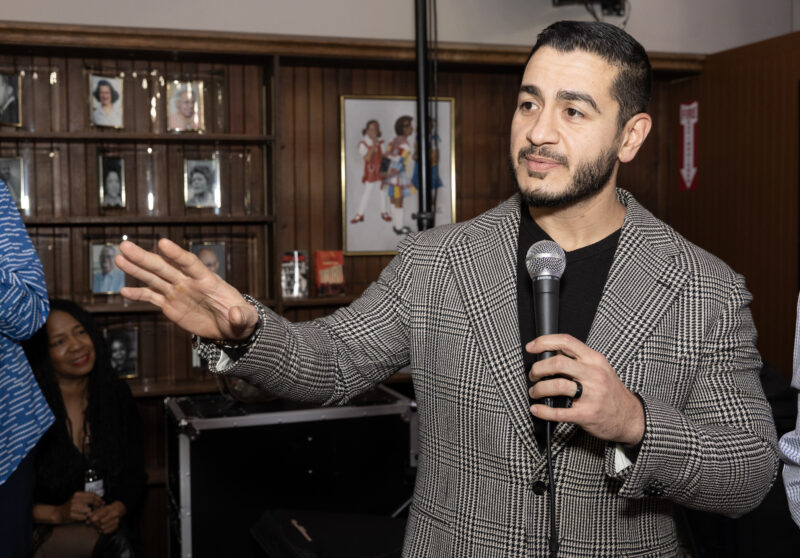






The signatories say they ‘fear the far-left and anti-Jewish elements in the Democratic party would become dominant’ if Abdul El-Sayed is elected
Paul Sancya/AP
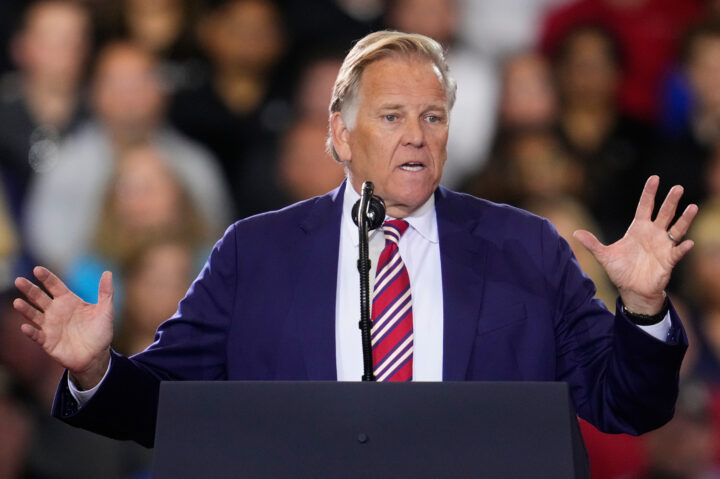
Republican Senate candidate Mike Rogers speaks before President Donald Trump at an event at the General Motors Proving Ground Monday, July 27, 2026, in Milford, Mich.


 Add JewishInsider on Google
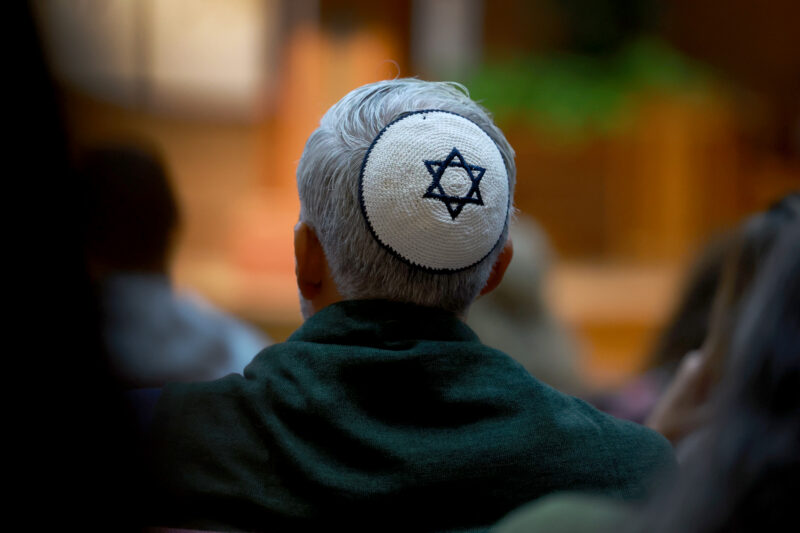
Jewish leaders in Michigan are circulating an open letter urging Jewish Democrats and independents in the battleground state to sign their names in support of former Rep. Mike Rogers (R-MI) as he faces Abdul El-Sayed, the far-left Democratic nominee for Senate whose hostile positions on Israel have alarmed many Jewish voters.
The letter, which was obtained by Jewish Insider on Wednesday and has not yet been publicized, is led by Eric Bronstein, a Detroit businessman, among others identifying as Democrats and independents.
It came to light after a fundraiser for Rogers on Tuesday night hosted by three prominent Jewish Democratic bundlers in Michigan who are likewise alarmed by El-Sayed’s candidacy. The growing efforts among Jewish Democrats to rally support for Rogers in the key Senate race illustrate the degree to which El-Sayed has alienated a sizable and politically active swing voting bloc in what is expected to be a close election.
“We know it is unusual for many Jewish voters to support a Republican candidate for senate and we understand the implications,” Bronstein wrote in a recent email courting Jewish signatories that was also reviewed by JI. “Our fellow Jewish voters need to see their friends and neighbors — including you — willing to take a stand in this specific, crucial race.”
Bronstein did not immediately return a request for comment on Wednesday.
The open letter, which the authors intend to share online once it has gained “a significant initial group of signers,” emphasizes that many signatories “have been fiercely supportive of Democratic candidates and principles.”
“All of us have felt threatened and alienated by the politics and allies embraced by Abdul El-Sayed,” the letter continues, “which has included demonization of Jews, equivocation on terrorism, exclusion of Jewish Americans from public life, and expression of implacable hatred of the world’s only Jewish nation.”
If El-Sayed were to claim victory in the general election, the authors say, “we fear the far-left and anti-Jewish elements in the Democratic party would become dominant, including in the imminent 2028 presidential race,” when Michigan will be among the early nominating states in the Democratic primaries. “We cannot allow him to become the Democratic standard-bearer or Michigan’s senator.”
While the letter calls Rogers “a friend to the Jewish community,” it clarifies the signatories’ endorsement “does not require that we agree with him on every issue or that we support” President Donald Trump. “There are other elections locally and nationally, with different candidates aligned with our values,” it says. “Here in Michigan this year and in this Senate race, our own well-being and our own voice are at stake.”
“This is a moment when each of us must speak out,” the letter states. “We’re voting for Mike Rogers. We ask other Michigan Jewish voters to join us.”
Following the primary early this month, Rogers has been working to fine-tune his outreach to disaffected Jewish voters — balancing private engagement with a key constituency alongside a more broadly calibrated public invitation for Democrats to join his coalition.
On Tuesday, Rogers posted a video testimonial to social media from a supporter in the heavily Jewish Detroit suburb of West Bloomfield who called herself a “lifelong Democrat” and said that she had chosen to cross party lines to support “candidates that actually share our values.”
The voter did not say she was Jewish but was wearing a necklace featuring a Star of David and another with the shape of the State of Israel.
The Fox News survey shows Rogers leading El-Sayed, 51-47%, winning over a small but critical mass of Democratic voters
Sarah Rice/Getty Images
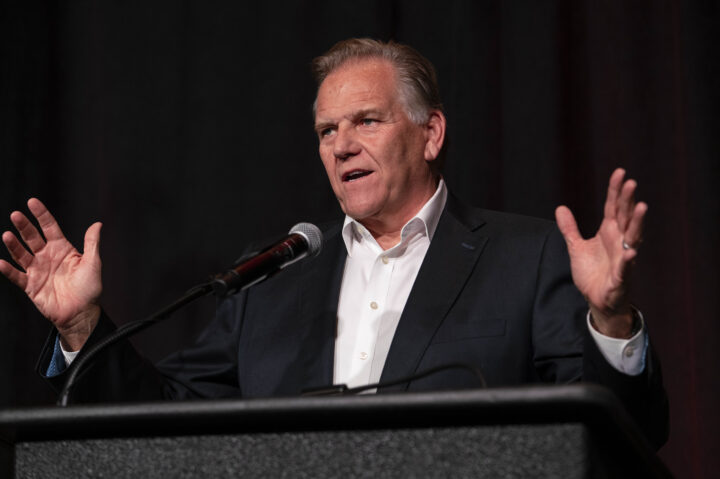
Michigan Senate candidate Mike Rogers speaks at his election watch party.
Former GOP Rep. Mike Rogers starts off the Michigan Senate general election race with a narrow advantage over Democrat Abdul El-Sayed, according to a new Fox News poll, aided by an advantage with independents and making inroads with a small but significant number of Democrats willing to cross party lines.
Overall, Rogers leads El-Sayed among registered voters by four points, 51-47% — and is one of the only Republicans to hold a lead in the series of Fox News Senate battleground polls that have otherwise shown Democratic Senate candidates ahead of their GOP opponents.
The poll found Rogers’ advantage is sustained by holding onto more of his base than El-Sayed, while claiming a small edge with independents. Rogers wins 96% of Republican support, while El-Sayed support is at 91% among Democrats and is only polling at 69% with Democrats who don’t support the Democratic Socialists of America.
54% of Michigan voters surveyed said El-Sayed is too extreme for the state, while 51% of respondents said Rogers was too close to President Donald Trump.
El-Sayed starts the general election with 54% of Michigan respondents viewing him unfavorably and a 41% minority viewing him favorably. That minus-13 net negative unfavorability is a notch worse than Rogers’ 45% favorable rating and 51% unfavorable rating (minus-6).
The pollsters also found that El-Sayed is underperforming with Black voters, women and suburbanites — all key constituencies in a midterm election. Rogers, however, is lagging among younger voters under 30 and independents compared to Trump’s 2024 showing in the state.
The poll surveyed 1,006 registered Michigan voters between Aug. 6-10, and has a 3% margin of error.
Adams would have to win over most New York City Republicans while remaining competitive with Democrats and winning over independents who weren’t eligible to participate in the Democratic primary

Yuki Iwamura-Pool/Getty Images
Democratic mayoral candidate Zohran Mamdani
Mainstream political and business leaders in New York City, including the organized Jewish community, will soon need to decide whether to coalesce against far-left presumed Democratic mayoral nominee Zohran Mamdani — by rallying behind the candidacy of scandal-plagued Mayor Eric Adams despite his significant political baggage.
Adams, who is running as an independent in the race, appears to be the only alternative candidate capable of putting together a campaign rallying anti-socialists across the city to stop Mamdani. It won’t be easy, given Adams’ own low approval ratings and record of alleged corruption, but the makings of an anti-Mamdani coalition are there — at least on paper.
For Adams to win plurality support in a general election, it would require most Republicans to put partisanship aside and vote for Adams to stop the socialist, and hold onto most of the Black, Jewish voters and moderate Democratic voters who voted in large numbers for former New York Gov. Andrew Cuomo in the primary. Adams benefits from the name recognition of incumbency, and the potential to receive support from outside centrist groups spending on his behalf.
Keeping a bipartisan coalition of that nature will be challenging, especially given the mayor’s own unpopular record. It would require a number of lucky breaks, from Cuomo opting not to run in the general election (he appears to be staying on the ballot without an active campaign) to Republicans effectively nudging their voters to back Adams when there’s a Republican already on the ballot. But if the campaign is less about Adams and more about stopping left-wing radicalism on crime, the economy and antisemitism, it’s not implausible to see a campaign coalescing around a “block socialism, vote Adams” type of message.
Here’s the political math: Adams would have to win over most New York City Republicans — President Donald Trump won 30% of the citywide vote in 2024 — while remaining competitive with Democrats and winning over independents who weren’t eligible to participate in the Democratic primary.
An Emerson College poll conducted amid Mamdani’s surge in late May offers some empirical evidence that such a coalition has an outside shot at victory in a general election, with a broader, more-moderate electorate. The survey found that with Mamdani as the Democratic nominee, he leads with 35%, Republican Curtis Sliwa finishes with 16%, Adams holds 15% and independent Jim Walden tallied 6%.
Put together the Sliwa, Walden and Adams votes, and you’ve got yourself a competitive race.
There’s already a lot of rumbling that Trump administration officials, eager to see Sliwa off the ballot, are looking at offering him a job in the administration to help nudge GOP voters into the Adams column to stop Mamdani. But Sliwa has given every indication so far that he’s not dropping out, which would force Republican leaders to more subtly nudge GOP partisans towards Adams.
The big red flag for anti-Mamdani moderates? Adams’ favorability rating in the same poll was a dismal 19%, with 69% viewing him unfavorably. That said, given the changed nature of the contest, the perception of Adams could change amid the shifting strategic environment. He’s already running a more energetic campaign than Cuomo did in the primary. (And it’s a safer bet to hope Adams’ numbers improve as an anti-Mamdani vehicle than betting on a total outsider with minimal name ID to play that role, as a few business leaders have suggested.)
There is some precedent for mainstream forces working to block a far-left or far-right candidate after an unexpected primary outcome. One of the most recent examples is socialist India Walton’s out-of-nowhere upset against Buffalo Mayor Byron Brown in a 2021 Democratic primary. Many analysts attributed her victory to a left-wing surge; it turned out to be a mirage of a low-turnout election before a broader array of voters really had a chance to scrutinize her record and background. Brown easily won the general election — as a write-in candidate.
There’s also former Sen. Joe Lieberman winning as an independent in 2006 after losing the Democratic primary, with Republicans signaling to their voters to back the senator over the also-ran GOP nominee on the ballot. And there’s the 1991 Louisiana governor’s election where scandal-plagued Democratic Gov. Edwin Edwards beat David Duke, whom Republican voters knowingly nominated. Edwards’ slogan? “Vote for the Crook. It’s Important.”
To be sure, any anti-Mamdani effort will be something of a long shot. Mamdani is now winning support from elected New York Democratic leaders all too willing to accommodate his radical record, and he generated strong turnout in the primary that underscores his natural charisma and strength as a politician. He’s got more starpower than many of the other aforementioned extreme nominees.
But if Jewish leaders believe Mamdani would pose a serious threat to Jewish life and safety in the city if elected, you’d expect they would make every effort to stop his candidacy — especially since there’s a chance, albeit a small one, that his momentum could be stunted as his record draws closer attention.
Please log in if you already have a subscription, or subscribe to access the latest updates.
 Continue with Google

 Continue with Apple