









































































Meta’s director of content policy spoke at a ‘Hack the Hate’ tech conference as the ADL released a report documenting antisemitism spreading unchecked on its platform Instagram
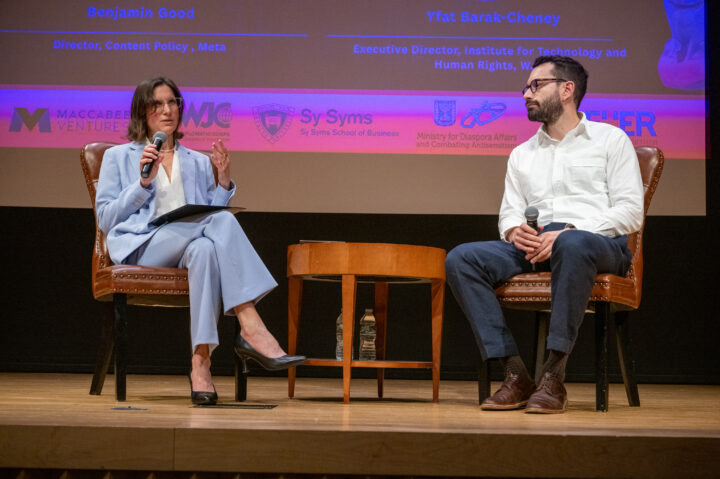
Shahar Azran/WJC
Ben Good, Meta's director of content policy, speaks at the 2026 Hack the Hate summit in Manhattan.


 Add JewishInsider on Google
Amid accusations that Meta’s moderation policies enable antisemitic content to circulate on its platforms, a Meta leader on Tuesday highlighted efforts to combat online Jew-hatred, including restrictions on Holocaust denial.
“We remove Holocaust distortion and denial, not because it’s false, which it is, but because it’s antisemitic. It is hate speech against Jewish people, so we’ve drawn a clear line against it,” said Ben Good, director of content policy at Meta, the parent company of Instagram, Facebook and WhatsApp.
Good spoke at “Hack the Hate NYC 2026,” an event at the Yeshiva University Museum in Manhattan spotlighting Israeli tech experts and Jewish leaders working to combat digital antisemitism.
Good, who leads Meta’s team that writes content policies — the rules for what can be posted to the platforms — spoke during a fireside chat with Yfat Barak-Cheney, executive director of the Institute for Technology and Human Rights at the World Jewish Congress.
“Those are policies that govern the global speech of 3 billion people, so we take the responsibility extremely seriously. We want to make sure people can express themselves maximally but we also have to keep our community safe,” said Good.
The event was held as Jewish communities in Israel and around the world marked Yom HaShoah. Barak-Cheney noted that it took four years of advocacy from groups like WJC for Meta to recognize Holocaust denial as antisemitism. In October 2020, the company updated its policies to explicitly prohibit content that denies, distorts or minimizes the Holocaust.
Even after that recognition, she said, the situation remains “especially alarming because it’s not just that we see a larger quantity of AI-generated material, but the quality is different, it’s getting better.”
“Holocaust denial is looking very realistic,” she said. “There’s fabricated quotes. I am worried that we’re losing our grip on the reality of the Holocaust. Does Meta see this as alarming from the inside as it is from our point of view?”
“I have seen new trends putting words in people’s mouths that were not said, having prominent Nazis say things that aren’t true. Those violate our policies. It’s hate speech and we remove it,” said Good. “The same goes for a lot of other conspiracy theories that are misinformation but really are about dehumanizing Jewish people. The most prominent one being the centuries-old tropes that Jewish people control the media or government. We know that underlies dangerous acts so we remove it.”
Good said that Meta, which uses AI-generated content moderation, has “tremendous potential to advance AI systems in dealing with what we call ‘integrity work’ in social media.”
He said that “traditional machine learning,” utilized about two years ago, required being fed “a ton of data, some content that violates [Meta policies], some that doesn’t and they begin to understand [and match] patterns.”
Modern LLMs are able to analyze context on their own, said Good, allowing for more accurate reasoning.
“That is extremely important in an area such as Holocaust denial because it’s very coded and can often be long-form speeches and text which can be hard to understand even for a human,” said Good. “The LLMs are really good at understanding coded language and context.”
But even as Meta has made strides in addressing Holocaust denial, the Anti-Defamation League released a new report on Wednesday revealing that Instagram failed to remove 93% of reported extremist and hateful content, tying the trend directly to Meta’s efforts to roll back content moderation last year.
A spokesperson for Meta told Jewish Insider after the report was released that “over two-thirds of the accounts and posts flagged by the ADL were removed prior to the publication of this report, while some did not violate our policies.” ADL told JI it gave Meta a two-week window from reporting the content to getting a response from the platform.
The January 2025 rollback of content moderation included ending the platform’s third-party fact-checking program and replacing it with a system modeled after the community notes feature on Elon Musk’s X.
At the time, some Jewish leaders expressed concern that the move would “open the floodgates to content” that could target Jewish communities and individuals, and called the decision a “step back” in the fight against rising antisemitism. Meta had said the relaxed guidelines aim to “allow more speech by lifting restrictions on some topics that are part of mainstream discourse.”
“The name of the game isn’t just relying on the magic of AI and setting it loose on our platform,” said Good. “Instead, we have to be extremely positive that it understands our written policies and will apply and enforce them. We don’t want to leave the guesswork to the technology. We will always be reporting our enforcement metrics. But this is a chance to bring contextual understanding to content moderation.”
Barak-Cheney asked Good what guardrails Meta, which produces its own AI system called Llama, has in place to stop its LLMs from generating content that might be antisemitic.
“We do train the models on our safety standards,” said Good. “The unique challenge with generative AI is that it’s interactive and adaptable. When we train the models to prevent harm, we’ve learned it’s not so much the ‘what’ but the ‘why.’ It’s not so much telling the model that it can or can’t say this, it’s explaining to the model why we have certain rules, prohibitions and standards and reasoning with it so it can extrapolate that reasoning into situations.”
“This can mean a number of things, but an old-school way of doing it would be to say ‘here are 500 words we consider slurs, don’t say them.’ A more dynamic rule might be ‘this is what a slur is, this is why we consider a word a slur and these are the circumstances in which you can say it,’ and let the model reason through various situations,” explained Good.
He added that “there’s no limit” to how much help antisemitism watchdogs can provide to Meta.
“To be clear, we understand that generally it’s our job to understand how problems manifest and address them, but when people who are on the ground in a given space give us reports and intel it allows us to validate our own research in a way that helps us make decisions better. The policy shouldn’t be a bunch of people in Silicon Valley deciding things. They should be decided collaboratively,” Good said.
The event, attended by some 150 Jewish leaders and innovators, opened with remarks from Rabbi Ari Berman, president of Yeshiva University. It was organized by Generative AI for Good and the 8200 Alumni Association, which preserves the legacy of IDF Unit 8200, in partnership with the Israeli Ministry for Diaspora Affairs and Combating Antisemitism, Gesher Israel, Maccabee Ventures, President Isaac Herzog’s Voice of the People Initiative, the World Jewish Congress’ TecHRI and Yeshiva University’s Sy Syms School of Business.
The South Carolina Republican brought Christian and Jewish leaders together to speak out against ‘stopping’ antisemitism in the GOP ‘before it gets stronger’
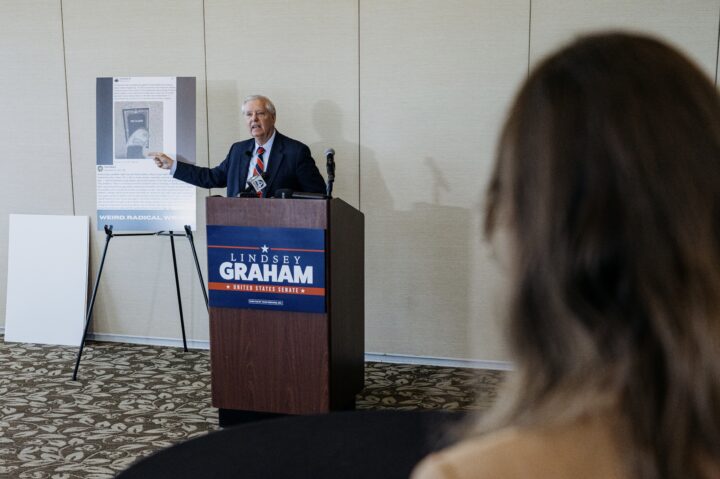
Lindsey Graham for Senate Campaign
Sen. Lindsey Graham (R-SC) at news conference last Thursday during which he criticized the actions of his primary opponents' staffers.
Sen. Lindsey Graham (R-SC) doubled down on his calls for two of his primary challengers in his reelection campaign to fire senior officials over their record of antisemitic statements after both candidates refused to do so — vowing on Tuesday to fight the growing tolerance for Jew-hatred in the GOP and call out aspiring lawmakers in South Carolina who excuse or embrace it.
The South Carolina senator convened Christian and Jewish leaders for a call with reporters to criticize Paul Dans and Mark Lynch, who are challenging Graham in the Republican primary for his Senate seat, over Dans’ refusal to fire Vish Burra as his campaign communications director and Lynch declining to part ways with Evan Mulch as his political director despite their respective records of making antisemitic statements.
Graham told reporters that while he would not typically make an issue of the behavior of staffers from an opposing campaign, he felt compelled to speak out because of the outgrowth of antisemitism in the Republican Party.
“I’m speaking more today as just an American, a senator representing South Carolina, rather than just a candidate. I’ve never had to make a phone call like this, and it, quite frankly, is disturbing,” Graham said. “There are two opponents of mine that have staff members that are very out of touch with where I think South Carolina is, and spewing hate in the form of antisemitism.”
“I’ve never done this before, but this is a problem in America, a small problem in the Republican Party, that I don’t want to grow,” he continued. “I seldom do this, go after other people’s campaigns, because I feel confident that what I’ve got to offer wins the day politically, but this is not about politics. This is not about my primary. This is about stopping something before it gets stronger, calling it out and making it unacceptable.”
Graham highlighted both staffers’ records at a news conference last Thursday and on Tuesday’s call, condemning Burra for depicting Jews as cockroaches in a video he created on the right-wing One America News Network, which ultimately resulted in his firing as a producer.
Mulch, meanwhile, posted a photo on X last June of a boot stepping on the Talmud and calling it a “hate filled book.”
“I call this out because I think it’s a vile antisemitic action. It has no place in politics or, quite frankly, decent society, and he hasn’t been fired,” Graham said on Tuesday. “As a matter of fact, Mr. Dans, in responding to the call to deal with the staffers, said that my campaign was controlled by Israel and that I’m being blackmailed by Israel and other affiliated groups, which I think is one of the oldest stereotypes, that the Jews control politicians.”
“When you step on the Talmud with a boot, I don’t think that’s American,” he added of Mulch. “I don’t think it’s Christian, and I don’t think there’s any place in running for higher office for people who engage in that behavior, and I’ve called for him to be fired with no response.”
While Graham said he does not believe it is inherently antisemitic to voice objections to the policies of the Israeli government, he argued that tolerance of such criticisms did equate to tolerance of blatant antisemitism.
“I’m a strong supporter of Israel, and you can oppose Israeli policies and not be an antisemite,” Graham said. “But when you’re an antisemite, not only do you oppose Israel, I think you oppose human decency and what America stands for.”
Graham told Jewish Insider on the call that he was confident “that when the people of South Carolina — Republicans, Democrats and independents — hear what’s going on, and that’s why I’m doing it today, it will be soundly rejected.”
Matt Brooks, CEO of the Republican Jewish Coalition; Tony Perkins, president of the Family Research Council; Ralph Reed, founder of the Faith & Freedom Coalition; Sandra Hagee Parker, who chairs the board of CUFI Action Fund, the political arm of Christians United for Israel; and Rabbi Yossi Refson of Chabad of Charleston spoke on the call in support of Graham’s efforts.
“We have witnessed, I believe, sadly, the institutionalization of antisemitism in the Democratic Party,” Brooks told attendees. “For us at the Republican Jewish Coalition, let me be very clear and unambiguous that this is a fight that we will take everywhere. We will ensure that antisemitism does not take hold in our party like it has taken hold in the Democratic Party. The fabric of America was woven together based on Judeo-Christian values, the values that we all cherish are built in partnership with our Christian allies and friends. Anybody who traffics in antisemitic rhetoric or antisemitic actions has no place in our party.”
Graham vowed at the end of the call to continue his push to ensure elected Republicans in and out of the state are individuals who repudiate antisemitism.
“The breadth of condemnation here and the quality of the thoughts expressed not only give me hope and prove that I’m doing the right thing. It inspires me. I am not going to let this go after what I heard today. I am never going to let this go until my last breath. I will make sure that any group, but particularly the long suffering Jewish people, have my unequivocal support.”
Dans and Lynch were unapologetic about their campaign staffers, instead releasing statements late last week and Tuesday directing their ire at Graham in deeply personal terms.
“He’s given a member of my campaign staff more attention than he’s given South Carolinians for decades,” Dans said in a statement last Thursday. “The real headline that you should be covering is how many opioid deaths happened in South Carolina last year on Lindsey Graham’s watch. Israel picks Lindsey Graham’s staff, but they do not pick mine. I am not firing Vish Burra and I am calling on the people of South Carolina to fire Lindsey Graham.”
Lynch, meanwhile, told JI in a statement on Tuesday evening that Graham was “an existential threat to both the nation of Israel and the United States.”
“Lindsey Graham is responsible for the deaths of countless Jews in Israel by the fact that he has sent 10s of millions of dollars to Al-Qaeda, Hamas, and Al-Nusra Front — funding the enemies of Israel,” Lynch said.
Please log in if you already have a subscription, or subscribe to access the latest updates.
 Continue with Google

 Continue with Apple