








































































The move was roundly criticized by British Jewish leaders, along with the conservative opposition parties in Parliament
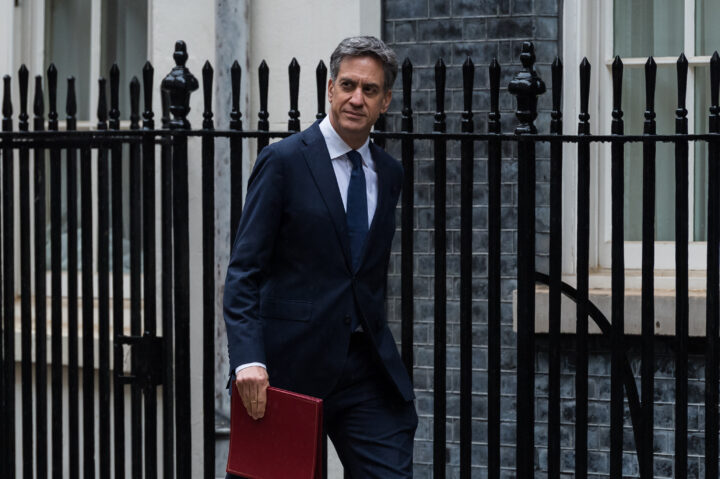
Wiktor Szymanowicz/Future Publishing via Getty Images
U.K. Foreign Secretary Ed Miliband arrives in Downing Street to attend weekly Cabinet meeting in London, U.K. on Sept. 8, 2026.


 Add JewishInsider on Google
U.K. Foreign Secretary Ed Miliband announced a sweeping new sanctions regime targeting Israeli settlements in the West Bank on Tuesday, marking a major escalation in Britain’s diplomatic stance toward Israel.
Addressing the House of Commons, Miliband unveiled an import ban on goods produced in settlements alongside targeted sanctions against individuals and corporate entities involved in constructing, advertising or financing settlement expansion.
The secretary also announced a ban on real estate events in the U.K. promoting the purchase of homes in West Bank settlements. Miliband went further than any previous British official in accusing extremist Israeli settlers of carrying out “ethnic cleansing” of Palestinians in the West Bank and calling them “terrorists” with the tacit backing of the Israeli government.
“My parents came here as Jewish refugees and found sanctuary and a country that stood up for the law, freedom and self-determination,” said Miliband, describing himself as a proud British Jew. Expressing a “deep sense of shame” over the actions and policies of the Israeli government in Gaza, he insisted the policy is intended to target illegal settlements — not Israel or the Jewish community — and is distinct from the Boycott, Divestment and Sanctions movement.
“We absolutely oppose the BDS movement against Israel. This is about the Occupied Territories, settlements in the Occupied Territories,” Miliband said. “[It takes] six to nine months precisely so that we get this regime right so it does not affect, so it does not impinge, on Green Line Israel,” he continued, referring to the Israeli borders established in the aftermath of the 1948 war.
Miliband also announced that the U.K. would be reimposing strict economic sanctions on Iran, as well as sanctions on Al-Qard al-Hassan, a Hezbollah-run financial institution.
The measures, triggered in part by Israel’s plans to expand the contentious E1 settlement zone east of Jerusalem, were coordinated with France and Canada. Denmark, Finland, Iceland and Poland joined the countries in announcing they would enact similar sanctions in a joint statement alongside countries that have already taken similar measures — such as Ireland, Spain, Netherlands, Norway and Belgium.
The countries reaffirmed their commitment to a two-state solution, firmly opposing “actions tantamount to the annexation of Palestinian land and forcible displacement” while reiterating Israel’s legitimate security needs and condemning the Oct. 7, 2023, Hamas terrorist attacks.
Denouncing what he described as a “hostile sanctions package,” Israeli Foreign Minister Gideon Sa’ar announced on Tuesday that Israel would be taking swift retaliatory measures, such as closing the British Consulate in Jerusalem, expelling British representatives from the U.S.-backed International Gaza Support Center, terminating the British Support Team in Ramallah tasked with training members of the Palestinian Authority Security Forces and barring 12 British officials “involved in antisemitic and anti-Israel activity.”
U.S. Ambassador to Israel Mike Huckabee suggested that Britain will face “repercussions” and accused the U.K. of “discrimination against the Israeli government.” The U.S. is expected to release a statement about the sanctions later today.
Despite gaining support within the Labour Party the government’s announcement triggered immediate pushback from the political opposition and British Jewish organizations, who warned the policy could inflame tensions at home.
Speaking to Miliband in the House of Commons, Reform U.K. Deputy Leader Richard Tice condemned the sanctions as a “grave mistake” that risks fueling anti-Jewish hostility. The U.K. has seen a spate of violent attacks against its Jewish communities in recent months.
“We all deplore settler violence, but the simple reality is these sanctions are a grave mistake,” Tice said, questioning whether the policy would “embolden the scourge of antisemitism against British Jews on British streets.” He added that the move risks damaging relations with the U.S., harming U.K. security and inviting retaliatory sanctions from Israel.
Conservative leader Kemi Badenoch similarly criticized the measures, accusing the Labour Party of being driven by domestic political motives rather than Middle East diplomacy.
“Labour’s obsession with Israel is rooted in U.K. politics — it’s got less to do with peace in the Middle East and more to do with trying to keep the peace in the Labour Party,” Badenoch said, warning that British Jews should not have to watch politicians condemn antisemitism while ignoring the ideologies that drive it.
Jewish community groups also raised alarms over the diplomatic fallout. The Board of Deputies of British Jews, the leading representative body of British Jews, cautioned against prioritizing party politics over national interests, warning that eroding ties between London and Jerusalem could undermine economic security, damage national security ties and heighten community friction within the U.K.
“As we have told both governments over recent weeks, the deteriorating relationship between the U.K. and Israel has the potential to negatively impact the two countries’ security and their economies and further inflame community tensions here too,” the statement read.
Meanwhile, the Jewish Labour Movement, while acknowledging that curbing settlement expansion and opposing Israeli Prime Minister Benjamin Netanyahu’s policies were worthy goals, voiced serious misgivings regarding the government’s timing and execution of the policy.
“Action against settlement expansion and settler violence is absolutely necessary, as well as the increased opposition to Netanyahu’s ruinous ideology, but many in our community and our membership will hold questions and voice concerns about the timing and specifics of the policy.”
The Jewish former Labour leader has supported Israel’s security but has declined to identify as a Zionist
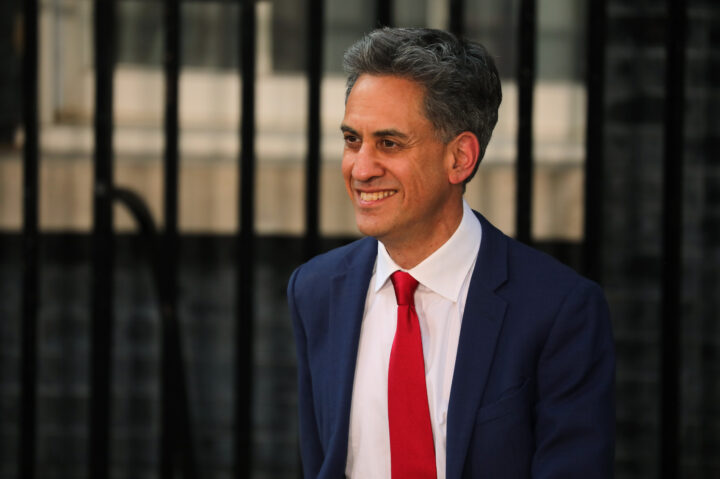
Alishia Abodunde/Getty Images
Newly appointed U.K. Foreign Secretary Ed Miliband departs Downing Street on July 20, 2026 in London, England.
Ed Miliband’s appointment on Monday as U.K. foreign secretary is raising questions about how the former Labour chief will influence Israel and Middle East policy under Andy Burnham, the country’s new prime minister.
Miliband, 56, had served as energy secretary under former Prime Minister Keir Starmer, who announced his resignation last month and officially departed 10 Downing St. on Monday. As the first Jewish leader of the Labour party, which he helmed from 2010-2015, Miliband has long balanced his commitment to Israel’s security with vocal criticism of the Jewish state that has fueled some tensions with British Jewish leaders.
The naming of Miliband to lead the Foreign Office has been seen as a sign that Burnham plans to adopt a tougher stance toward Israel as prime minister than his predecessor — who had already sought to cut off some arms sales to Israel while imposing sanctions on far-right Israeli ministers and recognizing a Palestinian state in a series of moves that soured ties between the U.K. and Israel.
In the days before his recent election as Labour leader, Burnham, the former mayor of Manchester, apologized for his party’s initial response to Israel’s military campaign in Gaza after the Hamas attacks of Oct. 7, 2023, saying that it had been “too slow to call for a ceasefire,” and suggested he would implement further sanctions on Israel and its government along with a possible trade ban on settlements in the West Bank.
For his part, Miliband, in a statement on Monday, spoke more broadly about his approach to the Middle East, vowing the new government would “seek to end the conflict in Iran,” while “working tirelessly to seek a sustainable peace in Palestine and Israel, including an end to the terrible suffering of the people of Gaza and security for the people of Israel.”
During his past tenure as Labour leader, Miliband “certainly wasn’t an instinctive supporter of Israel, but he also wasn’t as hostile as some expected given his background,” Arieh Kovler, a political analyst in Jerusalem who previously served as the director of policy and research for Britain’s Jewish Leadership Council, told Jewish Insider. “But that was a decade ago. Attitudes to Israel have hardened across British politics and the Labour Party with it.”
Kovler added that he would expect “the Burnham government to be tougher on Israel, and for Ed Miliband as foreign secretary to be quite comfortable moving forward an agenda of, for example, sanctions on settlements and broader arms embargoes while still publicly affirming that Israel’s an ally with a right to defend itself.”
In 2014, Miliband joined most of his party’s lawmakers in what was viewed as a largely symbolic vote calling to unilaterally recognize a Palestinian state — a position formally adopted by the U.K. last September.
Prior to that vote, Miliband had publicly rebuked then-Prime Minister David Cameron, a Conservative, during Israel’s Operation Protective Edge in Gaza, for his “silence on the killing of innocent Palestinian civilians caused by Israel’s military action,” which he called “wrong and unjustifiable.”
Despite his critical stances, Miliband — who drew some praise from the British far left on Monday — has defended Israel’s right to self-defense and said that “there is no place in politics for those who question” the country’s existence, underscoring his personal ties to Israel, where his grandmother took refuge after surviving the Holocaust.
“My relationship with my Jewishness is complex,” he wrote in a 2014 essay. “But whose isn’t?”
While Miliband has called Israel “a homeland for the Jewish people,” he has expressed ambivalence about referring to himself as a Zionist, declining to identify explicitly as such.
“I want you to know that if I become prime minister in less than a year’s time, I will be proud to do so as a friend of Israel, a Jew and, most of all, someone who feels so proud to be part of the community gathered here,” he said in a 2014 speech to Labour Friends of Israel, after he had returned from a trip to Israel.
In his statement posted to social media on Monday, Miliband invoked his family history, noting that his parents “came to Britain as Jewish refugees from the Nazis.” His father, Ralph Miliband, was a renowned Marxist theorist, and his mother, Marion Kozak, who died in May, was a Holocaust survivor who became a staunch supporter of Palestinian rights. His brother, David, was foreign secretary from 2007-2010 under former Prime Minister Gordon Brown.
Miliband’s new role as foreign secretary provoked barbed reactions from some British Jewish leaders before he was even officially named to the position, replacing Yvette Cooper in part of a broader Cabinet shakeup led by Burnham, who on Monday rose to the prime ministership.
Stephen Pollard, the former longtime editor of The Jewish Chronicle, said in a lengthy post that Miliband’s appointment was the “most nauseating political appointment of my lifetime.” He harshly criticized Miliband for leading the Labour party in a 2013 vote against U.K. military action to oppose former Syrian dictator Bashar Al-Assad after he had used chemical weapons on his own people, calling it a “disgraceful” effort that emboldened Russian President Vladimir Putin to invade and annex Crimea the following year.
Edmund Fitton-Brown, a former British diplomat who is now a senior fellow with the Foundation for Defense of Democracies think tank in Washington, said that Miliband’s “record on Syria suggests that he will be a skeptic on any new military engagements in the region, and that he and Burnham will therefore be even less inclined than” Starmer and Cooper “to join the U.S. in its current campaign against Iran.”
In gauging Miliband’s “leanings regarding Israel, Gaza, Palestine and the Middle East relative to his colleagues and former colleagues,” Fitton-Brown told JI that “he is much less rabid than Jeremy Corbyn,” the former Labour leader who had faced accusations of antisemitism, “but more anti-Israel than either of his predecessors,” including Cooper and David Lammy.
“This may suggest that Andy Burnham, who may be described as left of Keir Starmer on this issue, will shift the U.K. government into a slightly more anti-Israel position than Starmer allowed, although he will want to avoid accusations of being soft on antisemitism,” Fitton-Brown explained.
Jonathan Freedland, a Guardian columnist in London who co-hosts the “Unholy” podcast, which covers Israel and Jewish life, told JI that Miliband “has deep personal and family ties to Israel, and when he was Labour leader more than a decade ago he said those ties informed his view of the region.”
“Clearly,” Freedland said on Monday, “the context now is very different — opinions have hardened against the current Israeli government and I would expect Ed Miliband to reflect that change and to do so trenchantly.”
Please log in if you already have a subscription, or subscribe to access the latest updates.
 Continue with Google

 Continue with Apple