






































































Advocates say the pattern — agents advising cuts to Jewish names, editors going silent on Israeli-themed submissions — deepened sharply after the Oct. 7 attacks

Getty Images
Books


 Add JewishInsider on Google
Meg Keene, an established nonfiction author who has sold more than 150,000 copies of her two books offering tips for wedding planning, couldn’t find a publisher for her first novel — not because of the writing, she said, but because it was “too Jewish.”
Keene said she was advised by one agent to cut anything Jewish from the manuscript unless it drove the plot, including changing a character’s name because Yael read as Israeli. The book, written soon after the Oct. 7, 2023, terrorist attacks in Israel, about a Jewish woman’s long-distance relationship with a boyfriend in Tel Aviv, was never published.
Keene is one of a growing number of professionals who have announced in recent weeks the launch of their own Jewish publishing companies, aimed at fulfilling a need for frustrated authors who say they’ve hit the same wall: agents advising them to cut Jewish names and references to Israel, editors going silent on submissions that once would have been fast sales and a mounting sense that the industry’s embrace of the #ownvoices storytelling trend — a hashtag used to amplify the work of diverse and minority voices — has an unspoken exception for Jewish writers.
Keene recently announced the launch of Meg Keene Books, her own imprint at Wicked Son Press, a Jewish publisher known mostly for right-leaning nonfiction. The company plans to release four to six fiction books a year, from romance to thrillers, selected by Keene and the Wicked Son founders, with the goal of elevating Jewish voices.
“Earlier this year I got to the point where I realized I didn’t have anything left to lose,” Keene told Jewish Insider. “Jews were having all these conversations behind the scenes but it felt like whoever came forward was going to destroy their career. I felt like I was in a position — because of my past in digital publishing and connection to editors, I knew how to do it. So many authors couldn’t sell their first book. At least I had a track record, I could say I was a successful author and be taken seriously.”
“PEN America’s recent blog post about the targeted harassment of Jewish and Israeli authors and literary institutions is an important acknowledgment of this problem,” Ari Ingel, executive director of Creative Community For Peace, told JI. “At the same time, many in our community believe that acknowledgement came only after a long period in which prominent incidents involving Jewish and Israeli writers did not receive the kind of timely and forceful public defense expected from a leading free-expression organization.”
While discrimination against Jewish authors has been reported for years, industry professionals say it became more apparent and accepted after Oct. 7 and the ensuing Israel-Hamas war.
In 2024, the Palestinian Festival of Literature published a petition signed by Irish author Sally Rooney and more than 1,000 others, which stated that, “We cannot in good conscience engage with Israeli institutions without interrogating their relationship to apartheid and displacement.” More recently, the free speech organization PEN America published a report detailing interviews with more than 30 Israeli and Jewish writers and literary professionals describing a widening cultural isolation.
“PEN America’s recent blog post about the targeted harassment of Jewish and Israeli authors and literary institutions is an important acknowledgment of this problem,” Ari Ingel, executive director of Creative Community For Peace, told JI. “At the same time, many in our community believe that acknowledgement came only after a long period in which prominent incidents involving Jewish and Israeli writers did not receive the kind of timely and forceful public defense expected from a leading free-expression organization.”
There is no reliable industry-wide figure showing what percentage of Zionist or Jewish authors have been dropped, although Keene has collected data specifically on Jewish fiction publishing, which found that between 2023 and 2024, there was a 76% decline in fiction deal announcements to large presses that mentioned Jews, Judaism or Israel. “Publishing decisions are generally confidential and are rarely explained to involved parties,” said Ingel. “But the evidence points to a recurring and increasingly documented pattern rather than a handful of isolated cases.”
“What we are seeing is a form of a silent boycott set in, with authors being dropped or their projects not being picked up by editors, publishers, agents and publicists, sometimes not because of anything they had said about Israel, but because they were told that it was not the right time for a Jewish-themed book,” Ingel said. “[New] publishing ventures of this kind are necessary in the current climate.”
Howard Lovy with Canary Publishing and Jessica Kasmer-Jacobs with Blueprint Literary are among several others also launching new literary agencies for Jewish and Israeli authors.
Lovy, a former editor at Jewish Telegraphic Agency, said he started noticing Jewish exclusion in the industry before Oct. 7, with a novel he wrote several years ago.
“A publisher and agent kept saying, ‘We value diversity and we want under-represented voices,’ and it didn’t take me long to figure out that they did not mean Jews. We were not considered marginalized voices and it becomes a self fulfilling prophecy: We become marginalized because of this perception that we’re over-represented,” he told JI.
“Then Oct. 7 happened and in my work as a book editor and as a Jewish author and advocate, people came to me telling me their stories about how they were canceled or their agents suddenly wouldn’t return their calls. They’ve been asked to take the Jewish content out, or if there’s an Israeli character make it something else.
“No one publisher can pick up the slack for canceled and excluded authors; it’s literally going to require building an entire new industry,” said David Bernstein. “So we’re doing everything we can to not only encourage new entrants, but also to leverage our decades of publishing expertise to give them a leg up and to help build sustainable businesses. We’ve got a lot of things in the works behind the scenes that will change the game entirely.”
“It’s hard to prove a negative, to say because they’re Jewish this happened. But I have a lot of anecdotal evidence,” he said.
Lovy said the mission of Canary “is going to be finding the books that have been rejected elsewhere because of their Jewish or Zionist content,” though the press has not signed any authors yet.
“That doesn’t mean explicitly Zionist, it could mean anything,” he continued. “The criteria I’m looking for right now is whether this is something the mainstream literary world rejected that otherwise has literary merit. That’s going to be top of my list. We’re on a mission to amplify these voices that have been silenced.”
The new companies follow the 2020 launch of publishing company Wicked Son, co-founded by David Bernstein and Adam Bellow.
“We were operating out of a sense of civic responsibility to rebuild the Jewish reading public; for Jewish authors, opportunities to publish were widespread and often lucrative,” Bernstein told JI. “Obviously all of that changed in the last couple of years as we’ve all seen the rising antisemitism in publishing and other arts and media. What’s heartening is that, mirroring our own renewed energy to build a thriving, independent Jewish publishing world, so many others are joining the fight as well.
“No one publisher can pick up the slack for canceled and excluded authors; it’s literally going to require building an entire new industry,” said Bernstein. “So we’re doing everything we can to not only encourage new entrants, but also to leverage our decades of publishing expertise to give them a leg up and to help build sustainable businesses. We’ve got a lot of things in the works behind the scenes that will change the game entirely.”
“It’s not just a matter of publishers, it’s a matter of the entire pipeline,” Jewish literary consultant and advocate Erika Dreifus said. “It’s a matter of writers feeling empowered to attend conferences and classes and to write their Jewish stories in supportive spaces. Then it’s a matter of agents being willing to look at those stories and take them on. Then it’s a matter of the books being covered in pre-publication trade reviews, which I have noticed are not necessarily including certain narratives and certain authors. That’s how reviewers find out about books. Everything has a drip-down effect.”
Jewish literary consultant and advocate Erika Dreifus described the wave of new ventures as “wonderful,” but cautioned against reading it as a comprehensive fix for what ails Jewish authors.
“There’s certainly more writers out there who would love to be published than there are going to be slots, even with these new publishing houses. I welcome the developments and I’m eager to see what they’ll all be doing,” she told JI.
The deeper problem, she said, extends beyond the number of publishers willing to take a chance on Jewish stories.
“It’s not just a matter of publishers, it’s a matter of the entire pipeline,” Dreifus said. “It’s a matter of writers feeling empowered to attend conferences and classes and to write their Jewish stories in supportive spaces. Then it’s a matter of agents being willing to look at those stories and take them on. Then it’s a matter of the books being covered in pre-publication trade reviews, which I have noticed are not necessarily including certain narratives and certain authors. That’s how reviewers find out about books. Everything has a drip-down effect.”
She also called on the Jewish philanthropic world to “take a look” at helping to build the ecosystem “even beyond these publishers.” (Lovy declined to provide details on how his company will be funded, but said it has a funder who gave enough seed money to get it going.)
“Already within the Jewish philanthropic world, a miniscule fraction of funding goes to arts and culture to begin with. How much of that goes to individual initiatives?” said Dreifus.
“It’s all a big problem and challenge. We need to do a lot more,” she added. “This is an encouraging step, but if it’s just going to be publishers shouting into the wilderness, that may not be ultimately as positive a development as one would hope.”
Citing Rabbi Diana Fersko’s framework for how Jews have historically responded to antisemitism — stay and fight; leave and build something new; or do nothing — Dreifus said after witnessing this for two decades, she is personally worn out by the “stay and fight” approach. She’s now focused on supporting new, welcoming spaces for Jewish stories rather than fighting within existing institutions, although she credited groups like the Jewish Book Council for trying to work both the “stay and fight” and “build something new” angles at once.
Naomi Firestone-Teeter, CEO of JBC, told JI that “Jewish authors thrive when publishers are willing to take a chance on them. Publishers thrive when their books can reach readers. And the Jewish community thrives when it has access to high-quality Jewish literature with diverse voices and perspectives.”
“Authors need opportunities across the full spectrum of publishing, from major houses to independent presses. We believe that the existence of a wide range of publishers promotes a healthy ecosystem for Jewish literary excellence,” she said. “Part of our role is to demonstrate to publishers that there is a real, engaged audience for Jewish books and ideas.”
Jews in the industry have noted a double standard as major publishing houses continue to publish authors with viewpoints hostile to Israel or Jews.
Publishing giant Simon & Schuster, Ingel noted, recently published prominent Palestinian-American author Susan Abulhawa, who has repeatedly used terms such as “parasites,” “demons,” “ghouls” and “monsters” to describe Jews.
“The point is not that Abulhawa’s books should be banned or she should be silenced. The point is that an industry willing to platform such extremism is not showing the same courage when it comes to merely platforming Jewish, Israeli and Zionist writers telling any story,” said Ingel.
There’s another part of the equation that’s equally critical — sales after a book is published.
Firestone-Teeter pointed to her group’s program called Nu Reads, a bi-monthly book subscription service. “In less than a year, Nu Reads has grown to nearly 2,500 subscribers; this is significant, when, by some accounts, close to 90% of titles released by major publishing houses sell fewer than 2,000 copies,” said Firestone-Teeter.
But for authors who want their books on store shelves, “that’s gonna be an issue,” said Lovy.
Lovy edited a Judith Magazine April report that found many independent bookstores refuse to include Jewish and Zionist authors. Last week, Nashville indie bookstore Bell Bird Books canceled a planned book launch event for Jewish author Alyssa Rosenheck’s memoir, White. Blonde. Jew.: A Call to End Extremism, Speak Up, and Reclaim Center, after an online pressure campaign accused the store of promoting Zionism, according to statements from the author and the store’s owner.
“It’s ironic because that pushes readers to Amazon to get the books,” said Lovy. “Everybody wants to support the local indie bookstore but that’s hard to do when they’re silencing Jewish and Zionist voices. I don’t see that as an impediment but more that we can work around it to make them still become best-sellers.”
Even as she champions the new wave of Jewish-focused press, Keene said she still hopes there’s room for Jewish authors within mainstream publishing houses.
“Jews have a long history of founding companies when we’re shut out and then turning them into serious businesses, so I don’t think this is ghettoization,” she said. “I think this is the beginning of businesses starting that will be very significant. That said, should we still be pursuing publishing and representation with the big five [Penguin Random House, HarperCollins, Macmillan Publishers, Hachette Book Group and Simon & Schuster]?”
“Yes. I want them to change. I haven’t seen proof they will, but I don’t think we should stop trying.”
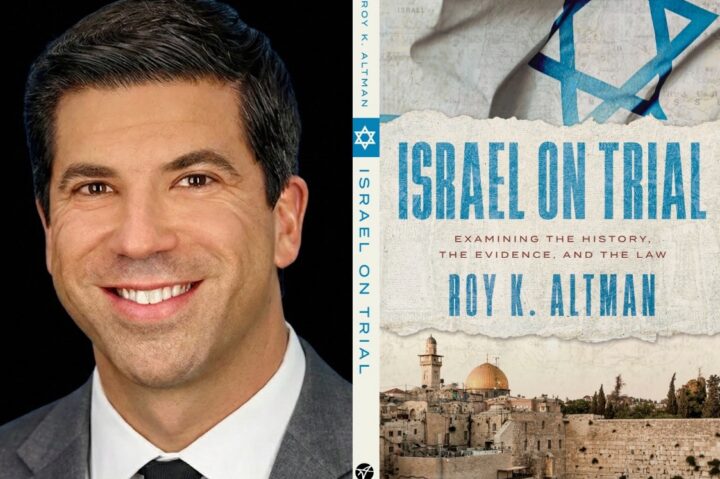
Altman, a Venezuelan-born Jewish jurist, decided to apply the same legal methodology that judges, lawyers and juries have deployed in courtrooms for centuries to address legal accusations being wielded against Israel
Courtesy
U.S. District Judge for the Southern District of Florida Roy Altman/book cover
While TikTok and X algorithms make it harder than ever for Americans to distinguish fact from fiction, a courtroom setting changes everything. Summoned to the jury box, citizens are “given the tools they need as human beings to be able to assess questions properly,” U.S. District Judge for the Southern District of Florida Roy Altman told Jewish Insider.
Altman, a Venezuelan-born Jewish jurist, decided to apply the same legal methodology that judges, lawyers and juries have deployed in courtrooms across America for centuries to address six legal accusations being wielded against Israel by its detractors.
Those include claims that Israel’s founding was illegitimate or aberrational; that Israel has prevented the establishment of a Palestinian state; that Jews are colonists in the land of Israel; that Israel was occupying Gaza (and had turned Gaza into an open-air prison or a concentration camp) before the Oct. 7, 2023, terrorist attacks; and that the Jewish state has committed genocide and apartheid.
Altman explores each of those claims in a new book called Israel On Trial: Examining the History, the Evidence and the Law, released on Tuesday. Each of those claims about the State of Israel, which the book describes as “compelling — almost intoxicating” arguments, gets its own chapter, which reads like a legal brief that is written for a lay audience. Each culminates with a conclusion, grounded in the law.
Altman sat down with JI, just ahead of the book’s release, to make the case for examining Israel through a legal lens.
This interview has been condensed and edited for clarity.
Jewish Insider: How does making the case for Israel using courtroom standards and the rules of evidence differ from the way traditional advocates for Israel — political activists, Jewish organizational professionals, politicians, etc. — make their case?
Roy Altman: Each of these claims is at their core a legal claim that requires legal analysis just like any contested legal claim in any courtroom across America. So I thought to myself, why not just apply the same legal methodology that judges, lawyers and juries have been applying in every courtroom and law office around this country for 250 years, a time tested methodology that we know we trust because we use it when truth telling matters most in our courtrooms?
Legal questions allow us to pair back the vitriol, emotion, bias and prejudice. That’s what we do with jurors every day in this country. For hundreds of thousands of years, human beings have been accustomed to living in small groups. It was really important in the context of that environment to tell the truth and for the group as a whole to be able to decide whether the person was telling the truth. We did that by using three basic tools. [First,] deciding things as a group, which is helpful because one person might have a bias or prejudice, but when everyone is together those biases are thinned out. Second, we did it face to face. Third, we did it one issue at a time. Using those three techniques over hundreds of thousands of years we developed some time-tested rules for deciding whether something was credible.
What happens in our courtrooms is we tap into those hundreds of thousands of years of human evolution. We bring people who at home, all the data shows, are really bad at discerning truth on their TikTok feed. That’s because they violate all of the techniques that we use: they do it alone, over a screen with an overwhelming tidal wave of information at a time that your brain isn’t equipped to handle.
In the jury box, we take 12 people who individually are really bad at discerning truth from fiction on their phones, and we sit them together and revert them in historical evolutionary time. We tell them they are going to make the most momentous decisions in our society, all together, face to face looking at the witnesses. And [they’re dealing with] one issue at a time.
The judge and the lawyers give the jury that methodology, the truth guide called jury instructions, which are just a set of rules for assessing the credibility of people and the reliability of evidence that have been tested [based on] those three techniques. Those people are not biologically or psychologically different than they were when they couldn’t tell truth from fiction on their phone. But when they get together as a group, I am constantly astonished by the extent to which we give them extremely complicated work — patent cases, antitrust cases — and they get the answers completely right. It’s not because they’re smarter. It’s because they are being given the tools they need as human beings to be able to assess questions properly.
These questions about Israel should be assessed properly, just like the questions in our courtrooms.
JI: What is your religious and cultural background with respect to Israel?
RA: My father was in the Israeli Air Force. He went to Israel when he was 18 from Venezuela. My mother went to Israel when she was 17 from Colombia. Her father had a wife and five children in Poland, my mother’s half-brothers and sisters, all killed in the gas chambers at Auschwitz. So my parents met and married in Israel and then moved to Venezuela where I was born. We moved to America when I was a kid. We grew up going to Israel in the summertime. It’s a very special and inspiring place.
I’m a religious person, a man of faith. We have dinner at the house every Friday night. I went to Jewish day school, my kids went to Jewish day school, my dad went to Jewish day school, so it’s a deep part of our identity.
JI: You began leading trips to Israel for federal judges in the wake of Oct. 7. Why do you organize these missions and what impacts have you seen from these trips?
RA: One of the things we learned is that our judges are inspired by the resilience of the Israeli people. People who are willing to stand up and defend western values … willing to do that with love for one another and optimism about their future.
The judges have come back and seen what the truth on the ground is. So many of these judges are not Jewish and have never been to Israel before. They go around their own states when they come back presenting to law clerks and friends.
Federal judges across America are not perceived as being political, we’re neutral arbiters of contested claims. So when federal judges come back from any scenario and say this is what it’s like, people tend to listen.
JI: Who are some of your mentors and role models among prominent lawyers and judges who have been strong American Zionists?
RA: The judge I clerked for, Judge Stanley Marcus, taught me that the American legal tradition really harkens back not to the English common law system, but the ancient Jewish tradition under the law.
We allow decisions to percolate through common law jurisprudence over many decades and centuries from people from different walks of life and diverse backgrounds making these decisions. When you’re a lawyer you can look to this body of law. We don’t say ‘this is the right answer,’ ‘that’s the wrong answer,’ we say, ‘Here are what the different scholars say, you pick the answer that’s right for you.’ That sounds just like the Talmud. That’s also foundational to the character of America … and the Israeli mindset.
Foundationally, philosophically, morally, Israel and America are two places where traditionally human beings are given the most important choices in their civil society, precisely because their governments trust them enough to make the right choices, because their populations are infused with this character of virtue.
JI: AI is being increasingly used by judges to help them sift through massive amounts of evidence and trial testimony and even help with crafting decisions. Can AI play a similar role in helping to defeat misinformation about Israel, especially on social media?
RA: I think so, but AI cuts both ways. To the extent that AI is valuable, it’s only as valuable as the inputs that are placed into it. To the extent that you’ve got millions of pieces of information that are false on the internet, all of those pieces of information are fed into the box that produces the knowledge base foundational to how large language models work. So we need to be careful about the things we put in because those will be outputs through AI on the backend.
People are no longer capable — because they’re no longer scrutinizing the information being provided to them the way a juror would — and because the fake information is being provided in such a realistic way, to discern what is true from what isn’t.
JI: Is a well-reasoned legal brief any match for posts on TikTok, X or the internet that are used by many young people as their main source of information?
RA: Standing on its own, absolutely not. The question isn’t whether one book can counteract the millions of pieces of false information being relayed every day. The question is whether we can revert our people to a place where they care about making choices in the right way. It’s not so important where you get your information as long as you’re scrutinizing the incentive structure of the people providing it to you.
We need to teach people, including our youngest people, the mechanisms and methodologies that we have used — corroboration, reliability and credibility — that we’ve been using for thousands of years in order to discern truth from fiction in an age of information warfare.
We’re not saying you shouldn’t use your phone or AI. The question is when you consume information through those media, whether you should be using the same time-tested reliability mechanisms we’ve been using for thousands of years. Those mechanisms are there for a reason. We know they work irrespective of where you get your information.
Please log in if you already have a subscription, or subscribe to access the latest updates.
 Continue with Google

 Continue with Apple