














































































Assistant Attorney General Harmeet Dhillon warned last week that countries participating in boycotts of Israel could face U.S. retaliation
Andrew Harnik/Getty Images
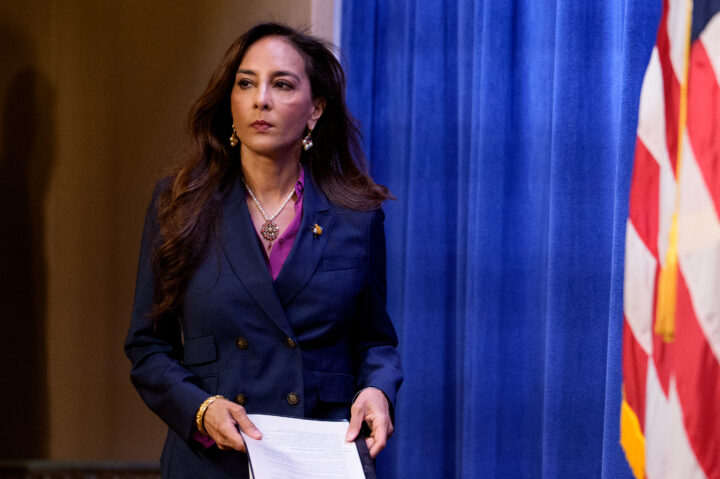
Assistant Attorney General for Civil Rights Harmeet Dhillon arrives for a news conference at the Justice Department on September 29, 2025 in Washington, DC.


 Add JewishInsider on Google
The assistant attorney general for civil rights, Harmeet Dhillon, warned last week that countries participating in boycotts of Israel could face U.S. retaliation, raising the prospect of sanctions against Britain and other European governments.
But Washington still has yet to clarify its policy, and it remains unclear whether the Trump administration plans to move forward with retaliatory measures.
Speaking in Washington last week, Dhillon sharply criticized the measures taken by European countries, describing the actions as involvement in BDS and a form of antisemitism. European officials, however, have argued that the sanctions are different from the BDS movement.
“What we call this in the United States is the BDS movement. It is antisemitism,” Dhillon said while speaking in D.C. on Oct. 6. “And I think every country that is doing that is going to risk, while President Trump is in power, retaliatory or corresponding sanctions potentially.”
One Republican congressional source told Jewish Insider that Treasury Department and Commerce Department officials had told their office that the departments were prepared to add those countries that announced sanctions targeting Israeli settlements last month to the Treasury’s international boycott list, but the State Department was refusing to grant the clearance necessary to do so.
Reached for comment, a State Department spokesperson told JI: “We are not going to comment on internal deliberations speculated on by an anonymous source.”
The U.K. announced an import ban on settlement goods and sanctions on related entities on Sept. 9.
The Netherlands introduced stricter measures on Sept. 22, including penalties of up to six years in prison for violations. Israel responded by revoking the diplomatic credentials of Dutch envoys in Ramallah.
France, Canada and other countries have also enacted or pledged similar restrictions involving the West Bank, east Jerusalem and the Golan Heights. The measures have drawn condemnation in Israel. U.S. Ambassador to Israel Mike Huckabee has warned that Britain could face economic repercussions.
Secretary of State Marco Rubio had previously indicated that the U.S. would not join the sanctions. Republicans in Congress have also told JI they oppose them. Before Dhillon’s remarks, the administration had not publicly condemned the measures.
A former U.S. administration official, speaking on background, confirmed the sanctions are not yet “settled administration policy” and noted that Dhillon’s comments could be strategic.
“Dhillon’s comment does not necessarily reflect settled administration policy. A decision to impose such sanctions would need consideration by Treasury, State, USTR, and above all the President; it’s not a DOJ decision,” the former official said. “It may reflect a decision to sanction the UK, or a warning shot meant to deter others from following the UK, or her view but not a final policy decision.”
The distinction between the European measures and the broader BDS movement could also become significant as the administration determines how to respond. European governments have presented their restrictions as measures targeting Israeli settlements rather than participation in the broader BDS campaign against Israel.
Jonathan Ruhe, a fellow at the Jewish Institute for National Security of America, said the uncertainty comes against a complicated history of U.S. policy toward Israeli settlements and BDS.
“Israeli settlements have always existed in a gray area when it comes to U.S. opposition to BDS. President Obama excepted West Bank settlements from his enforcement of anti-BDS laws, and Biden sanctioned certain settler activities while officially opposing BDS.”
He said that ambiguity appears to have carried into the Trump administration as tensions between Israel and European governments over settlement policy have increased.
“This gray area now seems to be carrying over to the Trump administration, where coherent and consistent policymaking has never been a strong suit, precisely as the West Bank and U.S.-European ties become particularly tense more generally,” Ruhe said.
Ruhe also pointed to the administration’s previous responses to European actions targeting Israel as a possible indication of how Washington could respond to the latest measures.
“Though Amb. Huckabee repeatedly called settler violence ‘acts of terror’ and ‘criminal activity’ over the summer, Europe’s latest threats follow a pattern where the administration jumps at the opportunity to retaliate for sanctions, embargoes, and arrest warrants aimed at Israel from Europe,” Ruhe said.
Jason Greenblatt, who served as White House Middle East envoy in the first Trump administration, did not clarify whether he expects the policy to be officially implemented, however he noted that he would “strongly support such a policy.”
“Countries that do that should understand there can be consequences, even if they are long standing friends of the United States,” Greenblatt said. “When governments turn the BDS movement’s anti-Israel agenda and antisemitic ideology into policy, the United States has every reason to respond.”
Greenblatt further argued that just because certain countries are U.S. allies, it should not shield them from consequences when acting against Washington’s interests.
“Ambassador Huckabee publicly warned of consequences before Britain announced these measures last month, and Britain proceeded anyway,” he continued. “Friendship and history should not provide immunity when a government acts against U.S. interests and principles, and against one of our closest and most important allies.”
Sen. Josh Hawley: ‘The European states have been anti-Israel forever, and I just think this is the latest iteration of that’

Amir Levy/Getty Images
A view over the Jewish settlement of Kedumim in the West Bank on Sept. 8, 2026 in Kedumim, West Bank.
Republican lawmakers are speaking up against recent moves by European countries to impose new sanctions and trade restrictions on Israeli settlements in the West Bank, east Jerusalem and the Golan Heights.
The latest restrictions took effect in the Netherlands on Sept. 22, when the country began barring goods obtained or produced wholly or partly in Israeli settlements from entering the country, including products carried by private travelers. Violations can carry a maximum sentence of six years in prison. Israel has since revoked the diplomatic status of Dutch diplomats serving in Ramallah.
On Sept. 9, the United Kingdom announced that it would ban imports produced in Israeli settlements in the West Bank and impose sanctions on companies and individuals involved in settlement construction, financing and related services, while also prohibiting the advertising of settlement properties and goods. France, Canada and other European countries have also committed to — or have already implemented — restrictions involving goods from Israeli settlements, the West Bank, East Jerusalem and the Golan Heights.
Sen. Rick Scott (R-FL) told Jewish Insider he was “disappointed” by the European measures and argued that Israel should be receiving greater support from those governments.
“First off, I’m disappointed. We ought to be supporting the only democracy in the Middle East, somebody that is part of making sure Europe is safe because Iran doesn’t have a nuclear weapon,” Scott said. “I think they ought to be thanking Israel rather than targeting them.”
Asked whether the Trump administration should respond to the European measures, Scott said he believes the White House is already working to address them.
“I think they are, they’re working hard,” he said.
Sen. Josh Hawley (R-MO) likewise criticized the sanctions, arguing that they represent another effort by European governments to pressure Israel over its settlement policy.
“That sounds anti-Israel to me. I don’t support it. I think that’s a bad deal,” Hawley said. “The European states have been anti-Israel forever, and I just think this is the latest iteration of that. It sounds a lot like the BDS movement just sort of laundered now into a different form. So no, I don’t like that at all.”
Hawley also said he expects the Trump administration to retaliate in some form against the European measures, pointing to the president’s previous statements on the issue.
“Well, I assume they will. The president has been very vocal about this, so I hope we’ll continue [to be],” Hawley said.
Rep. Claudia Tenney (R-NY) focused specifically on reports that Dutch customs officials had inspected the luggage of passengers arriving from Israel, calling the reported searches “intrusive” and “unconscionable.”
“The new Dutch BDS law forces Americans and American companies to undergo intrusive searches and prove that they do not possess any goods from Jerusalem or Judea and Samaria,” Tenney wrote on social media. “This is absolutely unconscionable and @USTreasury should IMMEDIATELY add the Netherlands to the list of countries requiring cooperation with a boycott under Section 999 of the Internal Revenue Code.”
Reports provided indicate that passengers were not searched writ large and that some goods were confiscated during routine customs searches.
Scott acknowledged the possibility that Democrats could pursue similar policies in the U.S. if they regain control of Congress. JI has previously reported that should Democrats retake one or both chambers, they could bring up legislation targeting Israeli settlement activity and settler violence.
“Democrats don’t support Israel. They don’t. They don’t fight antisemitism. If you care about stopping hatred in this country, you’re clearly not going to vote for a Democrat,” Scott said.
Several Democratic lawmakers said they were not yet familiar with the European measures and declined to comment.
Sen. Chris Coons (D-DE), the sponsor of legislation targeting companies and Israeli officials involved in settlement construction in the E1 area of the West Bank, drew a distinction between the European restrictions and his bill.
“Look, I think there’s a lot of concern here about settlement expansion and how to send a strong signal to discourage significant settlement expansion, particularly the E1 block,” Coons said. “I recognize that is distinct from some position blocking exports from settlements. I do think after our elections and the Israeli elections, there’s going to be some serious conversations about our long-term relationship and how to ensure that the West Bank continues to be a place in which there may be a viable future for a Palestinian territory.”
Please log in if you already have a subscription, or subscribe to access the latest updates.
 Continue with Google

 Continue with Apple