













































































Democrats say the administration has no clear endgame in its standoff with Tehran, while Republicans maintain the pressure campaign is working
Aaron Schwartz / AFP via Getty Images
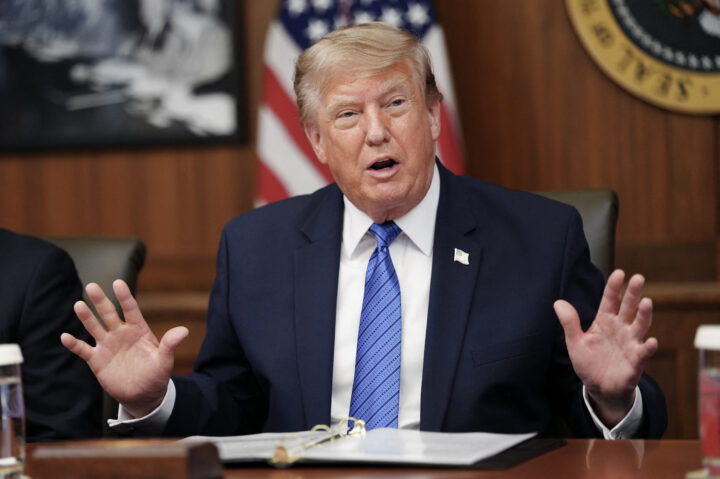
US President Donald Trump speaks during a Cabinet meeting at Camp David in Maryland, on July 31, 2026.


 Add JewishInsider on Google
More than six months into the conflict between the United States and Iran, House lawmakers remain split largely along partisan lines on whether the Trump administration’s strategy of targeted economic pressure and naval blockades is helping Washington gain a strategic edge in the conflict.
While the administration recently has said its focus remains on carrying out a new economic campaign against the regime, recent military flare-ups between the two sides threaten to drag the conflict back into broader hostilities. On Tuesday, the U.S. resumed strikes on Islamic Revolutionary Guard Corps targets in Iran, CETNCOM announced, following Iran’s weekend attacks on American forces in the region and two Iranian strikes on oil tankers in the Strait of Hormuz on Monday.
President Donald Trump vowed that any response would be met with further confrontation, shortly before Iran launched retaliatory strikes on U.S. bases across the region.
House Armed Services Committee Chairman Rep. Mike Rogers (R-AL) warned that lawmakers “can expect intensification” of U.S. strikes. Rogers was briefed Tuesday by CENTCOM commander Adm. Brad Cooper alongside Democrats on the committee.
When asked by Jewish Insider whether the administration’s strategy is working and whether the U.S. or Iran holds more leverage at this moment in the conflict, lawmakers were divided.
Rep. Greg Landsman (D-OH) said it is “very difficult to know” which side holds the advantage, arguing that the White House has failed to outline a clear end goal. He added that as long as Tehran threatens shipping in the Strait of Hormuz, “there is leverage there” in Iran’s favor.
“I have made the case that taking out the weapons shield was one thing — getting in the middle of a standoff in the strait is something else and could have been avoided,” Landsman said. “Pursuing an all-out regime change undertaking, as opposed to simply going in and getting out, to me is a huge gamble and one I wouldn’t have taken. I would have stayed focused on the incremental things you can do to further weaken the regime until change materializes, as opposed to forcing it like they’re trying to do with the blockade.”
Landsman added that lawmakers on both sides of the aisle remain largely in the dark regarding the administration’s strategy.
“One, there’s no briefings, there are no hearings, there’s no engagement — and I think that’s true for Republicans as well as Democrats, which is a huge problem,” Landsman said. “Two, based on everything I’ve read, there’s no clear strategy. I don’t know what the end goal is. Is it to topple the regime? If it’s not to topple the regime, what is it? Is it to regain the strait?”
Rep. Gregory Meeks (D-NY), the ranking member of the House Foreign Affairs Committee, told JI that the recent escalation between the two sides shows the administration’s strategy is not working.
“We still don’t have a plan. Everything that [President Donald Trump] ever said in regards to this war has all gone wrong,” Meeks said.
Meeks argued that preventing a nuclear-armed Iran requires diplomatic engagement rather than isolated military or economic actions.
“If you want to stop Iran from having a nuclear weapon and move forward, then you have to do it diplomatically. You need to be able to bring — as we did with the [2015 Iran nuclear deal] — China to the table, Russia to the table, our European allies to the table,” Meeks said. “All of the experts that know how to deal with diplomacy, none of them are doing it. Not even [Secretary of State Marco] Rubio is part of those negotiations. You have two real-estate developers [White House Special Envoy Steve Witkoff and Jared Kushner] doing that kind of negotiations, and none of it is successful because none of it makes any sense.”
Rep. Brad Schneider (D-IL) similarly expressed that he felt the administration lacked a clear strategy and criticized the economic pressure campaign as not fully thought through.
“I think most of the world saw the goals as ending their nuclear program, thwarting their development of missiles, rockets, drones, addressing their support for terrorism in the region and around the world and supporting its citizens, the people of Iran, against human rights violations of this terrorist regime,” Schneider said. “None of those seem to have been fully addressed.”
Schneider said that the closure of the Strait of Hormuz has given Tehran “leverage over the global economy” and claimed that the administration’s economic pressure campaign is not being applied to “countries that are doing economic trading with Iran.”
“Last week [Treasury Secretary Scott] Bessent said we’re going back to maximum economic pressure without mentioning China that provides Iran 90% of their revenues from their oil production,” Schneider said. “That’s not pressure if you’re not putting your finger on the pressure point.”
“Iran holds cards that the administration either doesn’t recognize or doesn’t know how to address, and we need to figure out how to apply the pressure on Iran and return all the leverage back to the United States,” he continued.
Rep. Brad Sherman (D-CA) said that the administration has appeared to regain “very little” leverage through its economic pressure strategy and questioned the long-term efficacy of the plan.
“We’ve been imposing sanctions on [Iran] for decades. Presumably these tougher sanctions could work in less than a decade, but I think Trump’s time horizon is remarkably short, so I can’t imagine that they would work anywhere near the timeframe he’s thinking about,” Sherman said. “I suspect that the Iranians have a higher tolerance for pain because the extremists running the country don’t care about whether their people are doing well as long as they can shoot those who are upset.”
Republicans, however, contended that the administration’s strategy is working.
Rep. Tim Burchett (R-TN) argued that the U.S. holds more leverage in the conflict, noting that gaining a strategic edge is Trump’s “strong point.” The Tennessee lawmaker said the current posture is “accomplishing its goals” by neutralizing regional security threats.
“We’re keeping nuclear weapons out of the hands of Islamic radicals. I think that’s a great thing,” Burchett said. “I think ultimately that’s the overall goal. I think [Iran] were rapidly approaching the ability to use those.”
Rep. Randy Fine (R-FL) expressed an even more optimistic note. “I think we’ve always had leverage,” Fine said. “I think we’ve been winning all along.”
Fine pointed to Iran’s worsening economic situation as evidence that the administration’s approach is delivering results.
“Breaking them economically is a winner and that’s what’s happening. I think their economy is in free fall and hopefully that brings them to their knees, which is where we all want this thing to end up,” Fine said. “First we destroyed their military — they don’t have a military anymore — and now we’re destroying their economy.”
Former Secretary of Defense Mark Esper, joining Rice at the Aspen Security Forum, said the U.S. was right to launch the war but may have overestimated or overstated its own capabilities
(Roberto Schmidt/Getty Images)
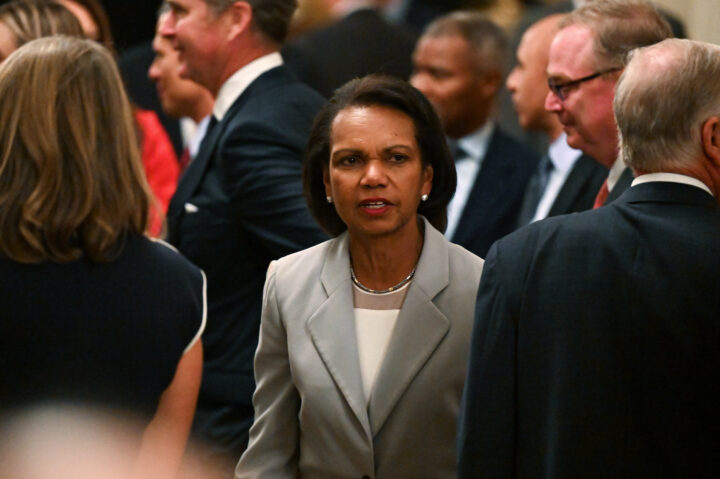
Former U.S. Secretary of State Condoleezza Rice attends the swearing-in ceremony for Chairman of the Federal Reserve Kevin Warsh in the East Room of the White House on May 22, 2026 in Washington, DC.
ASPEN, Colo. — Former Secretary of State Condoleezza Rice on Tuesday opposed any nuclear deal with Iran, arguing at the Aspen Security Forum that the U.S. should continue pressure on Iran’s economy and “see what happens.”
Meanwhile, former Secretary of Defense Mark Esper speaking alongside Rice on a panel, suggested that the U.S. had potentially overestimated its capabilities in the war, agreeing that continued economic pressure and a renewed blockade would be the best strategies going forward.
The two, speaking at the Aspen Security Forum, also offered strong criticisms of U.S. allies for not joining with and at times attempting to obstruct the U.S. campaign against Iran.
“I would not buy a nuclear agreement [with Iran] under any circumstances. I’d let them sit there and stew in their lousy economy, where most of their A-level nuclear scientists have been killed, where I believe there are deep splits in the Iranian government … and let’s just see what happens,” Rice said. “I wouldn’t give them a penny back, and let’s just see what happens to that economy over time.”
Rice said that she believes the U.S. did do significant damage to Iran’s nuclear program and that she’s “quite confident” that the country is not in a position to produce a nuclear weapon in the near future.
Mark Esper, who served during President Donald Trump’s first term, said that the U.S. war on Iran was a “a good thing to do to show the seriousness of of how we felt about this and our willingness to commit force to do that” but added, “we can discuss whether our reach exceeded our grasp, and some of the language used about unconditional surrender, et cetera, pushed them into a corner”
He said that a success in the war would require a return to the status quo in the Strait of Hormuz and a deal on Iran’s nuclear program superior to the 2015 Joint Comprehensive Plan of Action.
Esper argued that there would be no way to bring such a result solely through airstrikes, and that the primary path forward should be renewed economic pressure on Iran, including a renewed blockade targeting Iran’s ports and land and air routes. He said the U.S. should continue to respond to Iranian attacks with strikes on its missile and drone capabilities.
Esper said that strategy will take time, patience, discipline and the support of allies and come at the cost of higher gas prices. He said the end goal should not be to collapse the Iranian regime but to bring Iran back to the negotiating table.
“That approach, barring — I’m open to any better one — gives you the highest return with the lowest risk to where we don’t want to go,” Esper said.
Former Secretary of Commerce Penny Pritzker, who also spoke on the panel, emphasized that economic pressure is a useful tool, which can be effective but takes time, will and coordination, without which there are ways to evade sanctions.
“I’m hopeful that with all this pressure, that something rational can come of this, because we’re not in a good place right now, obviously,” Pritzker said.
Rice and Esper both expressed frustration with U.S. allies’ refusal to cooperate with the U.S. operations and, particularly, European allies’ decisions to block the U.S. from using their bases in their countries in the course of those operations — a move Esper called “really stupid.”
Rice said it was “really not a very smart thing” for allies to dismiss the conflict as not “our war.”
She said would have “preferred” if the U.S. had worked more closely with its allies before the operation, but acknowledged that actually getting them onboard would have been questionable, pointing to her own experience trying to bring allies onboard with the Iraq invasion during the Bush administration.
Sometimes, she said, “the United States has to do something really hard, like really deal with a bad guy who’s been a bad guy for a long time,” she said, emphasizing that the sophistication and range of Iran’s missile program was increasing and it was preparing to make a major agreement with Russia on missiles. “When the time comes, if it’s your ally and your friend, even if you’re not going to join, you don’t try to harm the effort,” she said.
“When I hear, ‘Well, it wasn’t imminent,’ I think, ‘Do you really want to wait until it’s imminent, or do you want to try to degrade it earlier?’” she continued.
Both Esper and Rice warned that, through their actions around the Iran war and comments denigrating the U.S.’ reliability as an ally, or declaring that they will handle their own defense without American assistance, allies are only playing into the hands of those who want to see those alliances collapse.
“You may speak into existence exactly what you need to avoid, because there are some people inside the American political system, on both sides of the aisle, who would be perfectly happy to withdraw from the world, and you don’t want to help empower those people,” Rice warned.
Joel Rayburn, a former Trump admin nominee, said the U.S. should carry out a sustained ‘campaign’ of pressure
Matthew Shea
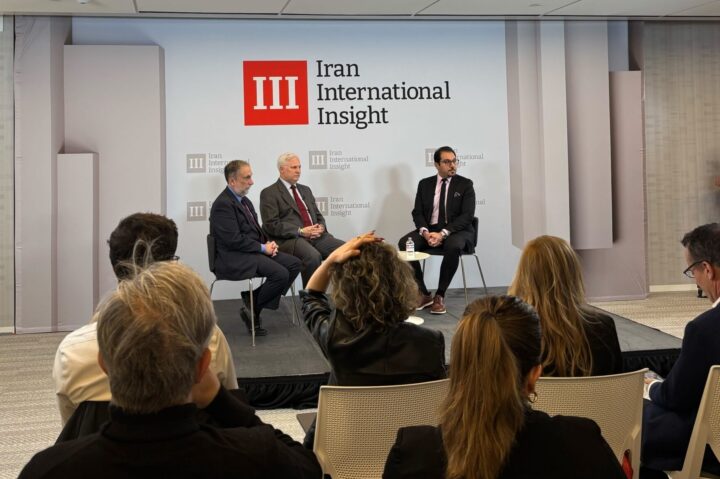
Iran International event, Jan 14th. 2025
Middle East policy experts argued on Wednesday that the United States should actively intervene in Iran’s unrest — including through cyber measures, economic pressure and potentially military strikes — amid the regime’s crackdown on nationwide protests. The comments were made during a program hosted by Iran International, one of the largest independent Persian-language news outlets in the world.
President Donald Trump has for days issued repeated warnings to the regime that the U.S. is “watching closely” and that Iran would “pay hell” for killing protesters. On Wednesday afternoon, however, the president said he had been notified that the “killing in Iran is stopping” and that Iran would not be conducting executions of protesters, as was expected, and downplayed the severity of protester deaths.
“The first thing I would recommend is that we use our very impressive capabilities to shut down the communication system for the government,” said Robert Satloff, executive director of The Washington Institute for Near East Policy, speaking of a potential retaliation for the regime’s decision to cut internet access to the public. “This will be a huge step.”
Satloff said if that did not work, he would then support subsequent U.S. strikes on Iranian military infrastructure.
“If that first act does not bring about a substantial change in Iranian behavior, then I would target very specifically the barracks and the facilities of the IRGC [Iranian Revolutionary Guard Corps],” said Satloff.
Joel Rayburn, a senior fellow at the Hudson Institute and a former diplomat in the Middle East, argued that any U.S. intervention in Iran should not be a “one-off military strike,” but rather a sustained “campaign” of economic and political pressure.
Rayburn was tapped by the White House to be assistant secretary of state for Near Eastern affairs in February 2025, however, his nomination was ultimately pulled last October.
“We have to use all of the tools at our disposal,” Rayburn said Wednesday. “There’s no reason not to be fully implementing maximum pressure to pressure the Iranian regime in order to change its behavior.”
Responding to questions about whether a weak Iranian regime — in the midst of dire economic and political challenges — can survive the protests, Rayburn suggested it is bound to fall, stating that there will be a “day after this Khamenei regime,” referring to Iran’s supreme leader, and that he believes that day will come “sooner rather than later.”
“The Iranian regime is going to collapse at some point in the not-too-distant future,” said Rayburn. “[It] can no longer function as a state. The last function they can perform is to use violence against their own people. That means they are not a sustainable regime.”
Tehran has threatened to respond to any military action with retaliation against the U.S. and Israel. Satloff said the fall of the regime would be “an enormous strategic gain for Israel,” but noted that Jerusalem is “playing it quiet.”
“The Israelis have made at least the tactical decision, that since Donald Trump has been out front, that Donald Trump has drawn a line in the sand, let Donald Trump be the key actor right now,” said Satloff. “There is no comparative advantage for Israel to be out in front in any military fashion. Let the United States play this role, the president seems to have embraced it.”
He also cast doubt on the likelihood that Tehran would strike Israel in response to U.S. action. Reports have indicated that Iran and Israel have conveyed reassurances through Russian intermediaries that neither side intends to carry out a preemptive strike.
“If the Iranians make the mistake of retaliating against Israel or Israeli assets, or Jewish assets around the world, there will be a very high price to pay,” said Satloff.
Analysts also weighed in on reports that Gulf allies have been lobbying the Trump administration to refrain from striking or intervening in Iran, warning that a U.S. intervention could be ineffective and expose them to retaliation. While the analysts acknowledged those concerns, they argued that regional governments would ultimately like to see the regime fall.
“I don’t think there are any major frontline countries in the Gulf region that believe that the Iranian regime is a regime that they can live with indefinitely,” said Rayburn. “We have not seen real restraint from the Arab capitals to either U.S. or Israeli pressure against the Iranian regime. All of those capitals would be better off without the regime.”
Regardless of whether the U.S. intervenes, Satloff emphasized that any outcome is “ultimately an Iranian process and an Iranian decision.”
“This will be their [the Iranian people’s] revolution, if it happens,” said Satloff. “It will not be something that we trigger or engineer, but to help them to be able to assert their own wishes and desires for the future.”
Please log in if you already have a subscription, or subscribe to access the latest updates.
 Continue with Google

 Continue with Apple