


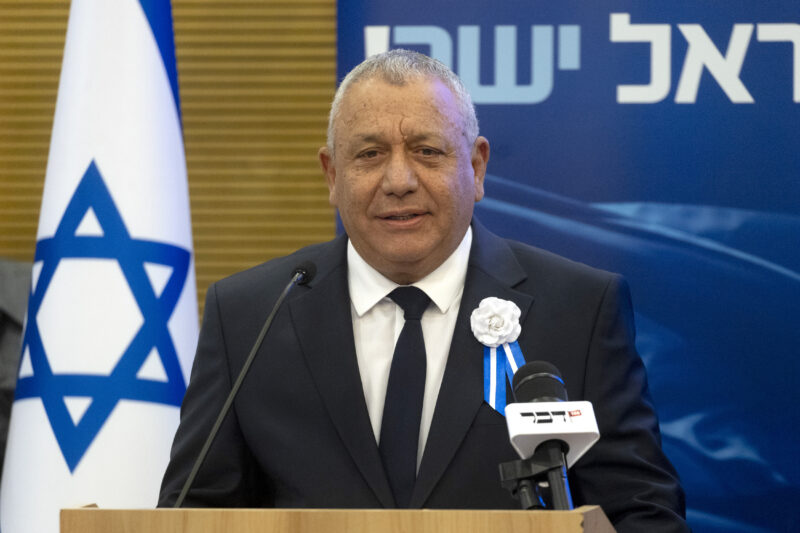







































































In an interview with JI, Hood reflected on a career included stints working on Iran policy, relations with Gulf states during the fraught Arab Spring and antisemitism policy in the tense aftermath of the Oct. 7 Hamas attacks in 2023
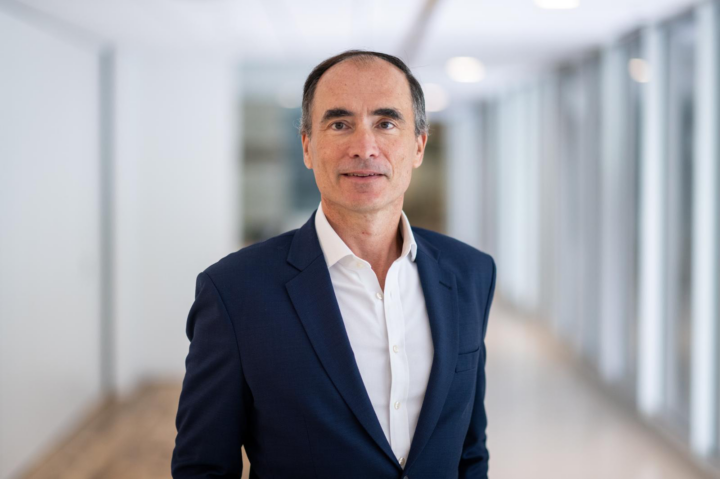
Courtesy
Ludo Hood


 Add JewishInsider on Google
After a career in the foreign service, where officers are obliged to keep their political views to themselves and promote the positions of the current U.S. administration, some retiring diplomats have a hard time getting used to speaking their minds, particularly when the press is involved.
Ludo Hood is not one of those people.
The 53-year-old retired from the U.S. Foreign Service last week after two decades of service, a career that took him to Kuwait, Bahrain, France and Qatar. Most recently, he served as a senior advisor to Keith Kellogg, President Donald Trump’s former special envoy for Ukraine, and before that as a close advisor to Deborah Lipstadt, the former U.S. special envoy to monitor and combat antisemitism — two roles that put him in the crossfire of some of the biggest political debates in Washington.
Hood, who is preparing to take on a role at a think tank, sat down with Jewish Insider this week to reflect on a career representing the U.S. that included stints working on Iran policy during negotiations for the 2015 nuclear deal, relations with Gulf states during the fraught Arab Spring and antisemitism policy in the tense aftermath of the Oct. 7 Hamas attacks in 2023.
Through all those foreign postings and geopolitical flashpoints, one of the most “alarming and shocking” moments of Hood’s time as a foreign service officer came within the halls of Foggy Bottom — when, in the months after Oct. 7, the State Department hosted listening sessions for staffers to express anti-Israel views and bash the policies espoused by the federal government.
“It was the only time in my career where active dissent against the elected president’s overall policy and strategic direction was allowed to be aired in the open, and was actually in many ways encouraged,” Hood told JI.
The gatherings were hosted by then-Deputy Secretary of State Kurt Campbell, and they came as some rank-and-file diplomats, plus many political appointees from the Biden administration, voiced dissent against President Joe Biden’s support for Israel.
“In terms of being politically correct, you had to give a lot of deference to a heavy anti-Israel point of view, which maybe is fine in the context of a social studies program at a university,” Hood said. “But it’s the State Department. We are national security professionals who are supposed to be implementing the policy of the duly elected president.”
Hood compared that moment to the sentiment among some foreign service officers who have struggled to represent the U.S. under Trump. Hood acknowledged that some diplomats do not agree with Trump’s approach to foreign policy, but said that they should not express that view publicly as part of their job — and that Trump would not stand for so much public expression of dissent.
“There was and perhaps remains opposition to the way that Trump does and says certain things in the State Department,” said Hood. “The difference here is the Trump people, either under [former Secretary of State Mike] Pompeo or now, would never tolerate unprofessional behavior, and it is unprofessional.”
“Obviously, you’re allowed to have your own personal points of view,” Hood continued. “But if you’re going to sign up to do this work, you ought to be reasonable.”
That doesn’t mean he always agreed with the positions that he was meant to promote as a diplomat. During the Biden administration, Hood took issue with the White House’s policy that nearly anytime antisemitism was mentioned, it had to be coupled with a mention of Islamophobia, a policy that Hood called “illogical and irrational.” (Lipstadt, his former boss, has called for antisemitism and Islamophobia to be discussed as distinct forms of hate.)
“It was official policy at the Biden White House in terms of how they named task forces and so forth,” said Hood. “We had to accept the horrendously problematic addition of ‘counter-Islamophobia efforts’ into what we were doing or what we were commemorating. I say ‘horrendously problematic’ because it undermines the fight against Muslim hatred or other forms of religious hatred to start conflating them for politicized reasons that have nothing to do with the actual strategies needed to curb that kind of discrimination.”
Even before Oct. 7, Hood said, getting certain State Department diplomats to include antisemitism in meetings with foreign leaders could be challenging.
“It could be painfully difficult to say and do certain things because of an institutional reluctance to highlight antisemitism,” Hood said, particularly in Europe.
When Trump was inaugurated early last year, Hood transitioned to the Ukraine file, the first time in his career when his portfolio did not include the Middle East.
He was more sympathetic to the plight of Ukraine than many members of the incoming Trump administration, which he said was more amenable to appeasing Russian President Vladimir Putin and less interested in continuing to spend billions on Ukraine’s defense. Kellogg, the Ukraine envoy, was also more supportive of Kyiv than Trump, leading to some of his portfolio being taken over by White House Special Envoy Steve Witkoff. Kellogg ultimately stepped down in January.
“It was frustrating to see how that played out, partly because the guy is a decent, honorable man who probably could have been treated better by some people operating in the White House and elsewhere,” said Hood. “Perhaps more relevantly, more substantively, I think Kellogg had a view on the Russian invasion of Ukraine, which, from where I stood, reflected reality and reflected how we should be approaching the conflict.”
On the other side of the Ukraine issue was the increasingly influential isolationist right. Hood called the ongoing intra-Republican feud about foreign policy “a profoundly important debate,” even as he came down hard against the isolationist wing.
“I think there’s very easy arguments to be had to push back on isolationism and restrainers,” said Hood. “I think those of us who want an assertive America aren’t asking for forever wars, aren’t asking to invade in the name of democracy. I think there are ways of putting America first on the global stage without deploying what has now become known as neocon objectives, basically democracy promotion.”
It’s fair to say Hood is aligned with the more traditional, interventionist wing of the Republican Party; he recently joined the Hudson Institute, a pro-Israel think tank closely aligned with several former top Bush administration officials. He said that over his two decades in diplomacy, his central views about the world and foreign policy have not changed. But he said he has come to hold a more realpolitik view of the world that is less Pollyannaish about democracy as a strategic objective.
“I think maybe democracy promotion, or even having a heavy focus on human rights, is probably at best naive, if not a lost cause, in some parts of the world,” said Hood. “We shouldn’t necessarily allow those issues to always get in the way of a bilateral strategic partnership that is broadly speaking good for stability and prosperity for that country or for that region.”
Hood is leaving the foreign service at a time when the institution’s future is in question. More than 1,300 State Department staffers — including many foreign service officers — were laid off last summer. The American Foreign Service Association, the union representing foreign service officers, called it “a catastrophic blow to our national interests.”
Hood called Trump’s “top-down approach,” where he leans heavily on personal advisors like Witkoff and Jared Kushner, “understandable in some respects.” He is not instinctually opposed to the cuts and thinks some were necessary.
“We needed a lot of disruption in the national security establishment. There’s still so much bloat to be cut,” said Hood. But, speaking diplomatically, Hood tentatively suggested that Trump might actually does have something to gain from the bureaucrats in Foggy Bottom and America’s embassies around the world.
“What you don’t have now is bottom-up information and recommendations being aired, discussed, debated,” said Hood. “Sometimes there are real questions about implementation and messaging.”
Next stop: the well-trodden Washington path of helping public officials hone their messages. In other words: a think tank.
Pretoria angered after Israel offers parched region water management aid; Jerusalem declares South African diplomat serving Palestinians persona non grata
Amb. David Saranga/X
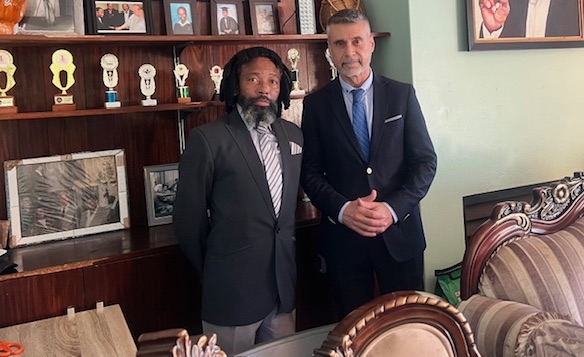
King Buyelekhaya Zwelibanzi Dalindyebo, the monarch of the AbaThembu people, and Amb. David Saranga.
South Africa and Israel banished each other’s highest-ranking diplomat serving in each country, after a video of Israel offering water technology and medical aid to minority tribes angered Pretoria last week.
The diplomatic row took place days before Congress is expected to vote on renewing the African Growth and Opportunity Act, which would allow many products from the continent to enter the U.S. duty-free. The Trump administration has considered removing South Africa from the program because it is a “unique problem,” as U.S. Trade Representative Jamieson Greer described it in December. Removal from AGOA would adversely affect about half of South Africa’s exports to the U.S., its second-largest trading partner, Bloomberg reported.
Pretoria declared Israel’s chargé d’affaires, Ariel Seidman, persona non grata on Friday, and hours later, Israeli Prime Minister Benjamin Netanyahu and Foreign Minister Gideon Sa’ar expelled South African envoy Shaun Edward Byneveldt, whom they called “the senior diplomatic representative of South Africa.” Byneveldt is South Africa’s “ambassador to Palestine,” but he was based in Tel Aviv, and diplomats serving the Palestinians are accredited by Israel.
Israel and South Africa have not exchanged ambassadors in recent years. South Africa announced in 2019 that it had downgraded its embassy in Tel Aviv to a liaison office. Israel maintained an ambassador in Pretoria until South Africa petitioned the International Criminal Court to arrest Netanyahu and then-Defense Minister Yoav Gallant in 2023.
However, with an active Jewish community of over 50,000, Israel has dispatched Amb. David Saranga, the Foreign Ministry’s director of digital diplomacy and a former ambassador to Romania, to be a kind of ambassador-at-large, visiting South Africa for specific meetings and projects.
Saranga visited South Africa’s Eastern Cape last Sunday, as a guest of King Buyelekhaya Zwelibanzi Dalindyebo, the monarch of the AbaThembu people. The group is part of the Xhosa nation, the second-largest tribe in the country. Dalindyebo had visited Israel weeks earlier. The largest tribe, the Zulu, dominates South African politics through the African National Congress, the largest party in the country’s parliament.
In a post on X, Saranga characterized the Eastern Cape as “a region rich in heritage, poor in infrastructure,” noting that in some areas, “access to clean drinking water remains a luxury rather than a given” and “healthcare challenges are equally severe.” Saranga helped arrange partnerships between Innovation:Africa, Israel’s Sheba Hospital, Dalindyebo and other traditional leaders in the region.
Saranga and Dalindyebo held a joint press conference with other traditional leaders outside the tribal leader’s home during the Israeli diplomat’s visit last week, videos of which were posted to social media by the Israeli embassy. In one of them, Dalindyebo said of the South African government’s opposition to cooperation with Israel: “They can go to hell if they wish.” Saranga can be seen chuckling next to him.
“As a king, I am a bona fide head and owner of the land. If any government, if any constitution disputes that, someone must educate me afresh,” Dalindyebo said, asserting his authority to accept aid from Israel if he so chooses.
Days later, the Eastern Cape province’s premier, Lubabalo Oscar Mabuyane, expressed “shock and concern” that Israel acted without consulting his office, calling it “a clear breach of diplomatic protocol.” Israel argued to the South African Jewish Report that it was acting within diplomatic norms.
On Friday, South Africa’s Department of International Relations and Cooperation (DIRCO) gave Seidman a 72-hour deadline to leave the country following what it called “unacceptable violations of diplomatic norms and practice which pose a direct challenge to South Africa’s sovereignty.” According to DIRCO, the violations included a failure to inform the department of visits by “senior Israeli officials” and insults to South African President Cyril Ramaphosa on official Israeli social media accounts.
South African political news site The Common Sense reported that the ANC, of which Mabuyane is a member, was “panicked by an Israeli effort to expand a service delivery programme in the Eastern Cape and the positive reception to that programme by communities,” and “feared that positive imagery of ordinary South Africans cooperating with Israelis would be very damaging to the government’s hostile foreign policy towards Israel.”
The South African Jewish Board of Deputies contrasted DIRCO’s actions against Israel with its “willful blindness toward ongoing international atrocities [in Sudan and Iran] … This glaring inconsistency exposes the hypocrisy at the heart of DIRCO’s actions.”
“Given the dire lack of basic services for countless South Africans, it is striking that just days after Israel offered water solutions to a desperate community in the Eastern Cape, DIRCO expelled the Israeli charge d’affairs, diverting attention from real domestic issues,” the SAJBD added.
The South African Zionist Federation said that the expulsion of Seidman “is an act of staggering moral bankruptcy — a choice that exposes a ruling party more committed to ideological hostility than to the welfare of the people it has so profoundly failed.”
SAZF argued that DIRCO’s actions were “never truly about process, protocol, or sovereignty.”
“A diplomat was declared persona non grata not for espionage, not for misconduct, not for breaching protocol — but for the unforgivable crime of helping South Africans get water. Clean water,” the organization stated. “In a country where taps run dry, where children walk kilometers with buckets, where elderly women queue for hours at communal pumps, and where the state has normalised collapse, neglect, and decay, the ANC chose to punish the one party actually delivering solutions. … When water flowed where excuses had ruled, the ANC did not respond with humility or gratitude. It responded with expulsion.”
SAZF also accused the government of corruption: “What the ANC cannot tolerate is … aid that bypasses the patronage machine. Help that cannot be claimed, captured, or corrupted. … The message sent by this government is as obscene as it is clear: if assistance cannot be politically owned, it must be destroyed, even if people suffer.”
Na’eh, who died on Monday, was ‘the Abraham Accords ambassador, ushering in a new era of regional diplomacy,’ Fleur Hassan-Nahoum said

Emre Senoglu/Anadolu Agency/Getty Images
Then-Israeli Ambassador to Ankara Eitan Naeh gives a speech during his first reception in Ankara, Turkey on December 5, 2016.
Veteran Israeli diplomat Eitan Na’eh, who had a long career in key posts representing Israel in the Arab world, died of a heart attack on Monday. He was 62.
Na’eh’s most recent role was as the Israeli Foreign Ministry’s representative to the U.S.-led Civil-Military Coordination Center (CMCC) in southern Israel, established in October to coordinate humanitarian relief efforts and the stabilization of Gaza.
Na’eh played a key role in growing and preserving Israel’s relations with Abraham Accords signatories. He was Israel’s first envoy to the United Arab Emirates in 2021, setting up Jerusalem’s diplomatic representation in Abu Dhabi. His last posting abroad was in Bahrain, where he served as Israel’s first ambassador to the country from December 2021 until August 2025.
In 2022, Na’eh told Jewish Insider: “I sit here in Manama and look outside to a beautiful view of the Gulf, and I am still pinching myself. I feel lucky to work in these countries.” The ambassador said at the time that he was optimistic about expanding the Abraham Accords and the potential in Israel-Bahrain ties.
A Foreign Ministry official characterized Na’eh to JI as “contributing the first steps in establishing relations in the framework of the Abraham Accords. … He built the content of the Abraham Accords at a critical time in which you don’t want to drop the ball.”
The official said Na’eh was skilled at bringing concrete results from diplomatic relations and had a talent for making connections. At the CMCC, “everyone knew him after five minutes,” the official recalled.
A Bahraini diplomat remembered Na’eh as someone who “represented his nation with grace and wisdom, but also fostered genuine goodwill and friendship wherever he went.”
Fleur Hassan-Nahoum, co-founder of the UAE-Israel Business Council and former deputy mayor of Jerusalem, called Na’eh “the Abraham Accords ambassador, ushering in a new era of regional diplomacy in the most professional way.”
Israeli Foreign Minister Gideon Sa’ar said that Na’eh was “a gifted diplomat who stood out in his ability to make connections wherever he served. Above all, in all of his missions and many positions he filled, Eitan was known for his big heart and endless caring.”
Na’eh was also Israel’s ambassador to Turkey from 2016 to 2018, the first after the diplomatic crisis between Jerusalem and Ankara following the 2010 Gaza flotilla incident. However, his term ended abruptly when Turkey expelled him in response to Palestinians killed by the IDF during protests and riots on the Gaza border.
He was previously Israeli ambassador to Azerbaijan and the head of the foreign policy department of Israel’s National Security Council, giving him a broad view of Israel’s international relations that the Foreign Ministry official said was very valuable.
Na’eh was also interim ambassador in London in 2013-2015, and Israel’s political consul at the Israeli consulate in Chicago in 1997-1999.
Hassan-Nahoum recalled Na’eh’s warmth and sense of humor, and said that he and his wife, Cheryl, had a marriage “to emulate in every way.”
Ahdeya Ahmed, former president of the Bahrain Journalists Association, called Na’eh “a friend who was like a brother.”
“I could talk about his professionalism as a diplomat, but what I really want to share is Eitan the friend — Eitan the warm soul who lit up every room, who always had a laugh, and who dreamed of a kinder world,” Ahmed said. “I’ll always remember his smile, his jokes, the way he made life’s burdens lighter for all of us, and all the celebrations we shared.”
Na’eh is survived by his wife, two children, Maya and Itai, and a granddaughter.
Bashir Goth hopes Somaliland’s story of building itself ‘by the bootstraps’ will resonate in particular with the GOP
X/Rev. Johnnie Moore
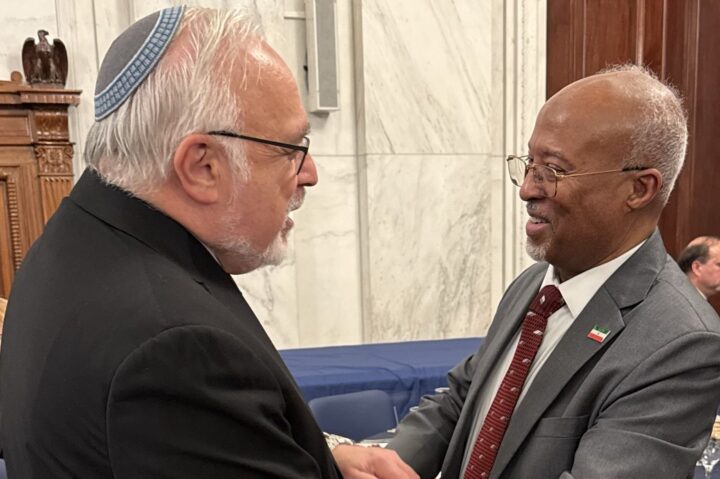
Somaliland diplomat Bashir Goth with Rabbi Abraham Cooper. associate dean and director of Global Social Action for the Simon Wiesenthal Center
Bashir Goth is in the unusual position of serving as a diplomat from a place that almost no one else in the world considers a country. That changed last month, when Israel became the first state to formally recognize Somaliland as an independent nation.
That gives Goth an opening he has been seeking since he arrived in Washington in 2018: a chance to try to convince the United States to now follow Israel’s lead and recognize the independence of Somaliland, a breakaway region of Somalia that has governed itself for 35 years.
“Our friends will be more active now, more vigorous, more encouraged by the Israeli recognition,” Goth told Jewish Insider in an interview on Wednesday.
Israeli Foreign Minister Gideon Sa’ar visited Hargeisa, the capital of Somaliland, for a meeting on Tuesday with Somaliland President Abdirahman Mohamed Abdullahi. Goth is hoping to capitalize on the rare occurrence of Somaliland being in the news, in part by attempting to rally American Jews to his cause.
“We always built very strong relations and engagements with Jewish organizations in Washington, D.C., and they are more active now, more than any time before,” said Goth. “I think they will also be very, very helpful in pushing this forward.”
Major American Jewish organizations, however, have not weighed in on Israel’s decision to recognize Somaliland, except for a post on X by AIPAC that took aim at Qatar for criticizing Israel’s actions. Sen. Ted Cruz (R-TX) has urged American recognition of Somaliland, but President Donald Trump said this week that he would not do so.
Goth, ever the diplomat, did a close read of Trump’s comments and held tight to one sentence that gave him hope — Trump told The New York Post last month that he would “study” the matter.
“Regarding President Trump, I think if you look at the end, at the last sentence of his statement, with that interview, he said, ‘At the end of the day, I study everything,’” Goth said.
Washington considers Somaliland part of Somalia, a policy in keeping with the African Union and the United Nations. And while geopolitics factor into Goth’s pitch — he suggests that a Somaliland aligned with Israel, the United Arab Emirates, Ethiopia and the U.S. could be a bulwark to China, Turkey and Somalia — his message to American officials is all about politics.
“The Somaliland story always resonated with the Republican community here in Washington, D.C., and in America, because it’s a country that has built itself from ruins, from rivers, to what it is now — its democracy and infrastructure — by its own resources, ‘by its bootstraps,’ as the Americans say,” said Goth. “We will be part of contributing to the prosperity and peace that the current American government is looking for.”
News reports last year suggested that Israel had approached Somaliland officials about the prospect of relocating Palestinians from Gaza, which Somaliland has denied. Goth called it a “false statement.”
Israel has sought ties with Somaliland in part because of its strategic proximity to Yemen, which could offer Israel a better position from which to attack the Iran-aligned Houthis. Deqa Qasim, the director of the political department in Somaliland’s Foreign Ministry, told Israel’s N12 on Thursday that Jerusalem and Hargeisa were discussing setting up an Israeli military base in the African territory, contradicting a previous denial that such an agreement was on the table. Goth would not say whether Somaliland had agreed to allow Israel to do so, but he did not deny it.
“There’s nothing that says we cannot have a security pact or agreement with Israel, and I can leave it like that,” he said.
Israeli recognition of Somaliland, home to 6 million people, also allows Goth to make the case that Israeli prosperity could be a beacon for Somaliland — an example, perhaps, of making the desert bloom.
“We could be the Singapore of the Horn of Africa, if we are given the chance. And there is no better example to look at than Israel. And what you achieved in Israel. To have our recognition from Israel will open that prosperity, I think, for us, in technology [and] agriculture,” Goth said. “That would be, actually, a role model for us.”
Please log in if you already have a subscription, or subscribe to access the latest updates.
 Continue with Google

 Continue with Apple