














































































Collins led Dooley 41-30 in the May 19 Republican primary, with Rep. Buddy Carter (R-GA) coming in at 25%
Miguel Martinez/Atlanta Journal-Constitution via AP
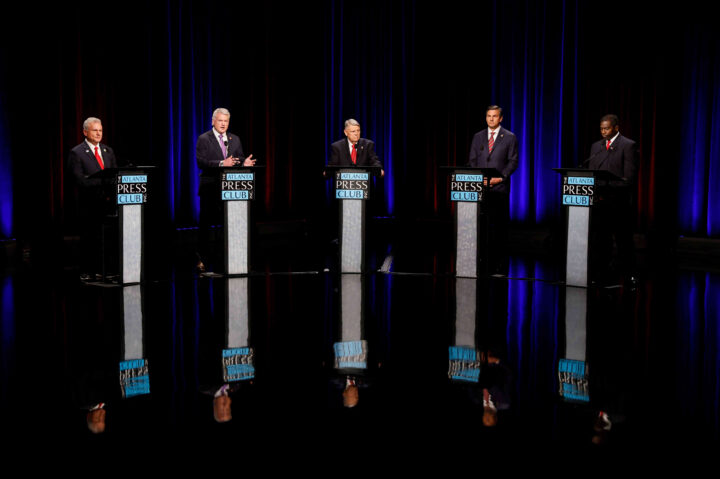
U.S. Rep. Mike Collins, R-Jackson, second left, speaks at the Atlanta Press Club Loudermilk-Young primary election debate for the U.S. Senate at Georgia Public Broadcasting, Sunday, April 26, 2026, in Midtown Atlanta.


 Add JewishInsider on Google
Rep. Mike Collins (R-GA), who has repeatedly faced controversy during his time in the House, appears favored to win the Republican Senate primary runoff in Georgia against Derek Dooley, a former college football coach backed by popular moderate GOP Gov. Brian Kemp.
Collins led Dooley 41-30 in the May 19 Republican primary, with Rep. Buddy Carter (R-GA) coming in at 25%. The runoff will take place on Tuesday, with the winner to face Sen. Jon Ossoff (D-GA) in November.
Polling shows Collins maintaining a sizable lead. Two late May post-primary polls, by JMC Enterprises and CivicLens Research, showed Collins ahead. Collins led by 16 percentage points in a JMC poll, 55-39, with 7% undecided, and by 10 points in a CivicLens poll, 50-40, with 10% undecided.
President Donald Trump endorsed Collins — generally seen as the more MAGA-aligned candidate — late on Saturday, while Kemp — who national Republicans initially sought to recruit for the race — has been aggressively campaigning around the Peach State in support of Dooley.
Trump described Collins as a “a true Friend, Fighter, and WARRIOR, who has been with us from the very beginning,” while dismissing Dooley as an unknown figure who lived outside of the state “for most of his life,” didn’t vote in 2020 or 2016 and said that Trump lost Georgia in the 2020 election, which Trump continues to deny.
Charles Bullock, a professor of political science at the University of Georgia, said that the state’s election history has shown that candidates who finish with such a commanding lead in the primary generally win the runoff, and that the little publicly available polling has largely reflected that Collins is maintaining his 10-point lead.
Dooley’s major asset, Bullock continued, remains the support he has received from Kemp. But Collins entered the race with name recognition in the Atlanta area, particularly from his work leading the Laken Riley Act, multiple previous runs for Congress and his father’s own service as a member of Congress.
Dooley, by contrast, entered the race as a largely unknown candidate. Collins’ advantages carried him despite the fact that he spent the least money of any of the GOP candidates in the race.
Bullock said that Dooely’s best chance of victory on Tuesday will be if there is strong turnout in the Atlanta area, rather than the more rural areas that have been Collins’ bases of support.
Collins and his campaign have repeatedly faced controversies relating to antisemitism and affiliations with extremist figures.
A recent report by Slate showed that Collins’ current congressional chief of staff, Kip Talley, was involved in a group chat that also included prominent white nationalists and Holocaust deniers, in which Talley pledged that he would “try and use the levers of the legislative branch” to defend and attempt to free from prison the far-right activist and Holocaust denier Charles Johnson.
Talley also said in the group chat that he contacted federal officials in an effort to “to get [Johnson] out” of prison.
In a statement to Slate, Talley denied acting at Collins’ direction or using official resources on behalf of Johnson, whom Talley described as “an acquaintance I have known for years.”
Collins himself faced criticism for endorsing an X post by an antisemitic, racist account attacking a reporter for being Jewish in 2024. Collins continued to deny that the original post for which he offered support was antisemitic and refused to apologize.
He also voted against the Antisemitism Awareness Act, though he has otherwise maintained a generally strong record on measures related to antisemitism and Israel policy in the House.
“Mike Collins has condemned the hate speech seen on college campuses and around the globe, and has been an ardent supporter of Israel in Congress. While [Georgia Sen.] Jon Ossoff capitulated to woke activists and voted to cut aid to Israel, Mike Collins has stood strong and protected its right to exist,” a Collins campaign spokesperson told JI last year, when asked about his online history and vote on the antisemitism bill.
Talley isn’t the only Collins aide who has caused controversy.
William Paul, a former Collins staffer and son of Sen. Rand Paul (R-KY), recently accosted Rep. Mike Lawler (R-NY) at a bar in Washington with an antisemitic rant, though Paul was no longer working in Collins’ office at the time of the incident.
In the final weeks of the runoff, a Collins campaign account on X made a crude post mocking a pro-Dooley GOP strategist over accusations of sexual assault made by the strategist’s wife against former news anchor Matt Lauer. Collins apologized and fired his former chief of staff, Brandon Phillips, who has long been dogged by scandal and is under House Ethics Committee investigation.
Dooley and his allies argued that the incident highlighted concerns about Collins’ electability against Ossoff.
Dooley has enjoyed support from conservative members of Georgia’s Jewish community since he entered the race. Emanuel Fialkow, a prominent member of the community, hosted a meet-and-greet with prominent Jewish leaders ahead of his campaign launch. He described Dooley as “very receptive” to their feedback and as a “staunch supporter of the Jewish people, and all religions, and of Israel” in an interview with Jewish Insider last week.
“Derek Dooley is our best chance to get rid of Ossoff, and I think that Derek Dooley will be true and unwavering in his support for Georgia, Israel and religious freedom, period, including Jewish people,” Fialkow said.
Fialkow did not comment on Collins beyond saying that Phillips’ activity was “awful and [Collins] should have fired him sooner.”
Though he predicted that Collins would win the primary, the University of Georgia’s Bullock said that Dooley would likely be the more electable candidate in November, which he said has been the factor driving Kemp’s support for the former football coach. “If he were to be chosen, Derek would probably be a stronger candidate in November,” Bullock said — though Ossoff would likely be the favorite against either man.
The swing voter population in the state, according to Bullock, consists of white, college-educated voters identifying as Republicans. If a Democrat can increase his share among those voters, he will likely win, and Ossoff is well-positioned to do so in November.
Campaign consultants, Bullock said, are “increasingly acknowledging” that it will be difficult to beat Ossoff, and are looking to direct money toward other Senate battlegrounds.
Dooley, the football coach-turned-candidate, has already begun Jewish outreach in the pivotal swing-state Senate race
Michael Allio/Icon Sportswire via Getty Images
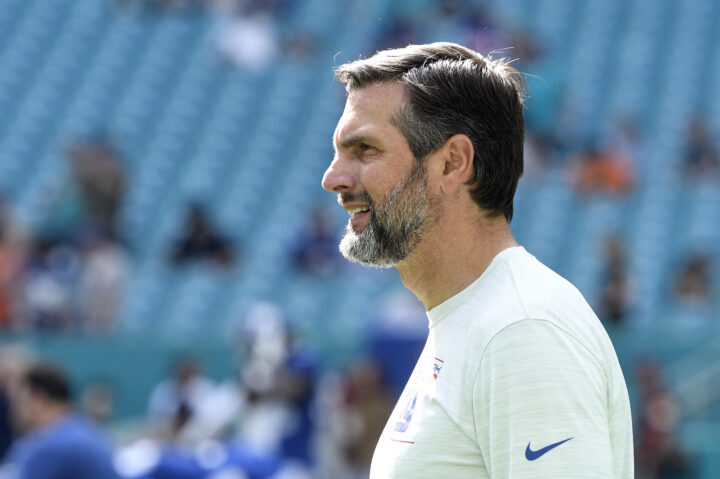
New York Giants Tight Ends Coach Derek Dooley looks on before the NFL football game between the New York Giants and the Miami Dolphins on December 5, 2021, at Hard Rock Stadium in Miami Gardens, Florida.
With the entry this week of Derek Dooley, a friend of Gov. Brian Kemp who hails from college football royalty in Georgia, the Republican field in the Georgia Senate race is taking shape.
Dooley, whose father coached the Georgia Bulldogs and who spent several years leading the rival Tennessee Volunteers, announced Monday that he’d be running against Reps. Buddy Carter (R-GA) and Mike Collins (R-GA) in the Republican primary to take on Sen. Jon Ossoff (D-GA), Republicans’ top-targeted incumbent.
Kemp, a popular Republican governor, was seen as Republicans’ best chance of ousting Ossoff. Some prominent Jewish former Ossoff donors in the state reached out to Kemp late last year urging him to run against Ossoff, frustrated by the senator’s votes last year to block some weapons transfers to Israel. But Kemp ultimately passed on the race. Ossoff has worked to rebuild trust with disaffected Jewish voters, but those efforts were hampered by his vote last week to block a shipment of assault weapons to Israel.
Kemp has family ties to Dooley, who has brought on top Kemp advisors, is likely to receive the governor’s backing and pursue a center-right lane in the race, while portraying himself as a political outsider. All the candidates have been making the pivotal pitch for President Donald Trump’s backing in the race and tying themselves closely to him, hoping that key endorsement will help them clear the field.
With Kemp’s help, Dooley could potentially peel off support from moderate Jewish Democrats still frustrated by Ossoff, though Jewish leaders in the state told Jewish Insider last week that they’re not yet making any commitments in the race. They say they’re waiting to see who emerges from the Republican primary and how Ossoff’s record shapes up over the coming months before they decide whether to support the incumbent next November.
Dooley, for his part, is wasting little time in courting their votes.
“I stand with our ally Israel and firmly believe they should have the necessary resources to defend themselves against terrorists,” Dooley said in a statement to JI. “While Jon Ossoff continues to vote against Israel and American national security interests, I will be a leading voice for a strong America and a strong Israel in the Senate.”
Emanuel Fialkow, a prominent conservative member of Georgia’s Jewish community, said that Kemp’s team connected him to Dooley and the two spoke at length on a variety of issues, including antisemitism and Israel. Fialkow said he was previously part of a group of Jewish donors who urged Kemp to run against Ossoff.
Fialkow said that Dooley had asked him about a range of issues including Israel policy, the war in Gaza and antisemitism, and that he subsequently agreed to help Dooley develop an Israel position paper, which Fialkow described as very strongly pro-Israel. He said that Dooley “will have a backbone” in support of Israel.
He subsequently organized a lunch meeting at his home to introduce Dooley to a small group of others in the state, many of them Jewish, including both traditional Republicans and Democrats. Fialkow said that the group discussed a range of issues and came away seeing Dooley as honest, humble, inspiring, engaging and curious to learn more. He praised Dooley as a proven leader and a “really good guy” who can speak to people from a range of backgrounds, and is interested in listening to and learning from people.
He said other Jewish leaders in the Atlanta area are also in discussions with and about supporting Dooley. Others said they haven’t been in touch with Dooley or his surrogates yet.
Fialkow said that he and some other Jewish leaders in the state see Ossoff’s relationship with them as broken beyond repair, and said they can’t trust him going forward to be a reliable supporter of Israel. He argued that Dooley is the “only chance” for Zionist voters who put support for Israel first.
Ossoff, for his part, maintains some vocal supporters in the Jewish community.
Cary Levow, a supporter of pro-Israel causes and candidates, told JI last week, “I support Senator Ossoff and know of other Jewish Georgians who understand that Jon’s approach to the Gaza humanitarian issue is genuine.”
“Senator Ossoff has voted for over $20 billion in aid to Israel, has family living in Israel and has spent a significant amount of time in the country,” Levow continued. “I think Jon has represented the Jewish community well and I have zero concern about a senator who is critical of how [Israeli Prime Minister Benjamin Netanyahu] Bibi is waging this war.”
Fialkow argued that the only way for a Republican to win is for both Kemp and Trump to be aligned behind the same candidate, and that a hard-right Republican can’t win statewide in Georgia, meaning that Dooley gives Republicans their best chance to beat Ossoff.
Fialkow said he’s spoken to Collins and is confident that he would never vote against U.S. support for Israel, due to his own religious convictions. Collins has voiced the same view in confrontations with anti-Israel activists.
Speaking at an Oct. 7 memorial ceremony in 2024, Collins called the U.S. Israel’s “greatest friend” and said that the Oct. 7, 2023, Hamas attacks had only strengthened the relationship between the two partners. He said he would work to make sure Israel receives all the support it needs to defend itself.
“Hamas not only attacked the peaceful people of Israel that day, but they launched an assault against the idea of free and fair democracies in the Middle East,” Collins said.
But some elements of Collins’ record on antisemitism could raise red flags for others in the Jewish community. Last year, he refused to apologize for and doubled down on engaging with an antisemitic, racist Twitter account that was attacking a reporter for being Jewish. And he voted against the Antisemitism Awareness Act, and has a record of engaging in otherwise extremist rhetoric online.
“Mike Collins has condemned the hate speech seen on college campuses and around the globe, and has been an ardent supporter of Israel in Congress. While Jon Ossoff capitulated to woke activists and voted to cut aid to Israel, Mike Collins has stood strong and protected its right to exist,” a Collins campaign spokesperson told JI, when asked about his online history and vote on the antisemitism bill.
Carter, who is close with some Atlanta-area Jewish leaders, has been a vocal supporter of pro-Israel and Jewish causes in the House, including leading pushes for funding and support for Holocaust education programs, calling on colleagues to address antisemitism in health care, leading legislation to support U.S.-Israel cooperative programs, urging support for the snapback of U.N. sanctions on Iran and calling for Qatar and Turkey to expel Hamas leaders. He also supported the Antisemitism Awareness Act, unlike Collins.
Carter’s campaign did not respond to a request for comment.
Other than Collins’ vote against the Antisemitism Awareness Act, both Carter and Collins have records of supporting legislation backing Israel and combating antisemitism, including voting for supplemental aid to Israel and a resolution describing anti-Zionism as antisemitic.
Please log in if you already have a subscription, or subscribe to access the latest updates.
 Continue with Google

 Continue with Apple