









































































Senate Democrats voted in lockstep to block a procedural motion to open debate on the 2027 National Defense Authorization Act
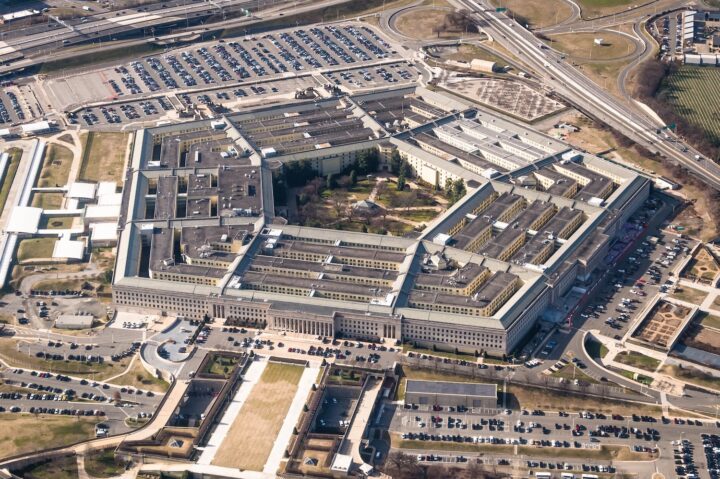
Getty Images
The Pentagon


 Add JewishInsider on Google
Citing concerns about the Iran war and the administration’s elevated defense funding request, Senate Democrats voted in lockstep on Tuesday evening to block a procedural motion to open debate on the 2027 National Defense Authorization Act, despite the bill passing out of the Armed Services Committee with bipartisan support.
The decision to block the start of debate on the NDAA — an annual must-pass bill that typically garners strong bipartisan support — is a rare step by Democrats signaling significant frustrations with the Trump administration’s ongoing war against Iran.
Sen. Jack Reed (D-RI), the top Democrat on the Armed Services Committee, said in a statement that he continues to support provisions in the bill, “but I cannot vote to proceed to a bill that enables an ongoing war against Iran that Congress never authorized and the American people overwhelmingly oppose.”
He said that Democrats are seeking amendments to “require accountability” for the war that have been rejected by Republicans. Reed added that Democrats also cannot support a significant increase in defense spending without more reliable accounting of the costs of the Iran war or “basic information” about it, and without a corresponding increase in non-defense spending.
Sen. Patty Murray (D-WA), the ranking member of the Senate Appropriations Committee, similarly cited the Iran war as a primary reason for her opposition to the bill.
“I will always do everything in my power to take care of our servicemembers and keep our country safe, but this bill authorizes President Trump’s absurd $1.5 trillion defense budget request while doing nothing to put an end to his disastrous war or prevent him from starting more costly conflicts abroad,” Murray said in a statement. “I refuse to endorse President [Donald] Trump’s obscene war budget, and I refuse to move this bill forward as Trump pushes our country deeper into a war the American people oppose”
Sen. Jeanne Shaheen (D-NH), the ranking Democrat on the Senate Foreign Relations Committee, said in a statement that it is “vital that we both pass the NDAA and that we constrain the President’s lawless and costly war against Iran.”
“With the President re-launching his self-defeating war, I voted against the motion to end debate on the NDAA, so we can continue to advocate for greater transparency and an end to this conflict,” Shaheen continued.
She said that amendments to reduce overall spending and withhold any congressional authorization for the Iran war failed along party lines during the closed-door committee markup of the NDAA.
Six progressive Democrats — Sens. Chirs Van Hollen (D-MD), Bernie Sanders (I-VT), Jeff Merkley (D-OR), Peter Welch (D-VT), Ed Markey (D-MA) and Elizabeth Warren (D-MA) — said they would vote against the motion to demand a vote on removing a provision on U.S.-Israel cooperation from the bill, and urged colleagues to do the same.
Though some anti-Israel voices have tried to paint that provision as the reason the Democratic caucus voted en masse against the bill, most Democrats did not cite that in their own statements on the bill.
Sen. John Fetterman (D-PA), the only Senate Democrat who has unreservedly supported the Iran war, was not present for the vote.
Republicans called the Democratic blockade dangerous to national security.
Sen. Chuck Grassley (R-IA) called the vote “SHAMEFUL” and said that the vote demonstrates that Democrats don’t take national security issues, which he described as the most important responsibility of the federal government, seriously.
The request includes cuts of $1.3 billion to FEMA grant programs, a category which includes the Nonprofit Security Grant Program
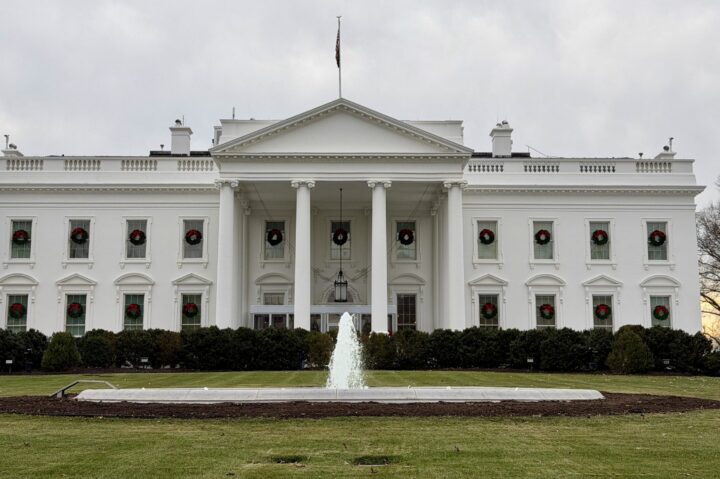
Daniel SLIM / AFP via Getty Images
The White House is seen in Washington, DC, on December 17, 2025.
The Trump administration’s 2027 top-line budget request to Congress calls for significant funding increases for the Department of Defense, while pushing for cuts to certain programs at the Federal Emergency Management Agency and the Department of Justice.
The budget request affirms President Donald Trump’s previously stated desire for a $1.5 trillion defense budget in 2027 — a $441 billion increase over 2026 funding levels.
The request urges cuts of $1.3 billion to non-disaster grant programs at FEMA, a category which includes the Nonprofit Security Grant Program, which has been critical to protecting Jewish community institutions and for which both lawmakers and Jewish community groups have sought increased funding.
The request does not specifically spell out how NSGP funding would be impacted, but states broadly that the budget “reduces wasteful FEMA grant programs, refocusing the agency on sound emergency management while encouraging States and communities to build resilience and use their unique local knowledge and resources in disaster response.”
The budget document does specifically lambast FEMA’s “Targeted Violence and Terrorism Prevention” program, which has support from some groups in the Jewish community, as having been “weaponized to target Americans exercising their First Amendment rights.”
At the DOJ, the administration again aims to eliminate the Community Relations Service, which has received support from some Jewish community groups in the past, charged with helping to mediate communal conflicts based on various forms of hatred and discrimination. It describes the program as a “woke [enterprise] that fails to serve the core function of the Department to fight crime and protect American communities.”
Lawmakers ultimately rejected efforts to fully defund CRS last year, though they did cut $4 million from the office’s budget.
“CRS has a long track record of supporting fringe leftist organizations such as Black Lives Matter and legitimizing riotous behavior that puts America’s police in the crosshairs,” the budget request continues.
The budget request also continues to push for the elimination of the Department of Education, though it doesn’t include a specific line item for the Office for Civil Rights, which is responsible for addressing, among other issues, antisemitism on college campuses. The administration had sought significant cuts to that office in 2026.
The administration called for $2.7 billion in cuts to the U.S.’ funding for international organizations including the United Nations, particularly taking aim at the United Nations regular budget and U.N. peacekeeping missions.
It specifically criticizes anti-Israel bias at the U.N.: The budget document states that the U.N. Human Rights Council and its commission of inquiry on Israel “has failed to uphold any semblance of impartiality or conduct objective investigations.”
The administration requested $15.2 million in additional funding for the Treasury Department’s Office of Terrorism and Financial Intelligence, “making key investments in critical cyber capabilities, sanctions targeting, and combating illicit financial activity” — with a focus on countering cartels.
More specific line-item requests should be released in the coming days.
Please log in if you already have a subscription, or subscribe to access the latest updates.
 Continue with Google

 Continue with Apple