












































































Israeli officials have increasingly indicated that Jerusalem is ready to return to military action if it determines that circumstances demand it
Ma'ayan Toaf (GPO)
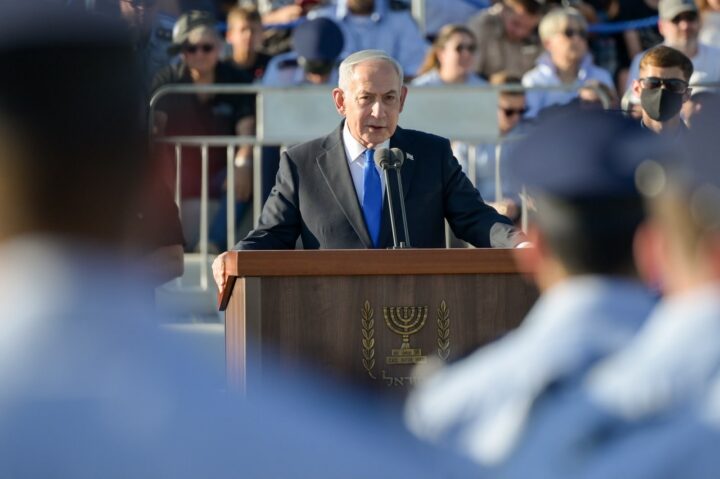
Israeli Prime Minister Benjamin Netanyahu speaks at the graduation ceremony of the IAF pilots' course, July 9th, 2026


 Add JewishInsider on Google
After several days of watching from the wings as the United States has conducted strikes against Iran, Israeli officials have increasingly indicated that Jerusalem is ready to return to military action if it determines that circumstances demand it.
Israeli Ambassador to the U.S. Yechiel Leiter told CNN on Thursday that Jerusalem is “supportive of the position of the United States” and would “fly alongside U.S. aircraft” if called on to do so.
At an Israeli Air Force graduation ceremony the same day, Defense Minister Israel Katz said the IDF is prepared to “regain air superiority and carry out ‘blue-and-white’ [Israeli] strikes in Iran to remove threats — even for a third time,” warning that it would be with “even greater force” than before. Meanwhile, IDF Chief of Staff Lt. Gen. Eyal Zamir told graduates that “on the drawing board are new plans. Major operations are still expected to lie ahead of us. Be prepared.”
Prime Minister Benjamin Netanyahu reinforced that message in his remarks at the ceremony. While celebrating the outcome of Operations Rising Lion and Roaring Lion, he made clear that Israel does not view the conflict with Iran as settled. “Our policy is clear: With an agreement or without an agreement, Iran will not have nuclear weapons,” Netanyahu said. He added: “The war is not yet over. Alongside old challenges, new ones are emerging. Axes fall, and axes rise. We are turning our attention to this. We are prepared for any scenario.”
Security analysts say the messaging reflects a desire to preserve military pressure without committing to another immediate campaign. Yoni Tobin, a senior political analyst at the Jewish Institute for National Security of America, told Jewish Insider, “While Israel isn’t exactly clamoring for more combat with Iran, particularly after nearly three years of multifront war, it is certainly ready for it.” Tobin noted that “Israel will likely feel comfortable acting against Iran if the United States does so as well, and if the two countries are aligned on objectives and strategy.”
David May, a senior research analyst at the Foundation for Defense of Democracies, said the memorandum of understanding “should be seen as part of the process of ending the fighting between the United States and Iran, not the final agreement.”
“Washington needed the Strait of Hormuz opened urgently, but Iranian provocations have prevented the strait’s return to normal. Iran has always tried to cheat on the margins of deals with the United States — even with favorable agreements — to test American resolve,” May continued. “With the terms of the MOU so favorable to Iran, Tehran would have been wise to abide by the deal but didn’t, thanks in part to internal divisions. The renewed fighting will hopefully lead to the MOU being scrapped and replaced by a more reasonable peace agreement.”
“Israel has enjoyed the relative quiet and is feeling a bit shaky over its exclusion from ceasefire talks,” May posited. “But open conflict with the Islamic Republic remains a likely possibility.”
At the same time, the current situation may be more complicated than the public rhetoric suggests. Ran Zimmt, director of the Iran and Shiite Axis research program at the Institute for National Security Studies, wrote in an op-ed for Ynet that both Washington and Tehran would prefer to avoid a return to full-scale war.
“In this reality, the most likely scenario at this stage appears to be a continuation of the current situation: not a full-scale war, but also not a long-term diplomatic arrangement,” Zimmt wrote. “From Israel’s perspective, this reality seemingly has clear advantages. The military option remains on the table, and Iran does not enjoy a broad package of economic benefits that could strengthen the regime and allow it to invest significant resources in rebuilding its power.”
Zimmt warned, however, that while the status quo “may be preferable in the short term,” it does not “provide a stable solution, but at most a temporary pause,” during which Iran can rebuild its military capabilities.
Izz al-Din al-Haddad was the leader of Hamas’ military wing and an architect of the Oct. 7 attacks, according to Israeli leaders
Saeed M. M. T. Jaras/Anadolu via Getty Images
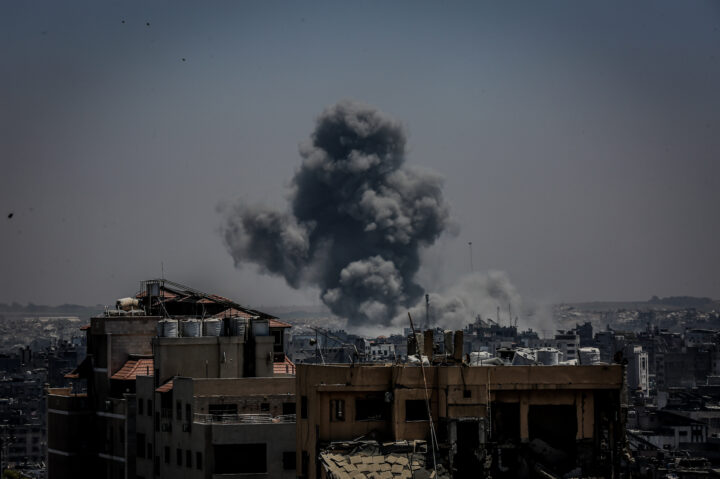
Smoke rises after an Israeli strike in the eastern part of Gaza Strip on July 3, 2025.
The Israeli military killed Izz al-Din al-Haddad, the most senior remaining Hamas commander in the enclave, in a strike on Friday, according to a joint statement from Prime Minister Benjamin Netanyahu and Defense Minister Israel Katz.
Al-Haddad was the leader of Hamas’ military wing and was “one of the architects of the October 7 massacre,” according to the statement.
The strike, carried out by the Israeli Air Force, had been approved about a week and a half earlier, during which time Israeli forces kept Al-Haddad under constant surveillance, an Israeli official told reporters. The official said the operation was carried out after an “operational opportunity” emerged.
Al-Haddad “held our hostages in brutal captivity, directed terrorist operations against our forces, and refused to implement the agreement led by U.S. President Donald Trump aimed at dismantling Hamas and demilitarizing the Gaza Strip,” Netanyahu and Katz’s statement said. “The IDF and the Shin Bet are effectively implementing the government’s policy of not tolerating threats and preemptively thwarting our enemies.”
The strike comes amid a fragile ceasefire between Israel and Hamas that was first implemented in October 2025, under which Israeli forces withdrew to a “yellow line” encompassing roughly 53% of the Gaza Strip. Hamas has yet to comply with the next phase of Trump’s plan, which calls for the group’s disarmament.
Nickolay Mladenov, the Board of Peace’s lead envoy for Gaza, wrote in a recent letter obtained by The Times of Israel to the technocratic committee governing Gaza that the board would not expect Israel to abide by the terms of the ceasefire if Hamas continues to refuse to disarm.
Prince Khalid bin Salman said increasing antisemitic and anti-Israel rhetoric out of the kingdom are not reflective of the monarchy’s position
Kayla Bartkowski/Getty Images
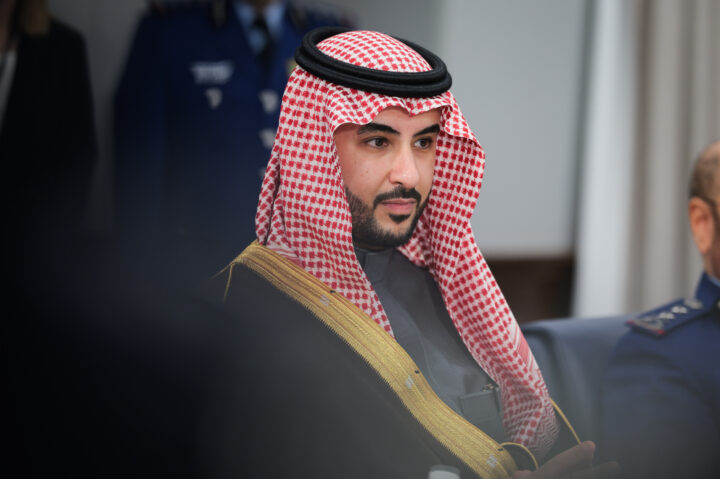
Saudi Minister of Defense Khalid bin Salman attends a meeting with U.S. Secretary of Defense Pete Hegseth at the Pentagon on February 24, 2025 in Arlington, Virginia.
Several Jewish and pro-Israel leaders met privately with Saudi Arabia’s defense minister in Washington on Friday afternoon, as Riyadh draws scrutiny for its increasingly hostile posture toward Israel and promotion of antisemitic messaging.
According to several sources familiar with the discussion, Prince Khalid bin Salman Al Saud denied to attendees that increasing antisemitic and anti-Israel rhetoric out of the kingdom was reflective of the monarchy’s position and emphasized that Riyadh and Jerusalem have mutual understanding and ongoing military, security and intelligence cooperation. He praised Israel’s actions against Hezbollah in Lebanon but said he doesn’t agree with Jerusalem’s recent decision to recognize Somaliland’s independence.
The same day of the meeting, a Muslim cleric in Medina gave a sermon calling for “victory” over the “Zionist aggressors,” while an imam in Mecca preached, “O God support them in Palestine and substitute their weakness with strength.” Hussain Abdul-Hussain, a research fellow at the Foundation for Defense of Democracies, noted that the Saudi government selects speakers to deliver Friday sermons.
On Saudi Arabia’s seeming decline in relations with the UAE, the prince acknowledged the two countries have clashed recently in Yemen but denied any broader pivot in Saudi foreign policy or increasing acceptance of the Muslim Brotherhood in the kingdom, which experts have alleged.
He also spoke to Turkey’s importance in the region, as Saudi Arabia’s growing alliance with Ankara, in addition to countries including Qatar and Pakistan, has raised concerns about the country’s increasing alignment with Islamist actors.
One source confirmed reporting by Axios that Prince Khalid told the group that if President Donald Trump does not follow through on his pledge to take military action against Iran, “it will only embolden the regime.”
Among the attendees, according to two sources with knowledge of the meeting, were Anti-Defamation League CEO Jonathan Greenblatt, American Jewish Committee CEO Ted Deutch, Conference of Presidents of Major American Jewish Organizations CEO William Daroff, B’nai B’rith International CEO Daniel Mariaschin and Rabbi Levi Shemtov of American Friends of Lubavitch (Chabad).
An AJC spokesperson confirmed Deutch’s participation at the meeting. “AJC is in regular, ongoing dialogue with our partners across the Gulf and in Israel to strengthen regional security and advance cooperation and integration,” the spokesperson told JI. “Today was another example of that work. We carry out these efforts continuously from Washington, Jerusalem and Abu Dhabi.”
Daroff also confirmed his attendance to JI, saying the group “had a constructive, off-the-record conversation as part of an ongoing dialogue with Saudi Arabia on regional and geostrategic issues, and appreciated the opportunity to speak frankly.”
Shemtov similarly confirmed his participation and said the prince’s demeanor was “friendly and engaging.” Shemtov said he left the meeting “somewhat encouraged, even if not yet completely convinced” but declined to provide details on what was discussed as the meeting was off the record. Mariaschin confirmed his attendance as well.
The nearly two-hour meeting was also attended by 15 representatives of Washington-area think tanks, including Daniel Shapiro, a former U.S. ambassador to Israel now at the Atlantic Council; Dennis Ross, a veteran Middle East peace negotiator now at The Washington Institute for Near East Policy; Barbara Leaf, former assistant secretary of state for Near Eastern affairs who is now a distinguished diplomatic fellow at the Middle East Institute; Douglas Silliman, former U.S. ambassador to Iraq who is now the president of the Arab Gulf States Institute; Rev. Johnnie Moore, the former executive chairman of the Gaza Humanitarian Foundation; Karim Sadjadpour, a senior fellow at the Carnegie Endowment for International Peace; and former diplomat Daniel Fried, now a distinguished fellow at the Atlantic Council, the sources told JI.
In a separate meeting earlier Friday that ran for almost an hour and a half, Prince Khalid met with a smaller group of pro-Israel national security experts, including Mark Dubowitz of the Foundation for Defense of Democracies and Michael Makovsky of the Jewish Institute for National Security of America. Both confirmed to JI they had attended but declined to share details about the discussion.
The IDF said it targeted Hamas’ senior leadership amid explosions in Doha
Screenshot/X
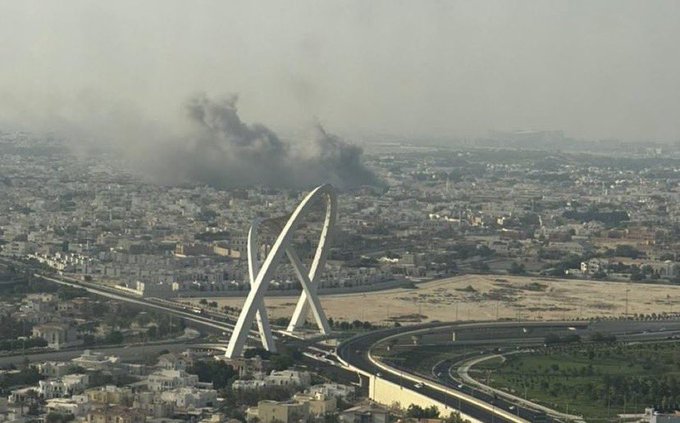
Israel strikes Hamas leadership in Doha, Qatar on Sept. 9, 2025.
Israel conducted a strike against senior Hamas leaders, the IDF said on Tuesday, following reports of explosions in Doha, Qatar.
The operation, whose Hebrew name translates to “Judgment Day,” reportedly targeted Khalil al-Hayya, Hamas’ chief negotiator in hostage and ceasefire talks, and longtime senior Hamas official Khalid Mashaal, as well as Hamas officials Zaher Jabarin and Nizar Awadallah, though reports conflict as to the success of the strike.
Israeli Prime Minister Benjamin Netanyahu and Defense Minister Israel Katz said in a joint statement that the Israeli defense establishment unanimously supported the strike.
“The action is totally justified in light of the fact that Hamas leadership initiated and organized the Oct. 7 massacre and did not stop launching murderous actions against Israel and its citizens since then, including taking responsibility for the murder of our civilians in the terrorist attack in Jerusalem yesterday,” they stated.
President Donald Trump was informed of the strike in advance and supported it, Israel’s Channel 12 reported. Netanyahu’s office said that “today’s action against the top terrorist chieftains of Hamas was a wholly independent Israeli operation. Israel initiated it, Israel conducted it, and Israel takes full responsibility.”
“The IDF and [Israel Security Agency (Shin Bet)] conducted a precise strike targeting the senior leadership of the Hamas terrorist organization,” the IDF Spokesperson’s Office stated. “For years, these members of the Hamas leadership have led the terrorist organization’s operations, are directly responsible for the brutal October 7th massacre, and have been orchestrating and managing the war against the State of Israel.”
The IDF said that it used precision munitions and intelligence to reduce harm to civilians.
Hamas leadership is based in the Al-Qatar neighborhood of Doha, where the explosions took place, according to videos posted on social media.
Qatar said it “strongly condemns” the strike in a statement posted to X by Majed Al-Ansari, spokesman for the Qatari Ministry of Foreign Affairs, which described the operation as “a cowardly Israeli attack that targeted residential buildings housing several members of the Political Bureau of Hamas in the Qatari capital, Doha.”
“This criminal assault constitutes a blatant violation of all international laws and norms, and poses a serious threat to the security and safety of Qataris and residents in Qatar,” he added, and said that Qatar “will not tolerate this reckless Israeli behavior and the ongoing disruption of regional security, nor any act that targets its security and sovereignty.”
The strike took place days after the Trump administration sent a Gaza ceasefire and hostage deal proposal via intermediaries, which Israel accepted and a senior Hamas official based in Istanbul rejected.
Earlier Tuesday, Netanyahu left a hearing in his ongoing corruption trial early due to “an exceptional security matter,” Israeli public broadcaster Kan reported.
In 1997, Israel attempted to assassinate Mashaal, the head of Hamas’ political bureau at the time, in Jordan, but gave Amman the antidote for the poison after then-King Hussein threatened to cancel the peace treaty between the countries.
Please log in if you already have a subscription, or subscribe to access the latest updates.
 Continue with Google

 Continue with Apple