













































































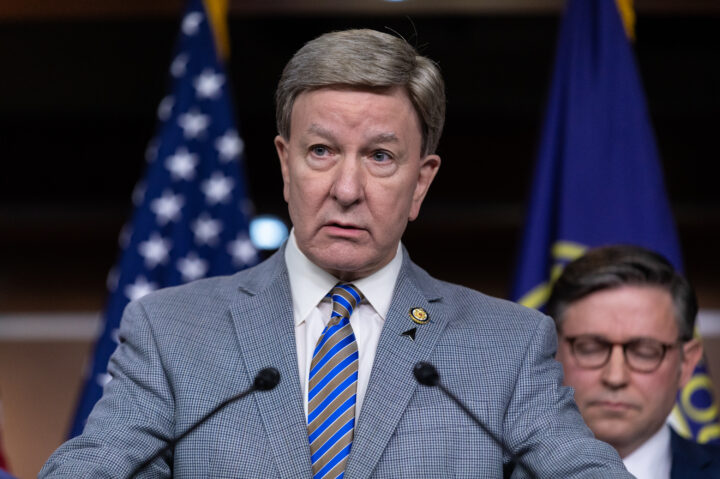
House Armed Services Committee Chairman Mike Rogers said after a classified briefing that lawmakers are ‘just not getting enough answers’
Anna Rose Layden/Getty Images
House Armed Services Committee Chairman Mike Rogers (R-AL) speaks to the press at the U.S. Capitol on October 17, 2025 in Washington, DC.


 Add JewishInsider on Google
The top Republican on the House Armed Services Committee told reporters on Wednesday, after a classified briefing, that the administration isn’t giving committee members enough information about its plans in Iran.
The comments by a senior, generally hawkish Republican, Rep. Mike Rogers (R-AL), are a sign of cracks between congressional Republicans and the administration — who have largely remained in lockstep through the first month of the war — over the strategy in Iran.
“We want to know more about what’s going on, what the options are, and why they’re being considered,” Rogers said, according to Politico. “And we’re just not getting enough answers on those questions.”
He said he’d told briefers that “this has consequences if you don’t remedy it” and told administration officials that they should be “thoughtful and deliberate” about the use of ground forces.
Sen. Roger Wicker (R-MS), chair of the Senate Armed Services Committee, told reporters, “I can see why he might have said that” but demurred when asked again about Rogers’ comments later in the afternoon, saying he hadn’t seen the context in which Rogers made the remarks and adding later that he wanted to talk to Rogers before commenting further.
Another House Republican, Rep. Nancy Mace (R-SC), who has some isolationist leanings and is prone to breaks with her party, was even more critical of the administration and suggested that the U.S. was moving toward putting troops on the ground.
“The justifications presented to the American public for the war in Iran were not the same military objectives we were briefed on today in the House Armed Services Committee,” Mace said on X. “This gap is deeply troubling. The longer this war continues, the faster it will lose the support of Congress and the American people.”
She also shared multiple posts expressing her opposition to ground forces in Iran.
“Let me repeat: I will not support troops on the ground in Iran, even more so after this briefing,” Mace said. She added, “Washington’s war machine is hard at work. They are try[ing] to drag us into Iran to make it another Iraq. We can’t let them.”
Other Republicans on the Senate Armed Services Committee, who participated in a separate Wednesday briefing, said they didn’t share Rogers’ concerns.
“I sit on Intel and I sit on Armed Services, so I get the classifieds on both — I think they’ve given us accurate information,” Sen. Mike Rounds (R-SD) told Jewish Insider. “And we always want more — so I understand the desire to get more information — but I’m not going to fault them for being careful on the information they give us because it’s a very fluid situation.”
“I’m satisfied,” Sen. Jim Banks (R-IN) said of the briefing on Wednesday.
Republicans and some Democrats insisted Trump made the decision, while other Democrats said that the timing of the onset of hostilities was impacted by Israel’s plans
Anna Moneymaker/Getty Images
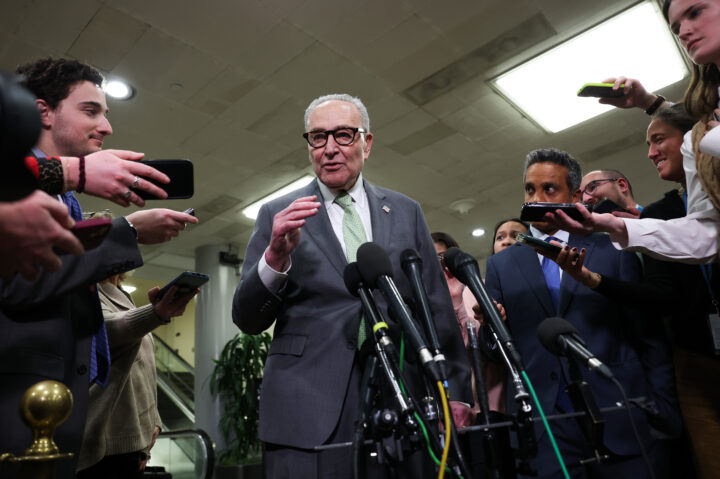
Senate Minority Leader Charles Schumer (D-NY) speaks to the media after briefings on Iran at the U.S. Capitol on March 3, 2026 in Washington, DC.
Following a classified briefing on Tuesday, Senate Republicans strongly rejected claims that Israel had effectively forced the U.S.’ hand into war with Iran or dictated the timeline of the conflict, claims that were fueled by comments on Monday by Secretary of State Marco Rubio and top lawmakers who were briefed on the Trump administration’s plans.
Sen. Rick Scott (R-FL) told Jewish Insider he had been in touch with the administration since the war began, and that no one in the administration had told him that Israel had triggered the U.S. to act.
“Anybody that thinks they’re going to get President Trump to do anything — talk to anybody that’s done business with him for his entire business career,” Sen. Markwayne Mullin (R-OK) told JI, calling the idea that Israel had forced Trump’s hand “a joke.”
Sen. John Hoeven (R-ND) added, ”We work very closely with our ally Israel for maximum effect to take out Iran’s capabilities when they are the weakest so we minimize the risk to our military and civilians in the region.”
Democrats also distanced themselves from the narrative that emerged on Monday.
Asked whether Israel had prompted the start of hostilities, Senate Minority Leader Chuck Schumer (D-NY), who was also briefed on Monday, told JI, “No one wants an endless war, but we certainly don’t want a nuclear Iran, that’s for sure.”
Sen. Andy Kim (D-NJ) said that the responsibility for the operation “always falls squarely on President Trump. Regardless of what other countries are doing, he is the one that owns this.”
“Look, I certainly have my concerns about how this all unfolded, but I think it’s very important for the American people to know that this was still Donald Trump’s decision,” Kim continued.
Other Democrats framed the narrative as one of several shifting explanations the administration has offered.
Sen. Cory Booker (D-NJ) said that the administration “jump[s] around until they think they found an explanation that could satisfy the most people. They have changed their justification for this time and time again, and we got nothing that even approached a justifiable reason for the president to commit an act of war.”
Rep. Greg Meeks (D-NY), the ranking member of the House Foreign Affairs Committee, also said that placing responsibility with Israel was one of just several shifting rationales. “Each day, sometimes twice a day, the rationale for doing this changes. That tells me it is not serious.”
Other Democrats, however, said that the timing of the onset of hostilities was impacted by Israel’s plans.
“The way we got into this war, I think, put the principal decision in another country’s hands, rather than ours, and did not lead to preparations in advance of the war starting that protected as many Americans as possible,” Sen. Chris Coons (D-DE) said.
Democrats supporting the war powers resolution set to come up for a vote in the Senate on Wednesday — which mandates the withdrawal of U.S. forces from combat with Iran — argued on Tuesday that the resolution would nevertheless allow some sort of wind-down of U.S. operations, as U.S. bases and embassies come under fire by Iran, though they did not offer specifics.
“I think they’d be allowed to conduct the completion of the operation,” Sen. Brian Schatz (D-HI) said.
Sen. Adam Schiff (D-CA), a cosponsor of the war powers resolution, said, “It would require an end to the use of force. I’m sure it would permit the safe drawdown of our forces in the region, but it would insist on the president coming to Congress to seek an authorization, to make the case — if indeed he believes there’s a case to be made.”
Though the resolution “terminate[s] the use of United States Armed Forces from hostilities against the Islamic Republic of Iran or any part of its government or military,” Meeks said that the resolution “does not say that the president has to move everybody out.”
“It says, though, that he has to come and talk to us and tell us what the end game, what the beginning game is. We just cannot get involved in the hostilities, as of right now,” Meeks told JI. “Israel will do what it’s doing, I would imagine. But the American people need to know where their members of Congress stand.” He’s supporting a similar resolution in the House.
Sen. Tim Kaine (D-VA), the lead sponsor of the war powers resolution, said that if it fails as expected, he can and may continue re-filing the resolution as the war continues, and as casualties and disruptions mount. He said that Democrats are also contemplating other measures, such as using the appropriations process or amendments to other legislation, to force lawmakers to vote on the war.
Several Democrats also said Congress should vote on an authorization for use of military force, in addition to the war powers resolution. Sen. Chris Murphy (D-CT) said that Senate Democrats should refuse to provide votes on any legislation until such a vote occurs.
Meeks said he expects that the conflict will still be ongoing in 60 days, the end of the period in which the administration is legally allowed to conduct unilateral operations without congressional authorization.
Lawmakers offered differing views on whether American ground operations inside Iran are likely.
Scott said that the U.S. shouldn’t take a ground invasion off the table but he was hopeful that the mission could be accomplished through airstrikes.
“You never take that off the table. That would be stupid. That’s what Obama did, and that’s what Biden did. We’d never do that,” Scott said. He said he did not think congressional authorization would be needed to send in troops on the ground, which others see as a significant escalation.
Sen. Josh Hawley (R-MO) said that Trump “hasn’t ruled it out, but I’d urge him to rule it out” and said that a congressional authorization would, in his view, be necessary to put boots on the ground.
Sen. Richard Blumenthal (D-CT) said his takeaway from the briefing is that U.S. ground forces “may be necessary to accomplish objectives that the administration seems to have.”
Trump reportedly spoke this weekend to Kurdish leaders about potentially launching an offensive against the Iranian regime, but Kim said that the subject did not come up in the briefing.
“You wouldn’t be having those conversations if you weren’t thinking about maybe getting different actors on the ground,” Kim told JI. “It very much feels like they are fomenting, potentially, different groups on the ground to start to get engaged in what will essentially be what happened in Syria before, what happened in Libya before. And so if they are trying to start a civil war, this is a very good way to go about it.”
Senators, particularly Democrats, also said after the briefing that Cabinet officials told them to expect stronger strikes going forward, and that the past few days have been the beginning of a much longer operation.
“This is the most significant military action this country has taken since the Iraq war. … They told us in there that this is an open-ended operation that hasn’t even really started in earnest yet,” Murphy said.
Sen. Lindsey Graham (R-SC) said that he believes the U.S. coalition against Iran is expanding, making the “demise of the regime far more likely” every day, adding, “Stay tuned … the liberation of Iran is at hand. The gateway to peace is about to open.” He predicted that normalization between Israel and additional Arab countries would be forthcoming.
Coons warned that the U.S. should be “careful” about how it addresses Iranian dissidents, emphasizing there was no plan he was aware of to send assistance, troops or arms to allow them to defend themselves from the Iranian security apparatus, which he said remains fully capable of repressing civilians. He said he’s “heard nothing that suggests” that enough of the regime has been eliminated to allow for a mass uprising.
Kim said that he is “very concerned” about the U.S.’ stockpiles of air defense interceptors, and “did not get a satisfactory answer,” though some Republicans said they believed U.S. munitions supplies are sufficient.
Kim said he believes that the interceptor stockpiles for both the U.S. and its Arab allies will be a “determining factor for the length of this war, as well as whether other countries are getting involved.”
Both Secretary of State Rubio and House Speaker Mike Johnson suggested Israel’s determination to strike Iran necessitated U.S. engagement

Andrew Harnik/Getty Images
Sen. Mark Warner (D-VA) address a Senate Intelligence Committee hearing on March 25, 2025 in Washington.
House Speaker Mike Johnson (R-LA) and Senate Intelligence Committee Vice Chairman Sen. Mark Warner (D-VA) emerged from a classified briefing with Cabinet officials on Monday split over whether the U.S. faced an imminent threat from Iran that necessitated and permitted the president to take military action under U.S. statute and the Constitution.
Before entering the briefing, held by administration officials for a bipartisan group of congressional leaders, Secretary of State Marco Rubio told reporters that the U.S. launched the strikes because Israel was determined to carry out an operation against Iran, which U.S. intelligence showed would have prompted retaliation by Iran against American assets.
He also said that the U.S. goal was to degrade Iran’s ballistic missile capacities and sink its navy, not to effect regime change.
Johnson emerged from the briefing offering strong support for the administration’s actions and echoing Rubio’s explanation of the strikes.
“The most critical point is that this was a defensive measure, a defensive operation,” Johnson said. “Israel was determined to act in their own defense here, with or without American support. Why? Because Israel faced what they deemed to be an existential threat. Iran was building missiles at a radical, rapid clip, to the point where our allies in the region do not keep up.”
Johnson argued that, if the U.S. had failed to act alongside Israel and instead waited for Iran to attack its forces in retaliation, “the consequences of inaction on our part could have been devastating. … those losses would have been far greater than if we had done what we did.”
He added that, if U.S. officials had deferred action, they would instead now be facing questions from Congress about why they had not acted sooner. He said that he believes the operation “will be wound up quickly, by God’s grace.”
Warner said that the war is “a war of choice that has been acknowledged by others [that] was dictated by Israel’s goals and timelines. Israel is a great ally of America. I stand firmly with Israel, but I believe at the end of the day, when we are talking about putting American soldiers in harm’s way, when we have American casualties and expectations of more, there needs to be the proof of an imminent threat to American interests. I still don’t think that standard has been met.”
He also criticized the administration and Trump for their shifting articulation of the U.S.’ goals, and said that the administration has no clear plan for what it will do if there is an uprising by Iranian demonstrators followed by another crackdown by the remaining regime.
Warner said that, in January, when the Iranian regime was massacring protesters in the streets, “you could have actually made a case then that taking a strike towards the [Islamic Revolutionary Guard Corps] might have pushed the people forward and the regime to crumble,” but said that such an action was impossible at the time because of the operation in Venezuela and the tensions with European allies over Trump’s ambitions to take over Greenland.
“I might not have agreed with an action then, but at least there was a logic to that moment in time,” Warner said. “Now it appears that the timeline is not being driven by American imminent security concerns, but by others.”
In a brief statement to reporters, Senate Minority Leader Chuck Schumer (D-NY) said he found the administration officials’ answers “completely and totally insufficient” and said that the briefing provided more questions than answers.
Lawmakers also indicated that the administration is likely to request additional funding from Congress to replenish weapons stockpiles expended in the war.
Johnson emphasized after the briefing that administration officials had made it clear that the “objective is not regime change” and that the U.S. mission did not involve eliminating the ayatollah or other Iranian leaders, several dozen of whom have now been killed.
While none directly contradicted the Trump administration, some Senate Republicans seemed to take a different view of whether the U.S. should be pursuing a change in the Iranian regime.
Sen. John Kennedy (R-LA) emphasized that the Iranian regime’s leadership is “crazy as a bed bug” and composed of “just insane” religious fanatics who cannot be reasoned with, and that their nuclear ambitions would set off a global arms race.
“I don’t want America to be the world’s policeman,” Kennedy said. “But I don’t want these crazy people in Iran to be the world’s policeman either. And if you give them a nuclear weapon, they will be.”
Pressed on whether he would think the administration has done enough if Iran remains ruled by someone who is, as he put it, “insane” and pursuing a nuclear weapon, Kennedy said, “that would not be my preference,” but he said he could not predict what the outcome of the war will entail.
“I’m assuming that the administration is destroying all capability to develop a nuclear weapon to the extent that we haven’t destroyed it already, destroying their ability to manufacture missiles, destroying their launchers,” Kennedy continued. “The key to controlling Iran is controlling the Revolutionary Guard and the military. And I assume that they’re trying to give them a curb stomping as well.”
Sen. James Lankford (R-OK) argued that “regime change has already occurred there, one way or the other, since all the senior leadership is now gone.”
Asked whether it would be a sufficient outcome if someone else from the current Iranian government ends up leading the country at the end of the U.S. operations, Lankford said it is dependent on the posture that Iran’s next leader takes — whether they still threaten Iran’s neighbors, attack the United States, pursue a nuclear weapon and seek to eliminate Israel.
“I think that’s the litmus test,” Lankford said.
Sen. Markwayne Mullin (R-OK) said that the question of Iran’s governance is up to the Iranian people.
The duration of the war, he said, is “just a matter of how much fight they have left and how long the Iranian people are going to put up with this … they get to choose their next leadership, hopefully, and we’re eliminating a threat to the United States and our assets. After that, it’s up to the Iranian people to choose.”
Pressed on whether he would be satisfied if the regime remains in power at the end of the war, Mullin emphasized that the U.S. was no longer willing to allow Iran to present a threat, but “what they choose next will be up to the Iranian people. We’re giving that opportunity, but we’re not going to fight for their country harder than they’re willing to fight.”
Johnson argued after the briefing that it would be “frightening” and “dangerous” for Congress to approve a war powers resolution to “take [Trump’s] authority away right not to finish the job.”
Democrats — who plan to force votes on such resolutions demanding the end of U.S. operations against Iran without congressional approval — did not articulate a clear exit strategy from the conflict in the unlikely event that that resolution passes.
“Ask the drafters of the resolution,” Warner replied, when asked about the consequences of pulling U.S. troops out of ongoing operations in Iran. Warner said he intends to support the resolutions.
Asked the same question, Sen. Richard Blumenthal (D-CT) emphasized that the key question in the war powers vote is one of congressional authority and that the White House needs to explain the threat that administration officials said the U.S. faced.
He argued that Rubio’s public statements — that Iran’s ballistic missile arsenal was growing to a point of “immunity” allowing it to “hold the whole world hostage” within the next year or year and a half — illustrate that the arsenal did not pose an imminent threat to the U.S.
“The president’s been all over the place. He’s, in effect, workshopping a war. It’s like he’s a kid with a puzzle trying to fit the pieces together in a way that creates a picture,” Blumenthal continued.
Asked whether there was any form of an operation in Iran that he could support, if the administration presented a clear plan to Congress for its approval, Blumenthal emphasized that he had no regrets about the death of Supreme Leader Ayatollah Ali Khamenei and other senior Iranian leaders.
“If this war, in effect, were not a war and simply the kind of strike that we did in Venezuela, where we removed the key leader, it might be a lot more palatable,” Blumenthal said. “Here’s what really concerns me: the president is talking about regime change, and there’s no way to accomplish regime change from 30,000 feet. There is no precedent for bombing successfully achieving regime change. There have to be boots on the ground.”
Trump and Defense Secretary Pete Hegseth explicitly did not rule out a U.S. ground operation in separate comments on Monday.
Blumenthal said that such an on-the-ground operation would be unacceptable to the American people and set off a “forever war.”
“I think we are on a very perilous path without defined objectives,” Blumenthal said. “If it’s only to kill Ayatollah Khamenei, we’ve accomplished that objective. Right now, we’re way beyond it in a regional war that is spreading in both intensity and geographic scope.”
And asked whether Trump had the authority to launch the war, Blumenthal responded that Trump “doesn’t have the power to continue it, constitutionally, without approval by Congress.”
Republicans praised the strikes, while most Democrats remained skeptical

Satellite image (c) 2025 Maxar Technologies.
ISFAHAN NUCLEAR TECHNOLOGY CENTER, IRAN -- JUNE 22, 2025: 04 Maxar satellite image reveals multiple buildings damaged or destroyed at the Isfahan nuclear technology center after the airstrikes. Charring and roof collapses are visible across the compound.
House lawmakers, like their Senate counterparts, remain divided over the U.S.’ strikes on Iran following a classified briefing Friday morning, with Republicans praising the strikes and most Democrats remaining skeptical.
“This is a historic time that we live in, and this has been an incredible two weeks,” House Speaker Mike Johnson (R-LA) told reporters. “We delivered a major setback [to Iran’s nuclear weapons program[ that resulted in a feeble, face-saving response from Iran and immediately thereafter the ceasefire agreement.”
Johnson said that the U.S. expects that Iran will now join “direct, good-faith negotiations, not through third parties, not through other countries” and agree to a lasting peace deal.
“We’re on the verge of a real peace in the Middle East for the first time in a long time, and that’s because of the decisive leadership in the United States,” the House speaker said.
Rep. Darrell Issa (R-CA) suggested that the factors that prompted the strike would likely have spurred past Democratic presidents into action as well. He argued that the exact timeline of how long the strikes had delayed Iran’s nuclear program is not as relevant as whether the strikes, and the threat of further military action, will convince Iran to give up its nuclear program.
“Everyone agrees that it has set them back substantially. It has destroyed vast amounts of very valuable work, above and below ground,” Issa told Jewish Insider. “Now the question is has it done what it was asked to do, which is to give the Iranian leadership a decision to make — one in which they appear to be, and very well might, have abandoned their nuclear ambitions and be willing to come to the table in a different way than they were at the table for the 60 days that President Trump negotiated.”
He added that, given the widespread destruction of Iran’s nuclear facilities, including the “above-ground stuff that they did need,” the U.S. and Israel would be able to know if Iran attempted to restart its nuclear program, and could stop them.
“If the Israelis are willing to not let them start building again, or punish them when they do, then, in fact, that’s what the Iranian leadership has,” Issa said. “Let’s just say, hypothetically, they’re pushed back one year. Can they get one year of building without the Israelis pushing it back again? And the answer clearly is no. So that’s their calculation today.”
“The debate is not about how long, anymore,” he continued. “It’s about, really, abandonment, or at least a pause in which they take no action.”
Asked whether the briefing had provided any clarity as to the Iranian leadership’s thinking on that issue, Issa declined to say, explaining that that information would be highly classified, but said he’d met with anti-regime Iranian diaspora activists the night before who believe that the 12-day Israeli bombardment was a “wake-up call” for the Iranian regime which could also embolden the Iranian people.
Rep. Scott Perry (R-PA), a member of the House Foreign Affairs and Intelligence Committees, told reporters that the U.S. strikes had “destroyed” their targets — one that he emphasized was achieved without the need for a massive U.S. invasion force or a protracted war.
“This was a spectacular success, spectacular under any measure whatsoever, spectacular with no casualties,” Perry told JI.
He said the briefers had shared information about how much Iran’s nuclear program had been delayed, but said he was not able to share it publicly.
House Democrats remained more cautious about the situation.
Rep. Jim Himes (D-CT), the ranking member of the House Intelligence Committee who is a lead sponsor of a war powers resolution aiming to block further U.S. military action against Iran without congressional approval, said that it is “pretty clear there was no imminent threat to the United States,” beyond the ongoing Iranian threat to the world.
“I have not seen anything to suggest that the threat from the Iranians was radically different last Saturday than it was two Saturdays ago,” that would have justified a unilateral strike without the consent of Congress, Himes told JI.
“The objective here has been a little bit of a moving target,” Himes continued. “And I think we actually got a clear statement of objective today, which was, you know, the secretary of state said it. The objective was to set back or destroy Iranian, Iranian nuclear capability in the service of bringing them to the table. He was clear on that point.”
But he said that the briefing did not indicate that any diplomatic “overtures or discussions” are actually currently underway.
Himes said that the administration has been using “a lot of very sloppy adjectives, like ‘obliterated'” to describe the outcome of the strikes, and said it’s “still too early to tell exactly how much” damage the strikes had done.
He said that the briefing affirmed that the U.S.’ goal in the strikes was not to eliminate Iran’s stockpiles of highly enriched uranium, which “must be accounted for at some point.”
Himes has been publicly frustrated about the administration’s failure to notify him and other senior Democrats about the strike beforehand — he told reporters that he learned about it on X while sitting on his couch on Saturday night — but said that the briefing was “a good start.”
Rep. Greg Meeks (D-NY), the ranking member of the Foreign Affairs Committee, told JI that “90% of what I heard in there is public,” when asked if anything he learned in the briefing had impacted his views on the necessity or justification for the strike.
Meeks is another lead sponsor of the war powers resolution, with Himes.
Another House Democrat, speaking on condition of anonymity to discuss the sensitive briefing, similarly told JI he “didn’t learn anything that was helpful in drawing a judgement,” and that there was “nothing that you walk away thinking, ‘Well, I learned this, and therefore I might consider whether I can draw an independent judgement on whether this was necessary or not.’”
“I got nothing out of it that I didn’t already think I had walking in,” they continued.
The Democrat said that military leaders had “brilliantly” executed the plan they were told to carry out, but there are still questions about the decision-making and judgement of the administration’s civilian leadership.
“One of the problems that you have … is when you pick such highly partisan heads of departments, you don’t know if the person has got sufficient experience to make certain judgements,” the Democrat said.
Rep. Wesley Bell (D-MO), who sits on the House Armed Services Committee, told JI, “It’s going to take time to get a full assessment and understanding exactly, exactly the extent of any damages and timelines and things of that nature.”
Bell added, “In order to effectively ensure that Iran doesn’t have a nuclear weapon, it’s going to have to be a coordinated effort. Obviously, you have to have credible military deterrence, as we’ve seen. Then there also has to be a commitment to the diplomatic side.”
He added that lawmakers agree on a bipartisan basis that Iran cannot have nuclear weapons.
The briefing, led by Trump’s top national security officials, did not change Democratic minds about the success of the operation

Satellite image (c) 2025 Maxar Technologies.
FORDOW UNDERGROUND COMPLEX, IRAN -- JUNE 22, 2025: 02 Maxar Satellite Imagery collected this morning shows extensive damage at the Fordow underground complex. Several large craters are visible across the ridge, and a wide area is covered in grey-blue ash, consistent with airstrike aftermath.
Senators remained divided about the success of the American military strikes on Iran’s nuclear program following a classified briefing on the subject from Cabinet officials on Thursday. Several Republicans hailed the strike as a success, while some Democrats said it had barely set Iran’s nuclear program back and many others on both sides said that it’s too soon to accurately judge the attack’s success.
The briefing led by Secretary of State Marco Rubio, Secretary of Defense Pete Hegseth and CIA Director John Ratcliffe also does not appear to have dissuaded Democrats from pursuing plans to call up a war powers resolution to block further military action against Iran.
Sen. Tom Cotton (R-AR), the chair of the Senate Intelligence Committee, told reporters that “we’ve caused catastrophic damage to Iran’s nuclear program.” He said Iran might try to rebuild the program at some point, but that the U.S. and Israel had struck critical targets in all parts of the nuclear weapons manufacturing process.
“You have seen several experts in the last couple of days, who I think it’s fair to say are not Donald Trump partisans, use words like ‘effectively destroyed,’ ‘catastrophic damage,’ ‘set back for years,’” Cotton said. “I think it’s safe to say that we have struck a major blow, alongside our friends in Israel, against Iran’s nuclear program that is going to … protect the world from the risk of an Iranian nuclear program for years.”
Cotton declined to comment on whether Iran’s stockpile of highly enriched uranium was destroyed or had been relocated, adding “it was not part of the mission to destroy all their enriched uranium, or seize it, or anything else.”
Sen. Lindsey Graham (R-SC) said that the program had been set back “years, not months,” adding, “I think it’s absurd that any member of the Senate would say … that this wasn’t necessary.”
“Nobody is going to work in these three sites any time soon. They’re not going to get into them any time soon. Their operational capability was obliterated,” Graham said. He also said he doesn’t know where Iran’s stockpile of highly enriched uranium is, but likewise argued that it was “not part of the target set.”
The South Carolina senator additionally said, “I don’t want people to think that the problem is over, because it’s not. They’re going to keep trying this until they change their stated goal” of eliminating Israel.
Sen. Kevin Cramer (R-ND) said he was “very confident it’s been set way back, a year at the minimum.”
Sen. Eric Schmitt (R-MO) said that the strikes had “accomplished the purpose of destroying the nuclear ambitions,” adding that assessments would be ongoing “but [are] very positive.”
Sen. Steve Daines (R-MT) declined to say whether he was confident that Iran’s nuclear program had been destroyed or disabled, but told Jewish Insider that the briefing had “set the record straight” from a leaked low-confidence Defense Intelligence Agency report indicating the strikes had limited effect and only set Iran’s nuclear program back by a few months. He said that report was not accurate based on the information he received.
Sen. John Fetterman (D-PA) told JI the briefing had “affirmed” his support for the strikes.
“You can’t possibly know with certainty” if the program was destroyed, Fetterman said. “We have to get beyond the partisanship. … We will know more and more as there’s more time. But at this point, it was the right thing. … What’s out so far confirms that significant damage was done.”
Sen. Josh Hawley (R-MO) said he did not learn anything new in the briefing that would impact his support for Trump’s decision to strike Iran’s nuclear facilities.
“I didn’t hear anything in there that I haven’t read in the press. I think the operation was obviously a great success, and the president’s achievement in getting a ceasefire in place, I think, is really significant. And now it’s a question of making that stick and pursuing our objectives going forward,” Hawley told JI while leaving the briefing.
Others were more pessimistic about the strike.
“Right now, it seems to me that leaked DIA report is right, that we only set this program back a handful of months, and that is not obliteration,” Sen. Chris Murphy (D-CT), one of the most vocal critics of the strike, said.
Senate Minority Leader Chuck Schumer (D-NY), reading off of a card of prewritten, typed remarks, said that he “did not receive an adequate answer” to the question of whether Iran’s nuclear stockpile had been destroyed.
“What was clear is that there was no coherent strategy, no end game, no plan, no specific, no detailed plan on how Iran does not attain a nuclear weapon,” Schumer said. “Anyone in that meeting, anyone — if they’re being honest with themselves, their constituents, their colleagues — would know that we need to enforce the War Powers Act and force them to articulate an answer to some specific questions and a coherent strategy.”
Many senators said that the full impact of the strikes will take longer to understand, as more intelligence is gathered.
Sen. Mike Rounds (R-SD) said that the briefing confirmed that the mission had gone off as administration officials had planned: “The guys hit the targets as planned. The munitions worked exactly as planned, and the results were as expected.”
Rounds added that it is impossible to say exactly how long the nuclear program was delayed “until we actually get the real analysis of proof of what happened.”
Sen. Jeanne Shaheen (D-NH), the ranking member of the Senate Foreign Relations Committee, said that “the reporting will continue to come out around” whether the program was set back by months or years, but added, “as Gen. [Dan] Caine and [former national security official] Brett McGurk, if you heard his analysis, followed up and confirmed that the first two phases of the operation seemed very successful.”
Asked if Trump had been honest in describing the program as eliminated, Shaheen said, “you’d have to ask the president.”
Shaheen said that the briefing was a “good follow-up” to a news conference by Caine, the chairman of the Joint Chiefs of Staff, earlier in the day, where Caine discussed the strike on Fordow and the bunker busting bomb used.
Sen. Mark Warner (D-VA), the vice chair of the Intelligence Committee, said it’s “going to take some time to get a final assessment of how much damage [was done],” adding that he’s concerned that President Donald Trump “jump[ed] to a conclusion too early” that the program was “obliterated.”
“I hope that is the final assessment. But if not, does that end up providing a false sense of comfort to the American people?” Warner said. He added that some of Iran’s enriched uranium “was never going to be taken out by a bunker-buster bomb, so some of that obviously remains in Iran.”
Warner said there are still questions about how quickly Iran could rush to a nuclear device using the material it still retains, particularly if it did not plan to mount the bomb on a missile.
Sen. John Cornyn (R-TX) also said that the briefers had told the senators it was “too early to know” whether the program was destroyed.
Asked by JI if he learned anything during the briefing that changed his assessment of Trump’s strike being the wrong decision, Sen. Chris Coons (D-DE) replied: “I came away feeling like I learned some valuable information, yes.”
“The whole time I’ve been a senator, I’ve been gravely concerned about Iran’s nuclear enrichment program and the threat it poses to Israel, Tehran, to the region. Your question is: do I feel safer [after the briefing]? We do not have a complete assessment yet of the impact of the strikes of last week, and when we do, I think that’ll answer a lot of currently unanswered questions,” Coons told reporters.
Sen. Raphael Warnock (D-GA) said that “the situation is evolving and what we know about it — the nature of the thing is what we’ll know about it is evolving,” adding that he plans to vote for the war powers resolution.
Multiple senators said that the administration appears to be focused on resuming diplomacy as its next step.
“The administration’s trying [to] engage, on a diplomatic level, and that would be the next step, is trying to have some kind of discussion with the Iranians about giving up their ability to enrich uranium,” Sen. Mark Kelly (D-AZ) said.
Graham expressed deep skepticism about the possibility of negotiations with Iran, though he said that now is probably the most ripe time for negotiations given Iran’s weakness.
“I talked to Rubio, I talked to the administration,” Graham said. “Try diplomacy, but if you don’t get a commitment up front that Iran, from this day forward, abandons its stated desire to wipe out Israel, if they’re not willing to recognize the Jewish state, you’re wasting your time.”
Warner, on the other hand, argued that diplomacy is the only path to ensure Iran cannot enrich uranium for military purposes, as inspectors will need to be sent into the country to verify that.
Sen. Maria Cantwell (D-WA) said that “there’s a lot to [discuss]” about the war powers resolution and the potential timing for a vote on it — originally expected Thursday or Friday. “There’s just a lot to think about in that, and I’d have to hear from our colleagues about why, or when, to call that [up].”
Senators largely described the briefing as cordial and said the briefers had answered the questions posed to them.
Asked whether he was concerned that Hegseth and Rubio had provided political talking points or failed to address the substance of the issue, Kelly said that the two “did a good job. They answered our questions.”
But Murphy said he was “deeply worried about the politicization of intelligence.”
Please log in if you already have a subscription, or subscribe to access the latest updates.
 Continue with Google

 Continue with Apple