








































































Texas Gov. Greg Abbott: ‘Terrorist sympathizers have no place in Texas’
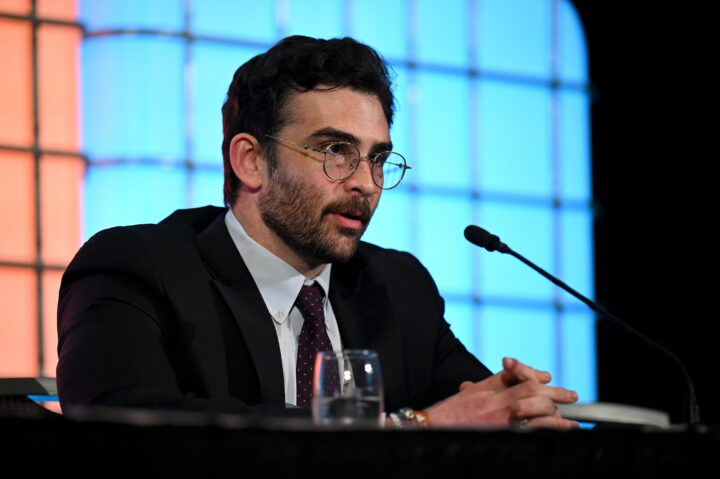
Sam Barnes/Web Summit via Sportsfile via Getty Images
Hasan Piker during day two of Web Summit Vancouver 2026


 Add JewishInsider on Google
The University of Texas’ College Democrats chapter invited antisemitic streamer Hasan Piker to speak on campus at the end of the month, sparking outrage from Jewish leaders and students on campus and generating a potential political firestorm in a red state hosting consequential elections in November’s midterms.
The event, hosted by the University Democrats, a decades-old student Democratic party political organization, is scheduled to be held on Sept. 30, amid the final stretch of Texas’ highly competitive Senate race between Republican Ken Paxton and Democrat James Talarico and a competitive gubernatorial contest between GOP Gov. Greg Abbott and Democrat Gina Hinojosa.
“Hasan Piker said America deserved 9/11 and praised the brutal terrorist organization Hamas. University Democrats at UT Austin are choosing to amplify that disgusting rhetoric. Terrorist sympathizers have no place in Texas,” an Abbott spokesperson told Jewish Insider.
Asked about Piker’s invitation, Hinojosa’s campaign spokesperson did not address the issue. “Gina will be in East Texas that day talking about securing the American Dream by saving our schools and putting money in your pocket,” Hinojosa spokesperson Tommy Kubitschek said.
Madison Cercy, a Paxton campaign spokesperson, told JI, “James Talarico and Hasan Piker are both leaders of the same Democratic Socialist Movement that wants to raise taxes, trans your children, and abolish prisons. They welcome extreme radicals into their base and don’t bat an eye when they start chanting ‘death to America.’”
Talarico’s campaign did not respond to requests for comment from JI about the invitation for Piker to speak on campus at the state’s flagship public university.
Piker, who has an extensive history of antisemitic and anti-American rhetoric, including justifying Hamas’ Oct. 7, 2023, terrorist attacks, calling Orthodox Jews “inbred,” and asserting in 2019 that America deserved 9/11 — a remark he later said he should have phrased better while standing by the underlying critique — has praised Talarico.
The University of Texas, Austin Mayor Kirk Watson and the Texas Democratic Party did not respond to requests for comments from JI. Rep. Marc Veasey (D-TX), who co-chairs the House Bipartisan Task Force for Combating Antisemitism, also declined to comment.
Jewish students, faculty and parents at the University of Texas told JI that the upcoming event marks a negative shift for a campus that they said had previously been one of the most welcoming in the country for Jewish students since Oct. 7. Some are pushing the public university to cancel the event, though they noted this is unlikely to happen because of free speech protections.
“My concern is not that Hasan Piker holds views I disagree with, it is that his public rhetoric has repeatedly crossed a line that Jewish students should not be expected to ignore simply because it is framed as political commentary,” Ella Trubek, a senior at UT majoring in psychology, told JI.
“When someone with an enormous platform has spoken about American Jews eventually facing ‘action,’ referred to Orthodox Jews as ‘inbred’ and repeatedly used rhetoric that many Jewish students experience as dehumanizing, inviting him onto our campus has a real impact on how safe and supported our community feels. Jewish students at UT are not asking to be protected from uncomfortable conversations; we are asking the university to recognize the difference between discomfort and feeling genuinely targeted. I love UT, and I believe our concerns deserve to be taken seriously.”
Trubek, who is president of the campus AEPhi chapter, wrote a letter to University of Texas President Jim Davis to reconsider holding the Piker event on campus. Davis has not yet responded to the request, according to Trubek.
Lisa Strauss, the parent of a UT student, described the Austin campus as handling the 2024 anti-Israel encampment movement that roiled campuses nationwide “extremely well,” noting it was one of the first universities in the country to ban encampments and non-students from entering campus to protest.
“That was a great thing for all students, not just Jewish students,” she told JI. “Everything has been pretty quiet on our campus since then. When this came out a week ago, that College Democrats were bringing him, the first response was that surely UT can shut this down.”
Strauss pointed to the University of Washington, where a student group recently planned to host Piker. The university canceled the event, citing a flawed planning process. The College Democrats of America also hosted Piker as a surprise speaker at its national convention last month, which drew condemnation from the group’s own Jewish Caucus over Piker’s history of antisemitic comments.
“When we dug further into what we should do as a community, everyone mobilized immediately, emailing and calling the president of the university, the governor’s office, our senators and the response we kept getting was they’re not sure they can do anything about it because of free speech and this is not being brought by the university. While it is going to be held on campus, it’s being brought by a student group,” said Strauss. “They can’t prevent a student group from bringing a speaker.”
“That’s one of the more upsetting things, that a mainstream organization is bringing this versus Students for Justice in Palestine or one of those,” she continued.
Rabbi Stephanie Max, executive director of University of Texas Hillel, said in a statement that the irony of the event being hosted during Sukkot, a holiday that encourages welcoming guests, “is disturbing.”
“We value our campus — with its obligations and limitations around free speech — as a place for disagreement, pluralism and debate … Mr. Piker’s views however go against our values as Americans and Jews, and his hateful, antisemitic rhetoric is repulsive.”
Max said Hillel leaders are in ongoing contact with university officials regarding the event.
Jewish Insider congressional correspondent Emily Jacobs contributed reporting.
UCLA banned SJP as a campus organization indefinitely in March 2025

Getty Images
Royce Hall building on University of California (UCLA) campus in Los Angeles, California, USA - May 28, 2023.
Despite being banned from campus, UCLA’s Students for Justice in Palestine chapter is actively lobbying candidates to influence upcoming student government elections, Jewish Insider has learned.
SJP contacted candidates and asked them to complete an attached questionnaire in order to secure the group’s endorsement, according to an email reviewed by JI. SJP is permitted to endorse in the race as an “external organization” since it is no longer officially recognized on campus, according to the election board’s guidelines.
“This is more proof that the anti-Jewish movement — even when banned from our campus — continues to break the rules to intimidate their fellow UCLA students,” UCLA Hillel’s executive director, Daniel Gold, told JI. “Student government should honor premier student leaders — and should be free of any influence by those banned for bad behavior.”
A UCLA student affairs spokesperson told JI, “Students for Justice in Palestine is not recognized as an official organization at UCLA nor receives any university resources. We want to make clear that candidates for student government may choose to ignore questions as they see fit.”
UCLA banned SJP as a campus organization indefinitely in March 2025 after the group led a demonstration outside the home of UC Regent Jay Sures, who is Jewish. SJP members left red handprints on Sures’ garage door, accusing him of having “blood on his hands” amid the Israel-Hamas war.
Last month, UCLA’s student government condemned a campus event featuring former Israeli hostage Omer Shem Tov, labeling the speaker selection as “selective platforming of narratives that obscure the broader reality of ongoing state violence” and “a troubling disregard for Palestinian life.”
Sures, who is also vice chairman of United Talent Agency, told JI at the time that UCLA’s student government was “shortsighted, antisemitic or both,” and called its members “lunatics” for condemning Shem Tov’s speech.
Efforts to delegitimize Hillels tell Jewish students ‘that their identity is suspect and that their safety and belonging is up to the vote of their fellow students,’ AJC’s Laura Shaw Frank said
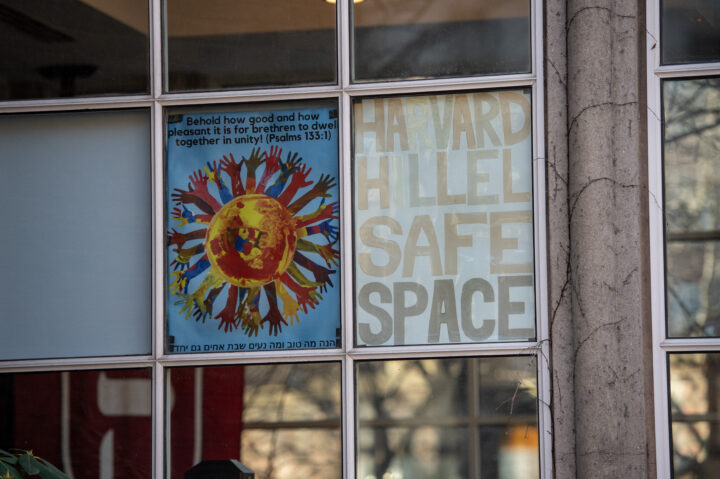
JOSEPH PREZIOSO/AFP via Getty Images
A sign calls the building a safe space at the Jewish student organization HILLEL society's building at Harvard University in Cambridge, Massachusetts on December 12, 2023.
In the aftermath of the New School student government’s vote to defund and sever ties with Hillel, Jewish leaders are warning that the latest front in campus anti-Israel activity is designed to delegitimize the world’s largest Jewish campus organization.
“Hillel is a space of Jewish belonging on campus. It is a place Jewish students need, and particularly need right now. For anyone to call into question a place that Jewish students go for their needs is beyond the pale. This absolutely crosses a red line,” Laura Shaw Frank, vice president of the American Jewish Committee Center for Education Advocacy, told Jewish Insider.
Last week, the New School’s student senate approved a resolution to strip funding and cease collaboration with Hillel, alleging that Hillel violated international law by running programming in Israel, including Birthright trips and volunteer opportunities with the Israel Defense Forces.
While the New School’s administration rejected the vote, the move marked the first time a student government has moved to officially cut ties with the organization that acts as a hub of campus life for Jewish students — although many have called on their universities to end partnerships with Hillel, particularly after the Oct. 7, 2023, terrorist attacks in Israel and the ensuing war in Gaza.
Now some in the Jewish community believe that student governments on other campuses will imitate the behavior.
“We’re very heartened by the New School making clear this is not going to happen and we’re pretty confident other university leaders would do the same,” said Shaw Frank. “At the same time, it has to be made clear that Hillel is one of the key places on campus that Jewish students go for support, Jewish identity and celebration, and this kind of message is that their community spaces are conditional, that their identity is suspect and that their safety and belonging is up to the vote of their fellow students.”
“None of those things are acceptable, so we will be doing everything in our power to ensure that any kind of trend in this direction is shut down. It’s completely unacceptable and antisemitic.”
Shira Goodman, the Anti-Defamation League’s vice president of advocacy, labeled the incident at the New School “an escalation,” voicing concern that campus organizations are targeted solely for supporting Israel.
“We’ve seen in the last two years calls to dissociate from Hillel; that was among some of the encampment demands and there have been protests blocking access to Hillel and Chabad events,” Goodman told JI. “We hadn’t seen a campus resolution like that so we’re certainly worried that it will become a bigger trend.”
Those concerns come as campus antisemitism and anti-Israel activity — which reached historic levels during Israel’s war with Hamas and has quieted down since a ceasefire was reached in the fall — appears to be ramping up again as the end of the academic year approaches.
The outgoing chair of University of Michigan’s faculty senate, who has a history of anti-Israel advocacy, attacked Israel at a commencement ceremony on Saturday in comments that deviated from his prepared remarks. The university apologized for his behavior.
Last month, UCLA’s student government condemned a campus event featuring former Israeli hostage Omer Shem Tov, labeling the speaker selection as “selective platforming of narratives that obscure the broader reality of ongoing state violence” and “a troubling disregard for Palestinian life.” UCLA said it stood by Hillel for hosting the event.
On Monday, the ADL sent a letter to around 150 campuses expressing concern about the resurgence of antisemitic harassment, including the recent reestablishment of encampments at Occidental College and Smith College. (Both were quickly dismantled.)
Goodman was skeptical that resolutions aimed at shutting down Hillel will be successful or that they could replace campus Boycott, Divestment and Sanctions efforts. While BDS initiatives had largely disappeared prior to Oct. 7, the months following the Hamas attack and the start of the war in Gaza sparked a resurgence in efforts to enact them on various campuses.
“Given that most of those resolutions have been unsuccessful in getting campuses to divest — although some have led to being able to present to investment committees — I think these will also be unsuccessful,” she said.
Still, both types of resolutions lead to a hostile campus climate for Jewish students, she said.
“These student government bodies are supposed to be places that deal with student organizations, funding, policies that impact students and they’re spending a lot of time on these issues that don’t impact students daily lives and are becoming increasingly hostile to the Jewish students on campus.”
Shaw Frank and Goodman both said that a silver lining of recent campus turmoil is that institutions are now better equipped to handle antisemitism than they were in 2024, when anti-Israel encampments first roiled campuses nationwide and university administrators floundered in shutting them down and negotiating with student protesters.
“I think with respect to the demonstrations that took place in 2024, it was very clear to campus administrators that their campuses were being shut down and they were unable to continue their work as institutions of learning,” said Shaw Frank. “Employing time, place and manner restrictions as we and other Jewish organizations called for largely solved the problem.”
She added that the current situation “is much smaller” than it was two years ago. “Most students are no longer active in this space on campus, even in places that were hotbeds of protests in 2024. The protests are much more anemic now. We know that students who see themselves as activists tend to choose places like student government. A small number of students have a disproportionately powerful impact,” said Shaw Frank.
Jewish leaders are looking to university administrations to take decisive action in protecting Jewish students.
“We want to make sure that they use the policies that they enacted, or decided to enforce, after 2024 and that they continue to do that, they continue to be clear that there are consequences for violating university policies and that all students can access their educational and extracurricular activities equally,” said Goodman.
Shaw Frank added, “This is a moment when university leadership must not only speak out very clearly to state this is unacceptable, but also ensure that their codes of conduct and guidelines are up to date and their departments of student life are educated about antisemitism.
“We urge universities to ensure that it is very clear to their student governments and student bodies what types of resolutions are OK and what are not OK.”
Magill resigned as president from UPenn after a disastrous Capitol Hill hearing where she evaded questioning over whether calling for the genocide of Jews violated school policies

Kevin Dietsch/Getty Images
Liz Magill, then president of University of Pennsylvania, testifies before the House Education and Workforce Committee at the Rayburn House Office Building on December 5, 2023 ,in Washington, D.C.
Liz Magill, the former University of Pennsylvania president who resigned after facing criticism of inaction against campus antisemitism, was tapped on Friday as the dean of Georgetown University Law Center.
Magill left her post at UPenn in December 2023, four days after she appeared at a contentious hearing on Capitol Hill where she evaded questioning over whether students who called for the genocide of Jews violated the school’s code of conduct.
Magill, who maintained her role as a tenured professor at the university’s law school after resigning as president, faced scrutiny following the Oct. 7, 2023 terrorist attacks in Israel over her handling of the subsequent rise of campus antisemitism from many elected officials in the state including Gov. Josh Shapiro. Even prior to Oct. 7, the Philadelphia campus saw increased hostility to Jewish students, including a September 2023 Palestinian Writes literature conference that featured a lineup of antisemitic speakers.
In a campus-wide email, Robert Groves, Georgetown’s interim president, said Magill was selected for her “rare combination of leadership and experience.”
“I am shocked and deeply taken aback by the announcement that Liz Magill will be the new dean of Georgetown Law. For many Jewish students including myself on this campus, this decision feels like a slap in the face,” Julia Wax Vanderwiel, a third-year student in the law school and founder of Georgetown Law Zionists, told Jewish Insider.
“At Penn she failed to protect the students in her charge, choosing instead to engage in what appeared to be a political and semantic exercise at a moment when moral clarity was required. When directly confronted, she refused to acknowledge the harm her institution allowed or the fear Jewish students were experiencing due to cries and chants of calling for the genocide of Jews,” continued Wax Vanderwiel. “At a time when antisemitism on college campuses has surged and Jewish students are looking to their institutions for leadership and protection, this appointment sends a deeply troubling message. It suggests that Jewish students’ concerns are negotiable, contextual or secondary. That is profoundly disappointing.”
Georgetown University — and its law school — have been under scrutiny for alleged inaction against extremism and the more than $1 billion the school has received from Qatar, a Hamas benefactor. In July, Groves was questioned about campus antisemitism by the House Education and Workforce Committee.
Last February, the law school scheduled a discussion featuring a convicted member of the U.S.-designated terrorist organization Popular Front for the Liberation of Palestine. The event, which was organized by Georgetown Law Students for Justice in Palestine, was postponed indefinitely following pushback from both Israeli Prime Minister Benjamin Netanyahu and Rep. Ritchie Torres (D-NY). Weeks after the Oct. 7 attacks, Georgetown Law hosted Palestinian writer Mohammed El-Kurd, who celebrated Hamas as a “liberation movement” and called the massacre a “resistance tactic.”
In a statement, Magill, who will begin at Georgetown on Aug. 1, said, “I know my testimony in Congress left many concerned and distressed, especially Jewish students on the Penn campus. That response matters deeply to me. I failed to convey my compassion and concern for Jewish students. I regret that; it does not reflect who I am as a person and a leader. I want every Jewish student, and all students, to have a secure environment at the law school where they can thrive.”
The university said that SJP was suspended for ‘violations to university policies,' but didn’t elaborate further

Robert Knopes/Education Images/Universal Images Group via Getty Images
American University, Washington, D.C.
American University has suspended its chapter of Students for Justice in Palestine through November 2027, the D.C. private school confirmed to Jewish Insider.
The organization was suspended for “violations to university policies,” an AU spokesperson told JI, but did not elaborate on details of the violation.
AU’s chapter of SJP has been under disciplinary probation since April 2024, following a silent indoor protest in which about 30 demonstrators held signs calling on the university to end support of Israel. The university banned indoor protests earlier that year when it updated its speech and expression policies in response to a federal civil rights complaint from Jewish students. SJP was previously under cease and desist status, the university told JI.
Last February, AU abruptly canceled an SJP event titled “Debunking Zionist Lies Workshop.”
The event, which was shut down just hours before it was set to begin, was advertised online with a photo of a masked individual wielding a slingshot and the call to “Smash Zionism,” which the university said contained “imagery and language that contributed to the safety concerns.”
“This event did not undergo the necessary safety assessment,” AU wrote in a statement at the time.
Stephanie Parnes, a sophomore in AU’s School of International Service, expressed hope that “this suspension helps move us toward a more peaceful campus, one where pro-Israel students don’t feel like they have to hide who they are to feel safe or accepted.”
While Parnes, who serves as an Israel on Campus Coalition community impact fellow and president of Eagles for Israel, was not yet on campus “to witness the harassment from SJP” in the immediate aftermath of the Oct. 7, 2023 terrorist attacks in Israel, but she told JI she “saw what came after and heard countless stories from friends in the years above me about the hostility and torment they experienced.”
“One moment that really stuck with me during my freshman year was the Gaza solidarity sukkah that SJP and Jewish Voice for Peace put up during Sukkot. It was deeply unsettling to watch a Jewish holiday be used in a way that felt antisemitic on many levels,” Parnes said.
AU SJP responded to the suspension in an Instagram post writing, “a suspension means nothing to us… University repression will be met with resistance.”
Please log in if you already have a subscription, or subscribe to access the latest updates.
 Continue with Google

 Continue with Apple