



































Worldwide, 20 people were killed last year in four antisemitic attacks across three continents

Christopher Furlong/Getty Images
Members of the public and congregants seen as Police and other emergency responders attend the Heaton Park Hebrew Congregation Synagogue, where multiple were injured after stabbing and car attack on Yom Kippur, on October 2, 2025 in the Crumpsall suburb of Manchester, England.


 Add JewishInsider on Google
Germany remained the country with the most antisemitic incidents relative to its Jewish population in 2025, among Diaspora countries with major Jewish populations, according to a new report from leading Jewish groups released on Wednesday.
According to the report, nearly 70 antisemitic incidents per 1,000 Jewish residents were recorded in Germany in 2025.
Not since the terror attack on a Jewish community center in Buenos Aires, Argentina, more than 30 years ago has the Jewish Diaspora experienced as deadly a year as 2025.
Worldwide, 20 people were killed last year in four antisemitic attacks across three continents — all in “J7” countries, the seven countries with the largest Jewish Diaspora populations — including deadly incidents in Sydney, Australia, and Manchester, England. Eighty-five people were killed in the 1994 AMIA attack in Buenos Aires, which still marks the deadliest terror attack on Jews outside of Israel.
The data comes from the second annual Report on Antisemitism by the J7 — a global alliance formed in July 2023 by major Jewish organizations representing the seven largest diaspora communities outside Israel: the United States, the United Kingdom, France, Germany, Canada, Argentina and Australia.
Tel Aviv University published a study with the same findings in April.
The J7’s 52-page report tracked over 23,000 antisemitic incidents across J7 countries in 2025 — a 136% total increase and a 97% surge in violent acts compared to 2022, prior to the Oct. 7, 2023, Hamas attacks in Israel.
While the number of antisemitic incidents in the U.S. plummeted by a third last year, assaults with a deadly weapon spiked, according to a May report by the Anti-Defamation League. The May 2025 killing of two Israeli Embassy staffers outside the Capital Jewish Museum in Washington marked the first Jews to be killed in antisemitic attacks on U.S. soil since 2019. One month later, a Jewish victim died from her injuries sustained in a firebombing attack in Boulder, Colo., at a march in support of the Israeli hostages.
Every J7 country’s antisemitic incidents remain dramatically above pre-Oct. 7 levels. Australia saw the sharpest rise of antisemitic incidents since 2021 (+270%), followed by Germany (+215%), the U.S. (+131%) and France (124%). Anti-Zionism was a key motivation behind a significant share of incidents: 48% in the U.K., 45% in the U.S. and 23% in Germany.
The report also features a new “in focus” section highlighting Ireland, which saw 143 antisemitic incidents — a rate of 65 per 1,000 Jewish people — while the country lacks a national strategy to combat antisemitism and dedicated security funding for religious institutions.
“The J7 Annual Report makes clear that antisemitism is no longer a temporary surge, but a sustained global crisis affecting Jewish communities across all seven countries,” said William Daroff, CEO of the Conference of Presidents of Major American Jewish Organizations, which represents the U.S. along with the ADL in the J7. Daroff called on governments, institutions and technology companies to “act with urgency, enforce the law, strengthen security and ensure that Jews can live openly and safely.”
Antisemitism envoy Yehuda Kaploun, who also spoke at the event, praised Argentina as having ‘transformed from a beacon where terrorism once reigned supreme to a beacon of Jewish life’
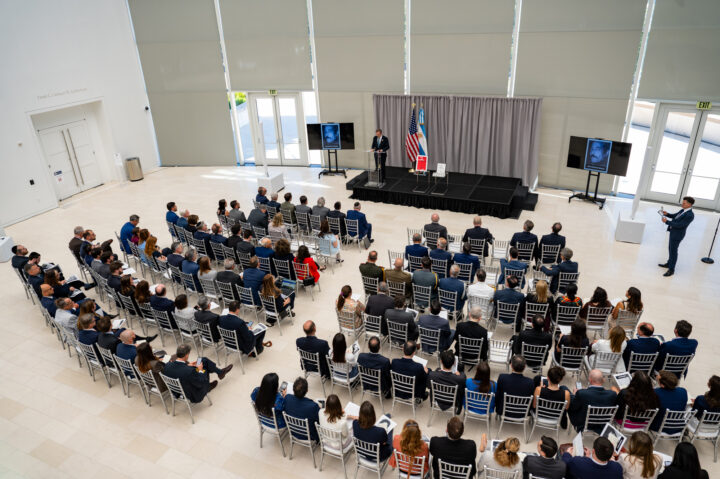
Embassy of Argentina
The State Department and Argentine Embassy in Washington host a commemoration ceremony for the 32nd anniversary of the AMIA bombing.
The State Department’s top legal advisor on Wednesday drew a direct connection from the signing of the Oslo Accords in 1993 — which sought to bring peace between the Israelis and Palestinians — to the global rise in Islamist terrorism, in remarks delivered at an event in Washington marking the anniversary of the deadly 1994 terror attacks on the AMIA Jewish Center in Buenos Aires. The suicide bombing, orchestrated by Hezbollah, killed 85 people and injured more than 300 others one year after the signing of the Oslo Accords at the White House.
Diplomats, survivors of the attack, Jewish community members and State Department officials gathered on Wednesday at the U.S. Institute of Peace to commemorate the July 18 attacks, where U.S. and Argentine officials vowed to work together to fight Islamist terrorism. Reed Rubinstein, the State Department legal advisor, used his remarks to herald President Donald Trump’s efforts to fight terrorism, which he described as a course correction from decades of failed leadership.
“The fruit of those accords paradoxically included a massive increase in brutal terrorism,” Rubinstein said, referring to the Oslo Accords. “Oslo led to an unprecedented wave of suicide bombing and death.”
He criticized activists who called the dead “sacrifices to peace,” chastising them for using biblical language “to justify the murder of many as ‘unfortunate but necessary’ sacrifices on the path to peace.”
“In those days, and for so many years after, when moral clarity and truth telling were required, the leadership failed,” said Rubinstein. He took aim at institutions like the United Nations, universities and the media for failing to speak out against antisemitism — and placed blame on Trump’s predecessor, President Joe Biden.
“Candidly, prior to Jan. 20, 2025, the United States government more often than not failed, and in many cases failed spectacularly,” said Rubinstein. “But under President Trump, things have changed. Under his direction, the United States has taken and is taking decisive and unprecedented steps to fight antisemitism.”
Rabbi Yehuda Kaploun, the U.S. special envoy to monitor and combat antisemitism, called Argentina a “model for the world” in combating terrorism. He shared that two days earlier, during a visit to the South American country, he met with President Javier Milei and thanked him for designating Iran’s Islamic Revolutionary Guard Corps as a terrorist organization.
“Argentina has transformed from a beacon where terrorism once reigned supreme to a beacon of Jewish life,” said Kaploun.
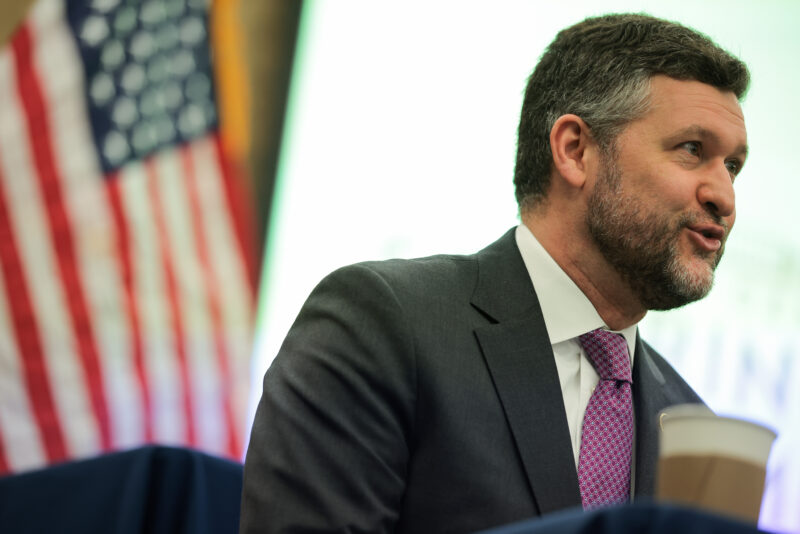
Other senior State Department officials at the event included Jacob Helberg, the under secretary of state for economic affairs; Thomas DiNanno, under secretary of state for arms control and international security; and the State Department’s counterterrorism coordinator, Gregory LoGerfo. Argentine Ambassador to the U.S. Alejandro Oxenford introduced the event, which was organized by Rep. Brian Mast (R-FL), chair of the House Foreign Affairs Committee.
Agustina Cruz was the first recipient of an award promoted by the U.S. Embassy in Buenos Aires and the city’s Holocaust museum that is named after a group of Germans who openly protested Hitler

Dina Brookmyer
Inside the Shapell Center of the U.S. Holocaust Memorial Museum
Until this month, 21-year-old Agustina Cruz had never left Argentina. Before this year, she had never even been to Buenos Aires, which is more than 900 miles southeast of her hometown of Palpalá, a small city of 60,000 people located in Jujuy, a region known for soaring rock formations.
That all changed earlier this year when she became the inaugural recipient of the White Rose Award, a prize administered by the U.S. Embassy in Argentina and the Buenos Aires Holocaust Museum. The award was named for a group of Germans who openly protested Adolf Hitler and the Nazis’ extermination of Jews.
Cruz won the award for advocating for the Romani, a community so marginalized in Argentina that people accused her of “getting into the mouth of the devil” — a Spanish expression — simply for publicly supporting a Roma family in the face of taunting from her classmates.
But her planned trip this month to Washington, where she was slated to visit the U.S. Holocaust Memorial Museum and tour the city, almost fell apart due to ignorance and hate.
One of Cruz’s university professors had initially told her that she would get an excused absence for missing class. But once that professor found out that Cruz would be on a trip to learn about the Holocaust, the professor said Cruz could not miss class, because the trip was sponsored by a Jewish organization.
“She shouldn’t be discriminated against for doing the right thing herself,” said Marc Stanley, who served as U.S. ambassador to Argentina from 2022 until January of this year. He worked with the Holocaust Museum of Buenos Aires on the award, and accompanied Cruz to Washington earlier this month after she decided to make the trip and risk a failing grade in her course.
“In my community, there’s lots of ignorance. They do not respect the Roma community,” Cruz told Jewish Insider via a translator at the end of an eventful day at the Holocaust Museum in Washington, which included a two-hour private tour and a meeting with a Holocaust survivor. As she described the bullying she faced for standing up for embattled members of the Roma community, Cruz began to cry.
She had learned about the White Rose Award from her teacher, Lorena Rosa Blanca, who accompanied her on the trip to Washington. Cruz was selected as the winner by a panel in Buenos Aires that included Stanley and Jewish, Christian and Muslim leaders.
“She’s a very strong girl who suffered discrimination at school,” Rosa Blanca told JI.
As Cruz walked through the museum, she recorded video of nearly everything her Spanish-speaking tour guide said, including when he told her that her work is important “for humankind.” She paused at a panel about the Roma, which explained that “long-held prejudices were fueled by Nazi racism.” Between 250,000 and 500,000 members of the Roma community were killed by the Nazis. Cruz took in the exhibits with awe and horror, including a section about the Nazis who hid out in Argentina after the end of the war.
“I feel so enriched by all of this information,” Cruz said afterward. “I’m thinking of using social media, perhaps TikTok or some other social media [platform], to reach out to teenagers and open their eyes to the history, to all the suffering, and to the fact that we are all human beings, and we all deserve to enjoy human rights.”
The project had a diplomatic goal, in addition to the educational goal for the recipient. Educating about the Holocaust — and about tolerance — is an American value that U.S. emissaries abroad have a duty to promote, Stanley explained.
“I think human rights is certainly a U.S. value,” Stanley said. “Making known that we both [the U.S. and Argentina] have museums like this, that we both constantly battle against discrimination against marginalized communities, is something that I worked on as U.S. ambassador. Showing that we’re in the same fights with Argentina, that we’re all in the same boat, I think is important.”
Cruz, now studying social work as a university student, said she plans to let her peers know “that they should not be afraid to speak up to defend other people, other people who may be different.”
Suzanna Tarica, an 85-year-old Holocaust survivor who was born in France in 1940, listened intently as Cruz shared her story.
“What you’re doing is what I want to do also,” Tarica told Cruz. “We are looking at accomplishing the same goal, which is tolerance, understanding and peace — and to get rid of ignorance.”
Please log in if you already have a subscription, or subscribe to access the latest updates.
 Continue with Google
 Continue with Apple