




































































The NYC mayor cited violence against Jews to justify his eight-figure funding boost for the city’s Office for the Prevention of Hate Crimes

Michael Nagle/Bloomberg via Getty Images
New York City Mayor Zohran Mamdani presents the fiscal year 2027 executive budget at City Hall in New York, US, on Tuesday, May 12, 2026.


 Add JewishInsider on Google
New York City Mayor Zohran Mamdani announced his administration would allocate $26 million annually toward anti-hate crimes measures, signaling that the significant funding increase — promised during the campaign season — would go toward a program that funds both leading Jewish organizations and left-wing nonprofits.
The new funding, part of a sprawling $124.7 billion budget that would resolve the city’s fiscal woes largely by delaying pension payments, would go toward the city’s Office for the Prevention of Hate Crimes — though the mayor provided few details about the funds’ destination in a Tuesday afternoon press conference. He did, however, acknowledge that Jewish New Yorkers represent a minority of city residents yet a majority of hate crime victims, and promised the anti-hate crime campaign would operate “alongside” the Mayor’s Office to Combat Antisemitism to reduce the number of prejudice-inspired incidents.
“These are investments in programs that have been found to be effective. And too often the only response offered to a hate crime is exactly that, it’s a response to the hate crime. We want also to do the work of preventing those hate crimes,” he said, adding that his antisemitism czar, Phylisa Wisdom, would soon embark on a “listening tour” to develop a “municipal approach to fighting antisemitism.”
Additional details were not immediately available, and Mamdani’s office did not respond to questions from Jewish Insider.
Initial reports asserted that this represented a $23 million increase over a prior $3 million budget. That $3 million figure matches the amount the Partners Against the Hate (P.A.T.H.) FORWARD Initiative, which operates under the Office for the Prevention of Hate Crimes, provided last year to “50 community-based organizations representing the city’s diversity to help combat hate and bias motivated incidents,” according to an analysis the Mamdani administration also released on Tuesday.
A list of subvendors for the initiative released last year features a wide range of social service providers, including a number based in or supporting Jewish communities across the city. Sources at several of these participating nonprofits did not immediately answer questions as to whether P.A.T.H. Forward might benefit from the new spending — and one, Devorah Halberstam of the Jewish Children’s Museum of Crown Heights, told JI she had “no idea, because he just announced it.”
P.A.T.H. Forward also provides resources to multiple leftist organizations, such as Jews for Racial and Economic Justice and the Council on American-Islamic Relations, that supported Mamdani’s election through political affiliates.
Netanyahu’s coalition promised Haredi parties to effectively bring back the draft exemption as IDF warns of dangerously low manpower
Yonatan Sindel/Flash90
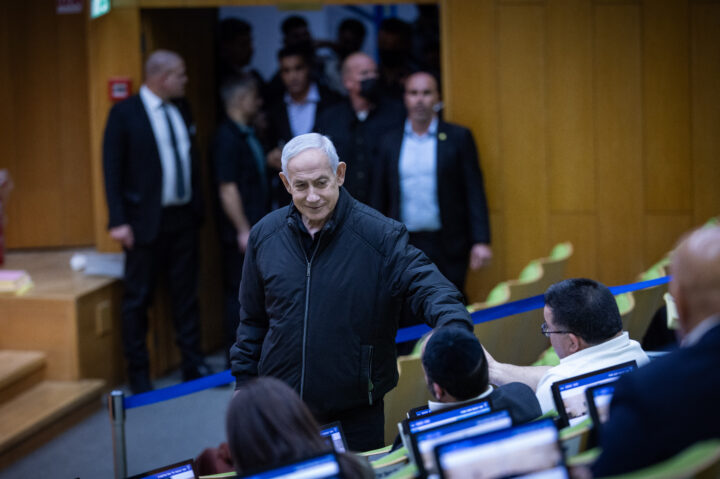
A vote on the state budget at the auditorium in the Knesset, the Israeli parliament in Jerusalem, during the war with Iran and Hezbollah, March 29, 2026.
Israeli Prime Minister Benjamin Netanyahu’s governing coalition narrowly beat a deadline that would have led to an early election, passing the 2026 state budget early Monday morning, a day before the March 31 deadline.
The budget passed after the coalition granted NIS 800 million ($255 million) in benefits to Haredi institutions, and promised Shas and United Torah Judaism that the government would pass a law that, in effect, would continue yeshiva students’ exemption from military service, even as Lt. Gen. Eyal Zamir, the IDF chief of staff, raised “10 red flags” about insufficient military manpower.
According to Israeli law, state budgets are meant to be passed by the end of the previous fiscal year, on December 31, but an extension is permitted to the end of March. If no budget is passed by the final deadline, the Knesset is automatically dissolved and an election is called for three months later.
This government had used that extension amid disputes over legislation reducing the penalties on Haredi yeshivas and young men who do not enlist in the IDF such that it would effectively continue their blanket exemption from military service. The matter remained unresolved, with Haredi parties threatening to vote against the budget, as the war with Iran began at the end of February.
Two weeks into the war, Netanyahu and Israeli Finance Minister Bezalel Smotrich announced that the coalition would set aside legislation under dispute, including Haredi conscription, in order to pass the budget.
As part of the conditions for Haredi parties Shas and United Torah Judaism to drop their demand to pass the conscription exemption bill, the budget included an increase of over NIS 1 billion (approximately $319 million) for Haredi yeshivas and other institutions. The funding would offset much of the sanctions on Haredi individuals and institutions in recent years, after the High Court of Justice struck down their exemption from IDF service.
Israeli Attorney-General Gali Baharav-Miara had blocked most of the funds from being included in the draft of the budget that went to a vote, because it was meant to circumvent the law, but the coalition voted it in soon after midnight Sunday as an amendment to the budget bill.
In addition, Knesset Foreign Affairs and Defense Committee chairman Boaz Bismuth, of Netanyahu’s Likud Party, said last week that the Haredi IDF exemption bill would be back on the Knesset agenda in two weeks, after Passover — meeting another demand by the Haredi parties that the exemption from the IDF be legislated as soon as possible after the budget.
Bismuth’s remarks about the return of the Haredi exemption bill came on the same day as a report on Israel’s Channel 13 that Zamir warned in a Security Cabinet meeting that the “IDF is going to collapse in on itself” if it does not increase its ranks.
In addition to the likelihood of Haredim no longer facing penalties for failing to serve, a law reducing mandatory IDF service from 36 months to 30 months is set to go into effect in January 2027. Zamir asked the government earlier this year to revert to the previous length of mandatory service.
”I am raising 10 red flags,” Zamir reportedly said. “The IDF needs a [Haredi] conscription law, a reserve duty [extension] law and a law to extend mandatory service. Before long, the IDF will not be ready for its routine missions and the reserve system will not last.”
The 2026 budget is the largest in Israel’s history, reaching NIS 850.6 billion ($271 billion), with an unprecedented NIS 143 billion ($45.8 billion) for the defense budget alone, amid the war with Iran and Hezbollah and continued operations in Gaza.
All other ministries were cut by 3% to fund the extra wartime spending.
The budget was passed in a final vote after over 13 hours of opposition filibustering, as well as repeated missile sirens stopping the proceedings, during which lawmakers voted from a fortified room, as opposed to the regular Knesset plenum.
The prime minister’s governing coalition is struggling to stay intact to pass 2026 budget amid shifting political priorities
GIL COHEN-MAGEN/POOL/AFP via Getty Images
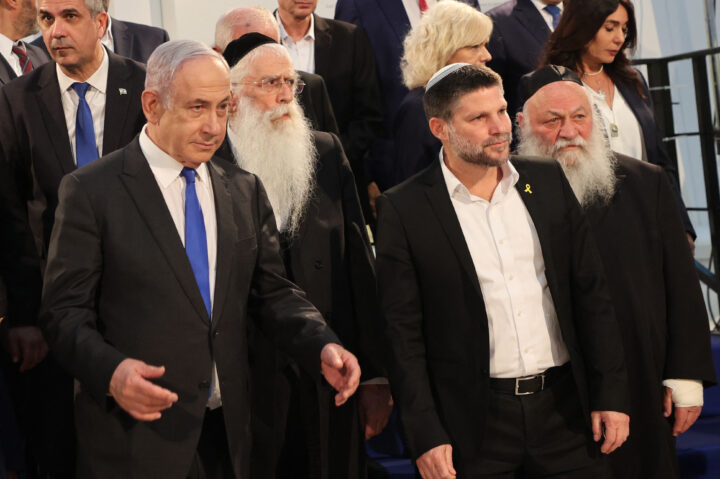
Israeli Prime Minister Benjamin Netanyahu (L) and Finance Minister Bezalel Smotrich (2nd R) arrive for a cabinet meeting at the Bible Lands Museum in Jerusalem on June 5, 2024.
The war against Iran may have united the vast majority of Israelis who support its aims, but much of the governing coalition’s prewar political obstacles still have to be resolved by the end of the month — including the passing of a state budget for the current year and a Haredi conscription law — or else an early election will automatically be called.
The coalition failed to pass a 2026 budget by Dec. 31, a regular occurrence in Israel, due to several policy disputes. By law, if the Dec. 31 deadline is not met, it may be extended to the end of March. However, if the Knesset does not pass a budget by the end of March, the law states that the body will automatically dissolve, with an election held 90 days later.
The Knesset is slated to go into recess on March 24, but it appears increasingly likely that the legislature will stay in session, with efforts to finalize the budget continuing until hours before Passover, which begins on the evening of April 1.
If Israeli Prime Minister Benjamin Netanyahu and his coalition succeed in approving a budget, the official election date would be set for Oct. 26, though the parties could choose to hold it on an earlier date.
Some Israeli media have reported that Netanyahu would prefer to hold the election before Rosh Hashanah (Sept. 12) and the subsequent three weeks of Jewish holidays; other analysts have said he would not want an election after Oct. 7, because the date will serve as a reminder of his government’s failure to prevent Hamas’ 2023 terror attack.
If the coalition does not succeed in passing a budget, the election will be held at the end of June, and Netanyahu’s Likud party will have to launch a campaign, potentially as the war with Iran is still ongoing.
Before the war, the biggest political challenge for Netanyahu’s government related to issues surrounding Haredi military service.
The Haredi exemption from the mandatory IDF draft was canceled by the High Court of Justice in 2023, just prior to the Hamas attacks — and shortly before Israelis became acutely aware of the IDF’s urgent manpower needs. Since then, the government has been embroiled in legal and legislative disputes over how many young Haredi men to conscript and what penalties should be imposed on those who refuse to serve.
With the issue unresolved, both Haredi parties quit their Cabinet posts last year, though Shas and parts of United Torah Judaism mostly continued voting with the coalition in the Knesset. Still, the parties demanded that a bill reducing penalties for not serving in the IDF be passed before they supported the budget.
While the head of the Knesset Foreign Affairs and Defense Committee, Netanyahu loyalist Boaz Bismuth, led the effort to draft legislation that the Haredi parties would agree to — the proposal would institute relatively low enlistment quotas and lessen and defer most penalties for refusing to serve — enough members of Knesset from other coalition parties opposed it that it was unclear that Bismuth’s bill would get enough votes to pass.
Last week, Netanyahu and Finance Minister Bezalel Smotrich announced that coalition parties agreed to put aside all controversial legislation, including the Haredi draft bill, as well as a reform led by Smotrich to further privatize the dairy sector, which faced significant opposition within Likud. The Haredi parties were reportedly incentivized to drop their insistence on passing the bill when Smotrich and Netanyahu agreed to meet their other budgetary demands.
Dropping the Haredi draft bill means that the status quo remains: The IDF is legally required to send draft notices to all Haredi men aged 18-26, though they do not have to send them all at once, and the government must stop funding yeshivas for young men who are required by law to draft. Yet the government does not plan to enforce the law while the war against Iran is ongoing, Cabinet Secretary Yossi Fuchs told the High Court on Thursday.
Attorney General Gali Baharav-Miara flagged some Haredi budgetary demands as illegal, leading the parties to threaten once again to vote against the state budget unless the same amount of funding is diverted to places that Baharav-Miara would not reject. That dispute delayed a vote on increasing the wartime defense budget that had been set for Monday.
At the same time, National Security Minister Itamar Ben-Gvir and his Otzma Yehudit party have yet to drop their most controversial proposal, the death penalty for terrorists, which they continue to demand be passed before the budget vote. Otzma has followed through on past threats to vote against the coalition or absent themselves from key votes if their demands are not met.
Ben-Gvir posted a video on X on Wednesday, in which an off-camera voice said, “I heard the Iranians say that you’re dead.” Standing in front of a gallows with a plaque with Israel’s anthem, a memorial to Jewish underground fighters who were hanged by the British Mandatory government, Ben-Gvir said: “I am dying to execute terrorists. Death penalty for terrorists.”
Please log in if you already have a subscription, or subscribe to access the latest updates.
 Continue with Google

 Continue with Apple