




































House Oversight Committee Chairman James Comer and Rep. Anna Paulina Luna are raising red flags about billionaire Neville Roy Singham’s funding of left-wing groups
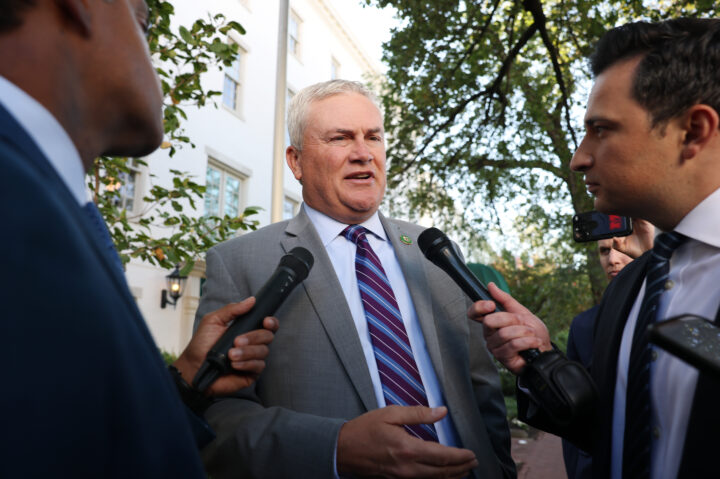
Anna Moneymaker/Getty Images
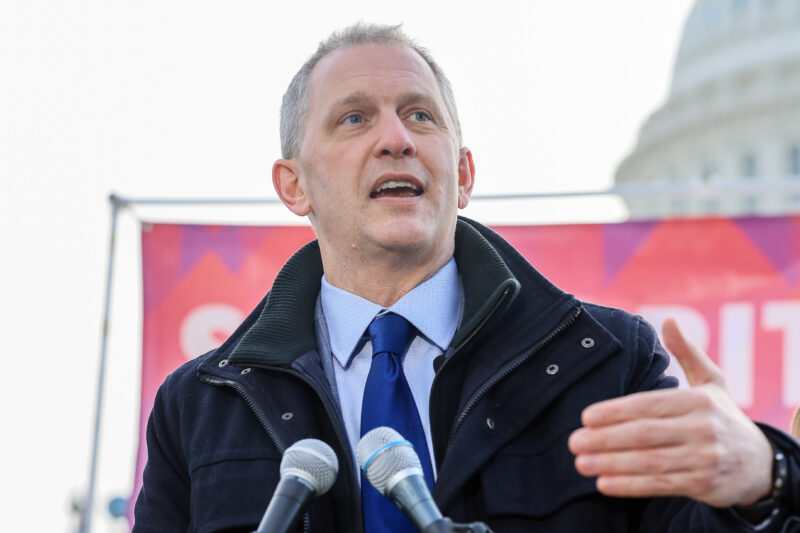
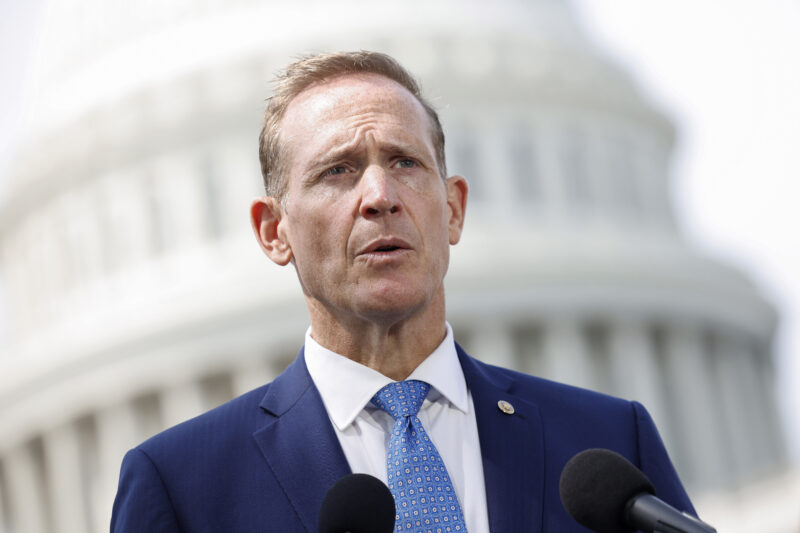
Rep. James Comer (R-KY) speaks to reporters after leaving the House Republicans weekly caucus meetings on Capitol Hill on September 09, 2025 in Washington, DC.


 Add JewishInsider on Google
The House Oversight Committee asked the Trump administration on Monday to investigate if far-left billionaire Neville Roy Singham’s bankrolling of “extremist organizations fueling division and civil unrest across the United States” would qualify him for federal sanctions or make him eligible for criminal or legal penalties.
Committee Chairman James Comer (R-KY) and Rep. Anna Paulina Luna (R-FL), who chairs the Declassification of Federal Secrets Task Force, sent a letter to Treasury Secretary Scott Bessent, requesting the Treasury look into “certain far-left entities, organized and funded by” Singham, as well as his failure “to register as a foreign agent under FARA.”
The lawmakers describe Singham as “a U.S. citizen with ties to the CCP” who has reportedly “been funding and supporting various extremist entities in the United States with the aim of causing destruction and division in our country.”
Singham is a financier who has been accused of funding groups to advance Chinese talking points as well as a network of anti-Israel protest groups responsible for unrest on college campuses, according to the Network Contagion Research Institute.
“Neville Singham has spent millions funding militant organizations that have orchestrated violent riots and launched targeted hate campaigns against Americans with different beliefs,” Luna wrote on X.
The lawmakers noted in the letter that they are investigating efforts by the Chinese Communist Party “to sow discord in the United States,” writing: “It is imperative that we expeditiously halt the continued flow of funds and material support for malign activities conducted at the behest of the CCP.”
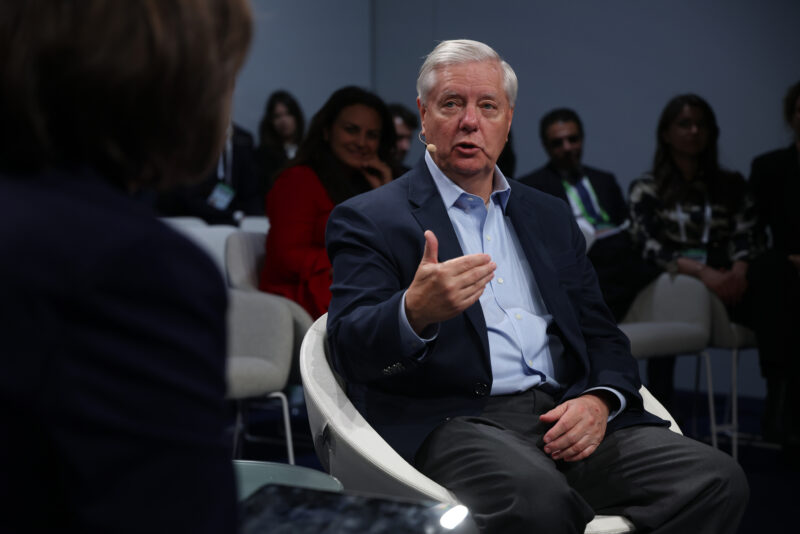
The letter cites reporting from the New York Times, the Free Press and a letter sent to former Attorney General Merrick Garland last year by Secretary of State Marco Rubio, while still serving as senator from Florida, and Sen. Lindsey Graham (R-SC) “raising concerns about Mr. Singham’s activities on behalf of the CCP.”
“It does not appear that the Biden Administration addressed this potential source of civil unrest,” the lawmakers wrote, citing reporting from data scientist Jennica Pounds alleging that Singham’s activities had recently “expanded to include the foment of unrest and civil disobedience in Los Angeles — prompting President Donald Trump to call in the National Guard to counter attacks on federal law enforcement officials.”
They added that, “It has been reported that Mr. Singham is ‘the main backer behind’ the Party for Socialism and Liberation, which has organized nationwide protests, including riots in Los Angeles.”
Singham, who resides in China, “created an elaborate dark money network which allows him to send funds to a series of non-profits,” the letter stated, later adding: “Mr. Singham has expanded his network to include not only far-left, pro-CCP entities, but also radical, antisemitic entities. One such organization is Shut It Down for Palestine (SID4P), an entity established in October 2023.”
The Trump envoy’s colleagues in real estate skeptical he’s mastered the art of the diplomatic deal

CHIP SOMODEVILLA/GETTY IMAGES
White House special envoy Steve Witkoff briefly speaks to reporters as he walks back into the West Wing following a television interview on the North Lawn of the White House on March 19, 2025 in Washington, D.C.
When the billionaire developer Steve Witkoff was tapped as the Trump administration’s Middle East envoy last November, several of his former associates in the real estate industry applauded the unorthodox appointment to a high-profile role overseeing some of the most sensitive foreign policy issues facing the United States.
Even as he had no diplomatic experience, Witkoff, a close friend of President Donald Trump, won praise as a shrewd negotiator and creative dealmaker with sharp business instincts who could draw on decades of experience navigating New York City’s cutthroat real estate market — where he had once been known to carry a handgun during his early years overseeing distressed properties.
But more than three months into his new posting, Witkoff, whose portfolio has expanded beyond the Middle East, is now facing scrutiny from a growing number of critics casting doubt on his qualifications as he assumes a leading role in nuclear negotiations with Iran as well as direct discussions with Russia to end its war against Ukraine.
Among some of Witkoff’s fellow developers who are already souring on his early tenure as Trump’s top envoy, there is skepticism that his insistent focus on striking a deal above all else, an asset in his former job, may be a liability as he engages in high-stakes negotiations with bad-faith actors such as Iran and Russia seeking potentially dangerous concessions from the United States.
“They came in almost wanting a deal more than anything, and that’s not a very good negotiation posture,” Dan Kodsi, a developer in Miami, where Witkoff also owns property, told Jewish Insider of the envoy’s team. “I think they showed their hand way too early, almost like having a deal was more important than having a good deal.”
Kodsi, who said he voted for Trump in the most recent election, suggested that Witkoff’s skills as a developer could potentially be useful in diplomatic efforts. “Developers deal with very tough situations. We’re always facing a wall — always looking for a door or a window to escape,” he explained in a recent interview. “It makes us good at being able to persevere and get around things and to get a deal done.”
But the “problem,” he said, is there are limitations to those analogies, particularly during negotiations with ruthless dictators in which traditional business incentives are irrelevant. “This is not business. It’s not like, ‘I’ll give you more money and we will make a deal,’” he said.
By initially suggesting that the U.S. was open to compromise with Iran, Witkoff left his team exposed with little leverage, Kodsi told JI, even as Trump has dangled the threat of military action to thwart the regime’s nuclear ambitions. “These guys have not kept any cards in their back pocket for negotiation,” he said of Witkoff and his team, which now includes a group of technical experts led by Michael Anton, the State Department’s director of policy planning.
Witkoff, for his part, has continued to use business analogies to clarify his approach to the ongoing negotiations, even while acknowledging he is now pursuing goals that are far more lofty than any real estate transaction.
“The enormity of it sort of struck me,” he said of his meeting with Russian President Vladimir Putin last week, in a WABC Radio interview on Tuesday. “I’ve been in the real estate business, and in the past, it was buying a bigger building, or building a bigger building,” he added. “And this was much more about saving people’s lives, ending the carnage, being there on behalf of the American people, on behalf of President Trump. I had to pinch myself.”
“From what I can tell, these guys are just trying to make a deal,” Henry Liebman, a top developer in Seattle, said. In the process, he added, “it almost seems like they’re getting played.”
He described a similar feeling about the nuclear talks with Iran — which he called “an existential issue for the world, nuclear and weaponization.”
“It felt like I was a fiduciary, that I was doing something larger than myself on behalf of, again, the United States government and President Trump, with strong directives from him as to what he wanted to achieve,” Witkoff said in the radio interview with John Catsimatidis and Rita Cosby.
Henry Liebman, a top developer in Seattle, argued that Witkoff and his team appear “naive” in their dual efforts to negotiate with Iran and Russia, which he characterized as misguided. “With Iran, you can’t let them have nukes and you can’t have them supporting proxies” in the region such as the Houthis in Yemen, he told JI, while describing proposed land concessions to Putin as “not a good idea.”
“From what I can tell, these guys are just trying to make a deal,” Liebman reiterated. In the process, he added, “it almost seems like they’re getting played.”
In recent weeks, Witkoff has drawn backlash over contradictory remarks about Iran’s ability to enrich its own uranium, a key issue in the ongoing talks, as well as a series of stumbles in which he has praised Putin and suggested he had been “duped” by Hamas amid failed negotiations to release the hostages held by the terrorist group in Gaza.
His continued lack of clarity about permissible continued nuclear enrichment by Iran has raised alarms among conservatives who are skeptical that Witkoff is in command of technical details crucial to reaching a deal with the Islamic Republic distinct from the agreement brokered by the Obama administration a decade ago — which opponents had viewed as a pathway to a nuclear weapon.
Trump, who recently said that the talks are going “very well” and suggested that “a deal” is imminent, pulled out of the original agreement during his first term.
Witkoff has not publicly shared details on the latest round of negotiations with Iran that concluded in Oman last weekend. Though he said in a statement in mid-April that Iran “must stop and eliminate its nuclear enrichment and weaponization program” in order for a deal to “be completed,” he has reportedly told Trump administration officials that seeking full dismantlement, which the Iranians have resisted, is unlikely to result in a deal.
His mixed messaging has raised questions about whether Witkoff is now on course to simply revive an old agreement that has long been anathema to most Republicans.
In his radio interview on Tuesday, Witkoff sought distance from the original nuclear deal with Iran, calling it “fundamentally flawed because the sanctions sunsetted, and yet the mandate as to how you’re supposed to conduct yourself — not enriching, not weaponizing — that did not sunset,” he said, referring loosely to terms of the agreement.
“I am concerned that in the face of ill-thought tariff policy, and resistance to Ukraine-Russia resolution, he and his administration are looking for a victory — any victory — and that early compromise on Iran is a bad thing,” Steve Minn, a real estate developer in Minneapolis, told JI. “We have Iran on the ropes,” he said. “Let’s keep Saudi Arabia and Egypt eager to see Iran diminished.”
“You and I both know, in business, one-way options don’t make sense,” he added. “Theyre not fair, and that was a one-way option for the Iranians, and it’s got to be rectified.”
As a fourth round of discussions with Iran is expected to be held in Rome on Saturday, Steve Minn, a real estate developer in Minneapolis who describes himself as an “Israel hawk” and voted for Trump three times, also voiced reservations about the current trajectory of U.S. talks with the Islamic Republic.
“I am concerned that in the face of ill-thought tariff policy, and resistance to Ukraine-Russia resolution, he and his administration are looking for a victory — any victory — and that early compromise on Iran is a bad thing,” Minn told JI. “We have Iran on the ropes,” he said. “Let’s keep Saudi Arabia and Egypt eager to see Iran diminished.”
In a statement to JI on Wednesday, Anna Kelly, a White House spokesperson, said Witkoff “is a trusted friend of President Trump, and he left behind a massive business enterprise to serve our country as a special envoy.”
“His results speak for themselves, including the release of Marc Fogel from Russia and hostages trapped in Gaza,” Kelly continued. “The president is incredibly proud of all Mr. Witkoff has accomplished to help restore peace through strength, and he will continue to leverage Mr. Witkoff’s talents to advance his America First foreign policy vision.”
“He’s not going to go in there and be the best person in diplomacy on Day One, but he knows that he has a mission and he has to get Problem A solved — and there are all these different variables in the problem he has to think about,” Eric Benaim, the founder and CEO of Modern Spaces, a residential brokerage firm in New York City, told JI. “It’s just like a negotiation of anything.”
To be sure, Witkoff still has several defenders in the real estate world who feel that he is doing a good job with a uniquely challenging set of issues. “I cannot think of any one instance where I thought Steve is underprepared or overwhelmed,” Joseph Moinian, an Iranian-born real estate developer in New York City who has known Witkoff for years, told JI. “With him you know that the best outcome is the one he has achieved.”
“If anyone thinks that he is ‘in over his head’ it is not because he is incapable,” Moinian said earlier this week, “it is because the problems are extremely and increasingly impossible.”
Eric Benaim, the founder and CEO of Modern Spaces, a residential brokerage firm in New York City, likewise expressed satisfaction with Witkoff’s approach and said he believed that a background in real estate development is helpful to shake free of a status quo that has hindered progress in the region, even as he acknowledged there is a “learning curve” for such diplomatic work.
“He’s not going to go in there and be the best person in diplomacy on Day One, but he knows that he has a mission and he has to get Problem A solved — and there are all these different variables in the problem he has to think about,” Benaim told JI. “It’s just like a negotiation of anything.”
But as Witkoff has struggled to find his footing on Middle East policy and other key issues, Eric Anton, a veteran real estate broker and Jewish Republican in New York City who has worked on deals with the developer, suggested the newly minted envoy could be reaching a point at which he is over-leveraged as he takes on a dizzying array of responsibilities in his initial months on the job.
“He’s got so much on his plate,” Anton told JI, “ it’s like drinking 20 milkshakes.”
New York Magazine, Wall Street Journal reports detail WeWork founder's political ambitions

Noam Galai/Getty Images
NEW YORK, NY - MAY 15: Co-Founder and CEO of WeWork Adam Neumann onstage during TechCrunch Disrupt NY 2017 at Pier 36 on May 15, 2017 in New York City.
WeWork founder and Israeli-born billionaire Adam Neumann has expressed interest in an ambitious political career, according to recent reports in New York Magazine and the Wall Street Journal.
New York Magazine referenced Neumann’s interest in a political career as part of a longer discussion about the political ambitions of Silicon Valley executives. According to the report, Neumann, who founded the office-sharing company in 2010, recently discussed his ambitions with an unnamed political operative. The Israeli CEO expressed particular interest in a run for the U.S. presidency. Such a proposition would necessitate an amendment to the Constitution, which requires that the president be a natural-born citizen.
When asked about the possibility of running for mayor or governor, Neumann reportedly replied, “Once you’ve reached my level of success, only president will do.” Though a source close to Neumann denied he made the comment, the WeWork CEO has yet to provide an official denial on any part of the report. Jewish Insider was unable to reach Neumann or a representative for comment.
But perhaps he would settle for something other than U.S. president. A Wall Street Journal report on Wednesday noted that the billionaire told at least one person that he’d like to be the prime minister of Israel. The WSJ also reported that Neumann told another individual the only thing he’d run for would be “president of the world.”
Though unscathed from government attention, WeWork has experienced a rocky year. After months of hype and media attention, earlier this week the company postponed its plan for a much-hyped initial public offering. Subsequent media and investor attention uncovered questions about company’s finances, profitability, and management. In addition to postponing the IPO, the WeWork board took recent steps to limit Neumann’s power as CEO.
Please log in if you already have a subscription, or subscribe to access the latest updates.