










































































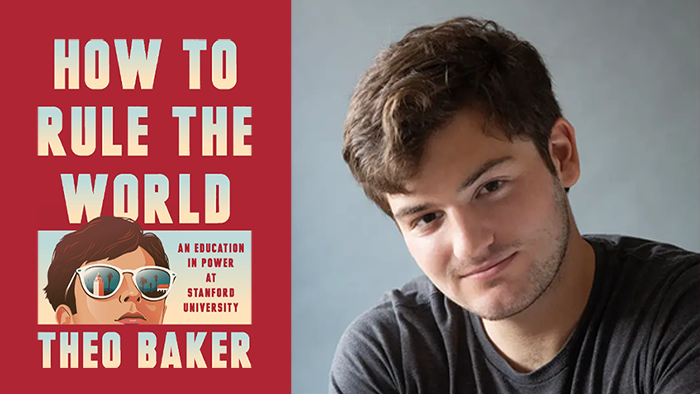
Discussing his new book 'How to Rule the World: An Education in Power at Stanford University,' Baker revealed to JI details about his turbulent and impactful college years


 Add JewishInsider on Google
Theo Baker describes himself as “an accidental journalist.” But at just 21, his writing has already sent shockwaves through the academic world.
As a freshman at Stanford University in 2022, he exposed then-President Marc Tessier-Lavigne’s decades-long pattern of manipulated data and research in scientific papers he co-authored or supervised, ultimately leading to his resignation. Baker, the son of New York Times reporter Peter Baker and New Yorker columnist Susan Glasser, became the youngest recipient of the George Polk Award for his reporting on Tessier-Lavigne.
During his sophomore year, Baker published a much-discussed essay in The Atlantic called “The War at Stanford,” exploring campus culture following the Oct. 7, 2023, terrorist attacks in Israel. He called college “a factory of unreason” and argued that anti-Israel demonstrations and rhetoric had created a pervasive climate of fear, accusing Stanford of failing to adequately condemn the attacks or protect Jewish students, all while training the next generation of tech and industry leaders.
Baker reflects on his turbulent college years in his new memoir and exposé, How to Rule the World: An Education in Power at Stanford University, published earlier this month. The book lays bare an elite university corrupted by Silicon Valley’s pursuit of power, all while Stanford saw a historic rise of antisemitism.
Whether it was navigating the release of ChatGPT or grappling with the impact of the Oct. 7 attacks, Baker said every year of his experience at the elite Palo Alto, Calif., university presented a unique challenge. Weeks away from graduation, Baker spoke with Jewish Insider about his past four years on campus, the role that technology plays in rising antisemitism — and what the future might hold for universities.
Jewish Insider: You’ve described yourself as coming from a home with “just a tiny bit of cultural Judaism.” How has covering antisemitism changed your Jewish identity? What about your relationship with Israel?
Theo Baker: In fall 2022, I went home for Thanksgiving and said, “There’s so much antisemitism at Stanford.” I was shocked by that. It’s not something I really countered growing up. As soon as I arrived at Stanford — even in the first week — someone asked me, “why are all Jews so rich?”
By the end of that year — and this is before Oct. 7 —- someone in my dorm, a kid who was Jewish, talked about being Jewish for the first time and someone put a bunch of swastikas and an image of Hitler on his door later that day.
So Jewishness is an identity and not one I would have placed much investment in prior to coming to college. It was something that I knew about myself but was not particularly salient. Certainly, I, like many college students in the last few years, have been made to feel more Jewish just by the circumstances around us. It was certainly interesting to be here on campus as a reporter when the biggest story happening was something that also intersected with my own background.
I have not taken trips to Israel [in college] but I lived in Israel briefly when my dad was the Jerusalem correspondent for The New York Times. I’ve tried to center my reporting on the things I have expertise on. Stanford is 7,000 miles away from Israel. It’s so fascinating that it became such an important issue for people, and then disappeared seemingly so quickly from the public conversation.
JI: You wrote that extremism had made it “normal for students to be harassed and intimidated for their faith, heritage, or appearance.” You described a campus environment where to get into a party you had to say things like “f**k Israel” at the door. Do you think campus culture has improved since then? Do you expect other issues to eventually overshadow the fixation with Israel on campuses? How come the Iran war didn’t spark as many protests?
TB: Certainly the focus has shifted dramatically. Stanford has not been a real hub of activism. It’s been a place where people have been more focused on their dorm-based startups. For one year, things were very different. Pretty quickly that [anti-Israel protests] dissipated come fall 2024. The tensions are still there, yet they’ve become far less visible. This all-consuming fixation with Israel is still certainly a thing for some quadrants of campus but is no longer the dominant narrative.
Many of the protests were fashionable because you could join them as a pregame to a party — literally. The vast majority of students didn’t come into 2023 with the Middle East being their focus and at this point I don’t think it is either for most of them.
Higher ed and academia perceives itself as under attacks from the federal government at the moment. A lot of attention has been focused on that, obviously a closer-to-home thing than Israel. But I also think people became less interested.
JI: Do you think elite universities can fix this problem and what would it take? Has the threat of losing federal funding has actually changed anything?
TB: Universities have become so sprawling that they’ve lost a sense of cohesive identity.
Yes [the threats made an impact but] it’s a mixture of things.
JI: Your Atlantic piece on Stanford antisemitism made you a target — you’ve described receiving death threats and messages saying you should be “cooked alive.” Are you expecting similar backlash from this book or do you think the current moment is less tense?
TB: There are a range of reactions, as you might expect. I’m grateful that both with that piece and this book there are people who care about these conversations and reasonable people can have differing interpretations.
Sophomore year I had events canceled because of “security threats.” I did an event at Stanford for the book [last week] and no one shouted at me. So that’s a little different. I haven’t gotten as many death threats. Higher ed right now, though, is a very charged landscape so people have different reactions to things they perceive as a critique.
JI: What reaction have you gotten from the Jewish community to the book? Who is the target audience? What should Jewish students reading this book take away from it?
TB: I hope different people can find different things of value in this book. The Jewish community on campus is very engaged. A lot of organizers belong to the Jewish community and some of them have opened up to me about their own experiences in relation to the book.
What I’m describing at Stanford is an inner world that is necessarily exclusive, necessarily kept obfuscated from the rest. That matters because these are the future masters of the universe who are going to assume their rightful place among the tech masters of the world. So understanding how they are being trained — all too frequently trained to cut corners to get ahead — that has a real salience for all our lives given the sheer dominance of technology.
JI: Your reporting on President Tessier-Lavigne, which led to his resignation, demonstrated the power of students holding institutions accountable. Do you believe student journalists have generally succeeded in covering campus antisemitism fairly and making a meaningful impact since Oct. 7, or have they fallen short?
TB: The student journalism community is a wonderful one. The past few years have been really tough for student journalists, the same we’ve seen for professionals doing this work in the “real world.” Sometimes that’s magnified on campus because you’re reporting on your peers. The number of threats and doxxing that has been targeted at journalists just doing their jobs is horrifying.
Institutions have arrested journalists just for covering college protests. A lot of student journalists have done important work in the last few years to document this important cultural story from the ground, from the campuses where these fights are breaking out.
JI: Your book describes Stanford as a place training kids to “rule the world.” What does it mean for American Jewish life — and American values in general — that so many future tech and political leaders are being educated in environments where antisemitism is largely unchecked?
TB: In addition to antisemitism, one of the major trends we’ve seen on college campuses in the last few years is a lack of engagement with high-quality information. This is a huge problem. The way students have come to grapple with the world is often filtered with unreliable sources that are intentionally distorting the facts and events of the world. One of the results of that is the rising surge of antisemitism, clearly prevalent among my generation. The overt antisemitism, expressed explicitly in polls, is significantly higher among people my age than even 10 years older. A big part of that technology and social media.
The people building those echo chambers are the same ones who are being trained on this campus to learn that getting ahead at any cost means putting yourself first.
JI: Do you think this is a Gen Z problem specifically, or is it more about the ideological framework that’s taken hold on elite campuses that your generation inherited?
TB: Our [Gen Z’s] manifestation of antisemitism is unique. So much of antisemitism is the denial of antisemitism, like Holocaust reductionalism and the anti-victim narrative refusing to allow Jews to be victims of a hate crime because they are somehow seen as a category you’re punching up at. That’s a big thing on college campuses. Part of that is how people grew up on the internet.
JI: A 2024 report from a Stanford committee focused on addressing antisemitism stated that although antisemitism manifested itself in classrooms, campus protests and among friend groups, “no venue has provided a wider and more uninhibited berth for the expression of hostility toward Jews and Israelis than social media.” How have you seen social media and AI exacerbate antisemitism — especially at Stanford which is a leader in technology?
TB: ChatGPT arrived two months after [my freshman year class arrived]. Already there’s a huge gap between what the freshmen coming in now who had ChatGPT throughout high school are like versus the kids who were seniors when we were freshmen.
Stanford is a vanguard of a lot of trends we see sweeping higher education — the same way Silicon Valley trends tend to filter out into broader society, the same thing is true for Stanford. It was true of the patent licensing program and corporate partnership programs. One of the biggest trends we’ve seen here in the last few years — and certainly we’ve seen filter out into the rest of higher ed — is this corporatization of the university, where students are no longer just people or teenagers, but they’re commodities that have to be both protected and buttered up. Something you can make your riches off of.
JI: The book examines how power operates at elite universities, particularly regarding who receives institutional protection and who is left vulnerable. Based on your reporting, did you find a direct link between the donor and venture capital influence you document and how these schools manage concerns raised by Jewish students?
TB: The most important thing to understand is that the attitudes of these institutions are shaped by their relationship to money and power. Stanford likes to think of itself as an underdog institution, a place where renegade outsiders build for the sake of it and that is what has created all the innovation and fortune that has followed. Stanford is very far from an underdog right now. It’s annual budget is higher than [more than 100] countries. The result of that is governance by corporate structure — this is a place with more administrators than undergraduate students.
You see that reflected in all facets of student life [including how] the administration is going to respond to antisemitism. Everything is filtered through the lens of donors and protecting the ability to fundraise at the level of billions of dollars Stanford has historically been at. Everything is filtered not as seeing students as going through a formative experience, but as commodities that have to be protected and preserved just as products of any business are seen.
JI: Jewish Insider spoke with you in 2024. Now that you’re about to graduate and have the perspective of all four years — what has changed for you? Do you think what happened at Stanford after Oct. 7 was unique in any ways or just part of a broader and systemic trend across elite institutions?
TB: Certainly very few of the things that happened at Stanford after Oct. 7 are unique to Stanford. Individual circumstances and behaviors may be, but the broader trends are all completely reflective of what we saw at basically every major institution.
Now with a couple of years of perspective, it’s still a hard thing to explain to some degree.
Everything was intense and quickly faded to the background. Universities got themselves into trouble by setting a standard for themselves that they weren’t equipped to hold onto when it came to the Middle East. They adopted the path of least resistance. In that sense, nothing has changed even if the words being uttered are different ones. The primary motivation isn’t an ideological one for why these universities were making statements on political causes routinely that aligned with the liberal perspective in the past, or why they are making statements now that appear to be in favor of academic freedom. For the most part, all of that is still guided by political expediency regardless of what the actual politics are.
JI: What would you advise a Jewish student considering attending Stanford or another elite university today?
TB: Universities for the most part are about finding your people. It’s still very much possible to do that. It’s important to keep your eyes open and observe the things happening around you because so much of what we’re seeing on college campuses right now is a representation of these broader national trends in terms of our politics, culture and technology that are important to understand and reckon with. I don’t think we properly understand the implications of having such a rancorous political climate, what it looks like to have these new technologies like ChatGPT taking on such an important role in our lives.
Every person going to college right now is well positioned to observe things that are important for our society going forward, and the lessons we draw from that have a huge impact and influence on everything.
I hope Stanford is a hyperconcentrated version of the modern university. It takes everything and turns the dial up to 11. It’s an interesting sociological experiment to look at what is happening here and see how that is reflected in what is happening in the rest of higher ed.
Lebanese-Iraqi writer and analyst Hussain Abdul-Hussain discusses Hezbollah, Lebanon’s future and the personal journey that transformed him from an anti-Israel youth into a prominent Arab advocate for normalization and peace with Israel
John Lamparski/Getty Images for Concordia Annual Summit
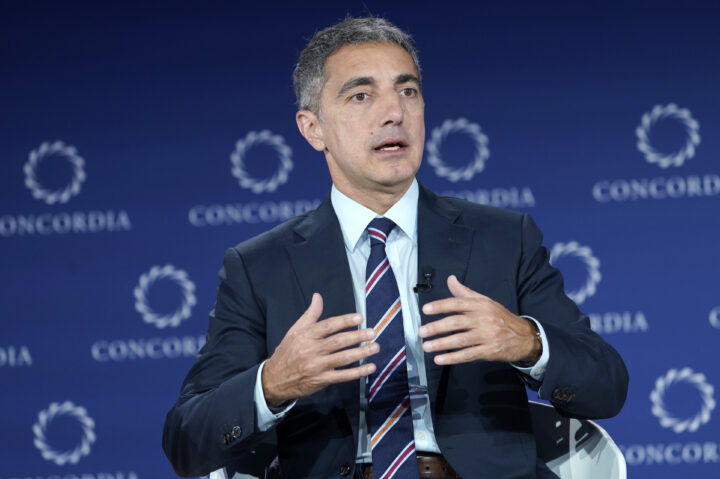
Hussain Abdul-Hussain, research fellow at the Foundation for the Defense of Democracies, speaks onstage during the 2025 Concordia Annual Summit at Sheraton New York Times Square on September 23, 2025.
Writer and researcher Hussain Abdul-Hussain has an unusual story: A Shia Muslim raised in Iraq and Lebanon and taught to hate Israel and the West, he is now a research fellow at the Foundation for Defense of Democracies living in Washington, and the author of a book called The Arab Case for Israel.
It was his years in Lebanon that gave him unique insight into the country’s political workings, which now play a major role in its tenuous ceasefire with Israel.
“Lebanon was a thriving state when the Arabs were fighting Israel state-to-state, when it was a symmetric military-to-military war,” Abdul-Hussain told Jewish Insider’s Lahav Harkov and Misgav Institute for National Security and Zionist Strategy Executive Director Asher Fredman on the “Misgav Mideast Horizons” podcast this week.
“What happened is that, after 1967, when the Arab armies were defeated, the Arabs switched from military-to-military to asymmetric war, with armed factions like Hamas, or the PLO before Hamas, or Hezbollah [against Israel],” he said. “They decided when to fight, how to fight, where to launch attacks, and these were in Jordan and Lebanon. … Jordan decided [to say] ‘We are a state and we will not allow these armed factions to run our affairs’ … They ejected them in 1970. Lebanon, unfortunately, came under enormous pressure from all kinds of Arab capitals. … Everyone forced Lebanon to accept [PLO leader Yasser] Arafat and his armed factions to operate out of Lebanon and launch attacks on Israel.”
“Since then, the Lebanese state has not been able to restore its sovereignty to pre-1969 days,” Abdul-Hussain argued. “After Israel ejected Arafat in 1982, Hezbollah inherited the mantle. … We have an issue of chronic weakness of the Lebanese state facing armed factions.”
Lebanese President Joseph Aoun is “probably the only elected Lebanese official to state on the record that Hezbollah is treasonous and wages war on behalf of Iran,” Abdul-Hussain said. In addition, there were reports as talks began last month that Aoun would be willing to meet with Israeli Prime Minister Benjamin Netanyahu.
However, Aoun said more recently that Lebanon would not be able to negotiate with Israel until its fight against Hezbollah ended.
“Hezbollah and Iran don’t want any kind of direct talks with Israel,” Abdul-Hussain pointed out.
Egypt and Saudi Arabia, he noted, have also been advising the Lebanese government not to negotiate normalization, a topic that was one of Israel’s conditions for entering the talks.
Riyadh’s motivation, according to Abdul-Hussain, is for Arab states to line up behind the Gulf state and wait for it to make peace with Israel — a move that Saudi Arabia has conditioned on the creation of a pathway to Palestinian statehood.
“This is leverage for the Saudis; it’s not in the interest of Lebanon,” Abdul-Hussain said. “These are factors that come in so the Lebanese state remains weak and unable to take on Hezbollah.”
Abdul-Hussain credited the Trump administration for “giving Lebanon more attention than any administration since the early days of Ronald Reagan. … I’m happy that someone sees Lebanon as it is, not as we imagine it to be or just dismiss it and say ‘This is too complicated for us and we’re not going to go into it.’”
That attention is “a golden opportunity … to help disarm Hezbollah and live at peace with Israel, Syria, Turkey, Iran, everybody else,” he said. “If the Lebanese don’t grasp it, I’m not sure there will be another opportunity in the coming future.”
Abdul-Hussain said that Aoun’s recent message that he will not shake hands with Netanyahu at the outset of negotiations does not diminish the major step he took toward peace talks with Israel.
“For a Lebanese president to say that we are parting ways with the Arab League and Saudi Arabia and that we are ready to shake hands with the Israeli prime minister if there is an agreement – that is huge,” he said.
As for France, which has often intervened on matters related to Lebanon, but is not involved in the talks with Israel, Abdul-Hussain said, “France has not paid a penny to Lebanon in a long time … but for some reason they keep sitting at the table deciding Lebanon’s fate. My guess is that they enjoy the spotlight.”
The French and the Saudis try to intervene in Lebanon “for their own ego,” Abdul-Hussain argued, but France is “more dangerous,” because it “tries to curry favor with Iran by taking Hezbollah’s side in Lebanon. The French would tell the Iranians, ‘Listen, we will not go against Hezbollah … [or] whatever Hezbollah policy. But keep in mind that when the time comes and there are no sanctions and you need to give contracts away, the French took your side. The French do this all the time. They did it with Saddam Hussein.”
A more recent example Abdul-Hussain cited was when the United Arab Emirates and Bahrain brought a draft resolution to the U.N. Security Council stating that the Strait of Hormuz is an international waterway and countries should be able to use military force to open it; “The French took the side of the Chinese, Russians and Iran” against it, he said.
“Why would France do that?” he said. “OK, you don’t like Trump, you don’t want to open your airspace to Trump. But if you are about international law, this is as [legitimate] as it can get. So what do the French do? They hedge against the West. … and this is what they’re doing in Lebanon.”
Abdul-Hussain said he was “thrilled” to hear Israeli Ambassador to the U.S. Yechiel Leiter say that he “would like to keep the French as far away as possible from pretty much everything, but particularly when it comes to peace negotiations.”
Abdul-Hussain’s book, The Arab Case for Israel, was published in February and features not only his arguments in favor of supporting Israel, but how he came to hold such views after receiving an anti-Israel education.
“My dad is from Iraq, from Baghdad, and my mom is from Baalbek in Lebanon,” Abdul-Hussain recounted this week. “I grew up in both countries. After second or third grade, we left Iraq permanently, during the war with Iran. … Of course, the 1980s in Lebanon is when Israel invaded [Lebanon] and when Hezbollah was being put together, and the days of the civil war.”
Abdul-Hussain recalled growing up in Iraq “shouting slogans against Khomeini and against Israel, and then … [in] Lebanon shouting pro-Khomeini slogans against Saddam Hussein, but still against Israel.”
He attended the American University in Beirut, where he was exposed to less conservative Muslim ideas of “all kinds, Marxist, socialist, anarchist, you name it” but still anti-Israel.
Abdul-Hussain became a reporter at the now-defunct Daily Star, a leading English-language newspaper in Lebanon, rising to the position of managing editor.
When Israel withdrew from southern Lebanon in 2000, Abdul-Hussain was covering the events and drove to the border.
“At the time, the border was just a flimsy barbed wire. You could see Israelis on the other side, and I stood there and I watched Israeli families in Metula and all these towns … mothers driving their children to school, men working the fields, some guy driving a tractor. This was the first time that I saw Israelis as humans … as people like us, and this made me so curious,” he recalled.
Abdul-Hussain was able to pick up Israeli radio stations from Lebanon, and began to learn Hebrew in that way, because “If you lived in Lebanon, you had no access to anything Israeli. The only access you had is anti-Israel books by Edward Said, [Norman] Finkelstein, [Noam] Chomsky. You can buy Mein Kampf anywhere.”
Listening to Israeli radio, Abdul-Hussain found that “These guys are not really obsessed with killing all the Arabs and taking all the land and establishing Greater Israel from the Nile to the Euphrates and all the conspiracy theories that I had learned.”
In 2004, he moved to Washington to work for the newly-founded Al Hurra, the U.S.-backed Arabic language news channel meant to support the spread of democracy in the Middle East, and has lived in the U.S. ever since.
“After I came to the U.S., I had unlimited access to everything Hebrew and Jewish and Israeli and I understood this is a totally different story from the one I was taught,” he said.
Abdul-Hussain makes the case that “Whatever happened in the past, whatever injustice has befallen the Arabs and the Palestinians, moving on and seeing Israel as an asset is much more in the Arab interest than trying to wind the clock back to a time when Israel didn’t exist.”
“I show the numbers, the receipts as we say here in Washington,” he added. “Look at the Abraham Accords countries and their trade and economy. Look at the cold peace with Egypt and Jordan and their trade and economy, which is much less than the Abraham Accords countries. Then, look at Lebanon and Syria, who are still at war and miserably behind the others.”
Abdul-Hussain pointed at a trend by which “The more peaceful you get with your surroundings, the better your economy thrives and blooms. This is the idea of the book.”
‘I had this concept that I put forth for myself, everything should have 12 or fewer ingredients, and I wanted to use very minimal pots and pans,’ Sussman told JI of her book, ‘Zariz: 100 Easy, Breezy, Tel Aviv-y Recipes’
Shanie Roth for Jewish Insider
Adeena Sussman
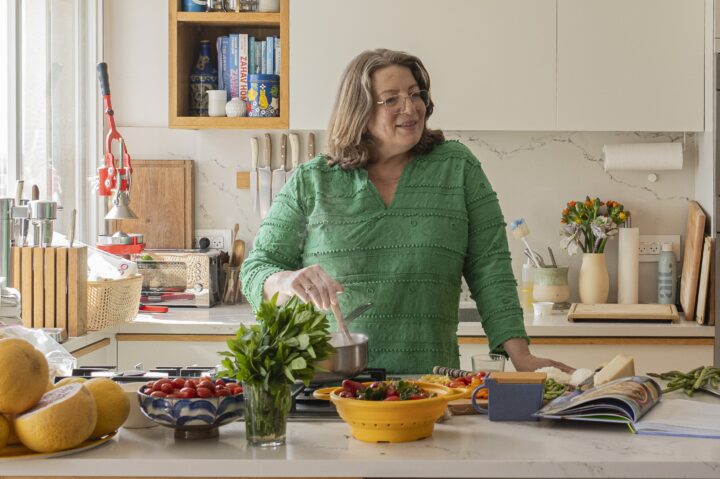
Adeena Sussman’s Tel Aviv kitchen is a chef’s dream. The long marble countertop next to the stove extends out from the gas range, perfect for preparing ingredients, pouring drinks and entertaining. A set of sharp knives is held in place by a magnetic holder affixed to the wall, while another set sits in a block on the counter. A bright red juicer stands next to the window. Hebrew and English cookbooks neatly line a shelf under the coffee presses and dried pasta, as well as additional shelves around the kitchen.
“This is my safe room,” Sussman half-jokingly tells Jewish Insider. Her actual safe room — called a mamad in Hebrew — is a floor below, used frequently during the war with Iran, in the midst of which JI visited the cookbook author last month, weeks before the release of her third book, Zariz: 100 Easy, Breezy, Tel Aviv-y Recipes, which was released on Tuesday.
“This is where I live,” Sussman said of her kitchen. “I get up in the morning, the first thing I do is come in here and make coffee and survey the fridge and decide what I’m going to cook or eat for breakfast for myself, and also just kind of commune with the space. It’s a really great place for me.”
The first sentence of the introduction of Zariz begins: “When the going gets tough, the cooking gets easy.” Sussman began writing the book in the weeks after the Oct. 7, 2023, Hamas terror attacks, amid regular rocket fire that frequently sent Israelis, including Sussman, who made aliyah in 2016, to their shelters.
“It’s simple cooking for complicated times,” Sussman explained of the book’s origins. Nearly two and a half years after she began writing the book, “it hasn’t gotten any less complicated.”
Indeed, hours before JI was set to arrive at Sussman’s home, she sent a version of a text message that far too many Israelis sent or received during the six-week war with Iran: “There was a direct hit right near the house,” she wrote, minutes after a cluster munition struck a building in her neighborhood.
She was OK, she said, and about to head to the shuk, which had gone back to its normal lively state minutes after Israel’s Homefront Command notified Tel Avivians they could reemerge from their bomb shelters.
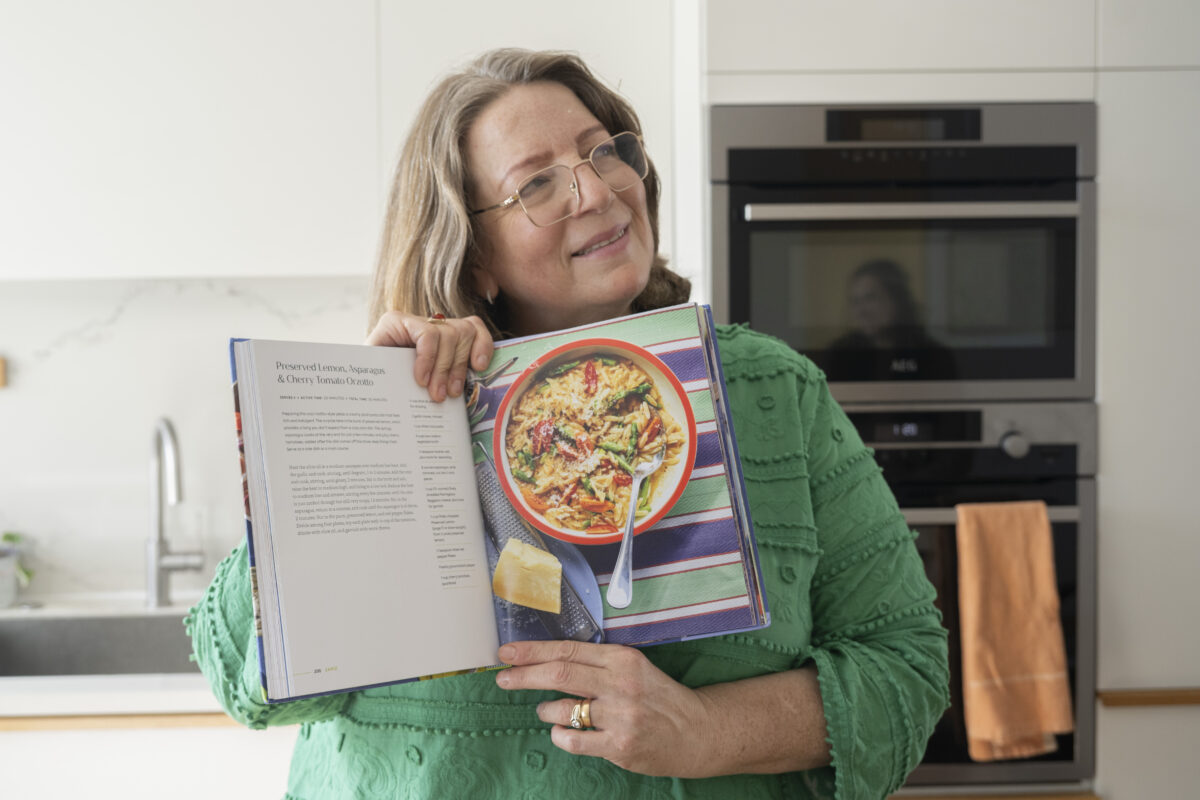
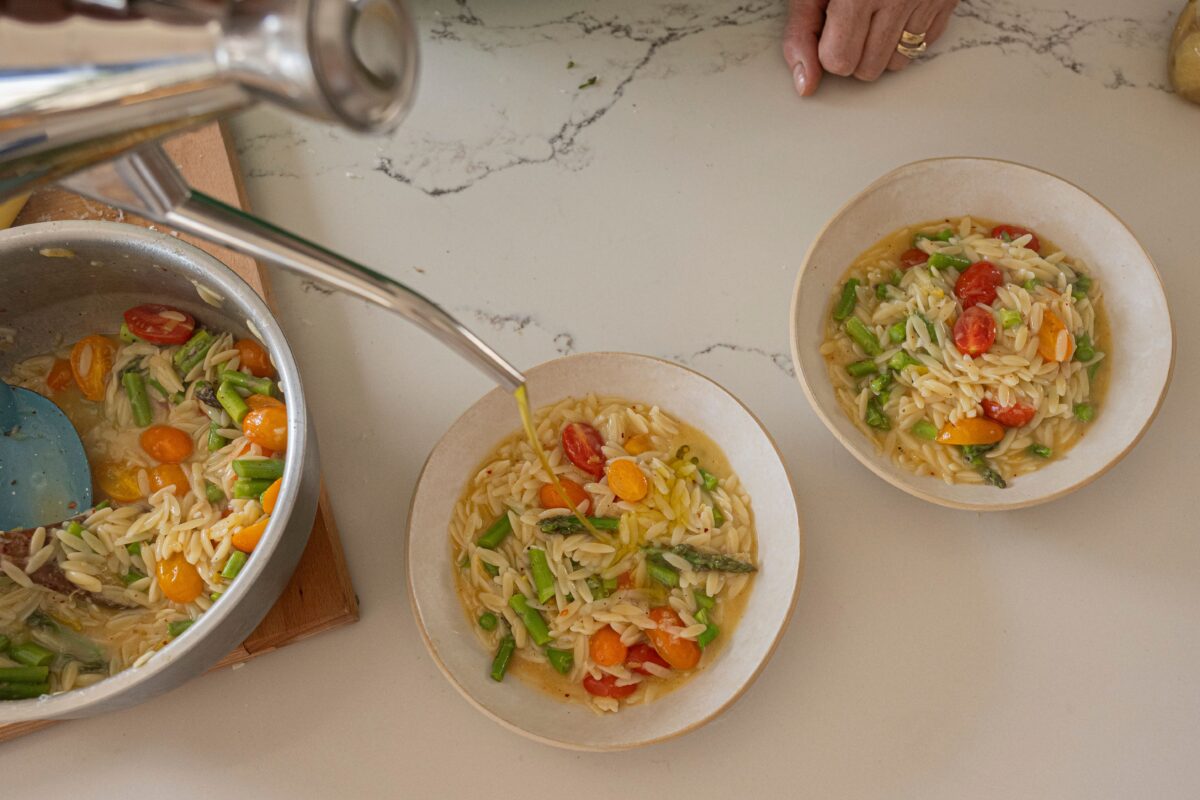
The shuk — an open-air market with fish, meat, produce and dairy vendors, as well as stalls selling tchotchkes, clothing and ready-to-eat food — is where Sussman does her shopping, and where she picked up the ingredients that day to make one of the dishes from Zariz: a preserved lemon, asparagus and cherry tomato orzotto (think orzo, but cooked in broth and given the risotto treatment).
The orzotto had a total preparation and cooking time of 30 minutes, and just a handful of ingredients beyond basic kitchen staples. That’s the vibe of Zariz — both the book and the Hebrew word itself: easy and agile.
“I had this concept that I put forth for myself, everything should have 12 or fewer ingredients, and I wanted to use very minimal pots and pans,” Sussman said as she toasted the orzo in a pan. “Making simple recipes is definitely more complicated, because every ingredient and every technique and everything has to have maximum impact.”

Limiting herself to a set number of ingredients — “fewer than a ‘bat mitzvah,’” she writes in the book’s introduction — was “a very intellectual exercise,” she told JI. “I actually enjoyed having those guardrails, especially because I had very limited mental bandwidth then.”
Sussman’s books — she’s written or cowritten more than a dozen in total, including three on her own — lean into local ingredients and what’s fresh in the moment.
“When you ask at the shuk when things are seasonally available, they respond by holiday, not by month,” she explained. “They’ll say, ‘Asparagus is between Tu B’shvat and Pesach, and rimonim (pomegranates) are Rosh Hashanah — [it’s a] very cool, very Israel-specific phenomenon.”
Many of the recipes in Zariz — like in her previous books Shabbat: Recipes and Rituals from My Table to Yours and Sababa: Fresh, Sunny Flavors From My Israeli Kitchen — lean into local ingredients familiar to Israelis, but are also easy to find at American supermarkets and specialty stores in the U.S.
“The Israeli pantry is my pantry,” she said. “Through all my books, the idea is that everyone gets familiar with this table of ingredients and that this is how I cook, and this is how I want people to cook. This is how this country cooks, and it’s multicultural, and the influences come from everywhere: Arab, Jewish, and the dozens of immigrant groups that comprise the fabric of the food here. And it’s very unique.”
That’s what she thinks many outside of Israel fail to understand about the country’s food scene — and it’s something she hopes to change.
“The shuk itself is like a late motif of life in Israel. Like when there’s an Arab holiday, 30% of people aren’t working there,” she said. “Now I know when Coptic Easter is because I have Eritrean friends who live in the shuk who celebrate it. And same with Ramadan and related holidays.”
The book combines local flavors with classic Western tastes: an onion dip made with labneh, guacamole with corn and schug (a spicy green sauce with origins in Yemen), a cheesy gnocchi with added heat from harissa paste.
But where Zariz differs from previous books is its focus on recipes that are faster, to account for having less time to grocery shop, prepare and cook — the reality of life for Israelis in wartime.
“The whole idea of this book was easy things that don’t lack for flavor or depth. It’s more relevant than ever,” Sussman said. “The recipes are not stupid simple. I still want you to have all the sensory pleasures of cooking, you know, like sizzling, stirring.”
Shortly after sitting down to eat Sussman’s fresh-off-the-stove orzotto, Israel’s Homefront Command sent out an alert notifying those in central Israel, which includes Tel Aviv, of an impending Iranian missile attack. (Sussman’s mamad is, as one would expect, cozy and full of snacks.)
“The mamad is like a necessary evil,” she said. But the kitchen remains “a pleasure.”
In a time when routines are hard to come by, and when, until the implementation of the ceasefire earlier this month, plans were frequently disrupted by missile attacks, Zariz is a reminder that cooking doesn’t have to be difficult or time-consuming.
“One of the beautiful things about cooking,” Sussman said, is that “cooking creates habits for you. The idea of having to make daily meals, you can view it as a chore, but then you can also view it as a privilege and pleasure, and also a method of self-care.”
Please log in if you already have a subscription, or subscribe to access the latest updates.
 Continue with Google

 Continue with Apple