































A new exhibition at the Upper East Side synagogue uses paintings of everyday Jewish life to explore nostalgia and identity as Jewish artists increasingly feel unwelcome in cultural spaces
Haley Cohen
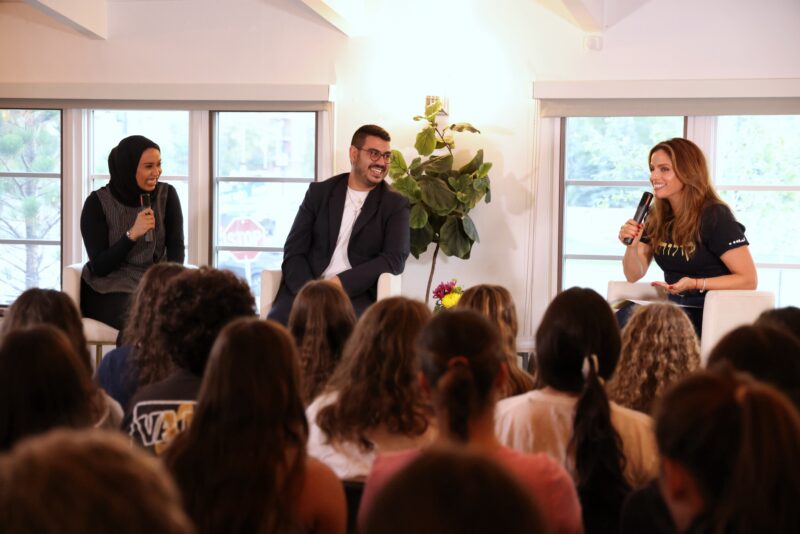
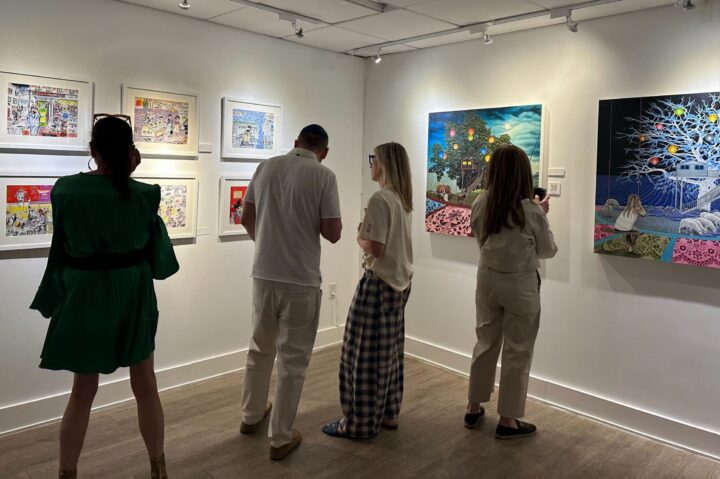
Opening night of "Golden Age: Nostalgia for the American Jewish Century" at Altneu in Manhattan.


 Add JewishInsider on Google
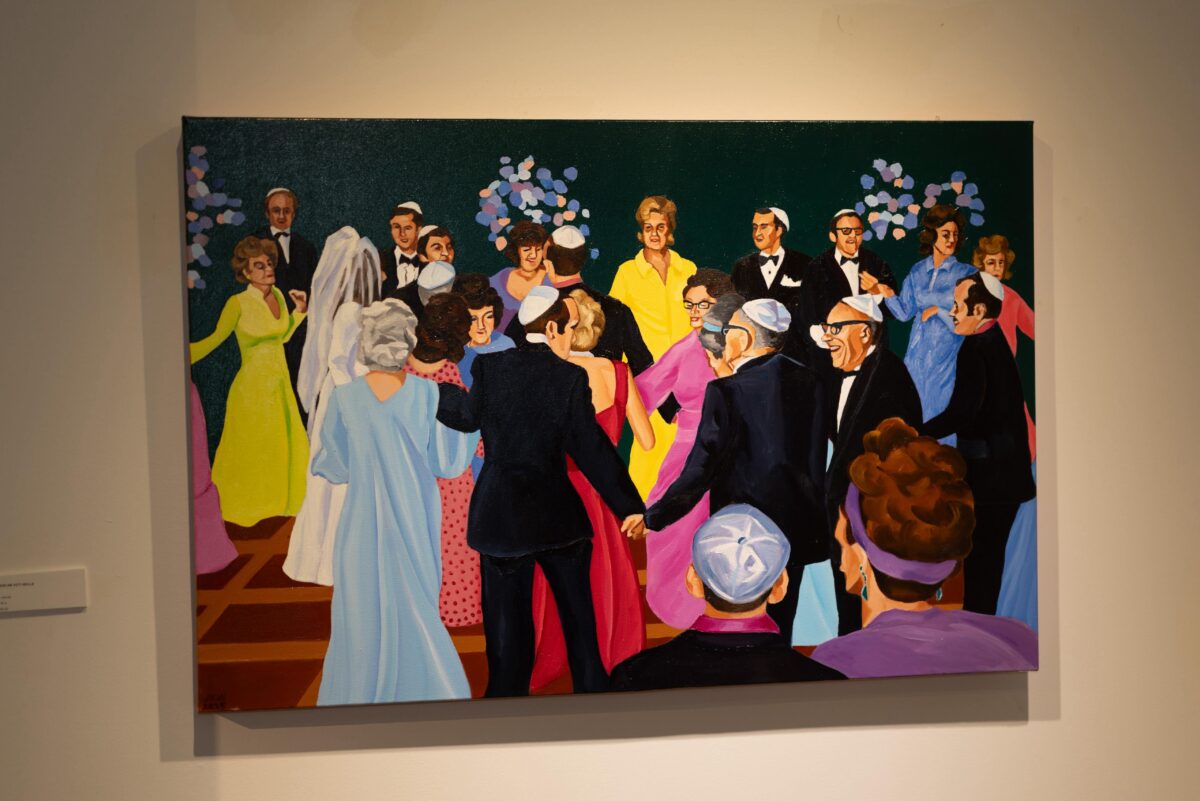
Four friends gather around a table as a waiter serves a tray of pastrami sandwiches; a Torah scroll is passed from grandfather to father and son, marking a bar mitzvah; three grandmothers sit on lawn chairs outside of a brownstone, watching passersby on a summer night.
These candid glimpses of ordinary American Jewish life, part of a new art exhibition, “Golden Age: Nostalgia for the American Jewish Century” — currently on display at the Altneu, an Upper East Side Orthodox synagogue — evoke a bygone era, before today’s historic rise in antisemitism.
“I grew up in the golden age [of North American Jewry], the ’70s, ’80s and ’90s. It was an easy time,” Jacqueline Kott-Wolle, one of the seven artists whose work is highlighted in the exhibit, told Jewish Insider on Wednesday at an event to mark the gallery’s opening. “My memories of growing up Jewish [in Toronto] were very positive. Everybody was Jewish — even the people at my high school who weren’t Jewish were Jewish. It was a good time to be alive. [Today,] antisemitism slammed into us so hard. It shocked us.”
Kott-Wolle, who is based in Highland Park, Ill., and is the daughter of Holocaust survivors, said her oil paintings “represent the height of that time period, when we were very comfortable being Jewish.” The artwork, she said, evokes memories of the “Golden Age of American Jews,” which a 2024 piece in The Atlantic claimed is ending due to antisemitism stemming from both the left and right.
In addition to her six paintings displayed in the exhibit, Kott-Wolle has a larger exhibit called “Growing Up Jewish – Art and Storytelling.” The series of 40 paintings illustrates five generations of her family photos, which have been exhibited in the Maltz Museum in Cleveland and Houston Holocaust Museum.
“[The paintings] are playful and fun, and they make us feel a little more nostalgic for something that we think or worry might be lost,” she told JI, noting that displaying her work in a synagogue is a unique experience.
“The paintings resonate everywhere, but differently,” she said. “I find Jewish audiences recognize it immediately. I can’t tell you how many times someone will come up to me and say, ‘I love this painting and how come my mom is in it?’”
In more mainstream settings, her art has also been widely embraced, she said. “It’s like our Jewish faces have been beaming into people’s TV screens forever. Our faces are familiar, so non-Jewish audiences also respond, but in a different way. Still in a very loving and receptive way.”
But amid the highest levels of antisemitism seen in generations following the Oct. 7, 2023, terrorist attacks in Israel and the ensuing war in Gaza, many Jewish and Israeli artists no longer feel their work is welcome in non-Jewish spaces. Located in the basement of the Altneu synagogue — a Tudor Revival townhouse on East 70th Street — the new exhibit directly responds to that exclusion, according to curator Anne-Marie Helwaser and co-chairs Diana Gordon and Avital Chizhik-Goldschmidt, who is also Altneu’s rebbetzin.
“At a moment when openly Jewish artists are facing growing barriers in cultural spaces, we are doubling down on Jewish creativity by giving space and visibility to strongly Jewish [and] Israeli emerging art, in the heart of the Upper East Side,” said Chizhik-Goldschmidt who founded Altneu in 2022 together with her husband, Rabbi Benjamin Goldschmidt.
“On a deeper level, there is a spiritual component too. Visual arts is a powerful connection point for people; in the words of Rav Kook, ‘Literature and art are positioned to express the deepest of secrets hidden within the soul.’ We believe it’s an important part of our spiritual experience, to be moved, to feel a stirring in the soul when seeing a particularly evocative piece of work,” she told JI.
“As the Altneu grew, I dreamt of people coming to an Orthodox synagogue for a contemporary art show, and for those two pieces to feel utterly organic together,” said Chizhik-Goldschmidt, who recalled growing up in the halls of New York’s museums, the granddaughter of a passionate art historian and tour guide.
“It was a major part of my upbringing, as a child of Soviet Jewish immigrants,” she told JI. “The arts were the only kind of spirituality that Jews had access to in the USSR. Now, we are blessed to be able to combine this with a sanctuary space.”
This is the fourth art exhibit the Altneu has hosted. Until now, the synagogue has focused on Israeli artists. However, the conflict with Iran made the logistics of securing their artwork nearly impossible in time for this exhibit.
The idea first came about “at a fragile moment,” said Helwaser, director of the Helwaser Gallery on Madison Avenue.
On a trip to Israel soon after Oct. 7, she recalled being moved by an exhibition by one artist who was an IDF soldier.
“He came back [from war] and started painting,” she said. “I talked to my friend, [Altneu community leader] Diana [Gordon], and thought we should show the images. We created — very improvised — an exhibition here. People responded really well.”
Once the organizers realized the Iran war would make it a challenge to bring Israeli art, they issued an open call for American Jewish artists, and the resulting meetings sparked the idea to highlight this different political moment.
“Hundreds of artists responded. I selected maybe 20 and we met with them and chose seven.
In different ways, all the selected artists were asking the same question: what does it mean to be Jewish today in America? It’s something we are concerned about,” Helwaser continued.
Asked why she displayed the art at Altneu instead of her own gallery, Helwaser admitted she never expected to curate for a synagogue. She explained that unlike gallery visitors, this audience comes for the story and to connect with the artists rather than just the art.
“We don’t need Altneu for art, we have the best galleries in the world in New York,” she continued. “[Visitors] want to talk about what it is to be Jewish. Art is a nice way to do that.”
“It’s not easy [to show Israeli artwork] in New York City galleries now,” said Helwaser. “I would do it but I’d be worried. In London, you wouldn’t be able to do it. Israeli artists here [are afraid] to be shown as Israeli.”
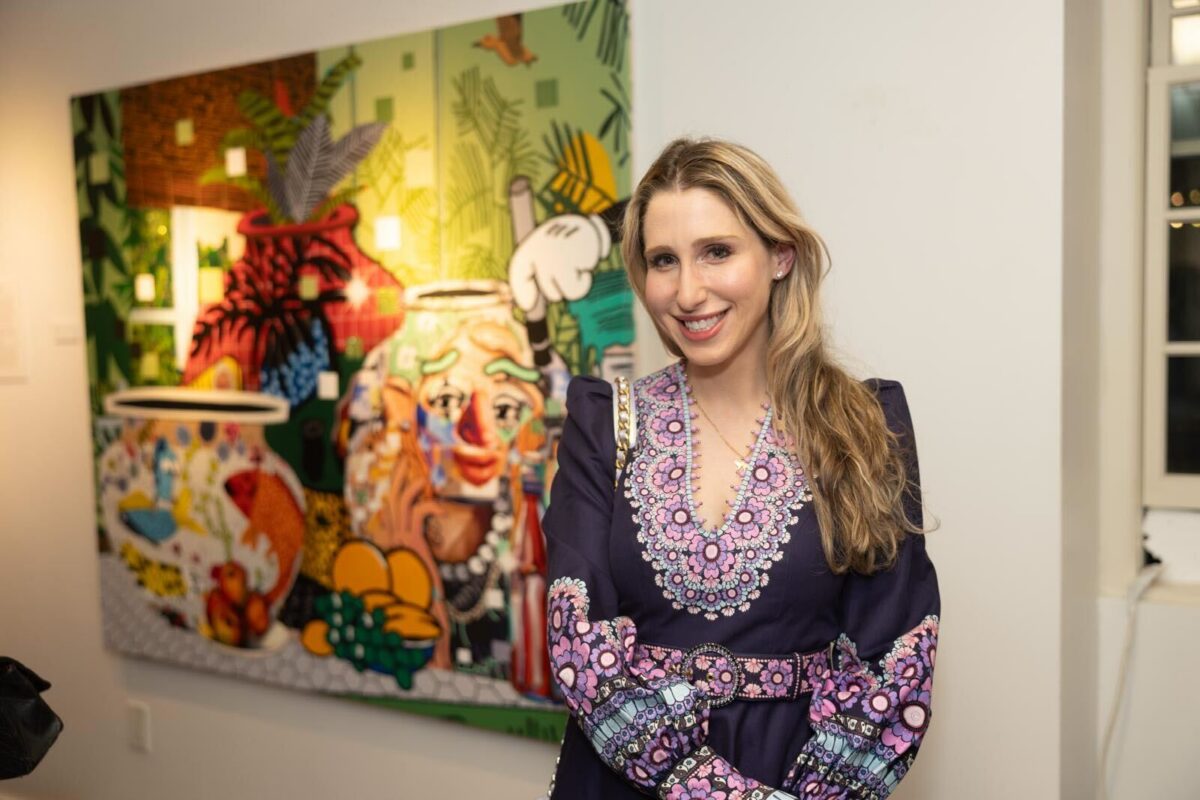
In addition to Kott-Wolle, participating artists are: Rotem Amizur, Nicole Gordon, Noa Ironic, Alan Richards, Ephraim Wuensch and Allison Zuckerman.
Paintings are priced between $600- $52,000. Many of the buyers are not Jewish, according to Helwaser. The exhibit is scheduled to run until July 6.
The opening night brought a diverse crowd of Jews together, including many newcomers to the synagogue — from those wearing black yarmulkes and sheitels to others sporting piercings and tattoos. “That’s the beauty of Manhattan, and of the Altneu as a gathering point. It goes beyond denomination,” said Chizhik-Goldschmidt.
The artwork appears to be resonating. At the debut, one guest was overheard gesturing toward a painting and remarking to a friend, “This is nostalgia for me. This is exactly how American grandmothers looked when I was growing up.”
Esther Kim Varet, one of the Democratic challengers running against Rep. Young Kim (R-CA), is worried about her party’s growing tolerance of extremism

Emma McIntyre/Getty Images for Hammer Museum
Esther Kim Varet attends Hammer Museum's 18th Annual Gala in the Garden on October 08, 2022 in Los Angeles, California.
Esther Kim Varet, an art gallery owner mounting an outsider bid as a Democrat to unseat Rep. Young Kim (R-CA), said she wants to help repair and strengthen a Democratic Party she said has been severely undermined by rampant anti-Israel activism.
Anti-Israel extremism and its proponents have “really decimated the Democratic Party,” Kim Varet, whose husband and children are Jewish, told Jewish Insider in a recent interview. She said that anti-Israel activists in the party are trying to divide Democrats at a time when unity is more important than ever.
She said their efforts have pushed Jews toward the Republican Party, which she argued is no true friend to the Jews, describing it as replete with “antisemitic Zionists.”
“We need to rebuild from the center out right now,” Kim Varet said. “We need to remember that being a Zionist is not a partisan issue. It never has been and it should not be.”
She argued that Jewish values, like tikkun olam, are at the heart of the Democratic Party, because Jews have for so long been a core Democratic constituency. She said that she wants to advocate for the party to refocus on those values.
Kim Varet’s connection to Israel dates back to her early 20s, when she and a friend backpacked through the Middle East for four months. She said that she saw stark differences between the authoritarian regimes in Syria, Turkey, Jordan and Egypt and the democratic government in Israel, and said, “my priority as an American is to do whatever it takes to preserve democracy.”
“These extremist groups want to exterminate my Jewish children simply because we believe that Jews also deserve a homeland. That’s the definition of Zionist,” Kim Varet said. “Would you rejoice if a pro-Palestinian terrorist gunned down, on American soil, my two Jewish children or my Jewish husband on the streets?”
Kim Varet, who spoke to JI in the immediate aftermath of the Capital Jewish Museum shooting, said it had hit particularly close to home because she had spoken recently at another American Jewish Committee event, about antisemitism in the art world, and because of the danger that antisemitism poses for her own family and children.
She said she was deeply disturbed by the response she saw to the shooting online, with the “‘Free Palestine’ left justifying the slaughter.”
“These extremist groups want to exterminate my Jewish children simply because we believe that Jews also deserve a homeland. That’s the definition of Zionist,” Kim Varet said. “Would you rejoice if a pro-Palestinian terrorist gunned down, on American soil, my two Jewish children or my Jewish husband on the streets?”
She also emphasized that, in the wake of World War II, Israel was a critical safe haven for the Jewish community when it had nowhere else to go, “which is something that every human should have a right to.”
Kim Varet, who grew up in an evangelical Christian Korean household in Texas going to a Christian school, said that she did not fully understand the richness of Jewish culture or the challenges of antisemitism when she and her now-husband first began dating, and has come to discover them over their time together.
“That became critical, for me, to be able to effectively talk to others about what certain kinds of language might feel [like] to a Jewish person, how that lands, how that gets internalized, how that gets processed,” she said.
“People don’t want to admit it, but I think for a lot of marginalized communities, they perceive Jews just to be wealthy, and they choose to just read them as wealthy instead of human, and they refuse to [acknowledge] their pain,” Kim Varet added.
She argued that her background can give her a unique perspective and strong voice to the fight against antisemitism. She argued that the Jewish community needs non-Jewish advocates who will step up and fight for it because of their own convictions, without receiving any political donations from AIPAC — which she criticized for supporting “antisemitic Zionists” in the GOP.
Kim Varet’s husband, Joseph Varet, is a descendant of the Rosenwald family, a founding member of the Sears Roebuck department store chain. He’s a relative of the renowned philanthropist Julius Rosenwald, and their son shares that name. Her family continues to operate a philanthropic foundation, which has turned its focus to Israel-related causes since Oct. 7.
Post-Oct. 7, Kim Varet and her husband have worked with the Israel Children’s Fund, supporting hundreds of children who lost parents or siblings in the attack. They have personally hosted dozens of those children in their California home, flying them out to the area for rest and relaxation, taking them to sites like Disneyland.
She and her family also recently traveled to Israel to visit some of the families who had stayed with them, Kim Varet’s third visit to Israel.
“I could see where the fractures started happening in my own world, and then I could see that it was mirrored on a larger scale in the Democratic Party,” Kim Varet said.
“For me, it’s always been like this. Walk the walk, don’t just have opinions about things,” Kim Varet said. “Also very similar to why I’m running because … I need to. I feel so much despair around Trump. I’m not going to despair. I’m going to do, and I’m going to work.”
In her professional life, she’s also seen how antisemitism has rocked the art world since Oct. 7 — many artists came out strongly against Israel, using slogans like “From the river to the sea,” while many of the collectors that Kim Varet works with are Jewish. She said she saw the hurt that such rhetoric exacted on the Jewish community.
She said she saw some of the artists reject out of hand accusations of antisemitism and refuse to examine their own rhetoric. “I could see where the fractures started happening in my own world, and then I could see that it was mirrored on a larger scale in the Democratic Party,” Kim Varet said.
Kim Varet said she never anticipated entering politics, but said that she saw the values she cares about under threat under the Trump administration, and believes that the incumbent in the seat, Kim, is a Christian nationalist extremist who could be vulnerable in the upcoming election.
She said she had early conversations with the Democratic Congressional Campaign Committee and other groups about the possibility of flipping the Orange County swing seat, a top Democratic target. She’s been endorsed by the political arm of the Congressional Asian Pacific American Caucus.
“I think we all felt really crappy after the election, if you’re a Democrat. I was like, ‘I’m gonna just go do something. I’m going to go flip the seat,’” Kim Varet said, adding that she’s channeling her “rage” at the unified Republican federal government toward her congressional bid.
“I’m fighting because you’re scared,” she said she’s telling prospective constituents.
A number of other candidates have also entered the race including the 2024 Democratic general election candidate, Joe Kerr; former local school board member Christina Gagnier; nonprofit leader and entrepreneur Nina Linh; and small business owner Paula Swift.
Kim Varet said her personal network from the art and philanthropic world can help her match the incumbent’s fundraising prowess. She raised more than $1 million in the first months of her campaign — placing her in rarified air among Democratic challengers nationwide.
“If I can figure out how to raise the money to compete against all her dirty money, then I have a fair shot here. And this district just hasn’t been able to produce anybody that has the network to do that,” Kim Varet said.
She said she wants to help support the American dream that her parents and grandparents — who fled North Korea — were able to pursue, having seen the hardships that her young employees, most of them first and second generation immigrants, have faced in making ends meet.
She said some consultants had urged her to aim for local office first, but she responded, “it’s 2025. It’s a freaking emergency situation. You think I want to be doing this? This is a call to action … I don’t need this job. This is not a great job … I have a really comfortable life, but at this point of my life, I am too educated, too privileged and too comfortable to not do anything for everybody else.”
The legislation aims to address obstacles raised by recent Supreme Court rulings against Holocaust survivors and their descendants, among other issues

FILE - This May 12, 2005 file photo shows an unidentified visitor viewing the Impressionist painting called "Rue St.-Honore, Apres-Midi, Effet de Pluie" painted in 1897 by Camille Pissarro, on display in the Thyssen-Bornemisza Museum in Madrid. Lilly Cassirer surrendered her family's priceless Camille Pissarro painting to the Nazis in exchange for safe passage out of Germany during the Holocaust. The Supreme Court is hearing the case about the stolen artwork. (AP Photo/Mariana Eliano, File)
A group of House members introduced legislation on Friday that aims to bolster efforts by Holocaust survivors’ families to reclaim or receive recompense for art stolen from their relatives during World War II, addressing issues in past legislation that have hampered repatriation efforts in the courts.
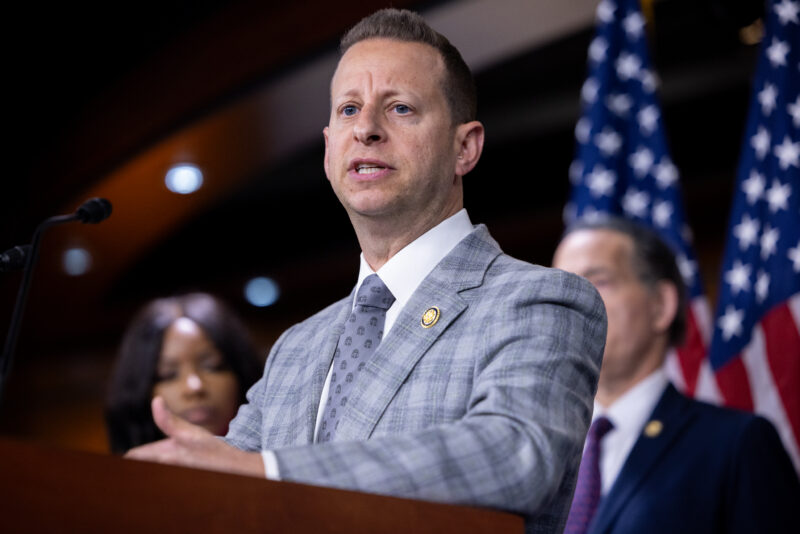
Identical legislation was recently introduced in the Senate by Sens. John Cornyn (R-TX) and Richard Blumenthal (D-CT). The House bill is being sponsored by Reps. Laurel Lee (R-FL), Scott Fitzgerald (R-WI), Jerry Nadler (D-NY), Jamie Raskin (D-MD) and Maggie Goodlander (D-NH).
The new bill, the Holocaust Expropriated Art Recovery (HEAR) Act Improvements of 2025, aims to fill gaps left by the original HEAR Act, passed in 2016. The legislation eliminates a time limit included in the original bill that led some courts to dismiss suits filed under the original law. It also extends the law in perpetuity, beyond its original 2026 expiration date.
The bill also specifically addresses issues raised in recent Supreme Court cases, in which the court has ruled against the families of Holocaust survivors, stating that, “in order to effectuate the purpose of the Act to permit claims to recover Nazi-looted art to be resolved on the merits, these defenses must be precluded.”
The new bill aims to ensure that the defenses used in those cases cannot be applied going forward, and aims to ensure that such cases are not thrown out or defeated on technicalities.
“The Nazi regime stole not only lives but legacies, including cultural and family treasures that carry deep personal and historical meaning,” Lee said in a statement. “This bill ensures that families who lost everything during the Holocaust are given a fair shot at justice. These claims should be decided on the truth, not on legal loopholes or paperwork deadlines. With this legislation, we reaffirm our commitment to standing with Holocaust survivors and their families. They deserve to have their stories heard and their property returned. It’s never too late to do the right thing.”
Nadler, a lead sponsor of the original HEAR Act said, “As a matter of principle, we affirm that in the United States, everyone who has a credible claim deserves to have their day in court. This bill realizes that principle and ensures that every family has the right to a fair and just process based solely on the merits of their claim. We cannot fix the past, but this bill is a promise to the victims of the Holocaust that the United States is committed to creating a fair judicial process for the return of property that was wrongfully stolen during the darkest period of human history.”
David Schaecter, a Holocaust survivor and president of Holocaust Survivors Foundation USA, said, “To allow museums here and in Europe, and foreign governments to keep Nazi looted art perpetuates the crimes of the Nazi regime, and demeans the memory of six million Jewish souls. We applaud Congress for making sure that families can recover their treasured legacies, and that the true history of the Nazis’ brutal campaign of murder and theft cannot be erased or trivialized by the scoundrels who refuse to return looted art.”
Gideon Taylor, the president of the World Jewish Restitution Organization, said that reclaiming these stolen belongings “is not simply about returning possessions; it is about restoring history, identity, and a measure of justice to those who lost everything.”
Joel Greenberg, president of Art Ashes, which helps fund the recovery of Nazi-looted art, said the legislation “renews and strengthens the HEAR Act, which is set to expire, by closing critical loopholes and addressing key oversights.”
“It reaffirms our commitment to ensuring that rightful owners of Nazi-looted art — and their families — receive the restitution they are owed,” Greenberg continued. “Any museum that knowingly retains stolen works is complicit in perpetuating the injustice inflicted on Holocaust victims. We have both a moral and legal obligation to correct these wrongs and to ensure the crimes of the Holocaust are neither forgiven nor forgotten.”
The legislation is supported by around two dozen Jewish and pro-Israel organizations.
Blumenthal: ‘Our bipartisan effort seeks to strengthen measures to bring long overdue justice to families whose cherished art was brazenly stolen by the Nazis’

J. Scott Applewhite/AP Photo
Sen. John Cornyn, R-Texas, center, is flanked by Senate Judiciary Committee Chairman Dick Durbin, D-Ill., left, and Sen. Richard Blumenthal, D-Conn., at the Capitol in Washington, Thursday, Nov. 14, 2024.
Sens. John Cornyn (R-TX) and Richard Blumenthal (D-CT) introduced bipartisan legislation last week aimed at eliminating loopholes used by museums and other stakeholders to continue possessing Nazi-looted artwork that Jewish families have been trying to recover.
Introduced on Thursday, the Holocaust Expropriated Art Recovery (HEAR) Act would expand on Cornyn’s 2016 legislation of the same name, which was passed at the time by unanimous consent, by ending the Dec. 31, 2026, sunset date on the original bill and strengthen the existing procedural protections to ensure that victims’ claims are not dismissed due to non-merit-based factors such as time constraints.
“The artwork wrongfully ripped from Jewish hands during the Holocaust bears witness to a chapter in history when evil persisted and the worst of humanity was on full display. I’m proud to introduce this legislation to support the Jewish people and Holocaust survivors by helping them recover art confiscated by the Nazis that they are rightfully owed and give them the justice and restitution they deserve,” Cornyn said in a statement.
“The theft of art by the Nazi regime was more than a pilfering of property — it was an act of inhumanity. Our bipartisan effort seeks to strengthen measures to bring long overdue justice to families whose cherished art was brazenly stolen by the Nazis,” Blumenthal said.
Many families of Holocaust victims in the U.S. who have located artwork from deceased relatives and sued to recover those items face the deadline at the end of next year before the statute of limitations sets in. Thousands of stolen works of art remain unreturned to their rightful owners from the Nazi plunder, and there are scores of ongoing cases to resolve disputes over ownership of those items.
“Unfortunately, many museums, governments, and institutions have contradicted Congress’ intent and obstructed justice by stonewalling legitimate claims, obscuring provenance, and employing aggressive legal tactics designed to exhaust and outlast Survivors and their families. Rather than embracing transparency and reconciliation, too many have chosen to entrench and litigate, effectively preserving possession of stolen works rather than returning them to their rightful owners,” a press release for the bill states.
Sens. Thom Tillis (R-NC), Cory Booker (D-NJ), Marsha Blackburn (R-TN), John Fetterman (D-PA), Eric Schmitt (R-MO) and Katie Britt (R-AL) co-sponsored the bill, which was endorsed by a number of Jewish organizations including Agudath Israel of America, the American Jewish Committee, Anti-Defamation League, Jewish Federations of North America, StandWithUs and World Jewish Congress, among others.
“This legislation helps to right a historic wrong committed during one of the darkest chapters in history. By eliminating unnecessary legal obstacles, the HEAR Act establishes a clear path to restitution for Holocaust survivors and their families, ensuring that art and cultural property stolen by the Nazis can finally be returned to their rightful owners,” Tillis said.
Fetterman said in a statement, “Eighty years after the Holocaust, we have a moral responsibility to do right by the victims of these atrocities and their families. I’m grateful to join my colleagues from both sides of the aisle in introducing the HEAR Act to help return artwork stolen by the Nazis to its rightful owners.”
Please log in if you already have a subscription, or subscribe to access the latest updates.
 Continue with Google
 Continue with Apple