














































































The U.S. ambassador to Turkey floated an overland route for regional trade centered on Iraq, sidelining the India-Middle East-Europe Economic Corridor meant to run through Israel
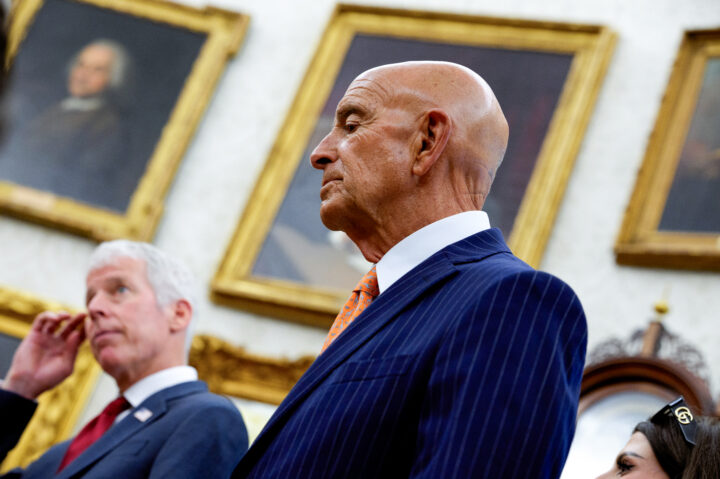
Photo by Andrew Harnik/Getty Images
U.S. Ambassador to Turkey Thomas Barrack attend a meeting with U.S. President Donald Trump and Prime Minister of Iraq Ali al-Zaidi in the Oval Office of the White House on July 14, 2026 in Washington, D.C.


 Add JewishInsider on Google
U.S. Ambassador to Turkey Tom Barrack on Friday promoted a new regional trade and security alignment in the Middle East centered around Iraq, Turkey and neighboring Arab states, appearing to sideline a similar regional project including Israel.
Speaking at the U.S.-Iraq Business Summit, Barrack told attendees that Iraqi Prime Minister Ali al-Zaidi, who visited with President Donald Trump at the White House this week, is considering a transformative agreement “that will make the Strait of Hormuz” — which has been effectively shut down due to the Iran war and continued hostilities — an “afterthought in two years” by shifting trade that usually passes through the waterway to overland routes.
“What this young leader [al-Zaidi] has in mind — aligned with Syria, Jordan, Turkey, Lebanon, Egypt — is a program that will make the Strait of Hormuz an afterthought in two years,” Barrack said. “We’re going from just-in-time delivery on boats through these minor straits to just-in-case delivery going the other way.”
The proposal appears to serve as an alternative framework to the stalled India-Middle East-Europe Economic Corridor (IMEC), which has faced roadblocks following regional turmoil and the Oct. 7, 2023, Hamas terror attacks. While the original IMEC agreement included Israel as a vital transit point connecting India to Europe via the UAE and Saudi Arabia, the newly envisioned corridor relies instead on a coalition featuring Syria, Lebanon and Jordan.
The State Department also released a statement on Friday welcoming the announcement of cooperation between Iraq and Syria on the “rehabilitation and reconstruction of the Iraq-Syria crude oil pipeline as a priority infrastructure project of bilateral and regional strategic significance.”
“We feel the chaos on one side, but actually, what’s happened is a brilliant realignment of security and strategic alliances in the region,” Barrack said in his remarks, with “Iraq being at the forefront of a new strategic security alliance.”
Barrack praised Trump for recognizing the necessity of working with localized “strong leaders” rather than enforcing Western-style regime change, which he admitted has historically failed.
“The connectivity of what can happen is mind-boggling,” he continued. “So, if we now take from Turkey, Azerbaijan, to Turkmenistan through Central Asia, the amount of gas that can be sent the other way towards Europe through commerce, we’re starting to find a way to create a different fabric.”
UAE and Saudi leaders spoke by phone; the GCC affirmed its ‘right to respond’
Fadel SENNA / AFP via Getty Images
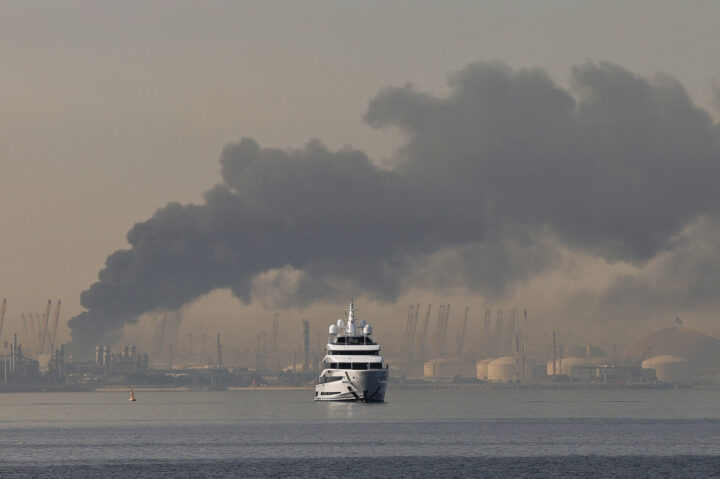
A yacht sails past a plume of smoke rising from the port of Jebel Ali following a reported Iranian strike in Dubai on March 1, 2026.
Major Gulf powers are coming together in rare lockstep amid Iran’s strikes around the region, with the United Arab Emirates closing its embassy in Iran and the Gulf Cooperation Council declaring it retains the right to respond.
After the U.S. and Israel launched a major operation against Iran on Saturday, the regime struck sites in at least nine countries around the Middle East, including Israel, Jordan, Syria and every member of the Gulf Cooperation Council — Bahrain, Kuwait, Oman, Qatar, Saudi Arabia and the UAE.
Despite claiming it is aiming at U.S. military assets in the region, Iran has struck widely at civilian infrastructure, including hotels, residential neighborhoods and airports in the UAE, Bahrain, Kuwait and Iraq. At least 12 civilians were killed in Israel over the weekend, along with three U.S. servicemembers.
On Saturday, the first day of the operation, UAE President Mohamed bin Zayed spoke by phone with Saudi Arabia’s Crown Prince Mohammed bin Salman to discuss Iran’s aggression and their response, a significant development and sign of the seriousness of the issue amid a regional rift between the two major powers.
The UAE has taken the brunt of much of Iran’s malign activity — its Ministry of Defense said Sunday that the country had been targeted by 165 ballistic missiles, two cruise missiles and 541 drones from Iran. Three civilians were killed and 58 injured in the barrage.
Shortly after, Abu Dhabi announced the closure of its embassy in Tehran and the withdrawal of its entire diplomatic mission, citing Iran’s “hostile attacks against civilian sites … in a serious and irresponsible escalation [that] constitute a flagrant violation of national sovereignty.” The country’s Ministry of Foreign Affairs also summoned the Iranian ambassador to the UAE and “delivered a strongly worded note of protest” about Iran’s “terrorist attacks and assault.”
Also on Sunday, the ministerial council of the GCC held a meeting over video conference and issued a statement strongly condemning Iran’s attacks and affirming the countries’ “legal right to respond.”
“The Council also expressed full solidarity among the GCC countries and their unified stance in confronting these attacks, stressing that the security of GCC member states is indivisible, and that any attack against any member state constitutes a direct attack against all GCC countries,” the statement went on. The countries “will take all necessary measures to defend their security and stability and to protect their territories, citizens, and residents, including the option of responding to the aggression,” they pledged.
The U.S. also joined the GCC in another statement Sunday, saying that Iran’s “targeting of civilians and of countries not engaged in hostilities is reckless and destabilizing behavior.”
The statement cites a clipped excerpt from the ambassador’s interview with Tucker Carlson that omits the second half of his response

Chip Somodevilla/Getty Images
Mike Huckabee moderates a roundtable discussion with President Donald Trump on Oct. 29, 2024 in Drexel Hill, Pennsylvania.
Saudi Arabia led a group of Arab and Muslim states and multinational organizations in condemning U.S. Ambassador to Israel Mike Huckabee, claiming that he approved of Israeli expansion throughout much of the Middle East, based on partial and misconstrued remarks from his interview with Tucker Carlson released on Saturday.
Among those who signed onto the condemnation were Egypt, Jordan, the United Arab Emirates, Indonesia, Pakistan, Turkey, Qatar, Kuwait, Oman, Bahrain, Lebanon, Syria, the Palestinian Authority, the Organization of Islamic Cooperation, the Arab League and Gulf Cooperation Council.
They “express[ed] their strong condemnation and profound concern regarding the statements made by the United States Ambassador to Israel, in which he indicated that it would be acceptable for Israel to exercise control over territories belonging to Arab states, including the occupied West Bank.”
The statement also says that Huckabee’s remarks “directly contradict the vision put forward by U.S. President Donald J. Trump and the Comprehensive Plan to End the Gaza Conflict … grounded in promoting tolerance and peaceful coexistence.”
Huckabee, however, repeatedly denied in the interview with Carlson that he was advocating Israeli expansion across the region, as Tucker repeatedly asked him about it and accused him of it.
The Tucker Carlson Network posted a clip of the video in which Carlson expostulated at length about Genesis 15:18, in which God tells Abraham, “to your descendants I will give this land, from the River of Egypt to the great river Euphrates.” The Biblical kingdoms of Israel and Judea never included all of the land promised in Genesis, even at its historically largest size.
Carlson asks if Huckabee believes that Israel was promised to the Jewish people and they therefore have the right to take all of the land promised, which covers modern-day Jordan and parts of Syria, Lebanon, Iraq and Saudi Arabia.
In the clip, which cuts Huckabee off mid-sentence, he says in a facetious tone of voice, “It would be fine if they took it all.”
The second half of the ambassador’s sentence, as heard in the interview, is: “but I don’t think that’s what we’re talking about here today.”
Pressed further by Carlson about Israel, Huckabee added that “they don’t want to take it over; they’re not asking to take it over.”
Carlson asked the question a third time, and Huckabee again said: “They’re not asking to go back to take all of that, but they are now asking to at least take the land that they now live in, they now occupy, they now own legitimately, and it is a safe haven for them.”
Carlson replied, “You’re saying it’s fine with you if they took all of Syria, all of Jordan and all of Lebanon,” and Huckabee interjected: “That’s really not exactly what I’m trying to say.”
“It was somewhat of a hyperbolic statement if that’s what you feel like we’re talking about, but it isn’t,” the ambassador added. “We’re talking about this land that Israel, the State of Israel, now lives in and wants to have peace in. They’re not trying to take over Jordan … Syria, Iraq or anywhere else, but they do want to protect their people.”
“I’m simply saying that the people who live in Israel, I think, have the right to have security, have safety. I think they have a right to live in this land that they have a connection to for 3,800 years,” Huckabee added.
Carlson then asked again if Huckabee thought it would be legitimate for Israel to conquer Syria, Lebanon and Jordan, and Huckabee responded, “I don’t think in this particular day and time they’re asking for it … I’m not sure that it would be … If they end up getting attacked by all of these places and they win that war and they take that land, then okay, that’s a whole other discussion. But you and I started out talking about something simple, Christian Zionism.”
Regarding the West Bank, Huckabee twice referred to the roughly 60% of the territory controlled by Israel, where all Israeli settlements are located, as part of Israeli territory, saying, “Area C is Israel.” Israel has not annexed Area C and refers to it as disputed territory.
Please log in if you already have a subscription, or subscribe to access the latest updates.
 Continue with Google

 Continue with Apple