




























































Airwallex and Andreessen Horowitz brought 12 Israeli founders to New York to build relationships, pitch investors and learn from their American counterparts

Courtesy
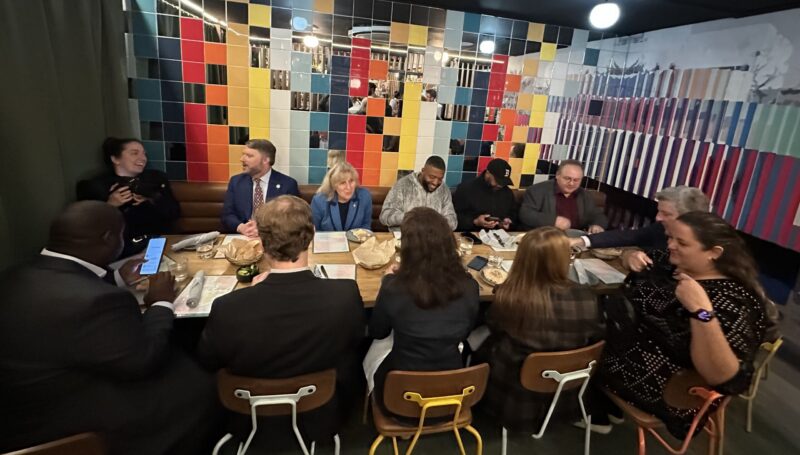
Fusion hosts a New York Tech Week 2026 event.


 Add JewishInsider on Google
There’s a mantra in the Israeli startup world that its founders are months behind their American counterparts. New York Tech Week gave them a chance to close that gap, according to investors who descended on Manhattan last week.
Michael Morgenstern, head of startups at financial technology platform Airwallex, which teamed up with Andreessen Horowitz — one of the world’s leading venture capital firms — to bring a delegation of Israeli founders to tech week for the first time, told Jewish Insider that VCs are looking to see more AI products come out of Israel, which historically has been security focused.
“It would be interesting to see an AI lab out of Israel,” he said. “Why haven’t we seen an OpenAI or Claude, something of that status, coming out of the Israeli ecosystem? It makes me wonder if we are stagnating as an ecosystem. So exposing the Israeli market to what’s going on on the ground gives Israeli entrepreneurs the chance to get months ahead.”
“The mantra in the Israeli startup market right now is that Israeli founders and entrepreneurs are nine months behind the Americans,” he continued. “So if we can fly them here, make sure that people with low budgets — that will soon have high budgets — come to the U.S. and get on the ground, they’re going to get back to Israel with a whole new set of insights that are going to prepare them and be on par with the American companies versus the ones in Tel Aviv.”
“So it’s a very strategic play for them to come, get the experience and do the pitches. Ultimately, the U.S. is the ultimate market for most Israeli founders so if we can be the corridor at Airwallex and I can be the shepherd, it’s a delight to do so,” he said.
The 12 Israeli founders included in the delegation said they felt widely embraced at last week’s New York Tech Week, overwhelmingly saying that they felt no need to hide their roots.
“I feel I can be openly Israeli in the U.S. — specifically at tech week,” Aviv Shamny, founder of Limy AI, an Israeli startup that helps brands and products show up on AI search engines, told JI. “I didn’t feel any antisemitism at all at tech week.”
Shamny, who recently moved to the U.S. from Israel to grow his company — and served in combat following the Oct. 7, 2023, terrorist attacks — said the idea for his startup “came to me in the trenches of war.” For the past year, Limy has been part of A16Z Speedrun, an elite, highly competitive 12-week startup accelerator program operated by Andreessen Horowitz.
“People are really hustling,” said Morgenstern. “Last week was Boston tech week, next week is London. New York is the primo one. People are enjoying it. It’s decentralized as there’s what feels like thousands of events all over the city for every stage and profile.”
Morgenstern led several events throughout the week, including taking founders who recently moved to New York in a helicopter to give them their first tour of Manhattan. “We did a pitch in the air called ‘Up in the Air with Airwallex,’” he said, adding that amid historic rates of antisemitism, “I’ve only heard positive things from Israelis meeting with non-Israelis.”
The Israeli delegation consisted of entrepreneurs launching new startups — many of whom declined to speak with JI due to their companies’ stealth status.
“It was a very selective process,” said Morgenstern. “There were hundreds, if not thousands, of applications. Andreessen Horowitz picked the founders, and we’re strategic partners with them. We’re the ones supporting the founders with their banking and corporate operations. This is the first time we’ve done this and we plan on doing it again.”
Much of the A16Z delegation is composed of deeper infrastructure companies, working on AI tools, cybercompanies, fintech and defensetech.
“Historically, cyber is what Israelis have been known for, but it’s interesting to see the early-stages people try to zig when everyone’s zagging and look a little different to stand out,” said Morgenstern. “So an Israeli founder doing a consumer company, selling to individuals is very unique. Healthcare and fintech also. We’re also seeing some big rounds happening. A lot of Israeli teams are raising $10, $20, $30 million-plus out of stealth mode. It’s interesting they don’t want anyone to know what they’re doing, but at the same time they’re raising a lot of money and growing their balance sheet. From my seat in the VC land, I see an incredible demand and the resilience of Israelis right now is showing why they’re such an investable asset.”
“Generally, Andreessen Horowitz has a unique stance,” said Shamny, who was not part of the A16Z delegation since the firm has already invested in his company.
“On one hand, they don’t take sides, they take the side of innovation. They see Israel as one of the main innovation hubs and are really doubling down on it. We’ve been getting positive feedback from the firm. I do think this contributes to us being able to position ourselves as still the startup nation, regardless of all the antisemitism going on in the world. I think the war — regardless of what is wrong and what is right — has been impactful on Israel’s presence and what people think about us as Israelis. Andressen’s push toward Israeli innovation has been helpful in positioning ourselves.”
“As Israelis we are very proud to take part in this unique group of people and companies. It’s fun to be a part of.”
Yair Vardi, an Israeli American venture capitalist and founding partner of Fusion, Israel’s leading pre-seed fund, produced several events during tech week.
“I didn’t see reluctance to work with Israelis this week,” Vardi told JI. “On the contrary, New York is the home to over 400 Israeli startups. In the last few years, New York has become even more attractive for Israeli startups. I don’t see that changing even with politics. New York is home for the stock exchange and many Fortune 500 companies and a big Jewish community. [Israelis] aren’t happy with the new mayor [Zohran Mamdani], but I don’t think it pushes them not to come. This week we saw the numerous delegations coming out of Israel [including the one from] A16Z. I’ve attended a dozen events with Israeli entrepreneurs, from cybersecurity to legal and finance,” said Vardi.
A jam-packed week of networking ended with a Friday night Shabbat dinner organized by Brex and Tech Tribe, a New York-based community for Jews in tech and digital media, part of the Chabad Young Professionals network, founded by Rabbi Mordechai Lightstone.
“We try to create a Jewish community for people who work in startups and try to give them the tools and skills they need for what they create,” Lightstone told JI. “We constantly have conversations around the intersection of technology and Judaism; can you ask halachic questions to ChatGPT instead of a rabbi, those types of things.”
“New York Tech Week is something that has grown over the past couple years in general,” he said. “The city is booming with excitement and energy, much more than previous years.”
“Jews in tech have woken up and realized they have to really represent it, to go out there and say I’m Jewish, I have Jewish values and I’m proud of it. In the past three years we’ve seen a lot of that, and this week has been an expression of that,” said Lightstone, who hosted the first Tech Week Shabbat dinner just weeks after the Oct. 7 attacks. “At the time, it was a very cathartic experience for everybody to be together and feel comfortable when people were very on edge and felt they couldn’t speak in the workplace,” he said.
“There have been incidents of antisemitism in tech since Oct. 7, especially in the big companies. They didn’t always handle antisemitism well. They’re very careful with [diversity, equity and inclusion], but when it came to Jews [they] were lacking,” continued Lightstone.
About 100 VCs and founders attended the Shabbat in downtown Manhattan, which Lightstone called an opportunity for an “un-networking experience to connect and unwind from the week.” Guests were served arak and whiskey made by the Israeli startup Verstill, which utilizes AI technology in its spirits creation and maturation process, and Israel’s Jezreel Winery sponsored the wine. American Friends of Reichman University co-sponsored the meal.
Ahead of the dinner, Noga Sapir, the founder of a mental health startup called Reflect, who came from Israel for her first New York Tech Week, told JI the week was “great.”
“I’m fundraising right now so I’ve been looking at the events where founders and fundraisers meet,” she said. “I did have concerns [coming as an Israeli] but I was completely embraced. There has not been one person that when I told I’m Israeli didn’t say that’s amazing and awesome. I think because Israel is such a powerhouse for tech companies, people in the startup environment have come to expect an Israeli presence.”
Lt.-Gen. Eyal Zamir said Israel is entering the war’s second phase with ‘additional surprises’ as Trump says he’ll pick Iranian leader – or else
ABIR SULTAN/POOL/AFP via Getty Images
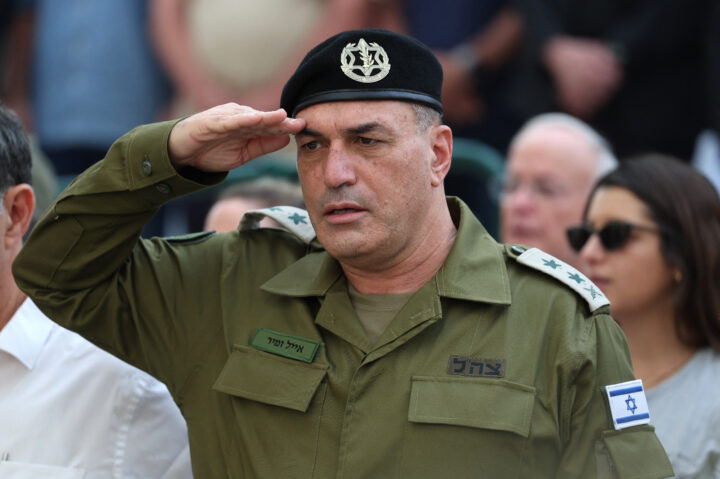
Israel's military chief Lieutenant General Eyal Zamir salutes during the funeral of Lieutenant Hadar Goldin who was killed during the six-week 2014 war in Gaza, at a military cemetery in Kfar Saba on November 11, 2025.
The U.S. and Israel have almost total control of Iranian airspace, IDF Chief of Staff, Lt.-Gen. Eyal Zamir said in a video statement on Thursday.
They “achieved near-complete air superiority over Iranian skies,” and Operation Roaring Lion, as Israel named the war with Iran, is entering its second phase, Zamir said.
The war is moving, he said, from the initial phase — beginning with Saturday’s “surprise strike” and followed by additional sorties to establish air superiority and degrade Iran’s ballistic missile array — to “further dismantle the regime and its military capabilities.”
“We have additional surprises ahead, which I do not intend to disclose. We will pursue our enemies, all of them, and we will overtake them,” Zamir added, paraphrasing Psalms 18:38.
Zamir said he is in “continuous contact with my American counterparts. We are fighting based on shared interests and shared values. We are fighting shoulder to shoulder. Through synchronized action, we are stripping the regime of its military capabilities, strategically isolating them and bringing them to a point of weakness unlike any it has known. This is truly historic cooperation״
The IDF Spokesperson’s Office said on Thursday that the military had struck over 300 of the Islamic Republic’s ballistic missile launchers and advanced defense systems in over 113 waves of strikes in western and central Iran, neutralizing 80% of Iran’s aerial-defense systems and over 60% of its ballistic missile launchers.
CENTCOM chief Adm. Brad Cooper said in a press conference on Thursday that Iranian ballistic missile attacks have decreased by 90% since Operation Epic Fury, the White House’s name for the operation, began on Saturday, with drone attacks declining by 83%.
The U.S. military has bombed nearly 200 targets inside Iran, including dropping 2,000-pound penetrator bombs targeting Iranian ballistic missile launchers stored underground, and sunk over 30 Iranian navy ships.
“We’re not just hitting what they have, we’re destroying their ability to rebuild. And so, as we transition to the next phase of this operation, we will systemically dismantle Iran’s missile production capability for the future, and that’s absolutely in progress,” Cooper said.
President Donald Trump told Politico on Thursday, “We’re taking out a threat to the United States of America, major threat, … and doing it like nobody’s ever seen before.”
Iran has “no navy. They have no air force. They have no detection of air. It’s all wiped out. Their radar is all wiped out. Their military is decimated. All they have is guts,” the president said.
Trump also said he plans to have a decisive influence on the next leader of Iran. “I’m going to have a big impact [on Iran’s future leadership], or they’re not going to have any settlement, because we’re not going to have to do this again,” Trump said. “We’ll work with the people and the regime to make sure that somebody gets there that can nicely build Iran but without nuclear weapons.”
The U.S. plans to “work with them to help make the proper choice,” so that the next Iranian leader will not “lead to having to do this [war] again in another 10 years.”
Trump said that Mojtaba Khamenei, the son of Iranian Supreme Leader Ayatollah Ali Khamenei, who was killed on the first day of the war, was a poor choice: “The reason the father wouldn’t give it to the son is they say he’s incompetent.”
Also on Thursday, the IDF launched its 26th wave of strikes in the Dahieh neighborhood of Beirut —a stronghold of the Hezbollah terrorist militia — hitting over 500 targets, including some in residential buildings in the Lebanese capital that the military said were used for terrorist infrastructure and UAV storage.
“Hezbollah made a strategic error,” Zamir said in his video statement, “[and] despite it directly conflicting with the interests of the Lebanese people, chose to join the campaign. Hezbollah is paying a heavy price.”
Israel killed the head of Hezbollah’s firepower array, known as Fidaa, whom Zamir said was “responsible for the deaths of many Israelis.”
“We will not let up on the objective of disarming Hezbollah,” Zamir added.
Magen David Adom emergency services reported 44 people injured amid attacks from Iran and Lebanon on Thursday through early Friday morning, all while making their way to shelters. MDA treated and evacuated 502 casualties from the start of Operation Lion’s Roar, including 359 injured on their way to shelter and five traffic accidents during sirens; there have been 12 fatalities.
Please log in if you already have a subscription, or subscribe to access the latest updates.
 Continue with Google

 Continue with Apple