












































































After 104 members of the House voted last week in favor of an amendment to eliminate military aid to Israel, pro-Israel activists who have spent years building ties with lawmakers are now wondering how to approach those relationships
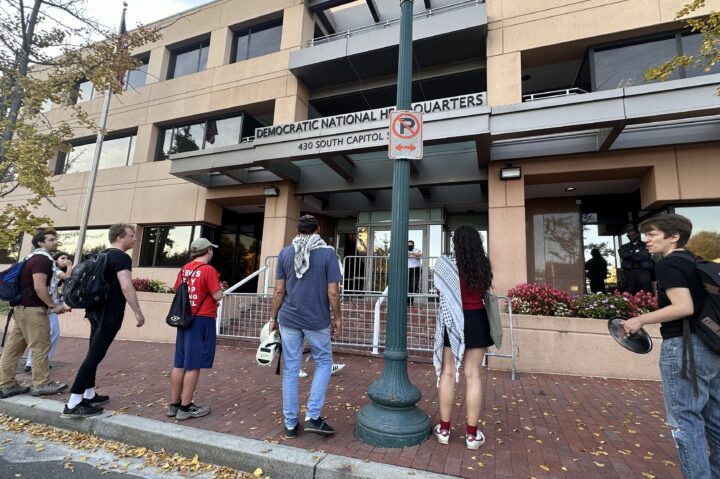
(Yasin Ozturk/Anadolu via Getty Images)
A group of demonstrators hold a noise protest outside the Democratic National Committee Headquarters in Washington D.C., United States on October 31, 2024.


 Add JewishInsider on Google
Before AIPAC began spending tens of millions of dollars per election cycle on campaigns, back when it was purely an advocacy organization that touted its relationships with many of the 535 members of Congress, the pro-Israel group used to describe its approach to Capitol Hill with a cheeky, upbeat motto: “You have friends, and you have potential friends.”
But when former Bay Area AIPAC leader Naomi Lauter used to invoke the slogan, she added a third category: “Friends who have a little less potential than others.” Lauter died in 2017, but the saying still resonates with her son, Sam, who is a major Democratic donor and pro-Israel activist in his own right — and who is now wondering whether that third category might be growing even larger.
After 104 members of the House voted last week in favor of an amendment to eliminate all $3.3 billion in annual military aid to Israel, pro-Israel activists across the country who have spent years building ties with lawmakers are now wondering how to approach those relationships following a vote that some see as a betrayal. Even many longtime Israel supporters — including Reps. Jack Auchincloss (D-MA), Glenn Ivey (D-MD), Laura Friedman (D-CA), Nancy Pelosi (D-CA) and Pat Ryan (D-NY) — voted for the amendment, which did not pass. Pro-Israel activists who spent years building trust and gaining access to these lawmakers are now grappling with whether whether those relationships are still worth their continued investment.
To borrow from AIPAC’s old slogan: Are the lawmakers who voted for the amendment still considered friends — or potential friends — of the U.S.-Israel relationship? Or was their vote against the annual aid package to Israel, and against a bill that was opposed by a wide swath of nonpartisan and Democratic Jewish groups, a crossing-the-Rubicon moment that cannot be undone?
Friends and backers of the members of Congress who voted for the amendment are struggling to answer those questions. Several who spoke to Jewish Insider said that a single vote on a measure that was sure to fail should not spell the end of years of friendship. But even as they acknowledged the seismic reverberations of the vote, many also spoke of the need to tread carefully at a politically uncertain moment.
“Our issues are too important to not hold onto the ability to have a conversation with the person, because the votes are not going to end. It’s not going to all of a sudden stop,” Sam Lauter said. He talked to several members of Congress in the days before the vote, including Pelosi, urging them to vote no.
“It’s not a good trend line, but also this idea that we’ve lost the Democrats — let’s not create self-fulfilling prophecies here. There’s an opportunity for us to turn some of this around,” Tyler Gregory, CEO of the Bay Area Jewish Community Relations Council, said. “I am optimistic that several of them could be flipped if the vote had actual consequences, and I think that’s the job ahead of us.”
“Now, if someone said to me, ‘You know what, I voted yes, and my reasoning was because actually I don’t think we should be allies with Israel anymore, and I have no interest in the friendship with the community or the country, I’m done.’ Well, OK, that friendship’s done,” said Lauter.
This vote was destined to fail, but Tyler Gregory, CEO of the Bay Area Jewish Community Relations Council, called it “a dress rehearsal.” It will not be the last time U.S. aid to Israel comes up for a vote, and Gregory said he will need to lean on those lawmaker relationships in the future when the vote is more consequential.
“It’s not a good trend line, but also this idea that we’ve lost the Democrats — let’s not create self-fulfilling prophecies here. There’s an opportunity for us to turn some of this around,” Gregory said. “I am optimistic that several of them could be flipped if the vote had actual consequences, and I think that’s the job ahead of us.”
Halie Soifer, who served as an advisor to then-Sen. Kamala Harris (D-CA), now leads the Jewish Democratic Council of America, which urged members to vote against the amendment — as did Democratic Majority for Israel and the more liberal J Street. She called the vote “an inflection point,” but said the group is not considering removing its endorsements of lawmakers who supported the amendment.
“We’ve maintained a very consistent, principled position with regard to aid for Israel, and it’s not us that shifted,” Soifer said. “There is clearly a fast-moving shift within the Democratic Party itself, and we’re considering what that means.”
When asked whether she had ever seen so many candidates shift their positions on an issue within a single two-year election cycle, Soifer answered directly: “Absolutely not.”
AIPAC responded to the vote by no longer allowing donations, through its political action committee, to the 18 lawmakers it endorsed who voted for the measure.
“AIPAC members across the country watched this vote closely and are making sure their representatives in Congress who stood on principle hear that they’re appreciated,” AIPAC spokesperson Deryn Sousa told JI.
“The reality is these are our representatives. There is a relationship that we have with most of them, and they continue to be our representatives today, tomorrow, next week,” said Jeremy Burton, the CEO of the Greater Boston Jewish Community Relations Council. “The ones who say, ‘No, I’m still committed to Israel’s security and the Jewish community,’ things like that — and I’m not going to quote any one of them — but the ones who are saying that in these private conversations, it’s incumbent upon them now to show what that means.”
Many activists who have relationships with lawmakers are taking the long view, arguing that cutting ties now will not help in future battles. For a lot of them, Israel is not the only issue about which they are concerned.
Jeremy Burton, the CEO of the Greater Boston Jewish Community Relations Council, said he knows that some Jewish Bostonians have told Massachusetts’ congressional representatives, all of whom voted for the amendment, that this moment represents a “break point.” But as the leader of a nonpartisan organization, he cannot end relationships over a disagreement on one vote. He has other issues — such as nonprofit security funding and cooperation on fighting antisemitism — to consider.
“The reality is these are our representatives. There is a relationship that we have with most of them, and they continue to be our representatives today, tomorrow, next week,” said Burton. “The ones who say, ‘No, I’m still committed to Israel’s security and the Jewish community,’ things like that — and I’m not going to quote any one of them — but the ones who are saying that in these private conversations, it’s incumbent upon them now to show what that means.”
For one Jewish former Biden administration staffer, voting to cut off security aid to Israel must be the red line.
“They’re like, ‘Don’t worry about it. It’s just symbolic.’ Well, no, you’re telling us not to care about it, but clearly other people care about it, and that’s why you’re voting in that way,” said the staffer, who requested anonymity to speak about communal organizations they support. “I don’t think the Jewish community should be giving these people a pass right now, and I believe that’s actually creating an incentive for them to actually take these votes against us and against our interests, because there’s no political consequence or repercussions for them.”
House Minority Leader Hakeem Jeffries (D-NY) said on Thursday that Democrats will adopt a new approach to Israel if the party regains control of the House in November. “The current status quo is unsustainable,” said Jeffries, who voted no on the amendment.
“On one hand, I am really disappointed to see some true friends of mine and Israel vote for the [amendment] or vote ‘present,’” said Jennifer Laszlo Mizrahi, a Jewish philanthropist and disability rights advocate in Maryland. “On the other hand, as an American and as a Jew, I am horrified by how Netanyahu and his administration treat Palestinians in the West Bank, give Haredim the ability to be draft-dodgers and don’t show empathy when legitimate security operations accidentally kill an innocent child.”
Many of the 103 Democrats who voted “yes” released statements saying that they still support America’s relationship with Israel, but that they viewed the amendment as a symbolic way to tell Israeli Prime Minister Benjamin Netanyahu that they disagreed with his handling of the wars in Gaza and Iran.
In doing so, they tapped into a difficult reality for many of the Jewish activists who wanted to see the measure defeated. Many of those activists also wish Netanyahu would do more to take the concerns of Democrats and liberal Jews into account, even as they think Washington should continue supporting Jerusalem’s security needs.
“On one hand, I am really disappointed to see some true friends of mine and Israel vote for the [amendment] or vote ‘present,’” said Jennifer Laszlo Mizrahi, a Jewish philanthropist and disability rights advocate in Maryland. “On the other hand, as an American and as a Jew, I am horrified by how Netanyahu and his administration treat Palestinians in the West Bank, give Haredim the ability to be draft-dodgers and don’t show empathy when legitimate security operations accidentally kill an innocent child.”
In Los Angeles, Democratic donor and pro-Israel activist Howard Welinsky said many of the “yes” votes were a result of political “noise” — namely, concerns about current or future primary challengers from the left. “It’s the volume of the noise, and some members of Congress have more intellectual capacity to withstand it, and others have less,” said Welinsky.
So he is holding out hope that a change in Israel’s political leadership might help rectify Israel’s plummeting support among Democrats. “I just pray that Oct. 27” — the day Israel goes to elections — “gives Israel a new prime minister, and we can turn a page,” said Welinsky.
The ousted New York lawmaker consulted for the far-left PAC, which is partially funded by Don Henley of The Eagles

Spencer Platt/Getty Images
Former Rep. Jamaal Bowman (D-NY) speaks at the National Action Network’s (NAN) three-day annual national convention on April 07, 2022 in New York City.
Former Rep. Jamaal Bowman (D-NY), who lost his bid for reelection in 2024 largely over his hostile views on Israel, now appears to be working for a political action committee linked to a radical anti-AIPAC social media account — a committee funded in part by soft-rock icon Don Henley.
The latest disclosure filings from Citizens Against AIPAC Corruption, one of two PACs tied to the X account AIPAC Tracker and website Track AIPAC, show that it paid $7,000 to a Yonkers, N.Y.-based firm called JAB Advocates for “General Campaign Consulting.”
JAB does not appear to be a registered company in New York, but its address in the filing belongs to Bowman, who lost a primary challenge for his seat covering parts of the Bronx and Westchester County to Rep. George Latimer (D-NY) in 2024.
Bowman’s LinkedIn identifies him as JAB Advocates’ “Founder & Principal.”
“Advising political leaders, EdTech companies, and advocacy organizations on policy strategy, government relations, and market entry — with active engagements across the U.S., Europe, and South Asia,” the description on his page reads, highlighting Bangladesh and Qatar as countries where his clients conduct business. “Senior advisor to members of Congress, elected officials, think tanks, and fundraisers across the country.”
Prior to his loss to Latimer, who received support from AIPAC, Bowman’s tenure in Congress was marred by his censure for pulling a fire alarm during a House vote, his eventually recanted denial of sexual violence committed during the Oct. 7 attacks and the revelation that he had promoted 9/11 conspiracy theories on his personal blog prior to holding office.
The former high school principal and congressman did not respond to questions about how he came to work for the PAC. Federal Election Commission records show his firm has also worked for New Hampshire Senate candidate Karishma Manzur, whom Track AIPAC has repeatedly promoted on X.
One of Track AIPAC’s co-founders, Cory Archibald, is a veteran of the far-left group Brand New Congress and previously reported working as a campaign staffer for Bowman and other Squad members. A Washington Free Beacon report last year found that Archibald had in the recent past identified herself online as a Marxist and a resident of Germany.
The Track AIPAC team did not respond to questions for this story. The group has come under criticism for the arbitrary manner in which it links politicians to the “pro-Israel lobby,” often simply on the basis of association with Jewish individuals and institutions — such as in the case of Sen. Jon Ossoff (D-GA) a Jewish lawmaker who has an openly hostile relationship with AIPAC and has opposed military aid packages for Israel.
And while Track AIPAC has cast itself as a crusade for transparency, FEC records show CAAC PAC has dumped tens of thousands of donor dollars into an anonymous consulting firm called Overton Strategies LLC. Overton formed last fall in Delaware, where the state’s notorious corporate secrecy laws make its structure and ownership inscrutable.
No other federal PAC appears to have ever retained Overton’s services. Much of the rest of the PAC’s money goes toward fundraising bids.
The Track AIPAC account has also attacked multiple members of Congress as “pedophile Protectors.” However, FEC filings show that one of its biggest donors is Don Henley, drummer and vocalist for The Eagles, has given more than $30,000 to CAAC PAC and its affiliate Tracker PAC — and who pleaded no contest to contributing to the delinquency of a minor after an infamous incident in 1980.
Henley was arrested at the height of his fame when an underage sex worker was hospitalized for overdose-related seizures after doing cocaine with the musician at his Los Angeles home. In a 2024 court proceeding, Henley admitted procuring the girl via a brothel operator, but maintained the two never had intercourse and that he believed her to be at least 20 years old.
Henley did not respond to a request for comment from Jewish Insider sent via his website.
Please log in if you already have a subscription, or subscribe to access the latest updates.
 Continue with Google

 Continue with Apple